-
China Aoyuan was ranked as one of the top 30 real estate developers by China Real Estate Information Corporation last year.
Sales have improved in recent months and the issuer has a stable credit profile with a consistent financial track record.
There is an ample amount of liquidity available to the company to repay debt.
Investors may consider the CAPG 6.350% 08Feb2024 Corp (USD) and CAPG 7.950% 19Feb2023 Corp (USD) with bond yields of 7.66% and 7.09% respectively.
It has been an eventful 2021 for the Chinese corporate bond market so far as companies like China Fortune Land Development Co., Ltd and China Huarong International Holdings Ltd were thrusted into the media spotlight.
The weak sentiment caused by those distressed events has spread to the broader Chinese credit market and while we cannot rule out further weakness, we think that there are some value spots within the real estate sector.
Figure 1: Ask and bid prices for the 2026 and 2027 USD senior notes
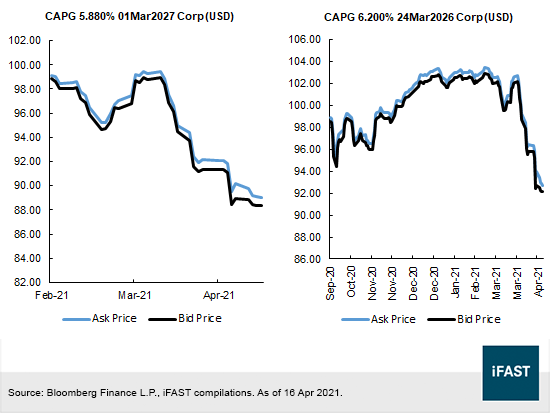
Senior notes issued by China Aoyuan Group Limited (“CAPG”) have been falling against the weak sentiment in the Chinese credit market. Prices of the CAPG 6.200% 24Mar2026 Corp (USD) and CAPG 5.880% 01Mar2027 Corp (USD) are now trading around 90 with ask yields to maturity (“YTM”) of 8.09% and 8.36% respectively. The notes are part of the Bloomberg Barclays Asian High Yield Bond Index and the outflows from exchange traded funds may have caused these bonds to fall.
By and large, we still think that valuations along the CAPG curve look appealing. The issuer announced on 9 Apr 2021, that it had made an USD 3m open market purchase of the senior notes, comprising of USD 1m of the CAPG 6.200% 24Mar2026 Corp (USD), USD 1m of the CAPG 5.980% 18Aug2025 Corp (USD), and USD 1m of the CAPG 5.880% 01Mar2027 Corp (USD).
In line with our earlier publications and new issue views – “China Aoyuan stands out with strong 2018 results”, “China Aoyuan launches 3.6NC2.6 USD bond at 6.75% IPG” and “China Aoyuan launches new 5.5NC3 USD senior notes at 6.5% IPG”, we continue to maintain our positive credit view on the issuer.
About China Aoyuan
China Aoyuan is one of the leading property developers in the Guangdong province and has been in the business for over two decades. As a publicly listed firm on the Hong Kong Stock Exchange, the group is ~45.0% owned by public investors (as of 2 Jul 2020) and 55% owned by Guo Zi Wen / Guo Zi Ning, who are the Chairman and Vice Chairmen of the company.
The developer has an ownership in two listed exchange entities. First, China Aoyuan has an approximate 54.6% interest in Aoyuan Healthy Life Group Company Limited and secondly, a 29.9% interest in Aoyuan Beauty Valley Technology Co., Ltd. The corresponding market capitalizations for these companies are HKD 3.57 billion (~RMB 3.00 billion) and RMB 9.29 billion on 15 Apr 2021.
Over the years, Aoyuan has been expanding its presence in the Guangdong-Hong Kong-Macao Greater Bay Area (“GBA”), South China, East China, core regions of Central and Western China, as well as in the Bohai Rim. The company had a land bank of approximately 48.7m square meters (“sqm”) as at 30 Jun 2020, the bulk of which are located in the GBA region, as well as in Central and Western China (see Table 1).
Table 1: Land bank breakdown
|
|
Total GFA (000’s sqm) |
Total saleable resources (RMB billions) |
Total saleable resources including Urban Revelopment projects (RMB billions) |
|
South China |
19,562 |
188.7 |
817.7 |
|
Core region of Central & Western China |
13,357 |
125.8 |
127.6 |
|
East China |
8,989 |
99.8 |
99.8 |
|
Bohai China |
5,098 |
58.8 |
86.7 |
|
Offshore locations (Sydney, Vancouver, Toronto, Hong Kong, Macao) |
1,729 |
28.4 |
28.4 |
|
Total |
48,735 |
501.5 |
1,160.2 |
| Source: Company, as at 30 Jun 2020. | |||
It is projected that the group will generate RMB 1,160.2 billion of total saleable resources, which includes contributions from urban redevelopment projects over the next 4 to 5 years. These urban redevelopment projects are essentially top-down state initiatives to reform “old towns”, “old factories” and “old villages” in China. According to the group, these urban redevelopment projects are highly profitable as the company earns a decent margin from primary or secondary development, and it may dispose its interest in the project for a high return.
As of the end of 2020, there were over 60 such urban redevelopment projects with a combined gross floor area of 42.85m sqm, 22.46m sqm of which may provide RMB 673 billion of additional saleable resources. Furthermore, nearly 97% of these saleable resources are located in the GBA, an area within China with a growing urbanization rate and high real estate demand.
As of June last year, China Aoyuan had 5.13m sqm of completed properties, 24.4m of properties under development and nearly 19.2m of properties held for future development. Overall, there are 317 projects at various development stages right now, 112 of which are located in Guangdong. In addition, the group has 9 projects in Sydney, Australia and 5 developments in Vancouver, Canada.
Residential, commercial, investment properties, and auxiliary facilities accounted for 80%, 15%, 3% and 2% of the group’s portfolio composition. When classified by city tiers, 54% of the land bank (excluding urban redevelopments) are in Tier-1, Tier-2 and international cities. The remaining 48% of the land bank are located in Tier-3 and Tier-4 cities.
2020 financial performance
During the year ended 31 Dec 2020, total revenue increased 34.2% YoY to RMB 67.79 billion while contracted sales increased 12.7% YoY to RMB 133.01 billion. China Aoyuan was ranked as one of the top 30 developers in the country according to CRIC.
Average selling prices grew by 1.3% to RMB 9,349 per square metre (“sqm”), but the amount of gross floor area that was sold expanded by 32.2% YoY to 6.89m sqm. Geographically, sales in China, Australia and Canada climbed by 34.4%, 29.1% and 8.1% to RMB 65.42 billion, RMB 2.37 billion and RMB 7.05m respectively.
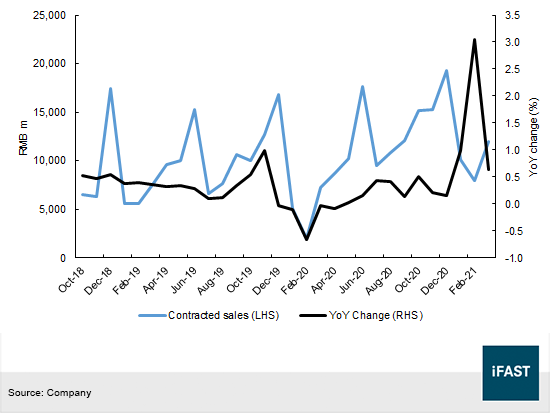
Despite tighter regulatory policies during 2020 such as the “three red lines” and the centralized management of real estate loans, selling activity continued to climb. As displayed in Figure 2, contracted sales soared to RMB 19.25m in December but dropped to RMB 7.93m in February 2021. Contracted sales are higher from a year ago but this is due a low base effect. From a –year-on-year comparison, contracted sales were up by 304.6% in February and up by 99.8% in January.
Figure 2: Monthly contracted sales
Net profit increased 35.03% YoY to RMB 7.05 billion in 2020 on the back of higher revenue. There were a few exceptional items that led to a higher bottom-line for the year as the company recognized RMB 1.84 billion of net exchange gains and RMB 1.13 billion of impairments. Excluding these items, net profit would have been ~RMB 6.34billion, up 16.0% from a year ago. Meanwhile, our estimated earnings before interest and taxes (“EBIT”) for the company climbed from ~RMB 11.55 billion in 2019 to ~RMB 12.97 billion in 2020.
Credit highlights
China Aoyuan has a comfortable liquidity position with its RMB 52.27 billion of short-term debt that is well covered by RMB 52.50 billion of unrestricted cash as at 31 Dec 2020. Short term borrowings are comprised of RMB 13.75 billion of senior notes and RMB 38.51 billion of bank borrowings that are due in a year. We expect liquidity to be boosted further as the group entered into a loan agreement relating to a HKD 1,598m and USD 20m dual currency term loan facility in March 2021.
Its liquidity profile measured by its current ratio is also healthy. Current assets were RMB 290.65 billion and this exceeded current liabilities of RMB 206.15 billion. However, the amount of cash as a multiple of interest expense has dropped from 8.09x in 2019 to 6.42x in 2020.
Figure 3: Debt maturity profile
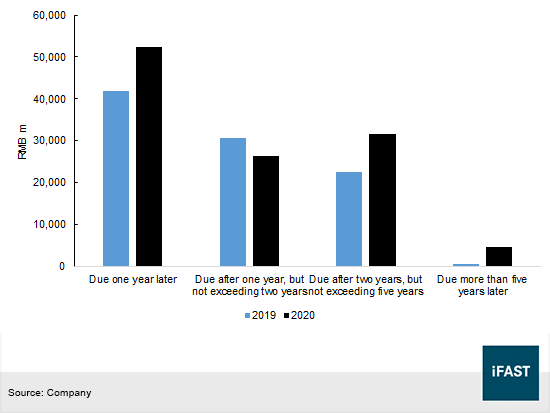
Total borrowings increased to RMB 114.87 billion (2019: RMB 95.76 billion), the bulk of which are due by the end of 2021 (Figure 3). After refinancing some of its senior USD notes last year, the developer managed to extend a higher proportion of its debt beyond five years. In 2020, China Aoyuan issued the CAPG 4.800% 18Feb2021 Corp (USD), CAPG 6.350% 08Feb2024 Corp (USD), CAPG 6.200% 24Mar2026 Corp (USD) and CAPG 5.980% 18Aug2025 Corp (USD).
In spite of challenging operating conditions at the start of 2020, the company managed to secure USD 280m of syndicated bank loans at HIBOR/LIBOR + 4.3% from nine banks including Hang Seng Bank and HSBC. Aoyuan Corporation (Group) Limited, a wholly-owned subsidiary also issued two puttable onshore notes, comprising of the RMB 2.54 billion AOYUAN 5.500% 03Mar2025 Corp (CNY) and the RMB 1.18 billion AOYUAN 5.650% 06Aug2025 Corp (CNY).
Contingent liabilities as disclosed by the company, added to RMB 110.43 billion in 2020 and this is for its guarantees in connection to home purchasers’ mortgage facilities and banking facilities granted to joint ventures and associates. However, if need be, the group may access its RMB 134.80 billion of undrawn credit facilities to repay financial obligations.
Net gearing ratio, measured as the amount of net borrowings (senior notes, bank borrowings net of cash and restricted bank deposits) over total equity was 82.7%, higher than the levels at June 2020 (79.8%) and December 2019 (74.9%). The percentage of debt and lease liabilities over total assets also increased from 33.4% in 2019 to 35.5% in 2020. Even though gearing has been on the rise, the proportion of debt on the company’s balance sheet is still manageable.
The group’s ability to pay interest has been on a downtrend through the last two years, falling from 2.15x at 2018 to 1.59x in 2020, against a backdrop of increased borrowings and higher debt servicing costs. Nonetheless, we are still comfortable with the issuer’s ability to service interest expenses at 1.59x, defined as its annual EBIT over interest costs. This interest coverage ratio is in line with other real estate developers of the same operating scale.
Recommendations
As mentioned, the weak sentiment surrounding Chinese corporate issuers may lead to further selling in the China Aoyuan bonds but we think that valuations are attractive at this level, especially considering that the issuer has a decent liquidity and credit profile. Additionally, we believe that China Aoyuan may continue to rely on offshore debt funding as it has demonstrated a good track record of issuing senior USD notes.
Among the CAPG credits, we like the USD 460m CAPG 6.350% 08Feb2024 Corp (USD) and CAPG 7.950% 19Feb2023 Corp (USD). The former is trading at around 96 with an ask yield to maturity (“YTM”) of 7.66%. The bonds are callable at 102 on 8 Feb 2023 and may be partially redeemed using the net proceeds of the sale of common equity. In a Change of Control Triggering Event, the issuer may offer to purchase the notes at 101.
The CAPG 7.95% 2023’s are also callable in Change of Control and Equity Call events. Following the terms of the offering, the senior notes may also be redeemed on or after 19 Feb 2022 at 102, which is close to its last ask price of 101.5 on 16 Apr 2021.
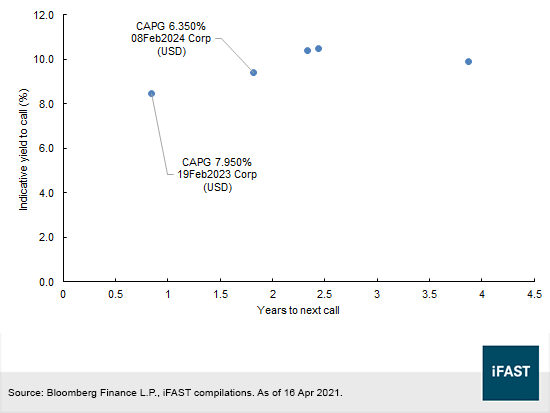
From another perspective, we are recommending the CAPG 6.350% 08Feb2024 Corp (USD) and CAPG 7.950% 19Feb2023 Corp (USD) as they have attractive yields to call (“YTC”) of 9.39% and 8.49% (see Figure 4).
Figure 4: Relative valuation using YTCs
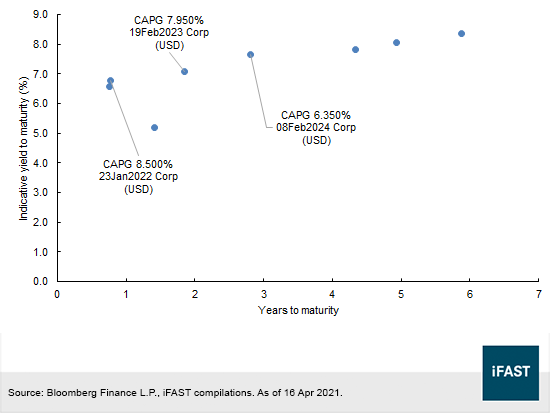
Comparing the YTMs of bonds along the CAPG curve (Figure 5), we observed that the CAPG 8.500% 23Jan2022 Corp (USD) traded at a relatively high yield (YTM on 16 Apr 2021: 6.79%) with a shorter maturity compared to the CAPG 7.95% 2023’s and CAPG 6.35% 2024’s. However, the CAPG 8.500% 23Jan2022 Corp (USD) is redeemable on or after 23 Jan 2021 at 102 and that is not far off from its ask price of 101.2 on 16 Apr 2021. The likelihood of the issuer calling the CAPG 8.5% 2022’s seems high, and if called, investors’ returns will be fairly low.
Figure 5: Relative valuation among CAPG USD notes using YTMs
China Aoyuan is one of the property developers with adequate credit metrics. The issuer is likely to benefit from newly acquired urban redevelopment projects in the Greater Bay Area. That aside, it has a decent land bank to support future growth. We believe that the issuer may rely on available credit lines and capital markets to refinance its senior offshore notes. The recent sell-off in the CAPG bonds are probably due to broader negative factors that are unrelated to the issuer. Even though bonds prices may head lower, we feel that the valuations are cheap right now and are worth investing. Among its outstanding notes, we recommend the CAPG 6.350% 08Feb2024 Corp (USD) and CAPG 7.950% 19Feb2023 Corp (USD) for their high yields and short durations.
Declaration:
For specific disclosure, at the time of publication of this report, IFPL (via its connected and associated entities) and the analyst who produced this report hold a NIL position in the abovementioned securities.
Our podcast series, Yield Hunters, is available on Spotify and iTunes Podcasts and Google Podcasts. We share our thoughts on new bond issues and hold discussions on the fixed income space. Listen to our latest episode below and follow us!