Chart 1: Bond Yield Curves
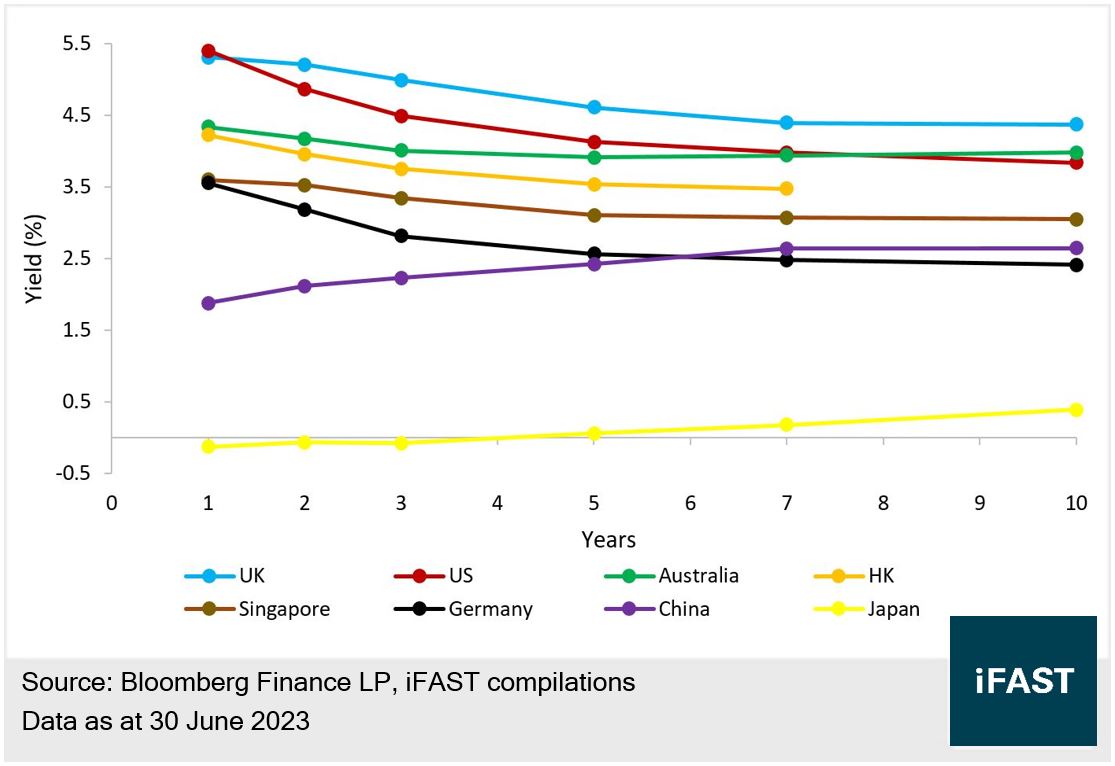
Table 1: Bond Yield Curves
| Region | Currency | 1-Year | 2-Year | 3-Year | 5-Year | 7-Year | 10-Year |
| UK | GBP | 5.31% | 5.21% | 5.00% | 4.61% | 4.40% | 4.38% |
| US | USD | 5.41% | 4.87% | 4.49% | 4.13% | 3.98% | 3.84% |
| Australia | AUD | 4.34% | 4.18% | 4.01% | 3.92% | 3.94% | 3.98% |
| Hong Kong | HKD | 4.23% | 3.96% | 3.76% | 3.54% | 3.48% | / |
| Italy | EUR | 3.83% | 3.86% | 3.81% | 3.76% | 3.90% | 4.09% |
| Singapore | SGD | 3.60% | 3.53% | 3.34% | 3.11% | 3.07% | 3.05% |
| Germany | EUR | 3.56% | 3.19% | 2.82% | 2.56% | 2.48% | 2.41% |
| Malaysia | MYR | 3.26% | 3.38% | 3.49% | 3.61% | 3.75% | 3.85% |
| China | RMB | 1.88% | 2.12% | 2.23% | 2.43% | 2.64% | 2.65% |
| Japan | JPY | -0.13% | -0.07% | -0.08% | 0.06% | 0.18% | 0.39% |
| Source: Bloomberg Finance LP Data as of 30 June 2023 |
|||||||
Number One: UK
UK gilt yields have reached new highs since 2008 and surpassed all the other major countries, including the debt-laden Italy.
In contrast to the US, where inflation appears to be slowing down, the inflation and wage growth in the UK have remained high. The market even expects the Bank of England to raise the terminal rate to 6%. Such aggressive expectations have resulted in a less inverted yield curve compared to the US, making medium-term bonds (2 to 5 years) more attractive relatively.
In addition to the spike in bond yields, the strong performance of GBP in recent months may also help increasing the bonds’ attractiveness. Currently GBP has rebounded by almost 20% against USD from the 30-year record low in October last year. Considering the more aggressive rate hike forecast against the US, GBP may have certain support and GBP bonds should look appealing to investors who are confident in the exchange rate.
Number Two: US
As we expected, the market narrative has swung to no rate cut in 2023. In the latest FOMC meeting, the median interest rate forecast by 18 Fed officials was even as high as 5.6% at the end of the year. In fact, we mentioned earlier that some of the structural factors including wage growth and supply-side pressures have not changed, and the Fed may keep a high interest rate environment for longer period in order to avoid any rebound in inflation caused by policy mistakes.
US Treasury bond is currently one of the most popular investment products in the market. With interest rate and bond yields both at their highest levels since 2007, short-term bonds (1 to 2 years) are the most attractive now, and the time to avoid medium-to-long term bonds has gone as well.
Number Three: Australia
Australia has raised interest rates a total of 12 times since May last year, but the magnitude of those hikes is not as aggressive as UK and US. It has also paused rate hike once amid the banking crisis earlier. As a result, the inflation rate in Australia has significantly fluctuated and frequently deviated from market expectation. In response to that, the central bank mentioned in June Board meeting that inflation would take somewhat longer to return to target in Australia than in some other countries, which caused the bond yields to rise again.
Because interest rate may not have peaked yet, Australia’s yield curve is relatively flat, with 7- to 10-year Government bond yields slightly higher than corresponding US Treasury yields. Investors who are fond of medium-to-long term bonds (7 to 10 years) can consider investing in AUD bonds. If the local monetary policy is really following what the central bank described, AUD will also benefit from it in terms of exchange rate.
Lowest Yield: China and Japan
China, which is almost unaffected by inflationary pressures, has been able to cut interest rates in this global rate hike cycle. However, since the magnitude of rate cut is small, this is more of a strategic move to demonstrate the government’s intention and determination to rescue the economy.
Amid worse-than-expected economic data, sluggish real estate sector, and the possibility of local government debt woes, China’s monetary policy in can only be loosened but not tightened, and the next cut of required reserve ratio is also around the corner. Therefore, bond yields may not be able to rise significantly in the short term. Still, considering that China government bond yields are lower than most of other major countries, we believe it is only suitable for investors who wish to hold RMB assets.
As for Japan, it is still implementing policies such as negative interest rate and yield curve control. Although the central bank has not pivoted yet, the resurging inflation after 30 years and JPY/USD reaching a new low since 1990 is leading to a mounting pressure on policy side. JPY could return to an upward trend if Kazuo Ueda, the new Bank of Japan Governor who has already scrapped forward guidance on interest rate and suggested to review the monetary policy, decides to adjust any part of the existing ultra-loose policies.
However, from yield perspective alone, JPY bonds are indeed unattractive. Even investors who are bullish on the exchange rate may not be able to be compensated for the undesirable yields.
Our podcast series, Yield Hunters, is available on Spotify, iTunes Podcasts and Google Podcasts. We share our thoughts on new bond issues and hold discussions on the fixed income space. Listen to our latest episode below and follow us!