Hong Kong’s flag carrier
Founded in 1946, Cathay Pacific Airways Limited (“Cathay”; Bloomberg ticker: 293:HK) is the flag carrier of Hong Kong, serving over 200 destinations globally. The airline is listed on the Main Board of Hong Kong Stock Exchange since 1986 and sported a market capitalisation of HKD 41.0 billion as at 10 Sep 20.
The group reports five operating segments, categorised by the airlines it operates. These comprised of full-service airlines Cathay Pacific and Cathay Dragon, low-cost carrier HK Express, all-cargo carrier Air Hong Kong, and airline services. The last segment in the aforementioned list comprises airline operation support services, including catering, cargo terminal operations, ground handling services and commercial laundry operations. Cathay Pacific also holds deemed interests of approximately 18% and 35% in Air China Limited and Air China Cargo Co., Ltd respectively.
Geographically, most of Cathay Pacific’s revenues by origin of sale are derived from Hong Kong and Mainland China, which made up 50.7% of its total revenue in 2019. Americas and Europe are the next two largest segments, contributing 13.2% and 9.7% respectively. The rest comes from tickets sold in Japan, Korea, Taiwan, Southeast Asia, Southwest Pacific, South Asia, Middle East, and Africa.
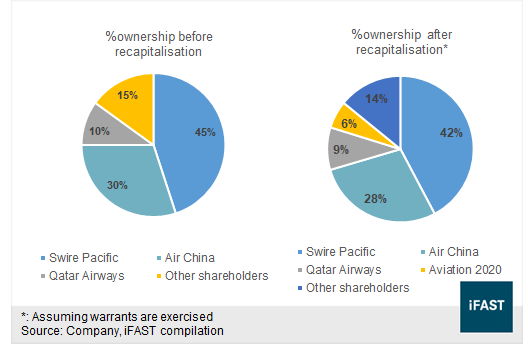
As at 30 Jun 20, the largest shareholder of Cathay Pacific is Swire Pacific Limited, which holds an equity stake of about 45%. Swire Pacific has been Cathay Pacific’s longest-standing shareholder since it first acquired a stake in the company back in 1948. Swire Pacific is the Asian operating arm of John Swire & Sons Limited1 (controlled by the Swire family members), with businesses spanning across property, beverages, marine services and trading and industrial.
The second biggest shareholder of Cathay Pacific is Air China Limited, with an equity stake of about 30% as at 30 Jun 20. Headquartered in Beijing, Air China is China’s flag carrier overseen by the China National Aviation Holding Company Limited, which is ultimately owned by China’s State-owned Assets Supervision and Administration Commission. Qatar’s national carrier, Qatar Airways Group Q.C.S.C., also owns a 9.99% stake in Cathay Pacific.
Fuel hedges detracted from earnings
In the six months ended June, Cathay Pacific incurred total fuel costs including hedging losses of HKD 7.3 billion, down 50.6% YoY, as the airline flew much less amid COVID-19. The group did not benefit from the oil price crash as it incurred hedging losses of HKD 1.6 billion, up significantly from HKD 114m in the previous corresponding period, due to fixed volume fuel hedges entered into before the pandemic.
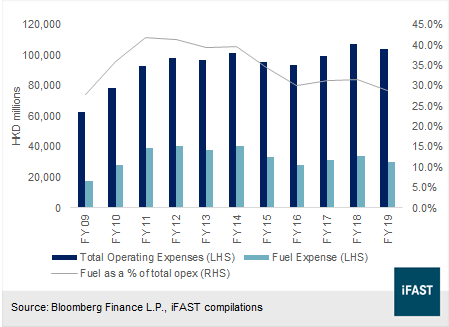
Figure 1 shows that fuel costs made up around an average of 34.7% of Cathay Pacific’s total operating expenses over the past ten years. The group has been persistently exposed to fuel price volatility, although fuel costs as a percentage of operating expense have declined, or improved, from 39.7% in 2014 to 28.8% in 2019.
Figure 1: Fuel costs
Cathay Pacific’s fuel hedging policy is to reduce exposure to fuel price risk by hedging a percentage of its expected fuel consumption. As at 31 Dec 19, less than 40% of expected fuel needs from 1Q20 to 4Q21 were hedged, at an average strike price between USD 57 per barrel to USD 65/barrel.
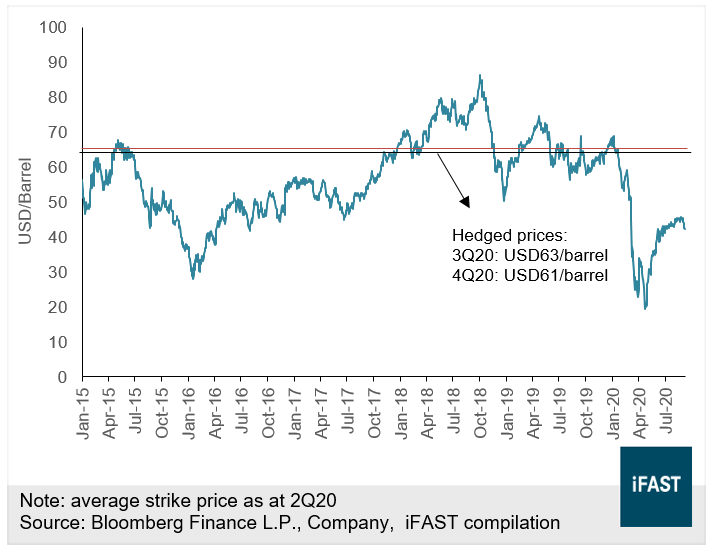
Based on management’s previous assessment of the group’s fuel hedging position (as at 31 Dec 19), about 40% of fuel consumption needs for 3Q20 and 4Q20 were hedged at a strike price of about USD 64/barrel and USD 61/barrel respectively. At current Brent price levels (see Figure 2), Cathay Pacific is likely to continue facing hedging losses ahead, though we expect the impact to be lessen given the oil price recovery since March.
Figure 2: Brent crude prices
In our view, the business nature of airlines inherently embed a certain degree of risks from oil price volatility. Cathay Pacific has been proactively reviewing its hedging policy, with fuel needs hedged for no longer than two years, in order to develop a better view on fuel costs as far as possible.
Fleet structure and capital expenditure
As at 30 Jun 20, Cathay Pacific has a fleet size of 235 aircraft, which have an average age of 10.3 years. Moving forward, the group plans to add 70 aircraft to its fleet, with 52 of them expected to be delivered from 2022 onwards. In the near future, Cathay Pacific expects to take delivery of ten and eight aircraft in 2020 and 2021 respectively.
With most airplanes grounded, Cathay Pacific has reached agreements with Airbus to defer delivery of the A350-900s and A350-1000s from 2020 and 2021 to the period between 2020 and 2023, and of the A321neo’s from 2020-2023 to 2020-2025. It is also in advanced negotiations with Boeing for the deferral of B777-9 deliveries. These delivery deferrals mean that Cathay Pacific will have substantial cash savings in the immediate future, at least for the remainder of 2020.
From Cathay Pacific’s fleet profile, we estimate that 51 aircraft out of the 70 planned additions are to be acquired as replacements for aged aircrafts, suggesting that the company is looking at further expansion of its fleet in the long term. This may not only weigh on its balance sheet, but also create a hard time for the airline to fill capacity. Even before COVID-19, Cathay Pacific faces tight competition from other airlines.
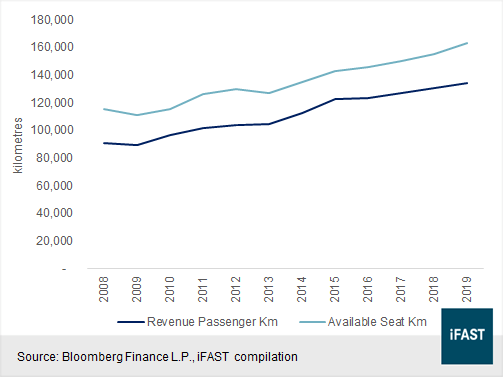
We observed that revenue passenger kilometres (“RPK”; the amount of distance travelled by passengers as a measure of demand) have been falling below available seat kilometres (“ASK”; a measure of passenger carrying capacity), suggesting a need for tighter fleet planning. Nonetheless, the supply of seats exceeding demand is a norm in the industry (see “Airlines are facing tough times, but we explain why some will spread their wings through disruptions”), and we take comfort that Cathay Pacific has started to review its operating strategies going forward, which may include a revised fleet planning.
Figure 3: RPK and ASK
Out of Cathay Pacific’s fleet size of 235 aircraft, 114 of them are owned by the group, while 42 and 79 are held under finance leases and operating leases respectively. In March, Cathay entered into an agreement with BOC Aviation for the sale and leaseback of six Boeing 777-300ERs and associated equipment at a total consideration of USD 703.8m.
Cathay Pacific has total assets of HKD 214.5 billion as at 31 Dec 19, of which 57% are aircraft and related equipment. We understand that some HKD 54.5 billion of aircraft-related assets (as at 31 Dec 19) have been pledged for borrowings. As such, we think there may still be room for Cathay Pacific to raise secured funding to help alleviate liquidity pressure if needed.
There was no guidance on future capital expenditure plans in Cathay Pacific’s report of 2020 interim results, although we noted that Cathay Pacific incurred an average of HKD 14.1 billion of investing cash outflow on property, plant and equipment and intangible assets in the past two financial years. Given the current situation, we expect the airline to incur mostly maintenance expenditures for the immediate period ahead. We also think that Cathay Pacific has been mostly successful in negotiating for favourable lease terms during this crucial period. Short-term lease liabilities barely moved at HKD 7.1 billion during the period (4Q19: HKD7.1 billion), while long-term lease obligations fell from HKD 33.4 billion in 4Q19 to HKD 30.8 billion in 2Q20.
Staff cost
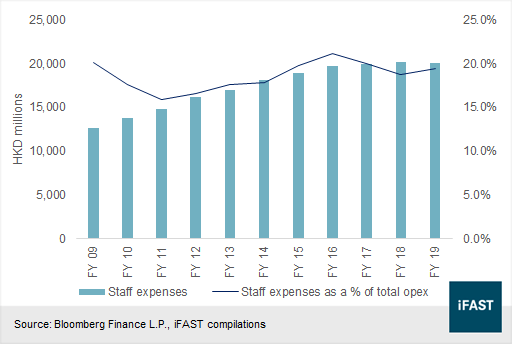
As at 30 Jun 20, Cathay Pacific employs more than 33,000 people globally, of which 27,600 of them are based in Hong Kong. In 1H20, Cathay incurred HKD 8.6 billion of staff expenses, down 14.9% YoY, after staff expenses were significantly reduced as a measure to preserve liquidity. The austerity measures included executive pay cuts and voluntary special leave schemes.
Cathay Pacific implemented two rounds of unpaid leave measures. The first round saw an employee take-up rate of 80%, with employees agreeing to take voluntary unpaid leave from March to June. The second round saw a higher take-up rate of 90%, where employees would take unpaid leave from July until the end of 2020.
Meanwhile, Cathay Pacific recognised HKD 1.06 billion of COVID-19 related government grants globally, of which HKD 640m were income grants that were presented as revenue from other services and recoveries. Given the extent of reduction in staff cost, which was typically a substantial component of the airline’s cost structure, we expect to see effective cost savings in 2H20.
In the pre-pandemic days, we note that Cathay Pacific incurred average staff expenses of HKD 17.4 billion from 2009 to 2019, representing an average of about 18.6% (see Figure 4) of total operating expenses. Cathay Pacific appears to be better able at controlling wage costs relative to peers. Based on Bloomberg data covering 64 airlines globally, wages as a percentage of total operating expenses were 26.6% in 2019.
Figure 4: Staff expenses
1H20 results
In the six months ended June, Cathay Pacific’s total revenue fell 48.3% YoY to HKD 27.7 billion. Revenue from passenger services fell sharply by 70.5% YoY to HKD 11.1 billion. RPK fell 72.6% YoY, while ASK dropped by a lesser degree of 65.7% YoY, indicating weak demand for air travel. Passenger load factor dropped to 67.3% in 1H20 from 84.2% in the previous corresponding period, further suggesting low demand for passenger flights.
Meanwhile, cargo services helped to offset passenger revenue loss, registering a turnover of HKD 12.7 billion, up 10.4% YoY. The rise in demand of pharmaceutical-related supplies and resumption of trade between Hong Kong and Mainland China in the second quarter have helped to lift demand higher for cargo transport. To improve the imbalance between the supply and demand of cargo services, Cathay Pacific has introduced additional cargo-carrying capacity wherever possible, including carrying cargoes in the passenger cabins of its Boeing 777-300ER aircraft. Overall, cargo yield (i.e. average fare per tonne freight) rose by 44.1% YoY to HKD 2.71 in 1H20.
In the six months ended June, Cathay Pacific received rent concessions of HKD 123m in the form of discounts on fixed payments as a direct consequence of the COVID-19 pandemic. That said, aircraft depreciation and rentals, and other depreciation, amortisation and rentals, totalled HKD 7.6 billion in 1H20, up slightly from HKD 7.3 billion in 1H19. Among its depreciation costs, Cathay Pacific incurred HKD 3.1 billion (1H19: HKD 2.7 billion) of depreciation on right-of-use assets (i.e. lease payments). The amount of rental reliefs appears little relative to the group’s lease obligations.
Cathay Pacific has also reviewed the values of its assets and cash generating units to reflect the difficult operating environment it is currently facing. In 1H20, the airline recognised impairment charges of HKD 2.5 billion (1H19: nil), of which HKD 1.2 billion was taken on 16 aircraft that were unlikely to return to meaningful economic services before their retirement. The remaining impairment charges mostly pertained to plants held at wholly-owned subsidiaries Cathay Pacific Catering Services (HK) Limited and Vogue Laundry Service Limited.
After incurring HKD 1.7 billion of finance charges and HKD 526m share of losses from associates, Cathay Pacific landed on a loss before taxation of HKD 10.9 billion for the six months ended June, primarily due to the loss of revenue from the pandemic.
High gearing, albeit set for deleveraging
In 1H20, Cathay Pacific incurred HKD 1.7 billion of finance charges, up slightly compared to HKD 1.6 billion in the previous corresponding period, in line with an increased debt load of HKD 62.5 billion (4Q19: HKD 56.8 billion). Including lease liabilities, which fell to HKD 37.9 billion (4Q19: HKD 40.5 billion), total borrowings were HKD 100.4 billion, up from HKD 97.3 billion as at 31 Dec 19.
Besides sharply lower revenue, Cathay Pacific also serviced a high level of ticket refunds during the period. As a result of this and operating costs incurred, Cathay Pacific saw its cash position dwindle to HKD 6.1 billion as at 30 Jun 20 from HKD 8.9 billion six months ago.
Including investments such as listed debt securities and bank deposits, Cathay had total liquid funds of HKD 7.4 billion at the end of June, down substantially from HKD 14.9 billion in December. The company monetised HKD 4.2 billion and HKD 484m of short-term deposits during the period, likely to support its cash burn (operating cash outflow was HKD 6.3 billion). The movement in debt and cash positions (including liquid investments) sent net gearing (net debt, including lease obligations, over equity) significantly higher to 1.9x, up from 1.3x as at 4Q19.
In our view, Cathay Pacific is a highly leveraged firm, though we note that a high net gearing of above 1.0x is a norm in the industry due to heavy capital expenditures. As a reference, Singapore Airlines Ltd (“SIA”) reported a debt-to-equity ratio of 0.68x as at 30 Jun 20. Nonetheless, we expect net gearing to fall substantially moving forward, given the financial aid from the Hong Kong government.
Near-term liquidity is adequate
Short-term obligations totalled HKD 23.9 billion at the end of June, comprising of HKD 16.8 billion and HKD 7.1 billion of debt and lease liabilities respectively. The refinancing wall is hence significant as the group’s liquid funds were just HKD 7.4 billion.
Cathay Pacific had access to HKD 8.2 billion of committed undrawn facilities as of end-June. Besides that, we think the group should be able to monetize its HKD 25.7 billion of investments in associates if needed, principally its 18.1% stake held in Air China (market cap as at 8 Sep 20: HKD 117.3 billion). Finally, the HKD 39.0 billion of financial lifeline elaborated in the next section of this article should tide the airline through the current crisis.
The ongoing health crisis continued to underpin the outlook for air travel going forward. With the persistently rising number of new COVID-19 cases, air travel demand is likely to continue to stay under pressure. In a recent report published by International Air Transport Association, the trade association forecasted RPK to decline by more than 60% in 2020 compared to the previous year. It also expected travel demand to return to pre-COVID-19 levels only in 2023, and only in an optimistic scenario.
According to Cathay Pacific, the carrier is burning cash at a rate of HKD 1.5 billion per month from May, with little cash inflow amid a steep fall in passenger flights. Cathay Pacific has been taking proactive steps in cost cutting, such as the unpaid leave schemes and negotiations on lease terms. Prior to the pandemic in December, the carrier expected to take delivery of 17 aircraft in 2020, out of which seven had been successfully delayed for future delivery.
We think Cathay Pacific’s cash burn rate is unlikely to increase substantially moving forward, given that ticket refunds have already been mostly front-loaded, the oil price recovery since March, and the increase in take-up rates of unpaid leave. The group expects to have sufficient working capital to operate for at least the next twelve months from June.
However, we expect Cathay Pacific to take a longer journey to recovery due to the absence of a domestic market at a time when international travel is very limited. We note that the bulk of Cathay Pacific’s revenue by origin of ticket sale comes from Hong Kong and Mainland China. While the exact split is not disclosed, we take some comfort that the city will continue to enjoy long-term growth drivers from its status as one of the world’s busiest financial hub and a springboard to China and the Greater Bay Area.
Recapitalisation plan
In June, Cathay Pacific proposed to implement a recapitalisation plan to raise cash proceeds of approximately HKD 39.0 billion, via a mix of debt and equity financing. The price tag of the package was 12.4% above Cathay Pacific’s market cap of HKD 34.7 billion on the eve of the announcement. Through a newly formed entity named Aviation 2020 Limited, wholly-owned by the Financial Secretary Incorporated, the Hong Kong Special Administrative Region (“HKSAR”) government will fund the bulk of the fund raising exercise.
The financial package included the following components:
1. Preference shares and warrants issue
Aviation 2020 would subscribe for HKD 19.5 billion of preference shares that are not redeemable at the option of Aviation 2020, but redeemable anytime at the option of Cathay Pacific. The preference shares carry a preference dividend rate of 3% for the first three years, which step up by two percentage points in each of the subsequent three years, up to 9% per annum from the fifth year onwards. Deferral of preference dividend is allowed at Cathay Pacific’s discretion.
The preference shares rank above junior obligations such as perpetual notes, but below senior preferred obligations like guaranteed debt. The preference shares carry no voting rights on any general meetings except in situations of amendments to the articles of association of the company where preference shareholders are adversely impacted, and in the case of a winding-up scenario.
Aviation 2020 would also subscribe to HKD 1.95 billion worth of 416.7m warrants at an exercise price of HKD 4.68 per share. The warrants do not carry any voting rights and will expire five years from the issue date of the preference shares and warrants.
2. Rights issue
Cathay Pacific would issue about 2.5 billion of rights shares on the basis of seven rights share for every eleven existing shares, at a rights subscription price of HKD 4.68 per share, seeking to raise approximately HKD11.7 billion. The rights subscription price represents about 46.9% discount to the closing price of HKD 8.81 per share on the trading day before the announcement of the recapitalisation plan, and 35.0% discount to the theoretical ex-rights price of HKD 7.20 per share. Cathay Pacific’s major shareholders Swire Pacific and Air China have irrevocably undertaken to subscribe for their respective allocation of rights shares. Subsequently on 7 Aug 20, Cathay Pacific announced the completion of the rights issue, which was oversubscribed.
3. Bridge loan facility agreement
Aviation 2020 will provide a loan facility of up to HKD 7.8 billion for Cathay Pacific. The facility can be drawn down in one or more advances for up to twelve months from the date of the facility agreement. Each drawdown has a loan term of 18 months and carries an interest rate of 1.5% plus the prevailing HIBOR.
The recapitalisation plan reportedly represents the first time in history that the HKSAR government to invest directly in a private company. Upon completion of the recapitalisation exercise, the HKSAR government will own a 6.08% stake in the airline (assuming the full exercise of warrants). Swire Pacific and Air China will remain as major shareholders, owning equity stakes of 42.3% and 28.2% post-transaction, assuming the full exercise of warrants by Aviation 2020 (see Figure 5).
Figure 5: Cathay Pacific’s shareholding structure
We see the recapitalisation as credit positive as it provides a substantial relief to Cathay Pacific’s balance sheet and liquidity. It also speaks for Cathay Pacific’s strategic importance to the HKSAR government and its importance to Hong Kong’s status as one of Asia’s busiest international aviation hub.
Despite owning a stake in Cathay Pacific, the HKSAR government has been outspoken that it does not intend to assert any influence on the airline’s operations and will not have any board seats. Instead, the government would place two representatives to Cathay Pacific’s board of directors as observers. The financial reliefs from the HKSAR government are aimed more at helping the airline to tide through the current crisis than tweaking its operations in a manner that favours the local economy. Subsequent to the recapitalisation plan announcement, a second round of voluntary special leave scheme was implemented.
The financial aid would also help to provide much-needed equity cushion to bondholders. Cathay Pacific guided that the deal would reduce net debt by at least HKD 31 billion and net gearing to 0.77x on a pro-forma basis. Assuming a full drawdown on the bridge loan facility, we estimated pro-forma net gearing at around 1.2x. This would still be on the high side, though we take comfort that the significant capital injection by the HKSAR government should facilitate the group’s access to capital markets.
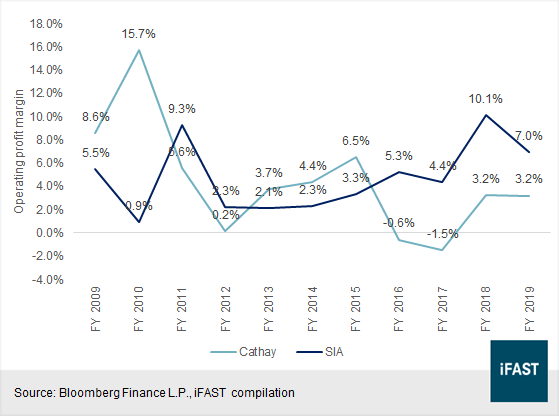
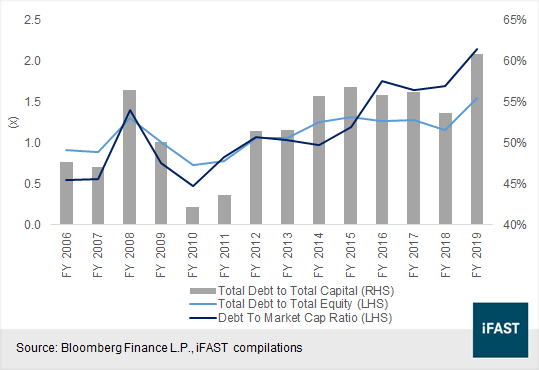
We note that Cathay Pacific’s capital structure has historically been heavily debt-funded (see Figure 7), while internally generated funds generally grow at a much slower pace than debt given its relatively tight operating profit margin (“OPM”). In the past five years, Cathay Pacific’s OPM stood at an average of 2.2%. As a reference, SIA’s average OPM in its past five financial years was 5.5%.
Figure 6: Cathay Pacific has thin operating margins
While we are cautious of a heavy and rising debt load, we take comfort from the high likelihood of shareholder support in times of need, supported by the HKSAR government’s bailout plan. Swire Pacific has also given its undertaking to remain as a controlling shareholder (i.e. at least 30% equity stake) of the group so long as Aviation 2020 remains the holder of any preference shares and any bridge loans remain outstanding. As such, we see a high likelihood of Cathay Pacific having sufficient liquidity to cover its debt obligations in the short term.
Figure 7: Cathay Pacific’s rising leverage
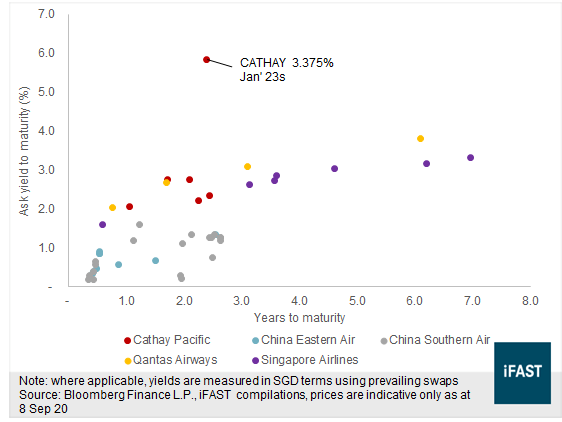
We like the CATHAY 3.375% ‘23s
Within the SGD bond universe, we think all three airline issuers in the market, namely SIA, China Eastern Airlines and Cathay Pacific, exhibit moderate credit risk premiums that have mostly priced in their respective potential sovereign support during this critical period. In particular, we find Cathay Pacific’s CATHAY 3.375% 22Jan2023 Corp (SGD) attractive at its indicative ask YTM of 6.06% (Z-spread: 574bps). This bond would offer a yield pick-up of 3.45% with a shorter maturity against SIA’s SIASP 3.160% 25Oct2023 Corp (SGD) (ask YTM: 2.61%).
The spread between Cathay Pacific’s bonds and SIA’s bonds represents a generous compensation for Cathay Pacific’s weaker credit profile, in our view. As at 30 Jun 20, SIA reported a net gearing of 0.68x (including leases). At the indicative ask price of 94.16, we think Cathay Pacific’s bond pricing offers a lucrative risk-to-reward ratio for a weak outlook ahead that is heavily contingent on pandemic developments.
Figure 8: Relative valuation
Overall, we initiate credit research coverage on Cathay Pacific with a neutral view on its credit outlook. The recapitalisation plan provided Cathay Pacific with much-needed liquidity at this juncture. Together with steep cost-cutting and cash-preserving measures, and some support from cargo demand, we expect Cathay Pacific to have sufficient financial room to tide through the current crisis.
Footnotes
1. The Swire Group is a Hong Kong- and London-based diversified conglomerate that has been in business since 1787, founded by Sir John Swire as a textile trade centre.Our new podcast series, Yield Hunters, is now available on Spotify, iTunes Podcasts and Google Podcasts. In this episode on the aviation industry, we discuss how to identify airlines who will spread their wings through disruptions, and those who won’t.
Declaration:
For specific disclosure, at the time of publication of this report, IFPL (via its connected and associated entities) has a principal position in CATHAY 3.375% 22Jan2023 Corp (SGD). The analyst who produced this report holds financial interests in the SIASP 3.030% 28Mar2024 Corp (SGD) - Retail.