It has been more than two years since a Singapore bank offered a USD-denominated additional tier 1 (“AT1”) perpetual note. This new perp would be the third Basel III-compliant USD AT1 instrument after the UOBSP 3.875% Perpetual Corp (USD) and DBSSP 3.600% Perpetual Corp (USD).
DBS Group Holdings Ltd (“DBS”) is the issuer of the note with credit ratings of Aa2 (stable) and AA- (stable) by Moody’s and Fitch respectively. These ratings are among the highest among financial institutions globally. The expected issue ratings are Moody’s Baa1 (hyb) and Fitch BBB.
Terms and conditions of the perp will follow DBS’s USD30 billion medium term note program dated 1 Apr 19. If the perp is not called on its first call date in February 2025, the note will reset to the prevailing five-year USD Treasury yields plus the initial spread. Similar to the other local bank AT1s, the loss absorption mechanism for the perp is a partial or full write-off in a predefined trigger event, which is the earlier of (1) the Monetary Authority of Singapore (“MAS”) notifying DBS in writing that it is of the opinion that a write-off or conversion is necessary; or (2) MAS provides a public sector injection of capital into the bank.
About DBS
DBS was named the World’s Best Bank in the Euromoney Awards for Excellence 2019. The bank is the largest and one of the three iconic banks in Singapore. After tripling its net profit between 2009 and 2019, the lender’s return on equity reached a record high of 13.2% in 2019.
Apart from a healthy profitability track record, the bank carried an ‘AA’ ESG (environmental, social and governance) rating by MSCI and is included in the Dow Jones Sustainability Asia Pacific Index. Singapore’s sovereign wealth fund, Temasek Holdings Private Limited, was listed as a 29.1% shareholder of the company.
Financial highlights
In the quarter ended 31 Dec 19 (“4Q19”), total income increased 7% YoY to S$3.5 billion. A large driver of income is non-interest income as net interest margin remained flat at around 1.86% at the end of both 4Q18 and 4Q19. Allowances for credit and other losses dropped by 40%, leading to a 14% YoY increase in fourth-quarter earnings to S$1.5 billion. Excluding allowances (which are set at the bank’s discretion), profit before allowances and taxes increased by 13% YoY to S$1.7 billion.
83% of the bank’s total income in 4Q19 came from Singapore and Hong Kong, regions that are experiencing weak economic growths. This indicated that future income could fall given the large exposure to these two geographies. Piyush Gupta, CEO of DBS group, also guided that revenue could decline by up to 2% this year as a result of the COVID-19 outbreak, assuming that the situation is controlled by summer.
DBS’s asset quality remained sound given its large loss absorption capacity. The bank’s stress test suggested that the lender would likely witness a 4- to 5-basis point increase in credit costs, translating to an incremental credit cost of S$250m to S$300m. This is a manageable amount relative to the general allowances set aside by DBS, and is unlikely to affect earnings according to the bank.
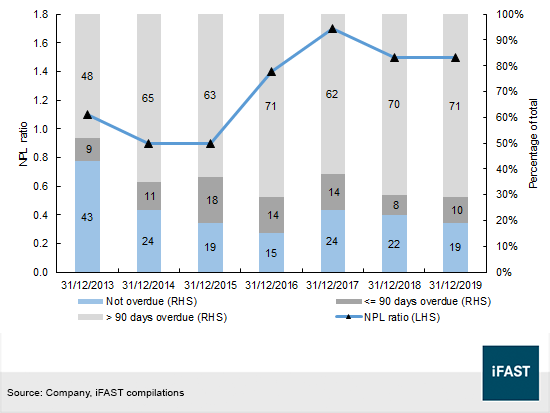
The percentage of non-performing loans, or NPL ratio, increased from 0.9% in 2014 to 1.7% in 2017 (Figure 1). This was driven by NPLs in the oil and gas service sectors as all residual weak cases in the sector were recognized as NPLs in 3Q17. We expect a modest increase in NPL ratio in 2020, after having fallen to 1.5% in 2018 and 2019.
The proportion of >90 days overdue loans climbed from 62% in 2017 to 71% in 2019, and could trend upwards in 2020. DBS has said that that it would offer a six-month debt moratorium on principal repayments for property loans to SMEs as well as on mortgages for homeowners.
Figure 1: Non-performing loans
Following the company’s guidance and delving into specific numbers, an estimated S$2 billion of DBS’s consumer services portfolio across Singapore, Hong Kong and China is vulnerable to further weakness. This will likely center around the travel and tourism industry, although construction and shipping companies will also be affected. Delinquencies from the ~S$8 billion of consumer unsecured loan book could rise to the extent of two to three times from the present level.
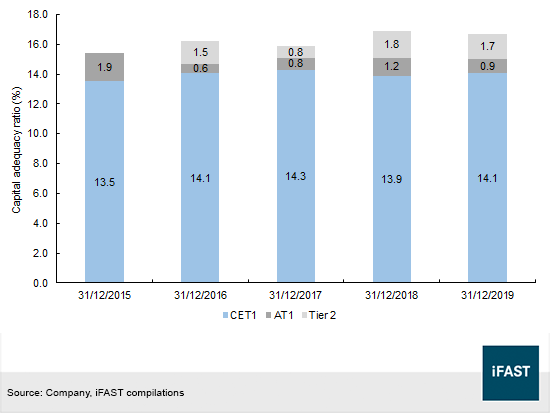
DBS maintained a strong capital adequacy ratio (“CAR”) of 14.1% in 2019. The widely referred CET1 ratio, a measure of the bank’s ability to absorb losses, has increased over the years, rising from 13.5% in 2015 to 14.1% in 2019. This exceeds the regulatory effective minimum CAR (including buffer requirements) of 9.3%. Total CAR was 16.7% as at 31 Dec 19, which was also well above the regulatory minimum of 12.8%.
Figure 2: Regulatory ratios
Bond valuation
In comparing the IPG of the new AT1 bond versus other bank credits, we adopted the ratio of CET1 capital to total assets as a measure of the lenders’ capital adequacy (see Figure 3). This is the unweighted measure of CAR using CET1 as the numerator. An explanation on the differences between the unweighted and risk-weighted capital adequacy measures may be found in our earlier article: Are Singapore bank bonds close to risk free?
Within the context of USD AT1 instruments with similar call dates, we think the new DBS USD PNC5 AT1s at their initial price guidance (“IPG”) of 3.65% are fairly priced. Having a spread of 224bps above the five-year Treasury yields, the new note provides reasonable value for a bank with strong credit metrics and Asian exposure. The relatively low yield is probably reflective of the strong sovereign support that DBS would likely receive at the point where its viability is threatened.
Looking across the USD AT1 space, the LLOYDS 12.000% Perpetual Corp (USD) (first call/reset: 16 Dec 24) seems better priced at a yield to worst (“YTW”) of 6.26%. Lloyds Bank PLC is the ring-fenced entity of Lloyds Banking Group plc, comprising the majority of the group’s retail and commercial banking activities. The issuer is rated A+ by both S&P and Fitch, while the LLOYDS 12% perp is rated BB+ and BBB- by the aforementioned rating agencies.
Investors may consider the LLOYDS 12% perp, which is callable on 16 Dec 24, for exposure to the United Kingdom. To access the macroeconomic profiles and the upside potential of China and Singapore, investors may purchase the newly launched DBS 3.65% perpetual.
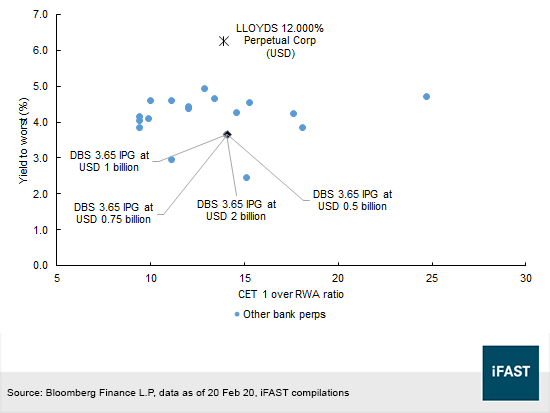
When viewed differently using the CET1-to-risk-weighted assets (“RWA”) ratio (Figure 4), the LLOYDS 12% perp would still be more attractive. We think the yield pickup of 261 bps from the LLOYDS 12% perp is tempting for a one- to two-notch lower bond rating. Furthermore, the LLOYDS AT1 provides a higher yield even though the UK bank (3Q19: 13.9%) and DBS had a similar CET1 ratio of close to 14.0%.
Figure 3: YTW vs CET1 over total assets
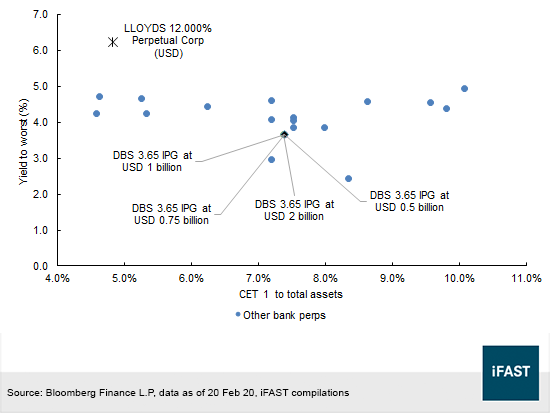
Figure 4: YTW vs CET 1 over RWA
Declaration:
For specific disclosure, at the time of publication of this report, IFPL (via its connected and associated entities) has a principal position in DBSSP 3.600% Perpetual Corp (USD). The analyst who produced this report hold a NIL position in the abovementioned securities.