Background
- First Real Estate Investment Trust (“First REIT”; stock ticker: FIRT:SP) is a Singapore-listed REIT established in 2006, investing in healthcare and healthcare-related real estate in Asia.
- Following the acquisition by OUE Limited and OUE Lippo Healthcare of First REIT’s Manager and units in 2018, the OUE group holds a deemed interest of ~19% in the trust.
- First REIT owns a portfolio of twenty properties located in Indonesia (16), Singapore (3), and South Korea (1).
Rental income fell in 1H20 due to rental reliefs
The first half of 2020 was a challenging period for First REIT, despite the general perception that healthcare should be resilient and steady in tough times. The REIT reported rental and other income of S$38.6m in 1H20, representing a decline of 33.0% YoY (1H19: S$57.6m).
The sharp fall in revenue was mostly due to rental reliefs provided by First REIT to its tenants in the second quarter. To cushion financials strains caused by the coronavirus outbreak, First REIT extended two months of rental relief in May and June to all its tenants, amounting to a total of S$19.6m. The REIT will also pass on all property tax rebates announced by the Singapore government, through rental relief or capital expenditure works, to its three Singapore properties, although we expect this amount to be small, given that the three properties constituted less than 3% of its property portfolio in 2019.
The management has guided that a further relief similar to that announced for 1H20 may be considered for the second half of the year. In the event that First REIT extends another two months of rental relief, we expect the trust’s rental and other income to see a similar decline of around one-third in 2H20. At this juncture, we think the likelihood of this scenario is low, given that operating conditions of private hospital operators should normalize in the second half of 2020.
Operating expenses decreased at a slower pace, with property operating expenses falling 15.7% YoY to S$1.1m due to property tax rebates for Singapore properties, and management fees falling 16.6% YoY to S$4.7m as a result of lower property income. Consequently, operating income, excluding income tax and net fair value losses of derivative financial instruments, plunged 44.6% YoY to S$22.6m (1H19: S$40.7m).
Credit metrics remained healthy, but could face downside pressure from falling property valuation and rising proportion of variable-rate debt
In 1H20, First REIT’s finance costs fell slightly to S$9.9m (1H19: S$10.1m) mostly because of lower interest rates, although we noted that the REIT recorded a S$3.6m of net fair value loss in derivative financial instruments, which related to interest rate swap contracts to hedge floating rate loans. We estimated First REIT’s interest cover (operating income over finance costs) to have fallen to 3.3x in 1H20 (1H19: 5.0x). Including the ~S$1.7m of distributions payable semi-annually on the FIRTSP 5.680% Perpetual Corp (SGD), we find First REIT’s adjusted interest cover at 2.8x (1H19: 4.3x), still manageable despite the significant fall in rental income.
First REIT’s reported gearing ratio (debt over assets) rose marginally from 34.5% at the end of 2019 to 34.9% as of end-June, corresponding to slightly higher total borrowings of S$493.4m (31 Dec 19: S$492.7m) and lower total assets of S$1.41 billion (31 Dec 19: S$1.43 billion). Including the REIT’s S$60m perpetual securities, we estimated its adjusted gearing ratio at 39.1% (31 Dec 19: 38.7%) as of end-June.
Although First REIT’s gearing ratios were still healthy, we noted that the carrying amounts of the trust’s investment properties were based on valuations performed in December last year, without any recognition of the impact from COVID-19 nor the recent rental reliefs. The REIT Manager expects to commission for a full valuation of the REIT’s investment properties to be performed by December 2020. Assuming a 20% fall in the valuation of First REIT’s property portfolio by year-end, the REIT’s gearing ratio and adjusted gearing ratio could climb to approximately 43% and 48% respectively, which would still be manageable, albeit high relative to other Singapore-listed REITs.
At the end of June, First REIT had interest rate swap contracts in place to hedge S$196.8m or 39.9% of its borrowings, down significantly from S$296.7m (60.2%) as of end-2019. As interest expense is the largest portion of the REIT’s total expenses—close to two-thirds in the last two financial years, excluding fair value losses and income tax—a rising exposure to variable-rate debt reduces income stability and earnings quality. Nonetheless, we think this is a less of a concern in the near future given the current low-for-long interest rate environment.
High refinancing wall with limited financial flexibility
First REIT faces a refinancing wall of S$196.6m in near-term debt, or 40% of total borrowings, with cash and cash equivalents of just S$17.8m. All of the REIT’s borrowings are due for repayment by 2023 (see Figure 1), and its weighted average debt maturity was only 1.51 years as at 30 Jun 20. With most of its debt maturing in the next two years, the REIT is exposed to high refinancing risk, especially given today’s highly uncertain capital markets.
Figure 1: First REIT’s debt maturity profile as of 30 Jun 20
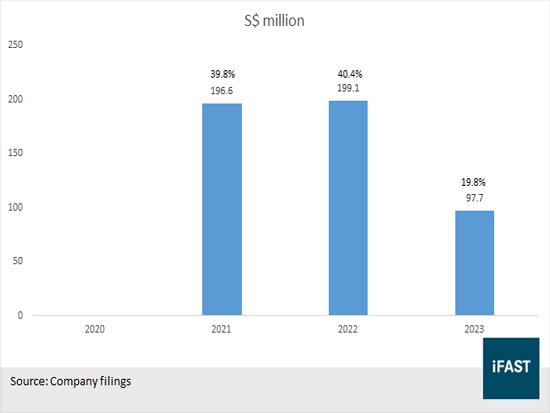
The short-term borrowings of S$196.6m related to term loan and revolving credit facilities due for repayment in March 2021. According to management, First REIT is negotiating with the bank lender to refinancing these borrowings.
Besides S$60m of perpetual securities, all of First REIT’s borrowings are secured debt, with a mortgage over all of the trust’s investment properties except Sarang Hospital, Siloam Hospitals Surabaya, and Siloam Hospitals Yogyakarta. These three properties together had a carrying value of S$63.1m as of end-2019, or less than 5% of First REIT’s property portfolio. As such, we think the REIT has limited ability to raise additional secured debt if needed, and is highly reliant on the continued support from bank lenders for refinancing.
Uncertainties over future lease terms weigh on credit profile
In our previous credit update on First REIT, we reminded investors of risks from the REIT’s revenue concentration and substantial income support from PT Lippo Karawaci Tbk (“LK”). As a recap, PT Siloam International Hospitals Tbk (“Siloam”), a listed subsidiary of LK, operates all of First REIT’s healthcare properties in Indonesia, while LK acts as the master lessee for most of these properties. In 2019, LK and its subsidiaries, including Siloam, contributed 83.3% of First REIT’s rental income.
LK announced in early June that it would be initiating a restructuring process with First REIT with regard to the significant rental support provided by the former. According to LK, COVID-19 led to a drastic decline in patient volumes across Indonesia, significantly affecting Siloam’s revenues and hence increasing the rental support from LK. Revenues in some hospitals were lower by as much as 40-50% YoY and management anticipated the impact to be significant and structural over the medium term.
The rental support agreements between First REIT and LK also have a currency peg component, which increases the burden on LK due to the rupiah’s depreciation this year, although the currency has rebounded substantially since April. In addition, and consistent with our previous report, LK asserted that rental amounts under these agreements were at a level that was unrealistic relative to Siloam’s revenue even before COVID-19 happened—accounting for 30-100% of its hospitals’ gross operating revenue, with a weighted average of close to 40%.
This event adds to the high uncertainty over future lease terms on First REIT’s Indonesian properties, and there is little clarity on how things will unfold from here. On one hand, we understand that the hospitals in Indonesia have unique characteristics tied to Siloam, such as the services offered and property structure. On the other, these properties are integral to Siloam’s operations, constituting most of the firm’s flagship and mature hospitals. First REIT has said that it will consider any reasonable and commercially viable proposal from LK, with any agreement to be mutually agreeable and beneficial in its long-term interest and taking into account applicable legal and regulatory requirements.
Besides the master lease agreements, First REIT is also in talks with LK about the asset swap deal for Siloam Hospitals Surabaya (“SHS”). Back in 2015, the REIT entered into an agreement with PT Saputra Karya—a LK subsidiary—to swap the existing property for a new SHS that is part of a mixed development on the adjacent land.
A road subsidence incident along the nearby highway has halted all development works for the new SHS since 2018. Consequently, First REIT served a notice in June to terminate the development works agreement, and the REIT Manager is in active discussions with all stakeholders to reach a settlement on this matter. At the end of 2019, First REIT has made progress payments and professional fees totaling S$27m for the asset swap deal.
Indonesia’s healthcare sector outlook
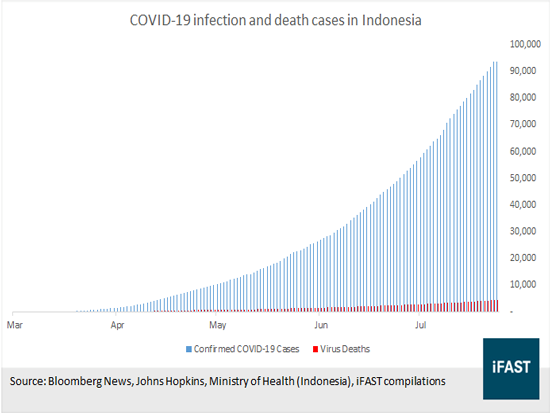
The coronavirus pandemic continues to ravage Indonesia amid easing of social distancing restrictions. Both the country’s number of confirmed infection cases and death toll are the highest in Southeast Asia, coming in at 100,303 and 4,838 respectively as of 27 July (see Figure 2).
Figure 2: COVID-19 pandemic showing no signs of slowing down in Indonesia
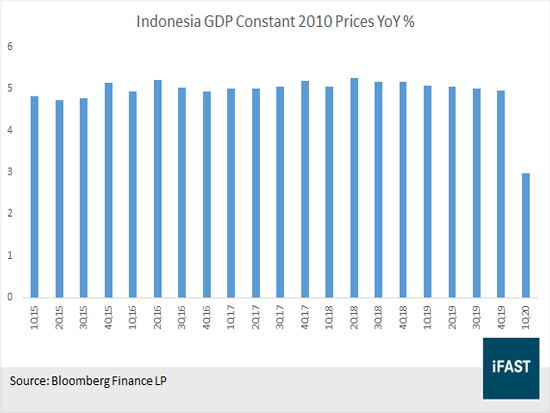
Rising infection cases forced Jakarta to extend coronavirus prohibitions in the country’s capital until 30 July, likely slowing its economic recovery. The pandemic has battered Indonesia’s economy, with growth plunging to 3.0% in the first quarter (see Figure 3), and likely falling into negative territory to a contraction of at least 3.8% in the second quarter, according to the government’s forecast.
Figure 3: Coronavirus stunting Indonesia’s economic growth
As the virus shocks Indonesia’s economy, the country’s National Planning and Development Agency recently warned that unemployment rate in the archipelago could climb to 9.2% by the end of 2020, versus 5.28% in 2019. Meanwhile, the poverty rate in Indonesia is expected to increase to at least 9.7%.
Healthcare has traditionally been looked upon as a recession-proof sector. While this is true to some extent, an economic downturn and rising unemployment are still likely to have a significant adverse impact on the industry. Due to rising financial insecurity and the loss of income and employer-sponsored health insurance, people will choose to delay or forgo elective and non-urgent healthcare procedures.
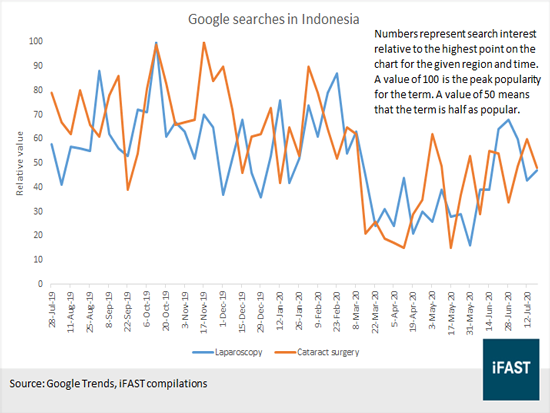
Furthermore, the COVID-19 outbreak puts an immense strain on a country’s healthcare capacity, especially in the case of Indonesia—one of the most medically underserved nations in Southeast Asia. Indonesia’s Ministry of Health in April issued an advisory urging healthcare operators to suspend elective services, in concert with similar recommendations seen in other countries. As such, it is likely that volumes of non-emergency procedures—those that are medically necessary but not urgent—will slump this year, similar to the overall economy. One sign of the lower activity is the precipitous drop in Google searches for elective medical procedures such as “laparoscopy” and “cataract surgery”, as illustrated in Figure 4.
Figure 4: Google searches for laparoscopy and cataract surgery in Indonesia
Although healthcare operators should benefit from COVID-19 patient volume growth, we think this is insufficient to offset the loss of revenue from declining elective care activity. Additionally, Indonesia’s bureaucratic red tape is holding up the government’s reimbursement to hospitals for the cost of treating COVID-19 patients, disrupting the operators’ cash flows.
We expect elective procedure volumes to rebound synchronously with Indonesia’s economy, noting that the World Bank forecasted earlier this month that the country is looking at a long road to recovery. The Indonesian government has earmarked IDR 695.2 trillion for virus relief and expanded its budgeted state expenditure to a record IDR 2,739.2 trillion to cushion the impact of the outbreak. Unlike countries such as Singapore, healthcare providers in Indonesia are mostly reliant on local patient visits, hence patient volumes should rebound quickly after the pandemic is over.
Weighing these factors, our view is that the healthcare sector in Indonesia will see a gradual and uneven recovery, with demand for private healthcare services starting to return in the second half of the year as virus prohibitions are lifted and the economy bounces back. The recovery of the sector, as is the economy, is likely to be subject to alternating periods of progress and retreat, driven by the ups and downs of consumer confidence.
Recommendation
Prices of both First REIT’s units and perpetual notes have taken a nosedive after LK’s unilateral announcement of its intention to restructure lease terms (see Figure 5). The significantly lower bond prices present us with a dilemma. The high uncertainty on future lease terms with LK and murky near-term outlook on Indonesia’s healthcare sector sway us toward maintaining our negative view on the FIRTSP 5.68% perp (first call: 8 Jul 21). On the other hand, First REIT’s perpetual notes are offering one of the highest yields among SGD real estate credits.
Figure 5: COVID-19 and lease negotiations push First REIT’s securities lower
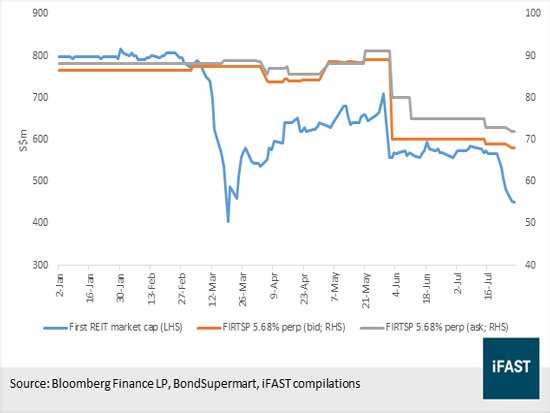
At the indicative ask price of around 73 as of 28 July, the FIRTSP 5.68% perps carried a yield to worst (“YTW”) or perpetuity of 6.7%. As a reference, the LMRTSP 7.000% Perpetual Corp (SGD) of Lippo Malls Indonesia Retail Trust (“LMIRT”)—whose properties are also concentrated in Indonesia and share links to Lippo Group—has YTW of 6.9%.
We think the likelihood of a redemption at first call is low for both the abovementioned perps. Based on prevailing SGD swap offer rates, the distribution rate of the FIRTSP 5.68% perp would reset to approximately 4.4%, just slightly above what First REIT is paying on its bank loans (weighted average cost of 4.1%).
Assuming that the two REITs manage to straighten their finances and redeem the perps within five years, the FIRTSP 5.68% perp would provide higher yields (upward of 12.5%) versus the LMRTSP 7% perp (10.5%). Nevertheless, LMIRT has higher financial liquidity and flexibility, and its income base is better diversified, albeit in a more virus-sensitive sector (retail). Overall, we are indifferent between the two REIT perps.
At its YTW of 6.7%, the FIRTSP 5.68% perp seems to offer less value than First REIT’s units, especially if we view the perp as “equity-like” given the lack of visibility on its possible redemption date. At their closing price of S$0.56 on 28 July, the First REIT units had a twelve-month dividend yield1 of 14.8%. To put this into perspective, when the perp was priced in June 2016 at 5.68%, First REIT’s units were yielding 6.68%. Even if we take cue from the substantially lower distribution per unit declared for 2Q20, and assume that dividend yields would halve from here perpetually, the REIT’s units would still have better risk-reward in our opinion.
More importantly, First REIT is facing elevated refinancing risk with little cash and financial flexibility, exacerbated by high uncertainties over its future leases terms with LK. Given our concerns about the REIT’s ability to meet its senior debt obligations, we think investors should avoid the subordinated FIRTSP 5.68% perp.
Notes:
1. The twelve-month dividend yield is derived by dividing the sum of dividend per share amounts that have gone ex-dividend over the prior twelve months, over the current stock price.
Declaration:
For specific disclosure, at the time of publication of this report, IFPL (via its connected and associated entities) has a principal position in FIRTSP 5.680% Perpetual Corp (SGD) and LMRTSP 6.600% Perpetual Corp (SGD). The analyst who produced this report holds a NIL position in the abovementioned securities.