Highlights:
- GLP continues to implement its asset-light strategy. The profit structure becomes healthier, with around 50% EBITDA coming from the recurring profit. The Group’s fund raising ability is impressive. The dry powder is still at a healthy level. The Group could take advantage of the dry powder to acquire the on-balance sheet logistics assets, in exchange for liquidity and monetised fair value gains.
- GLP’s credit performance is stable, and GLP still get new bank loan financing as usual. The Group chose to have dividend suspension, and successfully collect part of receivables from its parent company. These show its better corporate governance.
- The three acquisition news related to GLP are expected to have positive impacts on GLP, including deleveraging, improving liquidity and increasing financing ability.
- GLP has sufficient ability to sell its assets and get the liquidity, with a strong repayment ability. Investors could consider its bonds including perpetual bonds. The yield to maturity or current yield is ranging from 9% to 14%.
Since year to date, GLP bonds bounded a lot, with "GLPSP 3.875% 04Jun2025 Corp (USD)" up 33% from $66 to $89. The market starts to have more confidence in GLP's debt repayment ability. The case shows our previous analyses were correct, such as “GLP's business model is very different from that of Chinese real estate developers”, “The Group's solvency in the short- to medium-term is strong” and “Investors could take advantage of this golden investment opportunity”. Investors can review GLP's business model, advantages and past results in the following articles:
Idea of the Week: Global Logistics Properties (GLP)—Golden Investment Opportunity? Over 50% Return
Global Logistics Properties (GLP) – With Resilient Fundamentals, Is this an Opportunity?
Continue to Implement its Asset-light Strategy with a Healthier Profit Structure
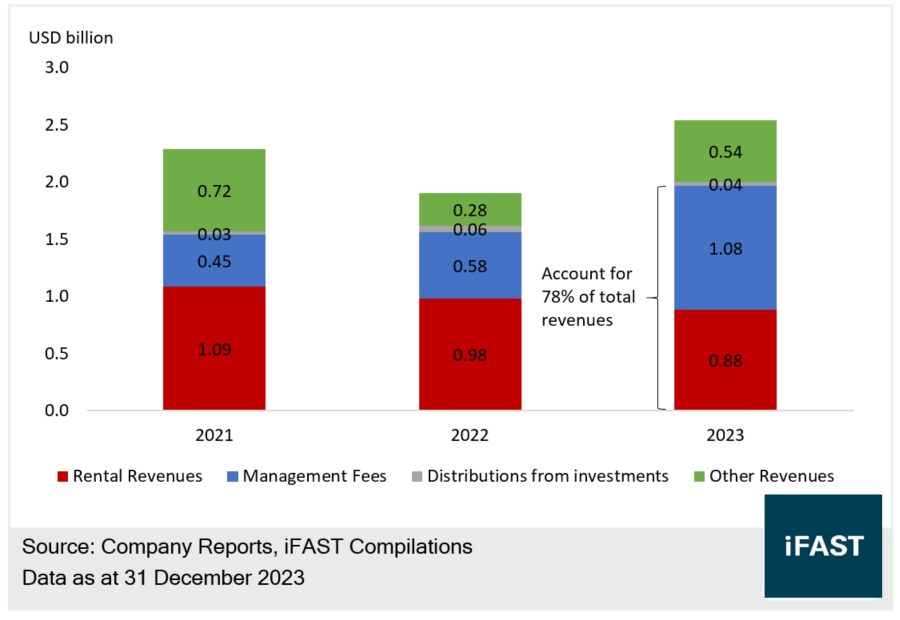
On 3 May 2024, GLP Pte (GLP) announced its 2023 result. As of the end-2023, GLP’s asset under management (AUM) rose slightly to USD 128 billion. In 2023, the Group’s revenues surged by 33% YoY to USD 2.54 billion, with management fees up 87% YoY to USD 1.08 billion, due to the change in accounting standards and the Group’s continuing to implement its asset-light strategy. 78% of the total revenues were generated from rental revenues and management fees (see Chart 1).
Chart 1: GLP’s Revenue Structure
Given that the alternative asset managers gradually sell the assets to its managed funds or JVs and associates (the typical examples include Blackstone in US, Brookfield in Canada, Capital Land in Singapore and Goodman in Australia), they would realise some gains from the asset disposal over time. GLP called it “Monetised Fair Value Gains”, which is not accounted in the revenue part but accounted in the core EBITDA.
In 2023, GLP’s core EBITDA was USD 2.09 billion, decreased by 15% YoY, mainly due to less profits generated from the asset disposal. However, its profit structure became healthier. Around 50% (1.05 billion EBITDA) from the recurring profit and around 50% (1.04 billion EBITDA) from the monetised fair value gains (asset monetization of USD 6 billion from January 2023 to March 2024 and some of them yet to be recognised as profits). Compared to 2022, the contribution from the recurring profit to core EBITDA was only 20%.
Impressive Fund Raising Ability with Dry Powder Offering Liquidity
We pointed out that the alternative asset managers, including GLP, have several advantages to maintaining the AUM. Under the global high interest rate environment and Chinese real estate debt crisis, the Group managed to raise USD 6 billion capital through its managed funds, which was quite impressive. About 65% of the capital raised was from the onshore funds, coming from the Chinese insurance companies’ demand for property investments with recurring revenues. The logistics assets meet their requirements.
GLP has a dry powder of around USD 13.4 billion, which is still at a healthy level. The Group could take advantage of the dry powder to acquire the on-balance sheet logistics assets, in exchange for liquidity and monetised fair value gains.
Besides, in 2023, GLP’s property occupancy rate remained high at 92%. The same property's net operating profit increased 2.5% YoY. The tenant retention was still higher than 60%. The overall quality of its investment properties remained decent.
Stable Credit Performance and Still Having New Bank Loan Financing As Usual
About the credit profile, as shown in Table 1, as of the end-2023, GLP’s total debt decreased to USD 15.1 billion. The net debt to total investments and the net gearing ratio were decreased to 44% and 64% respectively. The deleverage progress was on track. The Group’s net debt to core EBITDA dropped to 6.1 times. However, due to higher interest expense and certain deterioration in core EBITDA, the interest coverage ratio was 2.1 times, but it still has sufficient interest payment ability from the operating profit. The credit performance was stable.
Table 1: GLP’s Main Credit Metrics
|
(USD billion) |
2022 |
2023 |
|
Total Debt (Including Perpetual Debt) |
18.1 |
15.1 |
|
Total Cash |
2.6 |
2.3 |
|
Total Investments (Property and Equity Investments) |
32.2 |
29.2 |
|
Net Debt / Total Investment (%) |
48% |
44% |
|
Net Gearing Ratio (%) |
66% |
64% |
|
Net Debt / Core EBITDA (times) |
6.4x |
6.1x |
|
Interest Coverage Ratio (times) (Including Distribution to Perpetual Debt) |
3.2x |
2.1x |
|
Average Cost of Borrowings (%) |
4.5% |
4.9% |
|
Sources: Company’s Announcement, iFAST Compilations Data as of 31 December 2023 |
||
In terms of debt structure (see Chart 2), about 38% of GLP's total debt is in the form of bonds, while the rest is mainly bank loans, with an approximate 50-50 split between secured and unsecured loans. GLP said that no bank withdrew its credit lines during the last year conference call. The result confirmed this point. Despite the pressure of being downgraded to non-investment grade by the rating agencies, with the issuer credit rating of BB (Fitch), the Group was still able to refinance its bank loans. In 2023, the Group’s new bank loan financing amounted to USD 7.7 billion, sufficient to cover the bank loan repayment of USD 5.8 billon. The bank loan refinancing ability is strong.
Chart 2: GLP’s Debt Structure
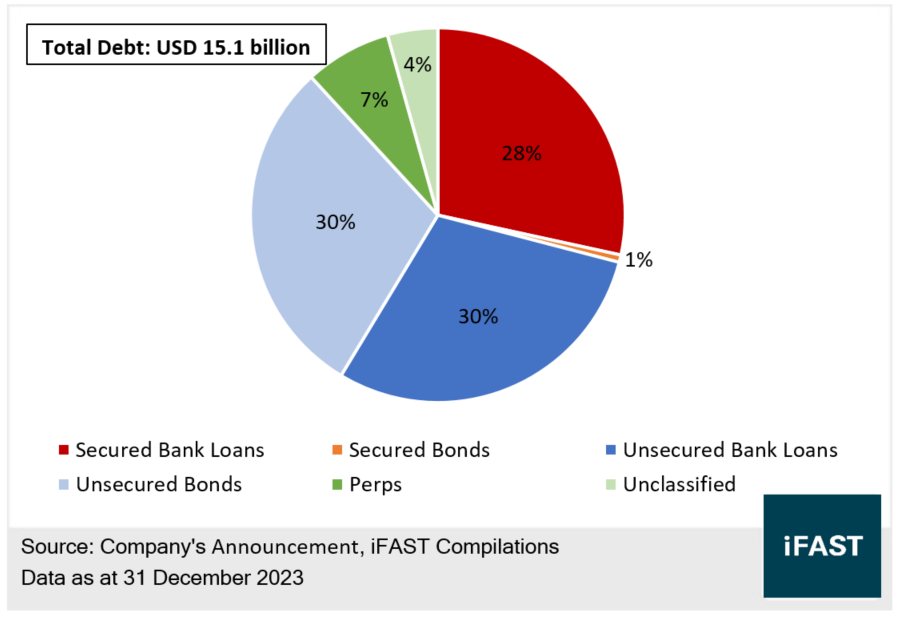
In addition, GLP's secured loans grew at a similar rate to its unsecured loans, suggesting that the Group does not need to pledge more assets to secure additional financing. The banks continued to provide strong financing support to the Group, indirectly reflecting that its credit profile is sound.
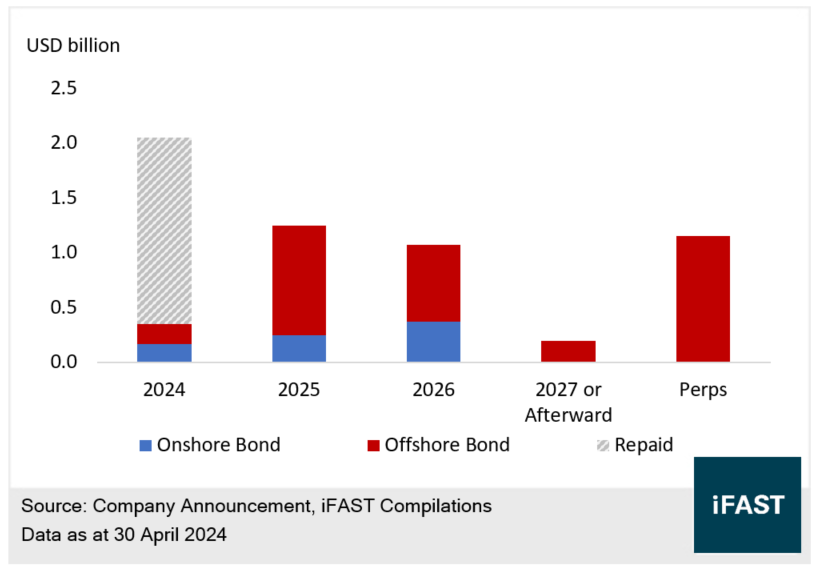
Since the beginning of the year, GLP repaid a total of USD 1.7 billion of onshore and offshore bonds (see Chart 3), bringing its total bond outstanding down to about USD 4.0 billion. The peak of its debt repayment period is over. Only about USD 1.2 billion of bonds will be matured in each of the next two years. The bond repayment would not put a high pressure on GLP.
Chart 3: GLP’s Bond Maturity Profile
Dividend Suspension and Collection of Part of Receivables from its
Parent Company Show its Better Corporate Governance
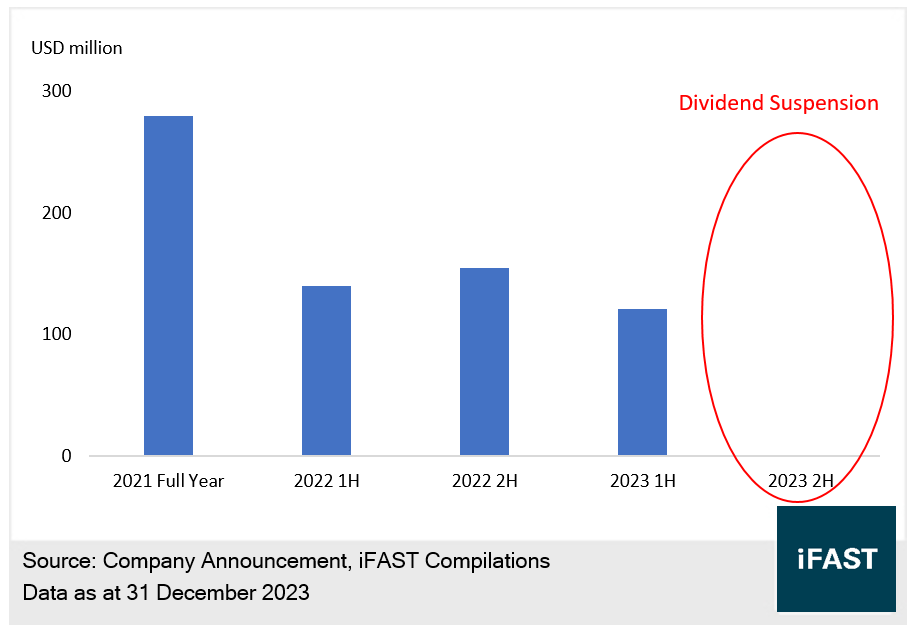
During 2021 to the first half of 2023, GLP kept paying dividends , ranging from approximately USD 120 million to USD 155 million per half year (Chart 4). However, GLP suspended its dividend payment in the second half of 2023. This showed the Group’s willingness to reserve liquidity in advance for debt repayment and to enhance its financial security. GLP should not be under pressure from the shareholders’ requests on paying a high dividend. Even though one of its shareholders, Vanke, is facing some liquidity pressure, GLP does not choose to rescue its shareholders at the expense of the Group’s own interests and creditors’ interests.
Chart 4: GLP’s Dividend Record
In addition, during the second half of 2023, GLP managed to collect receivables of about USD 800 million from its parent company, GLP Bidco (related receivables of USD 4.6 billion as of December 2023, which arose from the GLP privatization in 2018). As one of GLP's shareholders is Vanke, one of the leading property developers in China, the market was concerned that GLP might be emptied of its financial resources by property developers in the same way as property management companies in China (e.g. Evergrande, Aoyuan, etc.). But this did not happen in the GLP case. GLP even collected some of its receivables successfully, so this risk of being emptied is almost eliminated. GLP’s corporate governance is at a better level.
Three Acquisition News Expected to Have Positive Impacts on GLP
Chart 5: GLP’s Shareholding Structure
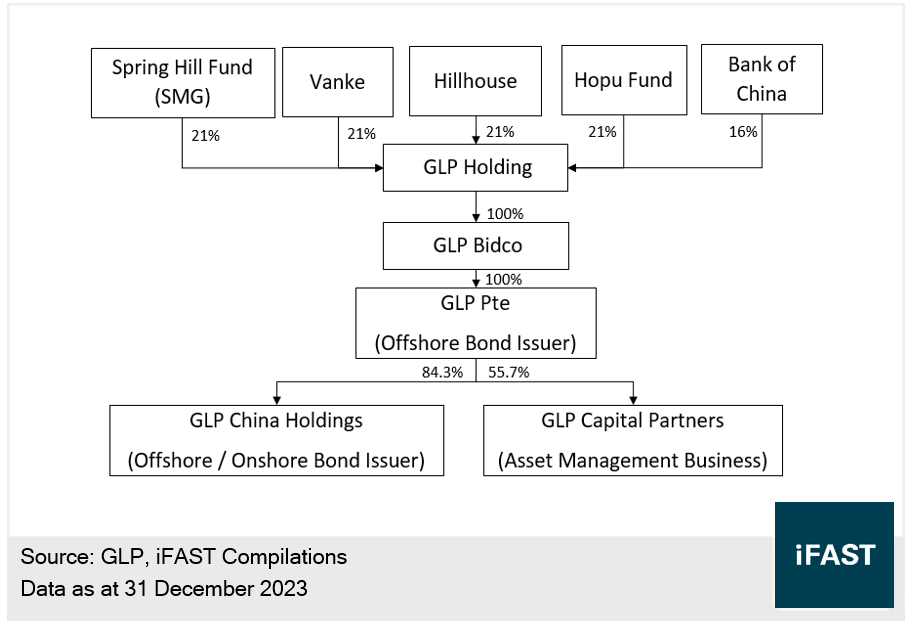
Recently, the news reported that Guangdong Holdings intends to acquire the major stake of GLP China Holdings, and another news reported that Vanke is negotiating with Guangdong Holdings and Tianjin SOEs to dispose its 21% stake in GLP Holding (see Chart 5 for the shareholding structure). Combined with the previous China Logistics Group’s intention to acquire GLP’s logistics assets, investors might be confused with the information.
In fact, these are three different pieces of news that will have different impacts on GLP. All of them have a positive impact on GLP in terms of deleveraging, improving liquidity and increasing financing ability:
Guangdong Holdings intends to acquire the major stake of GLP China Holdings:
- If the news is true, it implies that the major shareholder of GLP China Holdings will be changed from GLP Pte to Guangdong Holdings. The change of control put of the bonds issued by GLP China Holdings (GLPCHI bonds) will be triggered. The issuer has to early redeem the bonds at $101.
- GLP Pte could gain the sales proceeds to lower the debt and improve liquidity.
- According to the news, the GLP China Holdings’s valuation is USD 6.9 billion (equivalent to RMB 50 billion) or USD 5.8 billion after considering the attributable part to GLP Pte. These proceeds could cover around 91% of GLP Pte’s debt (after decomposing GLP China Holdings’s debt), and it could increase the likelihood of calling the perps in 2026 or 2027.
Vanke is negotiating with Guangdong Holdings and Tianjin SOEs to dispose its 21% stake in GLP Holding:
- The shareholder background of GLP will be changed, and GLP will become a logistics real estate and asset management company with a hybrid background, which might enhance GLP’s financing ability.
- It is expected that the change of control put of the GLP bonds (including the GLPCHI and GLPSP Bonds) will be not triggered.
China Logistics Group’s intention to acquire GLP’s logistics assets:
- GLP said that for the transaction, “dialogue is going” during the conference call. The management stated that they remain optimistic about completing the transaction.
- We estimate the potential size of the transaction to be around USD 5 billion, with an expected cash inflows of at least USD 2.5 billion after deducting the related liabilities. The proceeds are expected to be used in deleverage and liquidity enhancement.
GLP has Sufficient Ability to Sell its Assets and Get the Liquidity; Investors could consider its bonds including Perps
Consistent with our previous analysis, GLP has sufficient ability to sell its assets and get the liquidity to repay the bonds. The Group has a number of ways to liquidate assets at a reasonable price (or even better), including selling assets to the Group's related parties (JVs, associates and funds managed by the Group), securitising some of its self-owned properties and selling them to institutional investors or retail investors and directly selling properties to peers.
For institutional investors, the logistics and alternative assets have higher attractiveness (with the rental yields of over 7%), particularly in light of the low rental yields of traditional commercial properties in China (only 4% to 6%) and the high price decline risk of residential projects due to the Chinese real estate crisis. Therefore, GLP’s logistics and alternative assets attracted a number of institutional investors (particularly Chinese insurance companies). They gain the exposures through the subscription of GLP’s managed funds, directly acquiring GLP’s assets and/or becoming the GLP’s strategic partners. Investors do not need to worry about GLP to sell its assets at a cheap valuation.
Overall, GLP's repayment ability is strong. Despite a surge in GLP’s bonds, if the issuers could repay the bonds on time, the ultimate value will be $100 (the total return consists of the price appreciation and coupons received within the period). The bond will not be prone to adjustments like stocks due to the large short-term appreciation alone. Investors can still consider its bonds (see Table 2) in different tenors, with the yield to maturity ranging from 9% to 14%.
Table 2: GLP’s Bonds
|
Bond Name |
Issuer |
Currency |
Tenor |
Ask Price (Investors Buy) |
YTM |
| GLPCHI 4.000% 02JUL2024 CORP (CNY) | GLP China Holdings |
CNY |
0.2 |
98.8 |
9.9% |
| GLPSP 3.875% 04JUN2025 CORP (USD) | GLP Pte |
USD |
1.1 |
89.7 |
14.7% |
| GLPCHI 2.950% 29Mar2026 Corp (USD) | GLP China Holdings |
USD |
1.9 |
85.1 |
12.0% |
|
Source: Bondsupermart Data as of 7 May 2024 |
|||||
As shown in Table 3, GLP’s perpetual bonds have a current yield of around 9%, still having a high attractiveness. For the investment strategy of GLP’s perpetual bonds, investors could refer to this article:
Small Bets for Big Wins? Could NWD and GLP Perps Be Super High-yield Strategy in Crisis?
Table 3: GLP’s Perpetual Bonds
|
Bond Name |
Issuer |
Currency |
Next Call Date |
Ask Price (Investors Buy) |
Yield To Next Call |
Current Yield |
| GLPSP 4.500% Perpetual Corp (USD) | GLP Pte |
USD |
17 May 2026 |
49.1 |
49.8% |
9.2% |
| GLPSP 4.600% Perpetual Corp (USD) | GLP Pte |
USD |
29 June 2027 |
48.5 |
33.4% |
9.5% |
|
Source: Bondsupermart Data as of 7 May 2024 |
||||||
Related Risk
GLP is relatively dependent on bank loan refinancing. If the banks are unwilling to refinance its loans, it would significantly increase GLP’s liquidity pressure and default risk.
GLP’s asset disposal is dependent on the fund raising ability and dry powder of GLP’s managed funds. If these GLP’s managed funds lose the fund raising ability and dry powder, it would add uncertainty to GLP's asset disposal.
GLP’s sources of profits appear to be diversified but they are in fact interrelated. If the logistics property market is under pressure, its rental income, investments and fund management will also face certain degree of revenue declines or valuation loss.
Conclusion
GLP continued to implement its asset-light strategy. The profit structure becomes healthier, with around 50% EBITDA coming from the recurring profit. The Group’s fund raising ability is impressive. The dry powder is still at a healthy level. The Group could take advantage of the dry powder to acquire the on-balance sheet logistics assets, in exchange for liquidity and monetised fair value gains.
GLP’s credit performance is stable, and GLP still get new bank loan financing as usual. The Group chose to have dividend suspension, and successfully collect part of receivables from its parent company. These show its better corporate governance.
The three acquisition news related to GLP are expected to have positive impacts on GLP, including deleveraging, improving liquidity and increasing financing ability.
GLP has sufficient ability to sell its assets and get the liquidity, with a strong repayment ability. Investors could consider its bonds including perpetual bonds. The yield to maturity or current yield is ranging from 9% to 14%.
Declaration: For specific disclosure, at the time of publication of this report, IFPL (via its connected and associated entities) holds a NIL position in the abovementioned securities. The analyst who produced this report holds positions in GLPSP 4.500% Perpetual Corp (USD).
Our podcast series, Yield Hunters, is available on Spotify, iTunes Podcasts and Google Podcasts. We share our thoughts on new bond issues and hold discussions on the fixed income space. Listen to our latest episode below and follow us!