We are comfortable with Thomson Medical Group’s credit profile, which is underpinned by positive cash flows, recovery in demand for medical services and a healthy cash position.
We recommend the TMGSP 4.800% 18Jul2022 Corp (SGD) and the TMGSP 4.050% 28Jan2025 Corp (SGD). As of 25 Feb 21, the notes had yields to maturity of 3.02% and 3.79% respectively.
The TMGSP senior SGD bonds also provide decent value against the credits of other healthcare companies.
Earlier in the month, Thomson Medical Group Limited (“TMGSP”) announced financial results for the six-month period ended 31 Dec 20 (“1HFY21”). In spite of a challenging operating environment in 2020, the company managed to grow operating profit by 41.2% YoY to S$26.1m and generate an after tax profit of S$9.7m.
About Thomson Medical Group
TMGSP is a listed firm in Singapore that was first incorporated as asp Holdings Pte Ltd, an information technology training and software development company in 1999. The company was renamed Rowsley Ltd in 2003 and it soon turned into an investment business. After deciding to focus its portfolio on the healthcare sector in 2017, Rowsley was renamed as Thomson Medical Group Limited.
TMGSP now runs two main hospitals as its core assets, Thomson Medical Centre in Singapore and Thomson Hospital Kota Damansara in Malaysia. The group is expanding its operations to Johor Bahru, where it will build the Thomson Iskandar Medical Hub.
Mr Lim Eng Hock or Peter Lim is the ultimate controlling shareholder of the group. As of 18 Feb 21, Mr Lim had a 89.08% interest in the firm, which are deemed to be held through Jovina Investments Limited, Bellton International Limited, Garville Pte Ltd, Meriton Capital Limited, and his nominees.
Financial highlights
During the six month period before 31 Dec 20 (“1HFY21”), TMGSP reported a 1.3% decline in revenue to S$116.6m on the back of lower patient loads and government-imposed restrictions to contain the transmission of the coronavirus. Comparing its performance in 1HFY20 and 1HFY21, we note that the company recorded lower staff costs and other operating expenses, which led to higher results from operating activities.
EBITDA, or earnings before interest, taxes, depreciation and amortization expenses grew by 27.5% YoY to S$35.2m. Adjusted EBITDA, which excludes the effects of SFRS(I) 16 expanded by 32.6% YoY to S$31.8m from S$24.0m. The EBITDA expansion, according to TMGSP was a result of government grants under the Jobs Support Scheme and property tax rebates to provide support to Singapore employers during the recent coronavirus pandemic.
Results from operating activities were S$26.1m in 1HFY21. After deducting net finance costs and income tax expenses, TMGSP made a net profit of S$9.7m during 1HFY21.
Net cash flows from operating activities remained positive in both 1HFY20 and 1HFY21 at S$43.9m and S$33.6m respectively. Operating cash flows before changes in working capital also improved, as it increased to S$35.4m in 1HFY21 from S$28.5m in 1HFY20, partly due to higher profit before tax of S$14.3m (1HFY20: S$6.6m).
Thomson Medical has a healthy balance sheet. Total equity grew from S$552.9m in 2HFY20 to S$568.0m in 1HFY21, while net current assets fell from S$212.3m to S$168.6m. Total interest-bearing loans and borrowings dropped from S$649.3m to S$610.5m, out of which S$251.1m are secured bank loans that are secured by a charge over certain shares and assets of the group’s subsidiaries. The company’s unsecured bonds include the S$225m TMGSP 4.800% 18Jul2022 Corp (SGD) maturing in July 2022 and the S$175m TMGSP 4.050% 28Jan2025 Corp (SGD) maturing in January 2025.
Credit discussions
TMGSP has an adequate liquidity profile. With S$117.8m of cash and short term deposits, there is ample liquidity to cover its current borrowings and lease liabilities of S$5.8m. The hospital operator also has sufficient headroom for more secured financing as the ratio of secured debt to tangible assets is low at 34% as at 1HFY21, down from 90% in 2018.
These tangible assets comprise of property and equipment (S$423.9m), investment property (S$103.2m) and development property (S$97.2m). Property and equipment includes freehold land (2HFY20: S$212.9m) and construction-in-progress property (2HFY20: S$86.2m). Construction at Thomson Hospital Kota Damansara is progressing but the pace had been slow due to the Conditional Movement Control Order in Malaysia.
The investment property sits on a 9.23 hectare piece of land located within the Iskandar Development Region, Johor Bahru, Malaysia. TMGSP had pledged the property as collateral for loans in 2018 but the group paid off the loans in the recent financial period. Development properties also consists of land in the Iskandar Development Region that may be used as collateral for additional financing.
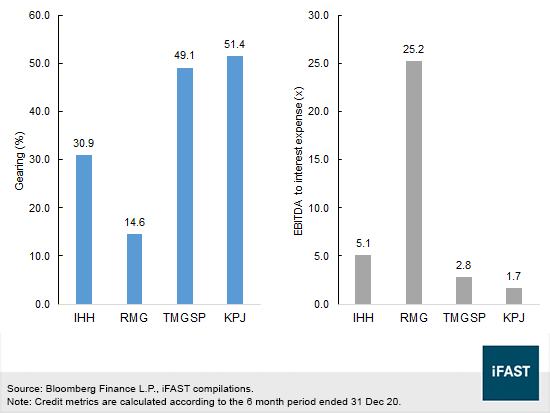
Interest coverage ratio, measured as adjusted EBITDA to interest expense improved from ~2.0x in 1HFY20 to ~2.8x in 1HFY21 (EBITDA to interest expense was ~3.2x in 1HFY21). Gearing on the other hand is high. The ratio of borrowings and lease liabilities to total assets was ~49.1% at the end of December, which is higher than two other hospital operators.
Competitor comparison
Thomson Medical Group competes against Raffles Medical Group Ltd (“RMG”), a Singapore-listed private healthcare provider with a lower estimated gearing of ~14.6% (Figure 1). Gearing for IHH Healthcare Berhad (“IHH”) was also lower at ~30.9% on 31 Dec 20. However, KPJ Healthcare Berhad (“KPJ”), a leading healthcare conglomerate with 28 hospitals in Malaysia had a higher gearing ratio of ~51.4% at the end of December.
Besides having a higher gearing ratio, KPJ had a weaker interest servicing ability than TMGSP. Coinciding with a drop in patient volume during the lockdowns, KPJ registered a smaller EBITDA to interest multiple of 1.7x in the six months ended 31 Dec 20. Nonetheless, interest servicing abilities for RMG and IHH were notably better than Thomson Medical Group.
RMG’s EBITDA to interest in the six month period ended 31 Dec 20 was ~25.2x. Meanwhile, the EBITDA to interest expense (including distributions to perpetual note holders) for IHH in the six month period ended 31 Dec 20 was ~11.0x, exceeding that of TMGSP in the six months before 31 Dec 20.
Figure 1: Credit metrics for hospital operators
RMG, KPJ and IHH have larger hospital operations than Thomson Medical Group. RMG is a publicly listed entity that operates in 5 countries with a presence in China, Singapore, Vietnam, Japan and Cambodia. Besides its network of 28 hospitals, KPJ also has stakes in healthcare providers in Indonesia, Bangkok and Bangladesh. IHH is the largest private hospital company in Southeast Asia with ownership of a number of healthcare brands including Gleneagles and Mount Elizabeth, and runs a chain of 80 hospitals across 10 countries.
Figure 2: TMGSP and RMG revenue since 1H19
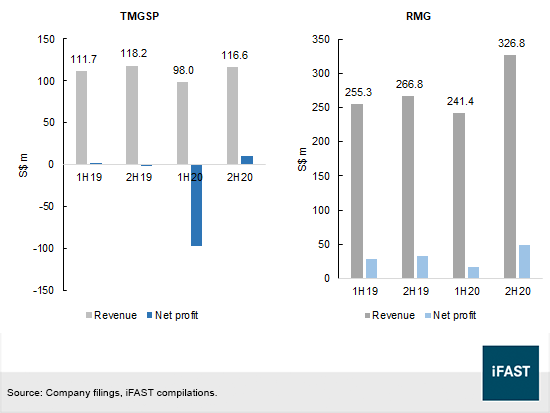
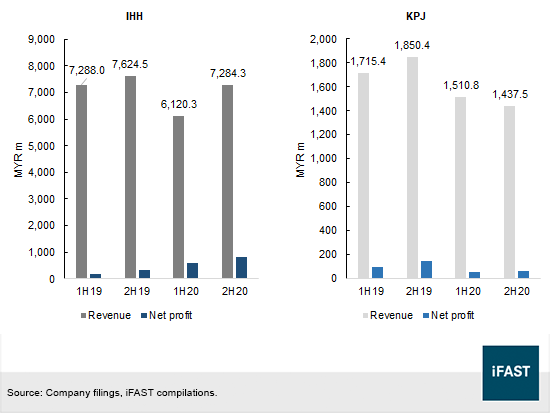
The scale of the companies’ operations may also be seen from their revenue levels (in Figures 2 and 3), which display the performance of these firms since 1H19. In general, top-line performance has been mixed across the board, with KPJ recording constantly lower revenue since 1H19.
Johor Corporation owns ~38.7% of KPJ. The company transacts with various state related government agencies and departments in its course of business. Recently, the Johor state is considering restructuring options for the healthcare firm, which may include bringing on another investor or a merger with another hospital operator.
On the other hand, RMG, IHH and TMGSP delivered higher revenue in 2H20 from 1H20. With a significant proportion of revenue in Singapore, RMG took swift steps to redeploy resources in the midst of the pandemic. The management at RMG took on initiatives to launch new services, such as Covid-19 Polymerase Chain Reaction and serology testing. Employees were stationed at the airports and dormitories to conduct checks such as air border screening and swabbing of foreign workers
IHH reported lower financial results for the fourth quarter ended 31 Dec 20 from a year ago due to the ongoing pandemic. Group revenue declined as patient traffic fell from the previous year due to the postponement of non-urgent procedures at the hospitals. Traffic from foreign patients also remained low due to the border travel restrictions that are currently in place.
However, the loss in revenue from the fall in patient traffic was offset by additional services rendered to conduct procedures related to Covid-19 detection. The group had been in collaboration with the public healthcare sector to provide screening and laboratory testing services.
EBITDA improved by 16% YoY in 4Q20, and this was due to higher revaluation gains in the company’s investment properties and government reliefs. In addition, the group implemented cost cutting measures across the group during the quarter.
Figure 3: IHH and KPJ revenue since 1H19
Bond valuation
As mentioned earlier, Thomson Medical Group has two outstanding medium term notes, more specifically the S$225m TMGSP 4.800% 18Jul2022 Corp (SGD) and the S$175m TMGSP 4.050% 28Jan2025 Corp (SGD). On 25 Feb 21, both notes traded at a yield to maturity (“YTM”) of 3.02% and 3.79% respectively, representing approximately 264 basis points (“bps”) and 335 basis points above their benchmarks.
Figure 4: Credit spreads
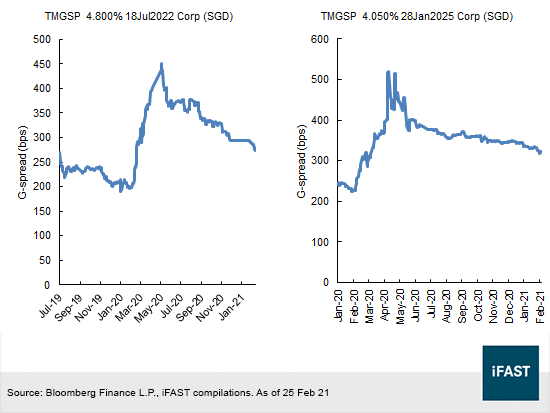
Credit spreads for the bonds have been falling since May 2020 (Figure 4). With the recent improvement in revenue and the prospect of higher patient traffic, we think that spreads will continue dropping in spite of the recent volatility in benchmark rates.
Modified duration for the bonds still indicate a low level. According to Bloomberg, modified duration for the TMGSP 4.800% 18Jul2022 Corp (SGD) and TMGSP 4.050% 28Jan2025 Corp (SGD) were at 1.32 and 3.58 respectively, which measure the change in value of the bonds in response to a 100bps change in interest rates.
Following the terms of the medium term note program, the TMGSP 4.800% 18Jul2022 Corp (SGD) and TMGSP 4.050% 28Jan2025 Corp (SGD) have embedded cessation put options, which allow the bondholders to sell back the bonds to the issuer if the shares of the company cease to trade on the Singapore Exchange or are suspended for a period more than 10 days.
In addition, the notes are secured by an interest service reserve account. As specified in the bond documentations, TMGSP will set aside an amount equivalent to at least one interest payment, which will be kept in the interest service reserve account.
We think that the TMGSP 4.8% ’22s and TMGSP 4.05% 25’s are attractively priced against peers in the sector (Figure 5). As a reference, the credit spreads of 264bps and 335bps are higher than Fullerton Healthcare’s FHCL 2.750% 07Jul2023 Corp (SGD), which traded at an ask YTM of 1.92% (Z-spread: 170bps). Fullerton Healthcare runs an extensive network of healthcare facilities across 9 markets. The firm is a privately held company with less frequent financial reporting than publicly listed entities.
Figure 5: Relative valuation
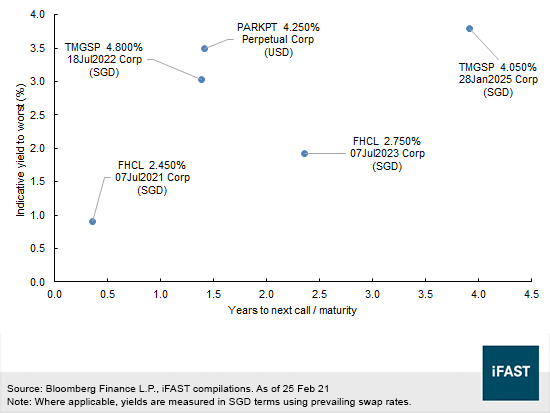
The PARKPT 4.250% Perpetual Corp (USD) is also attractively priced at a G-spread of 318bps. It has an indicative yield to worst of 3.48% on 25 Feb 21 and the note is issued by an IHH subsidiary – Parkway Pantai Ltd. With a first call date on 27 Jul 22, the coupon will reset to the sum of the prevailing 5-year US Treasury yield and initial spread of 4.43% if it is not redeemed.
Bond indentures of the PAKPT perps include a Change of Control (“CoC”) clause, stipulating that the issuer has the option to redeem the PARKPT 4.25% perp upon a CoC event, which is defined as (a) IHH or any person directly or indirectly controlled by IHH ceases to have control, directly or indirectly, of the issuer; or (b) when the issuer consolidates with or merges into or sells or transfers all or a substantial part of the issuer's assets to any other person or persons, acting together, unless the consolidation, merger, sale or transfer does not result in a change in control over the issuer or the resulting entity. The coupon on the note will also step up by 200bps in the occurrence of a CoC event.
To sum up, we are positive on TMGSP’s credit outlook and remain satisfied with its overall financial health. Although the company’s gearing looks significant, we believe that the group’s credit profile is underpinned by positive cash flows, recovery in demand for medical services and a healthy cash position. We recommend the TMGSP 4.800% 18Jul2022 Corp (SGD) and the TMGSP 4.050% 28Jan2025 Corp (SGD), which are offering one of the highest yields among bonds of healthcare providers.
Declaration:
For specific disclosure, at the time of publication of this report, IFPL (via its connected and associated entities) has a principal position in TMGSP 4.800% 18Jul2022 Corp (SGD). The analyst who produced this report holds a NIL position in the abovementioned securities.
Our podcast series, Yield Hunters, is available on Spotify and iTunes Podcasts and Google Podcasts. We share our thoughts on new bond issues and hold discussions on the fixed income space. Listen to our latest episode below and follow us!