In our earlier article “Idea of the Week: HSBC Earnings Hit New High After Major Restructuring, Bond Yields Up to 7%!”, we analysed HSBC’s full-year 2025 results in detail. The Q1 2026 results released in May further confirm the strength of its core operations. This update focuses on the latest developments and financial position.
Solid First Quarter Performance
HSBC’s Q1 2026 performance was in line with both market expectations and our forecasts. Excluding one-off items, total revenue grew 4% year-on-year to USD19.1 billion. Fee and other income rose 6% year-on-year and surged 32% quarter-on-quarter to USD7.9 billion, driven by particularly strong wealth management fees. Both Hong Kong and international wealth businesses benefited from increased client activity (see Chart 1).
On the other hand, net interest income softened sequentially from USD11.8 billion to USD11.3 billion, though it still recorded a modest 2% year-on-year increase. Despite lingering macroeconomic uncertainties, management raised its full-year 2026 net interest income guidance to approximately USD46 billion (from at least USD45 billion previously), reflecting greater confidence in the interest rate environment and deposit margins.
Chart 1: HSBC’s revenue trend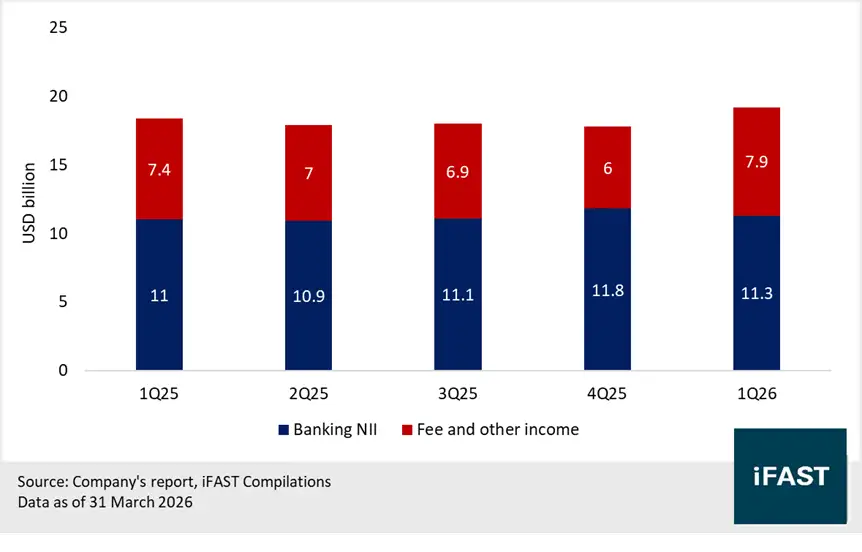
Pre-tax profit, excluding one-offs, edged down 4% year-on-year to USD9.4 billion, slightly below consensus of USD9.6 billion. The shortfall was mainly due to higher credit impairments, one-off costs, and provisions related to Middle East tensions. While the share price saw mild adjustment post-results, core banking engines remained strong, the balance sheet continued to expand, and capital stayed within expected ranges.
Credit Provisions in Focus, Profit Buffers Stay Robust
Market attention centered on expected credit losses (ECL) and management’s comments on rising geopolitical risks. First quarter ECL increased from USD0.9 billion to USD1.3 billion (See Chart 2), including a USD0.4 billion UK fraud case and an extra USD0.3 billion for Middle East conflict-related risks (higher oil prices, inflation, and slower growth). Management accordingly lifted its full-year 2026 ECL guidance from around 40bps to about 45bps.
Chart 2: HSBC’s Expected Credit Losses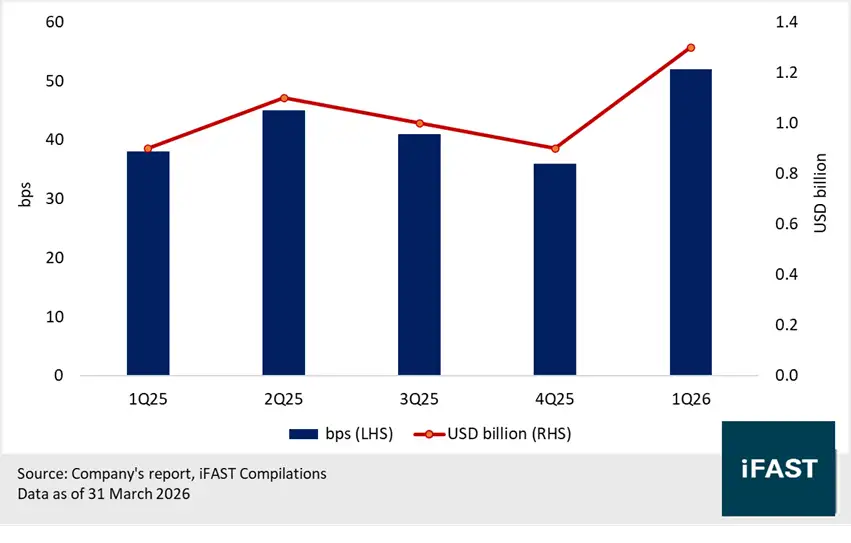
Importantly, these higher provisions mainly reflect short-term geopolitical uncertainty and a deliberately prudent stance by management, rather than any weakening in core credit quality. HSBC’s underlying profitability remains robust, with Return on Tangible Equity (RoTE) rising from 15.6% in 2024 to 17.2% for the year 2025 and further to 18.7% in Q1 2026 — clear evidence of strong profit buffers (See Chart 3).
Chart 3: HSBC’s profit structure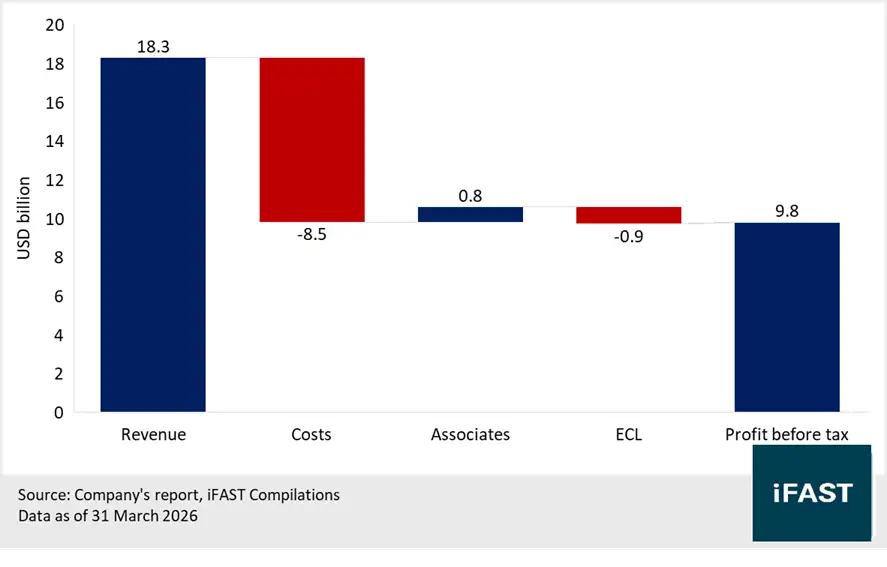
Cost discipline is also progressing well. Underlying operating costs increased only about 1% year-on-year in the first quarter. The group has already delivered USD0.2 billion of annualised simplification savings, with another USD0.1 billion expected in the first half to meet its USD1.5 billion total target. Management reiterated that full-year cost growth will stay around 1%.
The balance sheet continues to expand steadily, with customer deposits reaching USD1.8 trillion and loans at USD1.0 trillion. As anticipated, the CET1 ratio declined from 14.9% at end-2025 to 14.0% following Hang Seng Bank privatisation and other planned initiatives. Since management had already flagged this impact and confirmed it would pause share buybacks until the ratio returns to the 14.0–14.5% range, the drop was fully expected. Overall capital buffers remain ample.
Meanwhile, HSBC’s strategic simplification is advancing smoothly. The group has successfully completed the privatisation of Hang Seng Bank, sold its UK life insurance business, Sri Lanka retail banking and South Africa operations, and announced the disposal of its Indonesia retail banking business. These actions are sharpening the group’s focus on high-growth markets, supporting sustainable revenue growth and improved capital efficiency.
Overall, Q1 2026 results reinforce HSBC’s core business resilience. Recent earnings pressure stems mainly from one-off credit events and geopolitical factors, not fundamental weakness. Management reiterated its medium-term targets: 5% annual revenue growth by 2028, RoTE above 17% each year, and a 50% dividend payout ratio (excluding major one-offs).
Bond Investment
Although the share price saw a mild pullback after the results, the bond market reaction remained relatively stable. Credit spreads did not see much widening, reflecting investors’ continued confidence in HSBC’s underlying credit quality.
Investors can consider the range of HSBC bonds available on our platform (see Tables 1 and 2). Note the repayment priority: senior unsecured bonds rank highest, followed by Tier 2 bonds, with Additional Tier 1 (AT1) instruments ranking lowest.
It is also worth highlighting that AT1 bonds are contingent convertible instruments (often called CoCos). They carry loss-absorption features and are more likely to be written down or converted into equity first if the bank faces severe stress. These bonds therefore suit investors with higher risk tolerance. Investors should choose bonds according to their own risk appetite and ensure they fully understand each instrument’s features and terms.
Table 1: Selected HSBC Senior Unsecured and Tier 2 Bonds
| Bond | Seniority | Currency | Tenor (years) | Yield to Maturity |
| HSBC 5.546% 04Mar2030 Corp (USD) | Senior Unsecured | USD | 3.8 | 4.8% |
| HSBC 5.733% 17May2032 Corp (USD) | Senior Unsecured | USD | 6.0 | 5.1% |
| HSBC 5.813% 22May2033 Corp (GBP) | Senior Unsecured | GBP | 7.2 | 5.6% |
| HSBC 5.790% 13May2036 Corp (USD) | Senior Unsecured | USD | 10 | 5.5% |
| HSBC 4.500% 07Jun2029 Corp (SGD) | Senior Unsecured | SGD | 3.0 | 2.6% |
| HSBC 5.250% 27Jun2032 Corp (SGD) | Tier 2 | SGD | 6.1 | 4.1% |
| HSBC 8.113% 03Nov2033 Corp (USD) | Tier 2 | USD | 7.5 | 5.7% |
| HSBC 5.741% 10Sep2036 Corp (USD) | Tier 2 | USD | 10.3 | 5.7% |
| Source: Bondsupermart Data as of 21 May 2026 |
||||
Table 2: Selected HSBC Additional Tier 1 (AT1) Bonds
| Bond | Seniority | Currency | Tenor (years) | Yield to Next Call |
| HSBC 6.750% Perpetual Corp (USD) | AT1 | USD | Perpetual | 6.6% (24 September 2031) |
| HSBC 7.000% Perpetual Corp (USD) | AT1 | USD | Perpetual | 6.8% (23 March 2036) |
| HSBC 5.000% Perpetual Corp (SGD) | AT1 | SGD | Perpetual | 4.1% (24 March 2030) |
| Source: Bondsupermart Data as of 21 May 2026 |
||||
Declaration: For specific disclosure, at the time of publication of this report, IFPL (via its connected and associated entities) holds 'HSBC 5.300% 14Mar2033 Corp (SGD)' , 'HSBC 4.375% 23Nov2026 Corp (USD)' , 'HSBC 5.546% 04Mar2030 Corp (USD)' and 'HSBC 5.741% 10Sep2036 Corp (USD), and the analyst who produced this report holds a NIL position in the abovementioned securities.
RISK DISCLOSURE STATEMENTS FOR BONDS
Key risks of investing in bond
|
Key risks of investing in high-yield bonds
|
| Bonds with special features Some bonds may contain special features and risks that warrant special attention. These include bonds:
|
Remarks
|