Highlights:
- With HSBC restructuring its business framework in 2025 to focus on core growth markets, earnings have reached new highs even after excluding one‑off factors. The privatization of Hang Seng Bank could further support HSBC’s future growth and performance.
- HSBC’s credit metrics remain solid. While Hong Kong commercial real estate has led to higher than expected credit losses and provisions, overall asset quality is still resilient. The CET1 ratio remains strong, and even with Hang Seng Bank’s privatization, prudent profit management and share buybacks should ensure sufficient capital buffers.
- The platform offers multiple HSBC‑issued bonds, including senior unsecured, Tier 2, and AT1 instruments. Currently, AT1 yields can reach up to 7%. Investors should select bonds that align with their preferences and risk tolerance, while understanding the specific features and terms of each instrument.
One of the biggest stories in Hong Kong’s banking sector in 2025 was HSBC’s announcement to privatize Hang Seng Bank, acquiring the remaining 36.5% stake it did not already own. The deal was completed on 26 January 2026, at HKD155 per share in cash, for a total consideration of HKD106 billion (around USD13.6 billion). Following the transaction, Hang Seng Bank was delisted and became a wholly owned subsidiary of HSBC, while retaining its independent brand, branch network, and management structure.
This article reviews HSBC’s latest annual results and bond investment opportunities.
Restructuring Drives Record Earnings
Under the leadership of new CEO Georges Elhedery, HSBC undertook a major restructuring in 2025. The revamped business delivered strong profitability, with total revenue reaching USD68.3 billion, up 4% year‑on‑year. Excluding one‑off items, revenue rose to USD71.0 billion, a 5% increase.
Although global interest rates have peaked and begun to decline, putting pressure on deposit margins across banks, HSBC leveraged structural hedging strategies and redeployed surplus funds into trading portfolios. This lifted net interest income to USD34.8 billion, up 6.5% year‑on‑year, while net interest margin widened from 1.56% to 1.59%.
Across its four newly defined core segments—Corporate & Institutional Banking, International Wealth & Personal Banking, Hong Kong, and the UK—all reported revenue growth (see Chart 1). Corporate & Institutional Banking stood out, driven by stronger investment and insurance distribution income, as well as robust growth in Global Payments Solutions (GPS).
Chart 1: HSBC’s Revenue by Segment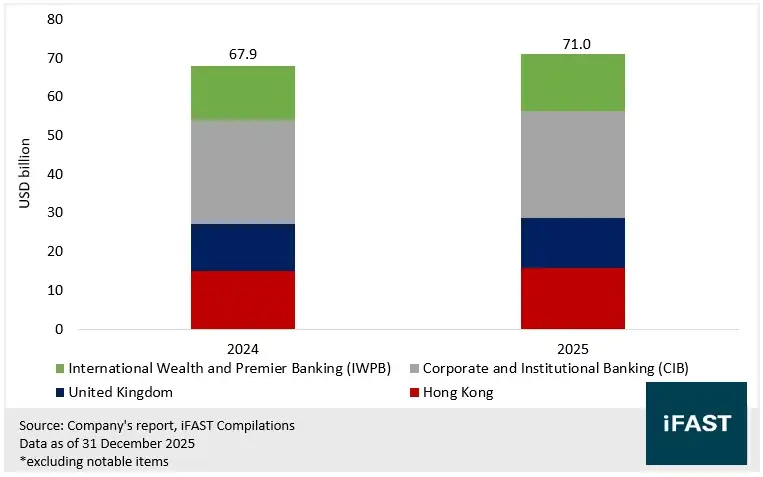 In 2025, operating expenses reached USD36.4 billion, up USD340 million year‑on‑year. Of this increase, USD300 million was related to one‑off items such as legal provisions, restructuring, and integration costs. To align with its new structure, HSBC divested several businesses during the year, including French retail banking, HSBC Canada, and operations in Argentina, Russia, and Armenia, while also exiting retail banking in Mauritius. Excluding these one‑off factors, costs grew at a low single‑digit rate, in line with management guidance.
Expected credit losses (ECL) rose 13% to USD3.9 billion, mainly reflecting higher provisions for commercial real estate. With rising defaults in Hong Kong’s commercial property sector and continued oversupply in non‑residential assets, rental and capital values remained under pressure. HSBC increased related provisions from USD100 million last year to USD700 million. ECL represented about 39 basis points of average gross loans, up from 36 bps in 2024, but still within the manageable target range of 30–40 bps.
Excluding one‑off items, HSBC reported pre‑tax profit of USD36.6 billion, a 7% increase year‑on‑year, marking another record high after 2024. Return on tangible equity improved from 15.6% to 17.2%, underscoring strong operational performance (see Chart 2). HSBC also expects the privatization of Hang Seng Bank to deliver an additional USD300 million in net income by 2028. Hang Seng’s strong foundations in Hong Kong retail banking, SME financing, and wealth management will further enhance HSBC’s market penetration and support future growth.
Chart 2: HSBC's Revenue and Profit Before Tax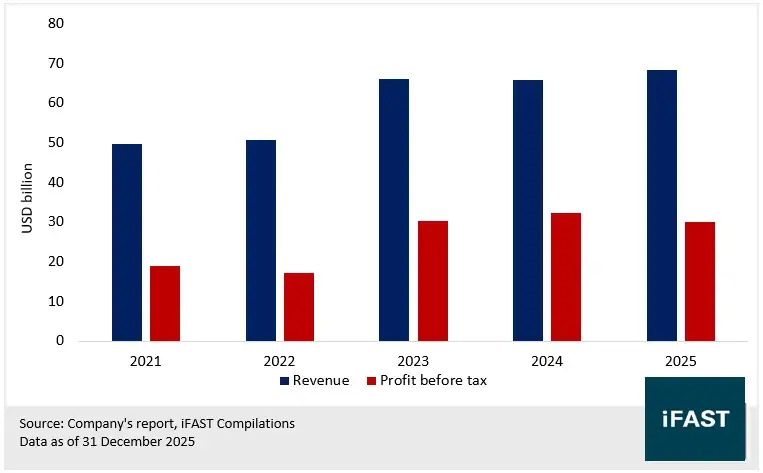 Increased Provisions for Hong Kong Commercial Real Estate
One of the key concerns around HSBC’s acquisition of Hang Seng Bank is the deterioration in Hang Seng Bank’s loan quality, particularly its exposure to Hong Kong commercial real estate. This implies HSBC will face greater risk and provisioning pressure following privatization.
As of end‑2025, HSBC’s loans and advances to Hong Kong commercial real estate stood at about USD30.6 billion, representing roughly 3% of the group’s total loan book—a relatively modest share. However, with local retail and office markets still under pressure from falling rents and capital values, credit quality has continued to weaken, largely driven by Hang Seng Bank’s portfolio.
At the group level, non‑performing loans in Hong Kong commercial real estate rose to USD6.3 billion, up 37% year‑on‑year. Of this, Hang Seng Bank accounted for USD3.5 billion, a 35% increase. This was the main driver behind HSBC’s higher ECL in 2025. Total ECL provisions increased to USD11.2 billion, up 10% year‑on‑year, with provisions for Hong Kong commercial real estate surging 1.75 times to USD1.1 billion (around USD700 million linked to Hang Seng).
Even so, HSBC’s overall ECL ratio remains within its target range of 30–40 basis points, while the group’s total non‑performing loan ratio held steady at about 2.4%, reflecting resilient overall credit quality.
Table 1: HSBC’s Hong Kong Commercial Real Estate Non‑performing Loans and Expected Credit Losses
(USD billion) | 2024 | 2025 | YoY Change |
Non‑performing loan | 4.6 | 6.3 | +37% |
Expected credit losses (ECL) | 0.1 | 0.7 | +600% |
ECL provisions | 0.4 | 1.1 | +175% |
Source: Company's report, iFAST Compilations | |||
Resilient Credit Quality
By the end of 2025, HSBC’s Common Equity Tier 1 (CET1) ratio remained strong at 14.9%, well above the regulatory minimum of 11.1% and slightly above the group’s medium‑term guidance range of 14–14.5% (see Chart 3). The overall capital adequacy ratio rose to 20.5%, up 40 basis points year‑on‑year, providing ample capital and buffer capacity.
Chart 3: Changes in HSBC's Common Equity Tier 1 (CET1) Ratio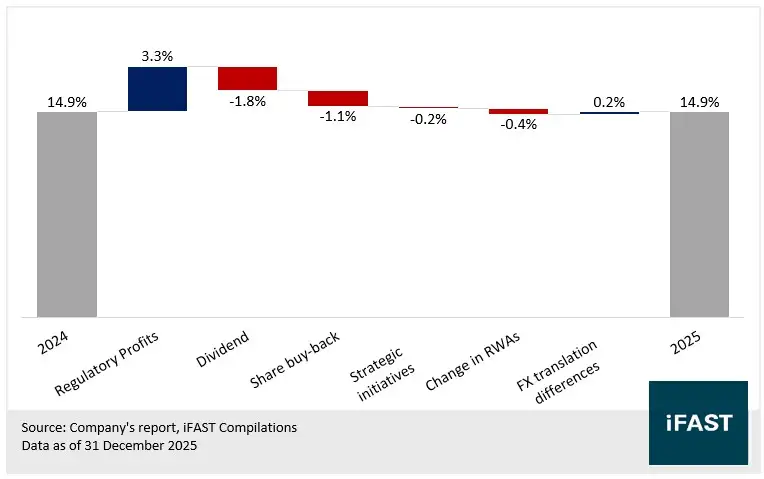 With the privatization of Hang Seng Bank completed in early 2026, HSBC expects its CET1 ratio to temporarily decline by around 120–125 basis points, dipping below the target range. Management has emphasized that restoring capital will be the priority in the coming year, through retained earnings and prudent management of risk‑weighted assets. Share buybacks will be paused until CET1 returns to the target range, ensuring the group’s capital structure remains robust.
HSBC also maintains strong liquidity, with a Liquidity Coverage Ratio (LCR) of 137% and a Net Stable Funding Ratio (NSFR) of 143%, both comfortably above regulatory requirements. This reflects a healthy balance sheet and solid repayment capacity (see Table 1). While expected credit losses have risen slightly, the impact on profitability is limited. Overall, HSBC’s credit quality and key indicators remain resilient and continue to improve.
Table 2: HSBC’s Credit Metrics
Dec 2022 | Dec 2023 | Dec 2024 | Dec 2025 | Regulatory Requirements | |
Common Equity Tier 1 (CET1) Ratio | 14.2% | 14.8% | 14.9% | 14.9% | 11.2% |
Capital Adequacy Ratio | 19.3% | 20.0% | 20.1% | 20.5% | 15.8% |
Expected credit losses (ECL) and other impairment charges (USD billion) | 3.5 | 3.4 | 3.4 | 3.9 | / |
Liquidity Coverage Ratio (LCR) | 132% | 136% | 138% | 137% | 100% |
Net Stable Funding Ratio (NSFR) | 136% | 138% | 143% | 143% | 100% |
Source: Company's report, iFAST Compilations | |||||
Bond Investment
HSBC carries strong credit ratings of A‑/A+ (S&P/Fitch), placing it firmly in the high investment‑grade category. As a Global Systemically Important Bank (G‑SIB), all of HSBC’s bonds include loss‑absorption triggers, meaning that in the event of a severe liquidity crisis, lower‑ranking bonds are more likely to bear losses.
HSBC issues bonds across different levels of seniority. Repayment priority is as follows: senior unsecured ranks above Tier 2 bonds, which in turn rank above Additional Tier 1 (AT1) instruments. AT1 bonds are contingent convertible instruments designed to strengthen capital buffers, and they carry loss‑absorption features. Investors should select bonds based on their individual preferences and risk tolerance, while understanding the specific characteristics and terms of each instrument.
On our platform, several HSBC bonds are available, including senior unsecured and Tier 2 issues. Notably, the senior unsecured HSBC 5.546% 04Mar2030 Corp (USD) and the Tier 2 HSBC 5.741% 10Sep2036 Corp (USD) yield at 4.6% and 5.7% now are listed on Bondsupermart Live, offering attractive yields and supporting real‑time, small‑lot trading. Investors may prioritize these options, though the platform also offers a range of maturities from 4 to 11 years, denominated in both USD and GBP (see Table 3).
These bonds include callable features, with redemption dates typically set one year before maturity. If not called, they convert to floating‑rate instruments, with coupons reset to SOFR plus the initial credit spread. Coupon payments also switch to a quarterly schedule.
Table 3: HSBC Senior Unsecured and Tier 2 Bonds Information
Bond | Seniority | Currency | Tenor (years) | Yield to Maturity |
Senior Unsecured | USD | 3.9 | 4.6% | |
Senior Unsecured | USD | 6.2 | 4.9% | |
Senior Unsecured | GBP | 7.2 | 5.4% | |
Senior Unsecured | USD | 10.1 | 5.3% | |
Tier 2 | USD | 7.6 | 5.7% | |
Tier 2 | USD | 10.5 | 5.6% | |
Source: Bondsupermart | ||||
HSBC’s operating performance remains stable with ample capital buffers. For investors with higher risk tolerance seeking elevated returns, HSBC’s Additional Tier 1 (AT1) bonds are worth considering, currently offering a net yield of up to 7.0% (see Table 4).
It is important to note that while AT1 bonds provide higher yields, they carry greater risk. As the lowest‑ranking instruments in the capital structure, they are more exposed in the event of stress. These bonds have no fixed maturity, making their prices more sensitive to interest rate and spread volatility. They include callable features and coupon reset clauses, and issuers have the right to suspend coupon payments without triggering default.
Table 4: HSBC Additional Tier 1 Bonds Information
Bond | Seniority | Tenor (years) | Current Yield | Yield to Next Call |
AT1 | Perpetual | 6.8% | 6.7% (24 September 2031) | |
AT1 | Perpetual | 7.1% | 7.0% (23 March 2036) | |
Source: Bondsupermart | ||||
Risks
HSBC has meaningful exposure to the Middle East, which it views as a long‑term strategic market. The region contributes about 5% of group pre‑tax profit, though related loans account for only ~2% of total lending. Ongoing geopolitical tensions and oil price volatility could pressure client repayment capacity, cash flows, and credit ratings, potentially requiring additional provisions and impacting HSBC’s profitability and capital ratios.
Rising energy prices may fuel inflationary pressures. If the global economy slips into recession, HSBC’s non‑performing loan ratio could rise, affecting cash flow and debt‑servicing capacity.
Investors should also be aware that HSBC bonds carry loss‑absorption features. If UK regulators determine the bank is in distress, they may exercise the right to write down the bonds in part or in full, or convert them into equity.
Conclusion
With HSBC restructuring its business framework in 2025 to focus on core growth markets, earnings have reached new highs even after excluding one‑off factors. The potential privatization of Hang Seng Bank could further support HSBC’s future growth and performance.
HSBC’s credit metrics remain solid. While Hong Kong commercial real estate has led to higher expected credit losses and provisions, overall asset quality is still resilient. The CET1 ratio remains strong, and even with Hang Seng’s privatization, prudent profit management and share buybacks should ensure sufficient capital buffers.
The platform offers multiple HSBC‑issued bonds, including senior unsecured, Tier 2, and AT1 instruments. Currently, AT1 yields can reach up to 7%. Investors should select bonds that align with their preferences and risk tolerance, while understanding the specific features and terms of each instrument.
Declaration: For specific disclosure, at the time of publication of this report, IFPL (via its connected and associated entities) holds "HSBC 5.546% 04Mar2030 Corp (USD)" and "HSBC 5.741% 10Sep2036 Corp (USD)" and the analyst who produced this report holds a NIL position in the abovementioned securities.
RISK DISCLOSURE STATEMENTS FOR BONDS
Key risks of investing in bond
|
Key risks of investing in high-yield bonds
|
| Bonds with special features Some bonds may contain special features and risks that warrant special attention. These include bonds:
|
Remarks
|