Receive first-hand news on the latest bond issues, credit updates and special events when you join us on our Telegram channel at https://t.me/bondsupermart!
Highlights:
- Anton Oilfield Services is the first non-stated-owned oilfield service company in China. In a high oil price environment or when oil producers have strong cash flow, they will increase their capital expenditures to expand their production capacity, and oilfield service companies will thus benefit. Since each oilfield service company specializes in different projects or technologies, non-stated-owned oilfield service companies can still survive in this industry.
- The company’s revenues are decent. The order backlogs will be converted to revenues and profits, ensuring future cash flows. The credit profile is fair, but the company’s debt structure is relatively simple.
- Given that (1) China’s major oil producers have been increasing their capital expenditures, (2) Anton's order backlogs continue to grow, (3) its cash flow performance is decent, (4) its bank loan refinancing ability is not bad and (5) we expect oil prices to remain higher for much longer, these factors allow the company to have strong repayment ability to redeem the January 2025 bond on time. This bond is yielding at up to 38%, which is worth investors’ consideration.
Oilfield Services Introduction
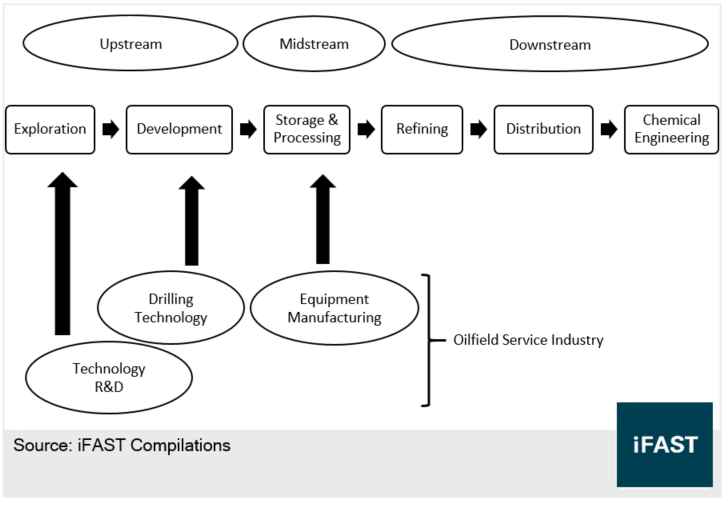
You might not have a deep understanding of how oilfield service companies work. As shown in Chart 1, oilfield service companies and oil producers are not the same. The former's revenue is primarily based on the provision of exploration and development technology services to oil companies, while the latter's revenue relies on the production of oil and oil-related products.
Chart 1: Positioning of the Oilfield Service Industry in the Oil Industry Chain
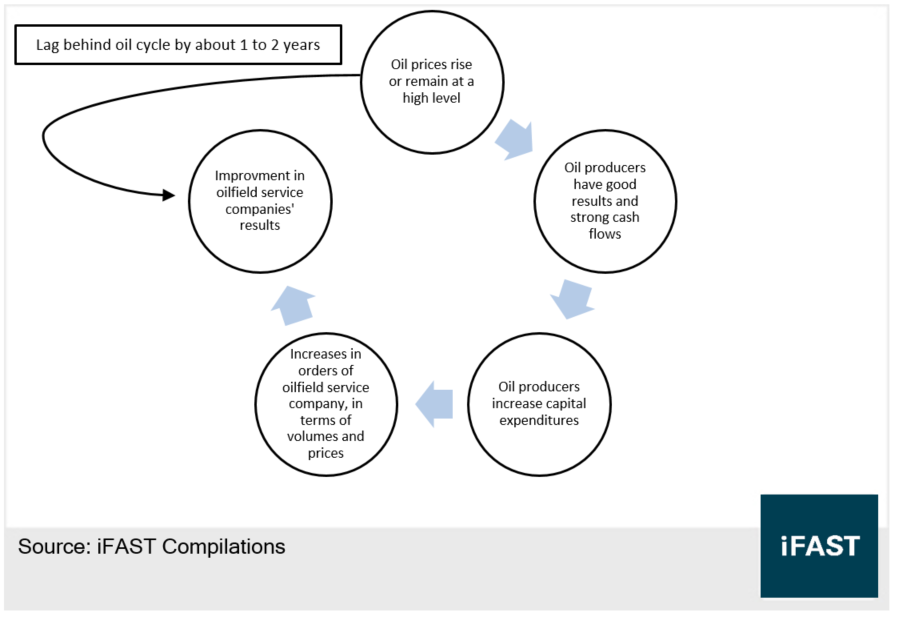
The revenues of both oilfield service companies and oil producers are driven by oil prices. However, oil producers will be the immediate beneficiaries when oil prices rise (Chart 2). In a high oil price environment or when oil producers have strong cash flow, they will increase their capital expenditures to expand their production capacity, and oilfield service companies will thus benefit.
Therefore, apart from oil prices, the future capital expenditure plans of oil producers are also one of the leading indicators of oil field service companies' revenues. In general, the recovery of the oilfield services industry will lag behind the entire oil upturn cycle by about one to two years. Therefore, we believe that the current higher oil price environment (Brent crude oil remains at or above $80 per barrel since the beginning of this year) will lead to a return to growth for the entire oilfield services industry.
Chart 2: Relationship between Oil Price, Oil Producers and Oilfield Service Companies
Overview of China’s Market
In China, before 2018, only four companies had oil and gas exploration and development rights, namely China National Petroleum Corporation (CNPC), China Petroleum & Chemical Corporation (Sinopec), China National Offshore Oil Corporation (CNOOC) and Yanchang Petroleum. Although the government has been approving non-SOEs to engage in oil and gas exploration and development, the big three oil producers (CNPC, Sinopec and CNOOC) still account for 90% or more of China’s total production. As a result, their revenues and capital expenditure plans will determine the size of the China’s oilfield service industry.
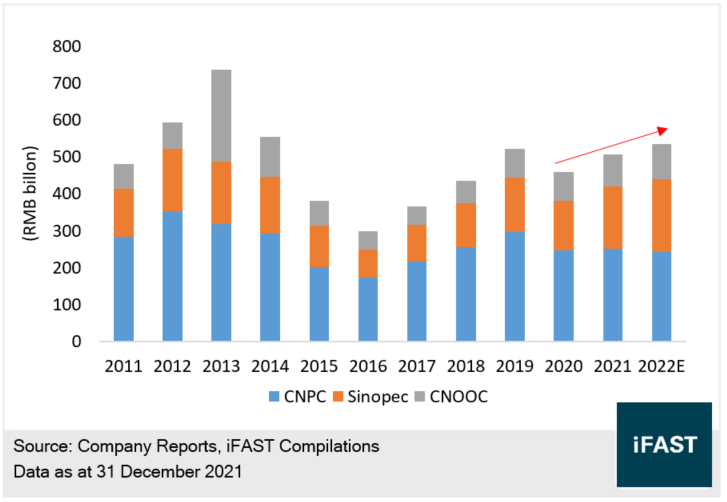
From Chart 3, the three major oil producers have capital expenditure plans of total of RMB 535 billion in 2022, up 6% YoY. Among these, exploration and development-related capital expenditure accounts for 67% of the total expenditures (about RMB358 billion, up 7% YoY). It means that oilfield service companies will have more orders, which is beneficial to the oilfield service industry.
Chart 3: Capital Expenditures of the Big Three Oil Producers
China’s oilfield services market is still dominated by the oilfield service companies under the big three oil producers. These oilfield service companies mainly provide ancillary and technical services to their respective oil producers. These SOEs account for about 85% of the market shares, including China Oilfield Services (under CNOOC), Daqing Well Logging Company (under CNPC) and CNPC Logging (under CNPC).
Non-stated-owned oilfield service companies, such as Anton Oilfield Services and Yantai Jereh Oilfield Services Group, account for around 10% market shares. Their main customers are still the big three oil producers. Most orders they receive are projects which the state-owned oilfield service companies are unable to complete due to technical reasons or manpower constraints. Since each oilfield service company specialises in different projects or technologies, the non-stated-owned oilfield service companies can still survive in this industry.
Oil Market Outlook
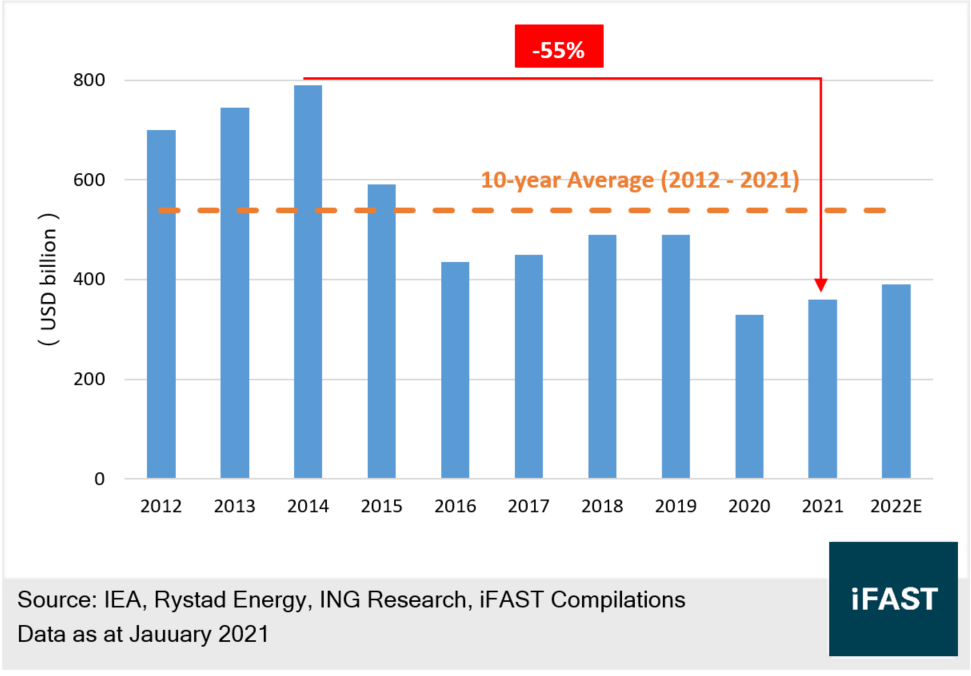
We expect oil prices to remain higher for much longer. As shown in Chart 4, the capital expenditures by global upstream oil and gas producers remain at a lower level in the past decade. Despite a gradual increase in their capital expenditures in recent years, they are still restrained in increasing production and investment after the oversupply caused by the 2012 US shale oil revolution and negative oil prices in 2020. These should support the oil prices and prolong the upward cycle of oil prices.
Chart 4: Capital Expenditures by Global Upstream Oil and Gas Producers
As shown in Chart 5, oil prices fell back to pre-Russian-Ukrainian war level recently, mainly due to a global recession fears. However, the oil demand is still at around 99 million barrels per day, and it is expected to rise to around 101 million barrels per day by the end of this year. There is no evidence that oil demand is in structural decline. Demand destruction has not occurred while the relatively high oil price environment persists for most of the year, which reflects a certain degree of stickiness in oil demand.
Chart 5: Global Oil Supply and Demand and Brent Crude Oil Prices
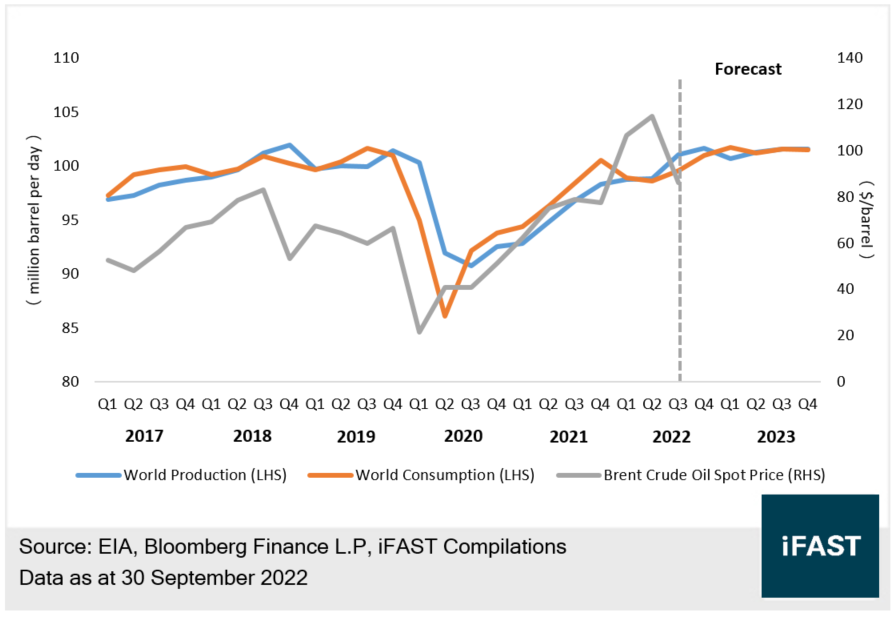
Looking forward, on the demand side, China’s city lockdown measures are expected to be relieved, together with the onset of winter in Europe and other regions. These factors will increase the energy consumption in the short-term. The supply of renewable energy is not sufficient to replace fossil fuels in the short-to-medium term. Denuclearization of some countries, such as Germany and France, is expected to bring them back to fossil fuels. Long-term developments in developing countries (e.g. India, with a population of about 1.4 billion) will also drive demand for oil.
On the supply side, the climate change and ESG (Environment, Social and Governance) concerns related to fossil fuels pose pressure on oil producers. They are cautious in ramping up oil production. The other factors that are favourable to oil prices include storage shortages (U.S. strategic oil reserves fell to about 470 million barrels, a new low in more than 30 years), upcoming Europe’s sanctions against Russia, OPEC+ capacity constraints due to prolonged underinvestment, international tensions and military conflicts in some regions (such as the Russia-Ukraine war, Yemen war, Persian Gulf crisis). These might cause oil production in some regions to fall short of expectations, which is beneficial to the oil prices.
Operating Results
In 1H22, Anton’s total revenues were RMB 1.69 billion, increased by 18.8% YoY. The operating cash flows increased 244% YoY to RMB 0.32 billion. The operating performance was good.
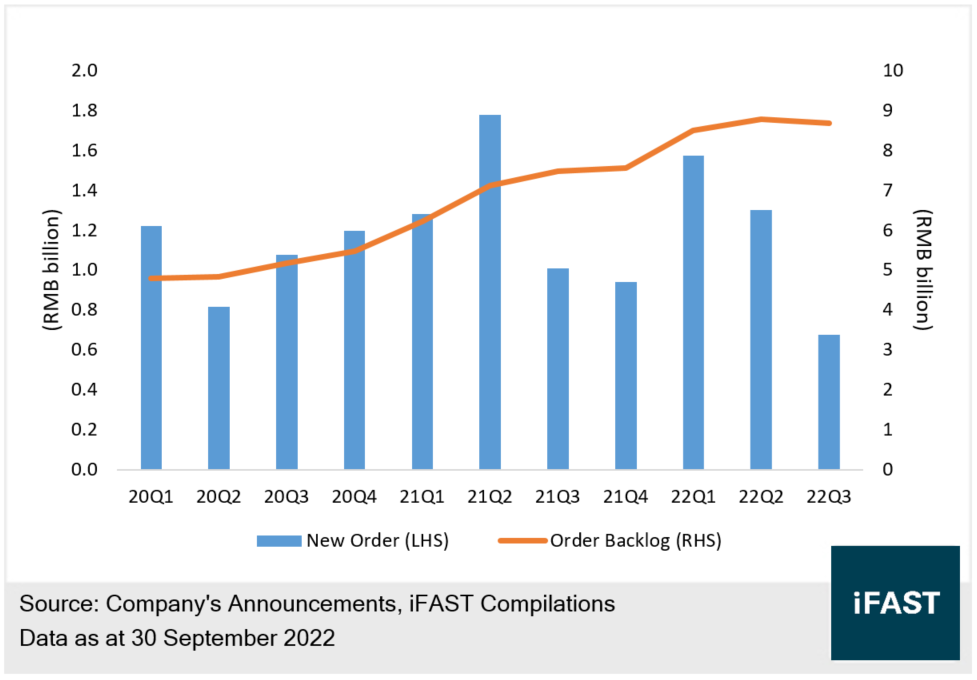
As shown in Chart 1, the company’s order backlog was increased to around RMB 8.78 billion, up 83% from RMB 4.79 billion in the first quarter of 2020. These order backlogs will be converted to revenues and profits, ensuring the future cash flows.
In terms of new orders, due to the high base effect from a large oilfield management project in Iraq in the second quarter of 2021 and China’s lockdown, resulting in a delay of tendering and bidding of some projects, the new orders in the first three quarters of 2022 dropped by 12.8% YoY to RMB 3.54 billion. If we exclude the impact of this large order, the new orders in the first three quarters of 2022 still increased by 14.8% YoY. The operating performance is fair.
Chart 6: Anton’s New Order and Order Backlog
The company puts emphasis on cash flow management and account receivables collection. As shown in Chart 7, the company’s operating cash flow and free cash flow were both positive in the recent years. During the oil industry downturn in 2020, the company’s free cash flow even grew by 46.2% YoY. It reflected the company’s decent cash flow management and selection of partners, which could avoid a large number of doubtful accounts during the industry downturn. Hence, the company is less cyclical compared to its industry peers.
Chart 7: Anton’s Cash Flow Performance in Recent Years (Net of Interest and Tax Expenses)
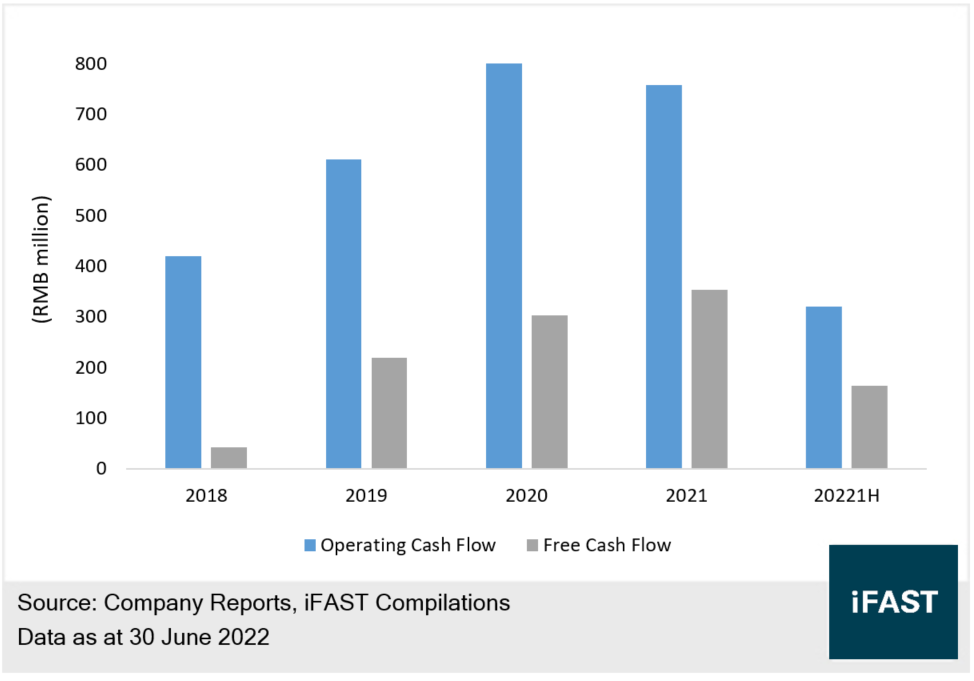
Notably, we expect that Anton will redeem the bond due in December this year, with a principal amount of USD 134 million and a coupon rate of 7.5%. It will help the company to save about RMB 32 million in interest expenses per annum (9.1% of 2021 free cash flow), which would improve its cash flow performance.
Credit Overview
As shown in Table 1, as of the end of June 2022, Anton’s net gearing ratio was around 42.5%, with average cost of borrowing dropped to 8.0% and cash to short-term debt of 0.89 times. The credit profile was fair only. However, a low cash to short-term debt ratio (less than 1.0 times) is normal in the industry.
Table 1: Anton’s Credit Indicators
|
Dec 20 |
Dec 21 |
Jun 22 |
|
|
Total Cash (RMB billion) |
1.33 |
1.59 |
1.60 |
|
Non-restricted Cash (RMB billion) |
0.88 |
1.17 |
1.15 |
|
Total Debt (RMB billion) |
2.93 |
2.94 |
2.87 |
|
Net Gearing Ratio (%) |
57.6% |
47.9% |
42.5% |
|
Cash to Short-term Debt (times) |
1.42 |
0.81 |
0.89 |
|
Average Cost of Borrowing (%) |
9.9% |
8.8% |
8.0% |
|
Sources: Company’s Reports, iFAST compilations Data as of 30 June 2022 |
|||
Nevertheless, the company’s debt structure is relatively simple. Amongst the total debt of around RMB 3 billion, bank loans account for 33%. Most of them are due within one year, while the remaining 67% are two USD bonds, with the outstanding principal amounts of USD 134 million (equivalent to RMB 0.9 billion) and USD 150 million (equivalent to RMB 1.07 billion) due in December 2022 and January 2025 respectively.
As for bank loans, the company successfully refinanced a large portion or even all of its short-term bank loans over the years. The bank loan refinancing ratio is high, and most of the loans are secured loans (Table 2). It shows the company’s good refinancing ability. Therefore, we believe that this part of the debt will continue to be refinanced by banks and will not pose significant pressure on the company's debt repayment.
Table 2: Anton’s Loan Financing Indicators
|
2018 |
2019 |
2020 |
2021 |
2022 1H |
|
|
Bank Loan Refinancing Ratio (%) |
109% |
70% |
130% |
83% |
144% |
|
Secured Bank Loan to Total Bank Loan (%) |
69% |
89% |
94% |
87% |
87% |
|
Sources: Company’s Reports, iFAST compilations Data as of 30 June 2022 |
|||||
The company has unrestricted cash of around RMB 1.15 billion, which is sufficient to cover the upcoming bond to be matured in December (around RMB 0.9 billion). Even if the company might not refinance the bonds with USD bonds, it can still use its own funds to redeem the upcoming bond. Thus, the credit risk is low in the short term.
Going forward, we believe the company should be able to convert its order backlogs into cash flows, and the free cash flow of about RMB 300 million to RMB 400 million per year will allow it to arrange funds to repay the bonds due in January 2025 (about RMB 1.07 billion). The company should have at least RMB 200 million of unrestricted cash left after the repayment of the December bond, and it has room to further borrow from bank loans. It still has about two years to wait for the entire China high yield bond market to recover, so there is an opportunity of issuing bonds in the future. Therefore, we believe the credit risk of this bond to be matured in January 2025 is quite under control.
Bond Investment
The January 2025 bond, "ANTOIL 8.750% 26Jan2025 Corp (USD)", now has a yield to maturity of 38% and is priced at around $60 with an investment horizon of approximately 2.3 years. The company currently has a credit rating of B1 from Moody's, and is a non-investment grade issuer.
Given that (1) China’s major oil producers have been increasing their capital expenditures, (2) Anton's order backlogs continue to grow, (3) its cash flow performance is decent, (4) its bank loan refinancing ability is not bad and (5) we expect oil prices to remain higher for much longer, these factors allow the company to have strong repayment ability to redeem this January 2025 bond on time. Therefore, this bond is worth investors’ consideration.
On the other hand, the company has a precedent of buying back bonds at a discount in the open market. In the next one to two years, if the company has sufficient funds, it should buyback the January 2025 bond in the market, which might push up the bond price to a high level of $90 or above. If this is the case, investors can reduce the exposures based on the price level, recycle the capital early and deploy the capital into other investment strategies.
Related Risks
Anton relies on a small number of customers in terms of the revenue stream. It means the company has a high risk of customer concentration. The company’s largest customers are CNPC and Sinopec, with the top five customers accounting for around 70% of revenues. If any of these customers decide to terminate the company’s services, or if these customers have significant financial issues, these could make a large impact on the company’s revenues.
Investors should be also aware of recession risk. It could reduce the oil demand, given the shrinking global consumption and sluggish economic activities. These might lead to a decline in oil prices and reduce the capital expenditure plans of oil producers, resulting in fewer new orders and less revenues for Anton.
A significant portion of the company's business is located in Iraq, which accounts for around 30% to 40% of the company’s revenues. It carries a certain degree of emerging market risk. The political situation in Iraq may be more volatile, and the economic and business environment is not as stable as in mainstream countries around the world.
Conclusion
Anton Oilfield Services is the first non-stated-owned oilfield service company in China. In a high oil price environment or when oil producers have strong cash flow, they will increase their capital expenditures to expand their production capacity, and oilfield service companies will thus benefit. Since each oilfield service company specializes in different projects or technologies, non-stated-owned oilfield service companies can still survive in this industry.
The company’s revenues are decent. The order backlogs will be converted to revenues and profits, ensuring future cash flows. The credit profile is fair, but the company’s debt structure is relatively simple.
Given that (1) China’s major oil producers have been increasing their capital expenditures, (2) Anton's order backlogs continue to grow, (3) its cash flow performance is decent, (4) its bank loan refinancing ability is not bad and (5) we expect oil prices to remain higher for much longer, these factors allow the company to have strong repayment ability to redeem the January 2025 bond on time. This bond is yielding at up to 38%, which is worth investors’ consideration.
Declaration: For specific disclosure, at the time of publication of this report, IFPL (via its connected and associated entities) and the analyst who produced this report hold a NIL position in the abovementioned securities.t holds a NIL position in the abovementioned securities.
Our podcast series, Yield Hunters, is available on Spotify, iTunes Podcasts and Google Podcasts. We share our thoughts on new bond issues and hold discussions on the fixed income space. Listen to our latest episode below and follow us!