Highlights:
-
C C Land usually chooses to work with partners in development projects to reduce the capital burden. In addition, its investment properties have a strong rent escalation. The exposure to China’s property projects is very low, and it already impaired the carrying value of the projects. Therefore, China’s Property Projects should not be a risk to the company.
Its leverage ratios are at a manageable level, with strong short-term liquidity. The balance sheet structure is decent, which is far away from Chinese property developers.
The company has sufficient assets to repay the bond. The credit risk of the September 2025 bond is manageable, with a yield maturity of 12%.
C C Land’s main businesses are property development, property investment and treasury investment. The company is listed on HKEX (Stock Code: 1224.HK), with the current market capitalization of HKD 6.13 billion. Cheung Chung Kiu is the company’s chairman and large shareholder, holding around 74% of its shares.
Choose to Work with Partners in Development Projects; Strong Rent Escalation in Its Investment Properties
The company currently has five property development projects (see Table 1). Due to the small scale of the company, it usually chooses to work with partners in the development projects to reduce the capital burden.
In addition, the Company wholly owns two commercial real estate projects in London, United Kingdom, known as Leadenhall Offices and One Kingdom Street Offices, as well as investments through joint ventures in Harbourside HQ, an office building in Kai Tak, Hong Kong and Kowloon Bay International Trade & Exhibition Centre, which is being redeveloped with the aim of building more office buildings for rental and selling purposes.
Thus, the company’s rental revenues and attributable profits from JVs and associates are the key to its profit stream (see Table 2).
Table 1: C C Land’s Property Development and Investment Projects
|
Project Name |
Region |
Company’s Attributable Investment Amount / Cost / Book Value |
Company’s Ownership |
Types of Accounting |
Main Purpose |
|
No. 15 Shouson |
Hong Kong |
Around HKD 1.2 billion |
42% |
JVs and Associates |
Development and Sales |
|
Thames City |
London |
Around GBP 500 million |
50% |
JVs and Associates |
Development and Sales |
|
The Whiteley |
London |
Around GBP 182 million |
46% |
JVs and Associates |
Development and Sales |
|
Jiangsu Yancheng Project |
Jiangsu |
Around RMB 496 million |
29.4% |
JVs and Associates |
Development and Sales |
|
Guangdong Jiangmen Project |
Jiangmen |
Around RMB 703 million |
34% |
JVs and Associates |
Development and Sales |
|
The Leadenhall Building |
London |
Around GBP 920 million |
100% |
Consolidation |
Lease and Long-term Holding |
|
One Kingdom Street Office |
London |
Around GBP 240 million |
100% |
Consolidation |
Lease and Long-term Holding |
|
Harbourside HQ |
Hong Kong |
Around HKD 1.875 billion |
25% |
JVs and Associates |
Lease and Long-term Holding |
|
Kowloon Bay International Trade & Exhibition Centre |
Hong Kong |
Around HKD 910 million |
15% |
JVs and Associates |
Lease or Sales |
|
Sources: Company’s Announcements, iFAST Compilations Data as of 30 June 2023 |
|||||
Table 2: C C Land’s Revenue and Profit Indicators
|
(HKD million) |
2022 1H |
2023 1H |
YoY |
2021 |
2022 |
YoY |
|
Rental Revenues |
2.6 |
2.4 |
-8.7% |
5.1 |
4.9 |
-3.4% |
|
Profits from JVs and Associates |
4.0 |
3.2 |
-19.7% |
2.0 |
9.1 |
355.4% |
|
Adjusted EBITDA* |
5.1 |
4.0 |
-21.0% |
4.4 |
10.4 |
135.0% |
|
*Include Profits from JVs and Associates but exchange the change in the fair value of investment properties and impairment losses on financial assets Sources: Company’s Announcements, iFAST Compilations Data as of 30 June 2023 |
||||||
Amongst the development projects, except those in Mainland China, the sales and delivery of projects progress well. As shown in Table 2, the company’s profits from JVs and associates were around HKD 320 million, despite a YoY decrease of 19.7%, mainly due to the one-time gain of around HKD 290 million from acquiring No. 15 Shouson project, the profits from JVs and associates are still the key to the profit basis.
In the same period, the company’s rental revenues dropped 8.7% YoY to HKD 240 million, mainly due to GBP depreciation against HKD, an expiry of some leases and the company's discretion to carry out refurbishment works. During the period, the company renewed the lease with one of its major tenants (the area representing around 10% of the two UK investment properties) with an approximately 26% uplift on the passing rent. This reflects the strong rent escalation of the investment properties. As such, we believe that the company is able to generate significant growth in rental revenues after re-leasing the vacant area in the portfolio.
China’s Property Projects Should not be a Risk to the Company
As mentioned above, the company has two projects in Mainland China. The progress, pre-sale and delivery of these projects are slower than expected due to the break in the capital chain of the partners. The total invested amount is around RMB 1.2 billion in total for the two projects.
The invested amounts of Jiangsu Yancheng Project and Guangdong Jiangmen Project are RMB 500 million and RMB 700 million. As the counterparties have defaulted on their corporate bonds, the company made a provision for credit losses on the receivables. It impaired these items by a total of approximately RMB 850 million during 2022.
For the Jiangsu Yancheng Project, around 20% of saleable areas were sold. Phase I should be completed at the end of December 2023. The progress is acceptable. For the Guangdong Jiangmen Project, not much progress has been made. The overall performance is really fair.
It is worth emphasizing that these two co-development projects should not be a risk to the Company. Firstly, the company already impaired the carrying value of the projects by nearly 70%. The recent balance sheet figures should factor in the risk. Secondly, the total invested amount in these projects represents only about 6% of the company's total property investment and 5% of its total assets, which should have little impact on its operations or credit performance. Thirdly, given the very slow progress of Guangdong Jiangmen Project, we believe that the company suspended this project and is less willing to pay more to develop the project. This significantly reduces the operational risk.
Leverage Ratios are at a Manageable Level, with Strong Short-term Liquidity
On the credit side, as shown in Table 3, as of the end of June 2023, the company’s total debt was HKD 11.1 billion, slightly up 3.6% from the end of 2022. While some credit indicators deteriorated, such as the average cost of financing rising sharply to 5.6%, the interest coverage ratio dropping to 1.5 times, and the leverage ratio trending upwards, they are still at a manageable level.
The company’s net debt to total property investment and liability to asset ratios were around 41% and 45% respectively. The leverage level is not high. These ratios also demonstrate that even if the asset value depreciates around 50%, it would still be in a good position to allow creditors to get back the full amount of the principal, indirectly reflecting that its credit risk is manageable.
Table 3: C C Land’s Credit Indicators
|
(HKD billion) |
Dec 22 |
Jun 23 |
|
Total Debt |
10.7 |
11.1 |
|
Total Cash |
1.9 |
2.1 |
|
Financial Assets |
1.2 |
1.2 |
|
Total Property Investments (Including Investment Properties and JVs and Associates) |
22.5 |
21.9 |
|
- Investment Properties |
12.1 |
11.4 |
|
- Investment in JVs and Associates |
10.3 |
10.5 |
|
Liability to Asset Ratio (%) |
43.2% |
44.9% |
|
Net Debt to Total Property Investments |
39.2% |
40.9% |
|
Net Gearing Ratio (%) |
51.1% |
54.7% |
|
Net Debt / Adjusted EBITDA (times) |
8.5x |
7.8x |
|
Cash To Short-term Debt (times) |
10.2x |
4.0x |
|
Average Cost of Borrowings (%) |
3.1% |
5.6% |
|
Interest Coverage Ratio (times) |
2.4x |
1.5x |
|
Sources: Company’s Announcements, iFAST Compilations Data as of 30 June 2023 |
||
The company successfully refinanced the secured bank loans of HKD 6.9 billion in 2022, bringing the short-term debt down to a manageable level. With a cash position of about HKD 2.1 billion and high cash-to-short-term debt ratio of 4.0 times, the company’s short-term liquidity is strong.
Decent Balance Sheet Structures of Hong Kong Developers; Far Away from Chinese Developers
We mentioned a few points in “Idea of the Week: Hong Kong Real Estate Companies—These Talents Might Be Overlooked”, including the low leverage advantage of Hong Kong developers, their higher profit margin in development projects, more investment properties for the rental purpose and being more conservative in acquiring land or investing in new projects.
It is emphasized again that the decent balance sheet structures of Hong Kong developers, which are far away from those of the Chinese developers. As shown in Chart 1, we selected their liabilities to assets ratios and interest-bearing debts to total liabilities for comparison.
Chart 1: Comparison between Indicators of Hong Kong Developers and Chinese Developers
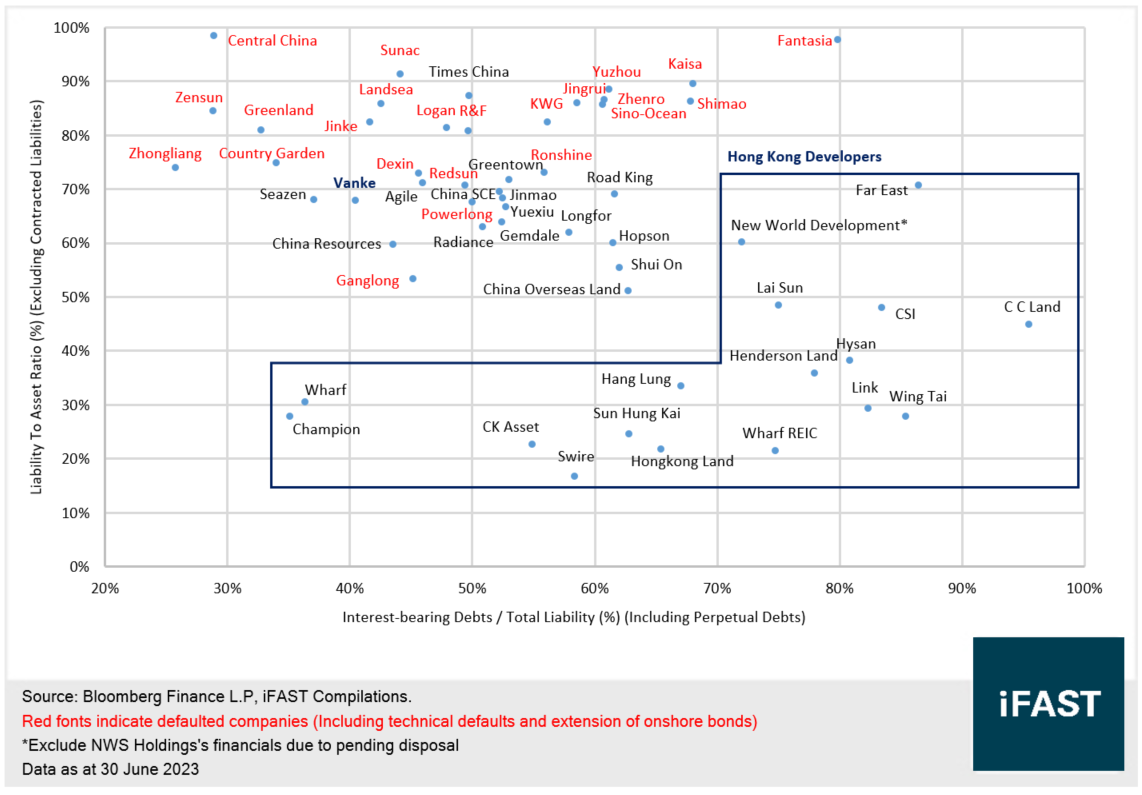
The liability to asset ratio indicates the overall leverage level. The lower the interest-bearing debts to total liability ratio, the more payables amongst the liabilities. Under the current situation of the break in capital chain of the upstream and downstream in the Chinese property sector, higher payables imply a higher business risk.
Take C C Land as an example, the liability to asset ratio is only 45%. The interest-bearing debts account for up to 95% of its total liabilities. Nearly all of the interest-bearing debts are bank loans or bonds. The debt structure is quite simple.
In general, the liability to asset ratios of Hong Kong developers are at a low level. Most of them are below 50%. Even for the Hong Kong developers with higher liability to asset ratios, their interest-bearing debts to total liability ratios are also higher, meaning that their liability structures tend to be simple.
On the other hand, even if we take China Vanke, which is a relatively healthy Chinese property developer, as an example, its liability to asset ratio is still as high as 68%, and the interest-bearing debt only accounts for about 40% of its total liabilities. This means that China Vanke takes advantage of more leverage at the operating level. The derived operating risks would be higher due to more payables on construction bills, amounts due to JVs and associates, land and tax payables etc. Furthermore, Chinese property developers with a poorer credit quality would take advantage of more debts, off-balanced sheet debts, disguise equity, commercial paper, non-traditional financing methods and wealth management products to raise funds, which greatly increased their operating and credit risks.
Have Sufficient Assets To Repay the Bond; Manageable Credit Risk
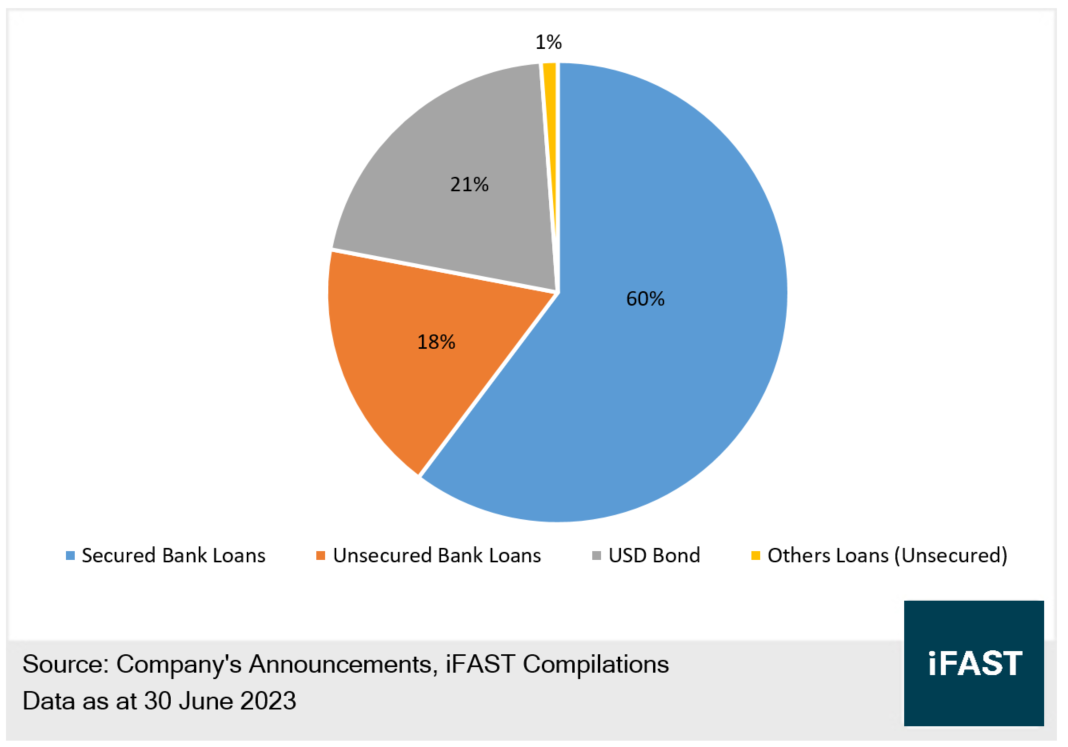
C C Land’s debt structure is simple. As shown in Chart 2, in the total debt of HKD 11.1 billion, the secured bank loans accounted for 60%. The company used the two UK office buildings as collateral for these loans, with a Loan To Value (LTV) ratio of 59%. There is limited room for further pledging these properties for more loans. The company has already impaired these properties by about 10% due to the increase in the capitalisation rate. It is less likely that the property value will have a significant depreciation. The refinancing risk is manageable.
Chart 2: C C Land’s Debt Structure
As for bonds, the company has only one USD bond matured in September 2025, with a principal amount of USD 300 million (equivalent to HKD 2.33 billion). The company has up to 2 years to arrange a bond repayment plan, including accelerating project sales, capital recycling (around HKD 10.5 billion in attributable JVs and Associates) and some disposal of financial assets (around HKD 1.2 billion) etc. The company has sufficient liquid assets to redeem the bond at maturity without issuing new bonds. Therefore, we believe that the credit risk of the September 2025 bond, "CCLAND 5.200% 20Sep2025 Corp (USD)", is manageable with a yield to maturity of 12%.
Related Risks
C C Land’s development projects are all cooperated with partners. If the partners have cash flow problems, it will have negative impacts on the company's operation and financials. For example, it might have to repay the development loans on behalf of the partners, or the projects will be delayed or even suspended. It may also take a longer time to recycle the capital.
The company's major projects are located in Hong Kong and the UK. Both are in the midst of a cycle of interest rate hikes, which will affect the desire of residents in Hong Kong and the United Kingdom to purchase houses. The company might have to reduce the selling prices or accept a lower sell-through rate.
In the rate hike cycle, the company's interest expense will increase. The average cost of borrowings rose to 5.6% as a result. Amongst the debt, GBP debt accounts for around 63% of total debt. All GBP loans are borrowed at a floating rate (the reference rate is LIBOR + 1.5%). While the company has partially hedged against the interest rate, the company's profitability may continue to be under pressure if local governments continue to raise the interest rates in response to high inflation.
A significant portion of the company's revenues and assets are denominated in GBP. A depreciation of GBP against HKD would affect its financial performance.
Conclusion
C C Land usually chooses to work with partners in development projects to reduce the capital burden. In addition, its investment properties have a strong rent escalation. The exposure to China’s property projects is very low, and it already impaired the carrying value of the projects. Therefore, China’s Property Projects should not be a risk to the company.
Its leverage ratios are at a manageable level, with strong short-term liquidity. The balance sheet structure is decent, which is far away from Chinese property developers.
The company has sufficient assets to repay the bond. The credit risk of the September 2025 bond is manageable, with a yield maturity of 12%.
Declaration: For specific disclosure, at the time of publication of this report, IFPL (via its connected and associated entities) holds a NIL position and the analyst who produced this report holds a NIL position in the abovementioned securities.