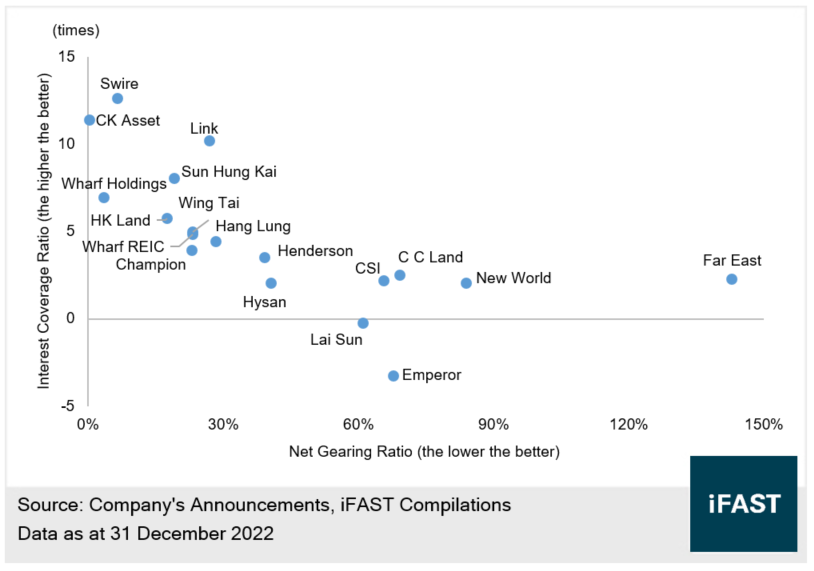
Unlike Chinese developers, the gross margin of Hong Kong development projects is generally higher (normally 40% or above), and significantly higher than that of Chinese development projects (around 10% to 20%). Besides, the leverage levels of these Hong Kong developers and REITs are generally low (see Chart 1), with a strong interest coverage ratio and lower cost of borrowings (around 2% to 4% level). This reflects the decent credit positions of most companies.
Chart 1: Net Gearing Ratio and Interest Coverage Ratio of Some Hong Kong Real Estate Companies
In general, Hong Kong property developers are more conservative in acquiring land or investing in new projects. With most of their assets located in Hong Kong, they have a greater advantage in refinancing by pledging valuable land and investment properties in Hong Kong to obtain loans with better terms. They also have many investment properties for rental and long-term appreciation purposes, so their credit positions are generally stronger.
For large developers (Table 1), one of their advantages is the massive amount of agricultural land available for long-term development. The Hong Kong Government proposed a “Northern Metropolis Development Strategy” in the 2021 Policy Address, spanning 300 square kilometers across the northern New Territories like Yuen Long, Sheung Shui, Fanling, Kwu Tung, Lok Ma Chau and Man Kam To. This policy is to address the shortage of housing supply in Hong Kong. We believe that it will facilitate the discussion with the government in accelerating the conversion of the agricultural land and replenishing the land reserve of these large developers.
Table 1: Agricultural Land Scale of Large Developers
Land Area (million square feet) |
|
| Sun Hung Kai Properties* | 31.0* |
| Henderson Land | 45.0 |
| New World Development | 16.4 |
| CK Asset | 12.4 |
| Sources: Company’s Announcements, iFAST
Compilations Data as of 31 December 2022 *As of 30 June 2018, the company did not disclose the land area going forward |
|
In view of the shortage of new housing supply in Hong Kong, in recent years, the Town Planning Board eases the plot ratios for different property projects. The Government even mentioned in the Policy Address that in the northern metropolitan area, the guidance for residential sites is the maximum plot ratio of 6.5 times, which is much higher than the maximum plot ratio of 5 times in the new towns in the early years. The housing policy directly benefits large property developers.
Therefore, we are bullish on the bond performance of large developers and some small and medium-sized developers. Below is our selection of Hong Kong developers.
Highlighted Hong Kong Real Estate Issuers
1. New World Development
New World Development Company Limited is one of the large property developers in Hong Kong. It engages in property development, property investment, hotel operation, roads, infrastructure, insurance, department stores and other strategic businesses. In the second half of 2022, the Group’s property contracted sales in Hong Kong and Mainland China amounted to HKD 7.9 billion and RMB 9.2 billion respectively, representing an increase of 81% and 19% respectively compared to the first half of 2022. This represented a robust sales performance.
About the credit profile, as of the end of 2022, its gearing ratio increased to around 80%. The Group was determined to deleverage and launched a series of deleveraging plans, such as capital expenditure optimisation, disposal of non-core assets, dividend reset, treasury management and corporate actions. Meanwhile, the Group had a cash position of around HKD 56.7 billion and an undrawn credit facility of about HKD 35 billion. It had sufficient liquidity to meet short-term expenses and debts. Also, its cost of borrowing was low at 3.8%. The Group was in a solid financial position.
The Group's long-term growth drivers are the massive agricultural land and the gradual completion of K11 investment properties, coupled with resilient property sales on the mainland. Combined with the credit metrics, we believe that the overall credit risk is under control. The default risk of short- to medium-term debt is low.
The Group’s bonds, “NWDEVL 5.875% 16JUN2027 CORP (USD)” and “NWDEVL 3.800% 21May2029 Corp (HKD)”, have higher attractiveness, with a yield to maturity of around 6.8% and 6.9%.
Related Article: “Idea of the Week: New World Development—Could They Hold On Without a Rights Issue?”
2. Henderson Land
Henderson Land is one of the largest real estate developers in Hong Kong. The Group’s main businesses include property development, property investment, gas supply, hotel operation and department store business. In 2022, the Group’s attributable contracted sales decreased 15% YoY to HKD 20.7 billion, aligning with our expectations. Going forward, we expect that the Group will be able to record annual attributable contracted sales of around HKD 15 billion to HKD 20 billion.
In 2022, the Group recorded total rental revenues of around HKD 8.5 billion, almost flat YoY. The Hong Kong and China Gas’s operating profit declined by 20% YoY to HKD 3.4 billion, mainly due to higher costs associated with higher natural gas prices. However, natural gas dropped significantly. In this year, the segment result should be significantly improved.
About the credit profile, as of the end of 2022, the Group’s net gearing ratio was about 39%, with average cost of borrowing of 3.6% (excluding interest-free loans from the parent company), which is not high. The interest coverage ratio was 3.5 times, a healthy level. Despite a fair sales performance, based on the massive land bank and agricultural land and stable rental revenues and gas supply business, we believe that the credit risk is low.
The 2025 USD bond, HENLND 2.375% 27May2025 Corp (USD), reaches 5.5% yield to maturity, which have certain investment value.
Related Article: “Idea of the Week: Henderson Land – A Developer Acquiring “Land King” with Massive Agricultural Land”
3. Hang Lung Properties
Hang Lung Properties’ main business is property investment. The company’s investment properties are mainly named "Hang Lung Plaza". It transformed from property development to property investment since more than 10 years ago. At the moment, the Company has only a very small number of end-of-life units for sale, with sales revenue accounting for only about 3% of total revenues. The rest of the revenues are from rental revenues and management fees.
In 2022, the company's total revenue reached HKD 10.3 billion, roughly flat YoY, while operating profit dropped 3% year-over-year to HKD 6.6 billion. The company was able to maintain its operating performance despite the COVID lockdown and the depreciation of RMB against HKD.
Regarding the credit side, the company's total debt was HKD 45.5 billion at the end of 2022, with a net gearing ratio of 28%, which is a good level of leverage. The company has sufficient liquidity with approximately HKD 5.2 billion in cash and HKD 21.4 billion in the undrawn credit facility. In addition, the company does not pledge any asset to third parties or banks for loans. Even the bank loans are all unsecured. The company has a low average cost of borrowing of 3.1%, indirectly reflecting the good credit profile.
Its 2027 HKD bond "HLPPY 2.280% 05Feb2027 Corp (HKD)" has a yield to maturity of 4.9%, which is worthy of investors' attention.
4. CSI Properties
CSI Properties’ main businesses are property development and property investment. Its features are the sale of luxury apartments and the purchase, sale and investment of commercial real estate. The group generally buys commercial properties, renovates them and/or changes their land use after the acquisition, with an aim to recycle capital and realize capital appreciation within a short period of time.
From April to September 2022, the company’s sales revenues (including JVs and associates) was HKD 900 million, a YoY increase of 100%. The rental revenues (including JVs and associates) also increased 29% to HKD 180 million. The overall gross margin reached 54%. The operating performance is decent.
As of the end of September 2022, the Group's total debt was HKD 11.8 billion, with a net gearing ratio of 66%. The debt structure is quite simple, with 81% of bank loans and 21% of its USD bonds due in 2025. It is not difficult to refinance the bank loans as they are secured loans. The Group had cash and financial assets of HKD 3 billion, which is sufficient to repay about USD 2.96 million (equivalent to HKD 2.3 billion) of the bond. The bond has a good margin of safety.
The 2025 USD bond, “CSIPRO 5.450% 21Jul2025 Corp (USD)”, has a yield to maturity of 12.0%, which is worthy of investors' attention.
5. C C Land
C C Land’s main businesses are property development, property investment and treasury investment. The company currently has six property development projects, namely Harbourside HQ and No. 15 Shouson in Hong Kong, Thames City and The Whiteley in London and Jiangsu Yancheng Project and Guangdong Jiangmen Project in Mainland China. Due to a small scale of the company, it usually chooses to work with partners in the development projects to reduce the capital burden.
Except those in Mainland China, the sales and delivery of projects progress well. The company’s profits from JVs and associates rose 3.5 times YoY to around HKD 910 million in 2022, reflecting the strong performance in the development projects.
The Company has three commercial property investments in the UK and Australia. The rental revenues declined by 3% YoY to HKD 490 million in 2022, mainly due to GBP and AUD depreciation against HKD. If excluding foreign exchange movements, it recorded a single-digit growth in rental revenues.
On the credit side, as of the end of 2022, the company’s total debt was HKD 10.7 billion, down 18% from the end of 2021. The net gearing ratio was 59% and the average cost of borrowings was only 3.7%. The company successfully refinanced the secured bank loans of HKD 6.9 billion during 2022, bringing the short-term debt down to just HKD 200 million. With the cash position of about HKD 1.7 billion and high cash to short-term debt ratio of 9.3 times, the company’s short-term liquidity is strong.
As for bonds, the company has only one USD bond matured in September 2025, with a principal amount of USD 300 million (equivalent to HKD 2.33 billion). The company has up to 2 years to arrange a bond repayment plan, including accelerating project sales, capital recycling (around HKD 12.1 billion in attributable JVs and Associates) and some disposal of financial assets (around HKD 1.2 billion) etc. The company has sufficient liquid assets to redeem the bond at maturity without issuing new bonds. Therefore, we believe that the credit risk of the September 2025 bond, "CCLAND 5.200% 20Sep2025 Corp (USD)", is manageable with a yield to maturity of 10.7%.
Declaration: For specific disclosure, at the time of publication of this report, IFPL (via its connected and associated entities) holds a NIL position and the analyst who produced this report holds a NIL position in the abovementioned securities.
Our podcast series, Yield Hunters, is available on Spotify, iTunes Podcasts and Google Podcasts. We share our thoughts on new bond issues and hold discussions on the fixed income space. Listen to our latest episode below and follow us!