- Revenue for 1H22 grew by 111% year-on-year (“yoy”) to USD 432m after the inclusion of ARA Asset Management into its results.
- With a total of USD 12b of development work-in-progress, ESR has the largest development workbook in APAC.
- ESR as of 1H22 had 17.9b of undrawn capital available to be deployed for acquisitions and investments.
- We recommend the ESRCAY 5.650% Perpetual Corp (SGD) as we find its YTW of 6.40% attractive.
On 20 January 2022, ESR Group Limited (“ESR”) announced that the proposed acquisition of ARA Asset Management Limited was completed. ARA Asset Management is now a wholly owned subsidiary and the enlarged group will have a total approximate AUM of USD 149b.
1H22 financial highlights
Revenue for the half year ending 30 June 2022 (“1H22”) grew by 111% year-on-year (“yoy”) to USD 432m after the inclusion of ARA Asset Management (“ARA”) into its results. On a pro forma basis, assuming that the ARA transaction was completed in 1H21, revenue increased by 2.5% yoy. Pro forma EBITDA increased by 15.3% yoy to USD 665m while profit after tax and minority interest (“PATMI”) grew 27.3% yoy.
ESR experienced strong growth due to the continued demand for new economy properties. New economy properties include logistics, e-commerce and data centre properties which are deemed to be in a high growth stage. E-commerce and third party logistics made up 76% of new leases signed in 1H22.
Largest development workbook in APAC
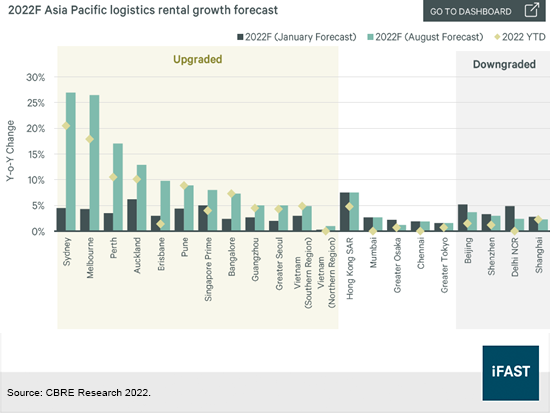
Logistic spaces continue to be scarce in the APAC region. The lack of supply of new logistic properties allows ESR to capture a stable tenant base as well as higher rental reversions. Group portfolio occupancy rate for ESR stands at 96% (99% occupancy rate ex-China). Rental reversions for ESR’s portfolio have also seen strong rental growth. Weighted average portfolio rental reversion increased by 5.8%. 40% of ESR portfolio leases are due to be renewed within the next 30 months and this allows ESR to capture the outsized rental growth in the market. According to CBRE Mid-year Real Estate outlook for 2022, CBRE revised its logistics rental forecast upwards for most cities in APAC. ESR’s key markets in Australia, Singapore and Korea saw upwards rental forecast revision by CBRE (Figure 1). According to CBRE, logistic properties in Australia are expected to see the highest rent growth in APAC.
Figure 1: CBRE Mid-Year APAC Logistics Rental Growth Forecast
In order to capture the high demand for logistic spaces, ESR has been expanding its developments in the new economy segments. Due to low vacancy rates across ESR’s portfolio, ESR increased its development starts by 109% to USD 3.5b while development completions increased 51% to USD 2.0b. With a total of USD 12b of development work-in-progress, ESR has the largest development workbook in APAC. The completed properties can be divested to its various funds as part of capital recycling.
Some of ESR’s developments include the ESR Yokohama Sachiura Logistics Park in Greater Tokyo which will be the largest logistics park (by value) in Japan and one of the largest (by value) in APAC. The second phase of the project commenced in June 2021 and is scheduled for completion in January 2023. In Australia, LOGOS and its partners are developing the Moorebank Logistics Park, Australia’s largest intermodal logistics facility.
Fund Management segment poised for growth
ESR’s Fund Management EBITDA grew 196.4% yoy to USD 288m from 97m in 1H21 due to the inclusion of ARA’s fund management segment. On a pro forma basis, Fund Management EBITDA grew 9.2% yoy. Total Assets under Management (“AUM”) grew by 196% after the acquisition and Fund Management EBITDA now makes up 31.5% of total EBITDA (1H21: 23.4%). ARA manages several REITs listed in SGX and HKEX such as Suntec REIT, ARA LOGOS Logistics Trust and Fortune REIT. The inclusion of ARA’s Fund Management portfolio is a positive boost to the group’s total revenue.
Additionally, ESR as of 1H22 had 17.9b of undrawn capital available to be deployed for acquisitions and investments. This allows ESR to be less reliant on debt to fund acquisitions, especially during an environment of higher interest rates. We expect ESR to deploy the available funds whenever there are opportunities available to grow its REIT portfolios.
Credit profile
Table 1: Credit profile of ESR
|
USD m |
Dec-21 (ESR Standalone) |
Dec-21 (Pro forma) |
Jun-22 |
|
Total Assets |
9,338 |
16,361 |
16,388 |
|
Cash |
1,638 |
1,922 |
2,015 |
|
Total Debt and Other Borrowings |
4,248 |
5,253 |
4,949 |
|
Net Debt |
2,610 |
3,331 |
2,934 |
|
Net Debt / Total Assets |
27.9% |
20.4% |
17.9% |
|
Net Debt / Equity |
59.1% |
33.0% |
31.3% |
|
Weighted Average Interest Cost |
4.1% |
3.8% |
3.8% |
|
Weighted Average Debt Maturity |
4.5 years |
4.4 years |
4.8 years |
|
Source: Company’s presentation. |
|||
ESR maintains a sound credit profile following the acquisition of ARA. Total borrowings amounted to USD 2.9b, an increase from USD 2.6b in 1H21 mainly due to the consolidation of borrowings from the acquisition of ARA. In 1H22, ESR had cash and cash equivalents of USD 2.0b which is sufficient to cover its short-term borrowings of USD 638.5m. Gearing for the company is also adequate after the acquisition as net debt to total assets stood at 17.9% while net debt to equity was 31.3%.
One thing to note is the group’s proportion of fixed-rate borrowings. As of 1H22, 15% of ESR’s borrowings was on fixed rate while the remaining 85% was on floating rate basis. Given the higher interest rate environment, the group may incur more interest expense due to a large proportion of their borrowings being on a floating rate basis. However, ESR can offset the rise in interest expense with the rise in rent growth. Additionally, weighted average interest cost is still manageable at 3.8%. ESR also has a strong interest paying ability with an interest coverage ratio of ~5.6x (~4.6x when including perpetual borrowings as debt).
Recommendation
We like ESR for its healthy credit profile and credit drivers that will fuel ESR’s growth in the future. The upsized AUM growth from the acquisition of ARA allows ESR to generate more fund management fees. On top of that, ESR can also take advantage of its large development workbook to divest its properties into its various funds that they manage. Its credit profile is healthy with healthy liquidity enough to cover borrowings for the next 2 years and well-spread debt maturity profile of 4.8 years.
The ESRCAY 5.650% Perpetual Corp (SGD) has an indicative yield to next call (“YTC”) of 6.40% with about 3.5 years to the next call date. Among other perpetual bonds callable in 2026, it has the most attractive YTC with the least time to its next call date. The perp has a call date on 2 Mar 2026 and if not called will reset at the prevailing 5-year SOR + initial spread of 4.73% + step up margin of 200 bps.
Table 2: Relative Valuation of ESRCAY with other perpetual bonds callable in 2026
|
Bond name |
Issuer |
Next Call Date |
Years to next call |
Ask price |
Yield to Next Call (%) |
|
ESR Group Ltd |
2-Mar-26 |
3.50 |
97.72 |
6.40 |
|
| MINTSP 3.150% Perpetual Corp (SGD) | Mapletree Industrial Trust |
11-May-26 |
3.69 |
94.72 |
4.72 |
| LREIT 4.200% Perpetual Corp (SGD) | Lendlease Global Commercial REIT |
4-Jun-26 |
3.76 |
97.55 |
4.92 |
| MAGIC 3.500% Perpetual Corp (SGD) | Mapletree North Asia Commercial Trust |
8-Jun-26 |
3.77 |
91.80 |
5.96 |
| SUNSP 4.250% Perpetual Corp (SGD) | Suntec Real Estate Investment Trust |
15-Jun-26 |
3.79 |
96.12 |
5.39 |
| AAREIT 5.375% Perpetual Corp (SGD) | AIMS APAC REIT |
1-Sep-26 |
4.00 |
99.50 |
5.52 |
| ARASP 5.600% Perpetual Corp (SGD) | ARA Asset Management Ltd |
4-Sep-26 |
4.01 |
99.07 |
5.86 |
|
Source: Bloomberg Finance L.P., iFAST compilations. Data as of 31 Aug 2022. |
|||||
Declaration: For specific disclosure, at the time of publication of this report, IFPL (via its connected and associated entities) holds a position in ESRCAY 5.650% Perpetual Corp (SGD), MLTSP 3.725% Perpetual Corp (SGD), SUNSP 3.800% Perpetual Corp (SGD), AAREIT 5.375% Perpetual Corp (SGD) and the analyst who produced this report holds a NIL position in the abovementioned securities.
Our podcast series, Yield Hunters, is available on Spotify, iTunes Podcasts and Google Podcasts. We share our thoughts on new bond issues and hold discussions on the fixed income space. Listen to our latest episode below and follow us!