ESR Cayman has become the largest real asset manager in the Asia Pacific region.
The group is owned by a number of institutional investors including pension funds in the Netherlands and Canada.
Pro forma estimates indicate a healthy credit profile and we think that the group has a reasonable refinancing ability.
We like the ESRCAY 5.100% 26Feb2025 Corp (SGD). Investors with a higher yield appetite and stronger risk tolerance may consider the ESRCAY 5.650% Perpetual Corp (SGD).
On 20 January 2022, ESR Cayman Limited (“ESR Cayman”) announced that the proposed acquisition of ARA Asset Management Limited was completed. ARA Asset Management is now a wholly owned subsidiary and the enlarged group will have a total approximate AUM of USD 140b.
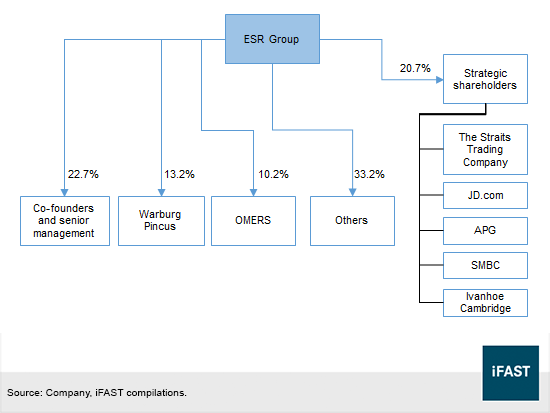
Even with the completion of the acquisition, ESR Cayman will continue to have a diversified shareholder base. Related entities of Warburg Pincus will own 13.2% of the enlarged group while OMERS, a Canadian public pension fund will have a 10.2% interest. Warburg Pincus is an international private firm that has been actively investing in Asian companies since 1994. OMERS had a 15% stake prior to the completion but that was diluted to 10.2%.
There are other shareholders of strong financial standing who own equity at different levels of the group’s capital structure. For example, APG, a Dutch pension investment company in the Netherlands has a 4.7% stake, albeit this had dropped from 6.9% before the transaction. Another prominent shareholder is JD.com, which has an indirect stake of 4.7% in ESR Cayman.
Figure 1: Closing capitalisation structure
Largest real asset manager in APAC
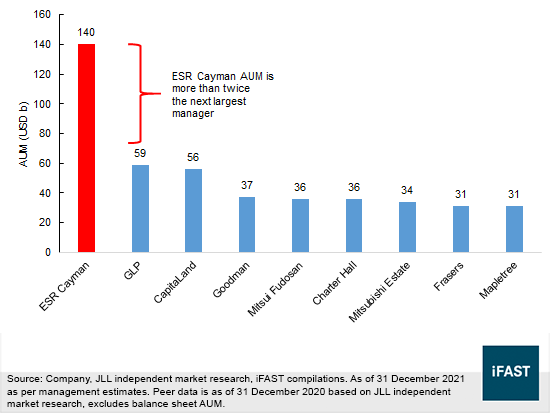
With USD 140b of AUM, ESR Cayman will have significantly more assets under management than its peers. As a reference, GLP, the second largest manager in Asia, had USD 59b of AUM while CapitaLand had only USD 56b of AUM.
Figure 2: AUMs of the largest real asset managers in APAC
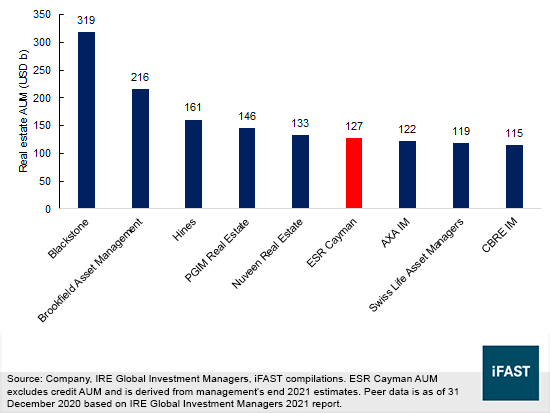
In terms of real estate AUM, ESR Cayman is now among the top 10 real estate investment managers in the world. It now manages close to USD 127b of real estate AUM, which is comparable to other large private equity and real estate companies (Figure 3).
Figure 3: Real estate AUMs of the largest managers in the world
Additionally, ESR Cayman will have a larger total global addressable market upon completion as the estimated size of its total addressable market had increased from USD 750b to USD 2.5t. More specifically in Japan, ESR Cayman is expanding its exposure by teaming up with SMBC / Kenedix. In Australia, the group will seek out more opportunities through its investment in Cromwell.
Within logistics, the sector is estimated to grow to a size of at least USD 850b by 2030, nearly 3.4x more from USD 295b in 2020. Following the launch of new REIT legislations across Asia, ESR Cayman will also grow its presence in the public REITs. According to JLL estimates, the market capitalisation for publicly listed REITs (including upcoming markets in Japan, South Korea, India and China) has a potential to reach between USD 900b and USD 1.3t by 2030. ESR Cayman is already the number one sponsor of public REITs in the Asia Pacific region and is looking to monetise more assets in upcoming new REIT markets.
Put simply, looking at its growth potential, we believe that the group has a high refinancing ability given that it is the largest real asset managers in Asia.
Financial performance and credit discussion
The enlarged ESR Cayman group will have USD 421.0m of revenue, according to pro forma estimates for the 6 months ended 30 June 2021 (“1H21”). Group revenue is primarily recognised through three business segments – Investment, Fund management and Development. Investment income consists of rental income, revaluation gains, pro rata earnings, dividend income as well as solar energy income of its completed investment properties.
Fund management revenue comes from fees from asset management, development, acquisition, leasing and promotion while Development revenue is recognised from revaluation gains on uncompleted properties, disposal gains, funds’ development profits and construction income.
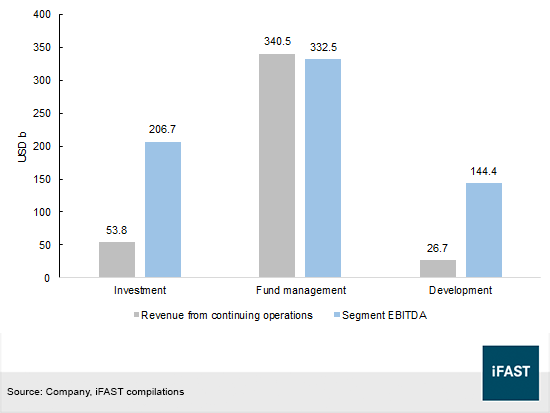
As seen in Figure 4, Fund management will be the largest future contributor of ESR Cayman’s revenue and EBITDA. Nearly half of the group’s revenue will come from ARA Asset Management’s Fund Management unit. Collectively, pro forma group revenue would reach USD 421.0m, up from USD 204.4m on a standalone basis. In the meantime, EBITDA for the combined entity will expand to USD 683.6m from an EBITDA of USD 268.0m pre-acquisition.
Figure 4: Unaudited pro forma 1H21 revenue and EBITDA by segment
With a greater contribution from Fund management, future fee based revenue will help to drive ESR Cayman’s earnings quality. Total equity will also be enlarged because of the USD 250m placement to SMBC, and the fact that 95% of the transaction consideration was paid in stock.
As a recap, total consideration for the ARA acquisition was satisfied through USD 519m in cash and the issuance of 1,345,898,078 shares (amounting to USD 4.67b). After taking into account the USD 519m cash drawdown, share repurchases and SMBC subscription, ESR Cayman’s pro forma cash position would add to nearly USD 1.37b as at 1H21. This cash position is still decent considering that there are ~USD 1.43b of short term borrowings due in 12 months.
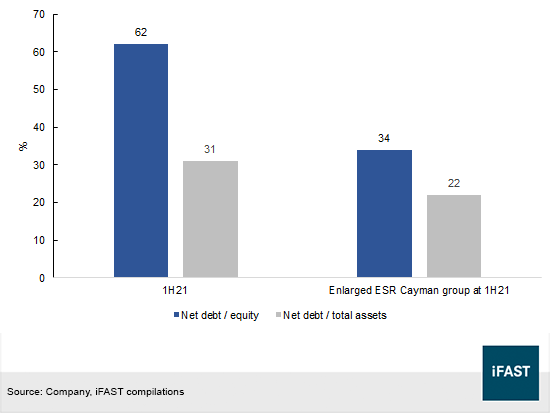
On another positive note, ESR Cayman’s credit profile will strengthen post transaction. Consequent to the larger equity base, group net debt / equity is projected to fall from 62% to 34%. Net debt to total assets will also improve to 22% from 31%. To compare them against other real estate managers, CapitaLand Investments (a well-known real estate group based in Singapore) had a net debt / equity of 49% and net debt to total assets of 29% as at 30 September 2021. Therefore, ESR Cayman is less geared compared to CapitaLand Investments.
Figure 5: Gearing metrics before and after acquisition
Furthermore, group gearing will still be at a reasonably low level if we treat perpetual securities as debt. Net debt / equity (treating perpetual securities as debt) is around ~48% at 1H21 while net debt to total assets increases slightly to around ~28%.
According to our estimates, interest servicing is healthy. Taking into account the EBITDAs of the individual entities, combined group EBITDA to interest would increase from ~4.9x to ~6.2x (including distributions to perpetual note holders).
Total borrowings, including non-current borrowings added to USD 4.78b. This is well covered by the company’s USD 3.60b of investment properties and USD 2.71b of investments in joint ventures and associates.
Approximately 50% of ESR Cayman’s debt matures within 2 years and its pro forma cash position (USD 1.37b) is not enough to cover its USD 1.43b of short-term borrowings. But we believe that ESR Cayman is able to refinance existing borrowings at a lower debt cost by leveraging on its stronger credit profile post-acquisition.
More recently, ESR Cayman upsized its sustainability-link loan from USD 700m to USD 1b. The USD 300m incremental facility was made up of 2 tranches – a 3-year tranche with a borrowing rate of Libor + 2.25%, and a 5-year tranche at Libor + 2.75%. Its new subsidiary - ARA Asset Management, likewise, managed to close a USD 1b loan facility at an all-in cost of 1.8%.
Recommendation
The transaction with ARA Asset Management will bring on more perpetual securities onto the group’s balance sheet, such as the ARASP 5.200% Perpetual Corp (SGD), ARASP 5.650% Perpetual Corp (SGD) and ARASP 5.600% Perpetual Corp (SGD). Among subordinated and senior unsecured securities, ESR Cayman currently has 2 outstanding notes - the ESRCAY 5.650% Perpetual Corp (SGD) and ESRCAY 5.100% 26Feb2025 Corp (SGD).
ARA Asset Management announced that a Change of Control Event has occurred upon the completion of the proposed acquisition. As a result, the coupon for the ARASP 5.200% Perpetual Corp (SGD) will step up by 3% from 19 July 2022. Meanwhile, bondholders of the ARASP 4.150% 23Apr2024 Corp (SGD) have the option of selling their bonds back to the issuer at par. The ARASP 5.6% and 5.65% perps are not affected by the Change of Control Event as ARA launched a Consent Solicitation Exercise to change the definition of a Change of Control Event for these notes.
Figure 6: Outstanding securities within the enlarged ESR Cayman group
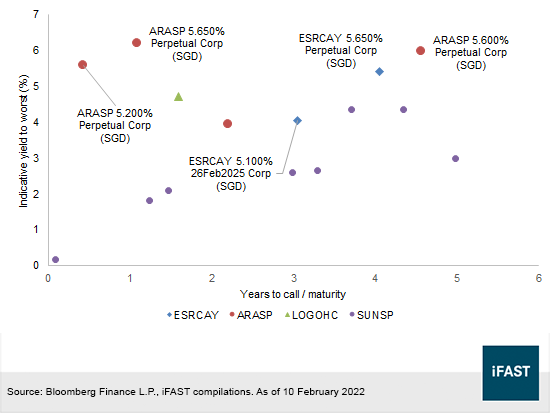
The relative valuation of the group’s bonds is displayed in Figure 6. Many of the ARA securities are trading at a higher yield and that is reflective of the issuer’s status as a private company with limited financial disclosures.
In view of its healthy credit profile and adequate refinancing ability, we think that the ESRCAY 5.100% 26Feb2025 Corp (SGD) is attractive at its indicative yield-to-worst (“YTW”) of 4.04%. Investors who have a higher risk tolerance may consider the ESRCAY 5.650% Perpetual Corp (SGD), which is first callable on 2 March 2026 with an indicative YTW of 5.39% on 10 February 2022. If not called, the distribution rate will reset to the prevailing 5-year Swap Offer Rate + initial spread of 4.73% + step up margin of 200 basis points (the “reset rate”). As of 10 February 2022, the reset rate was trading at 8.545%, higher than the perps’ 5.65% coupon.
Declaration: For specific disclosure, at the time of publication of this report, IFPL (via its connected and associated entities) holds a position in ESRCAY 5.650% Perpetual Corp (SGD), SUNSP 3.800% Perpetual Corp (SGD) and ARASP 5.200% Perpetual Corp (SGD). The analyst who produced this report hold a NIL position in the abovementioned securities.
Our podcast series, Yield Hunters, is available on Spotify, iTunes Podcasts and Google Podcasts. We share our thoughts on new bond issues and hold discussions on the fixed income space. Listen to our latest episode below and follow us!