Highlights:
- Henderson Land’s recent sales were dragged down by COVID-19, but we still expect the Group to generate around 15 billion to 20 billion in annual contracted sales. Its rental revenues are stable, but an increase in operating costs results in lower profits. However, its fundamentals remain robust.
- The Group is a developer with the largest amount of agricultural land in Hong Kong, which could be the biggest potential beneficiary under the “Northern Metropolis” policy. The CIFI’s credit event might affect the Group, but the Group does not necessarily take on more debts for partners.
- The Group has a sufficient ability to acquire land with sky-high costs, with the Group’s low funding cost and higher room for refinancing. The overall credit risk is low. Hence, investors could consider the short- to-middle-term bonds, with a yield to maturity reaching 5.3%.
Henderson Land was founded in 1973. It is one of the largest real estate developer in Hong Kong. The Group is listed on HKEX (Stock Code: 12.HK), with a current market capitalization of around HKD 113.7 billion.
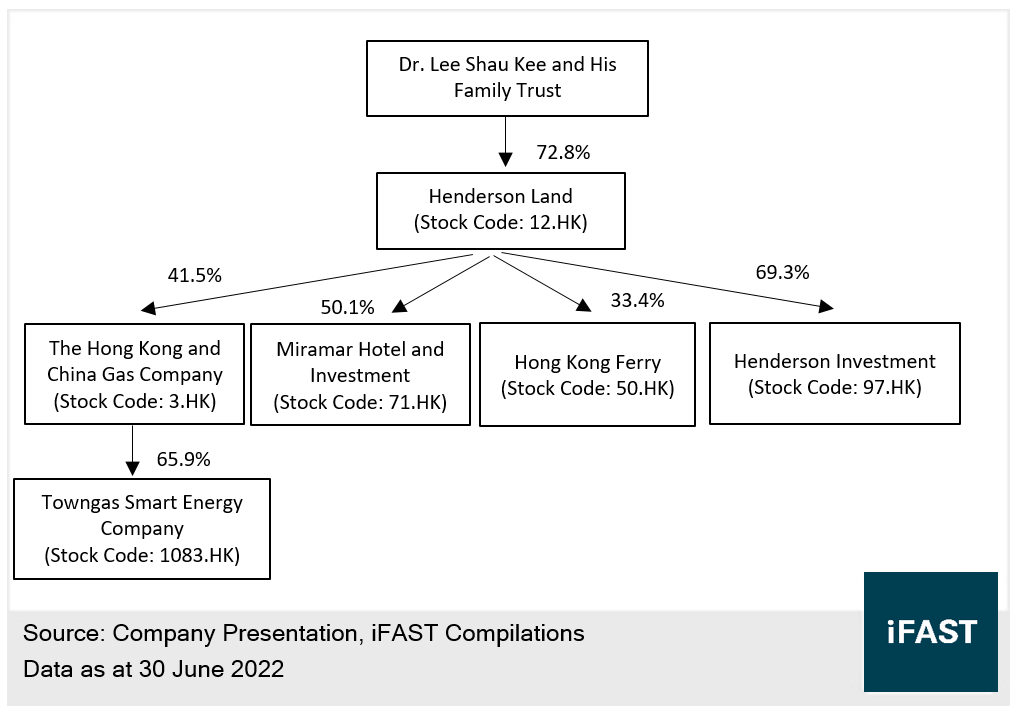
The Group’s main businesses are property development, property investment, hotel operation and infrastructure projects. The Group indirectly engages in gas supply and department store business through its associates, The Hong Kong and China Gas (Stock Code: 3.HK) and Henderson Investment (Stock Code: 97.HK). The Group also holds certain stakes in listed companies (see Chart 1).
Chart 1: Henderson Land’s Corporate Structure
Still Expected to Generate Around 15 Billion to 20 Billion Annual Sales Amount despite the impact of COVID-19
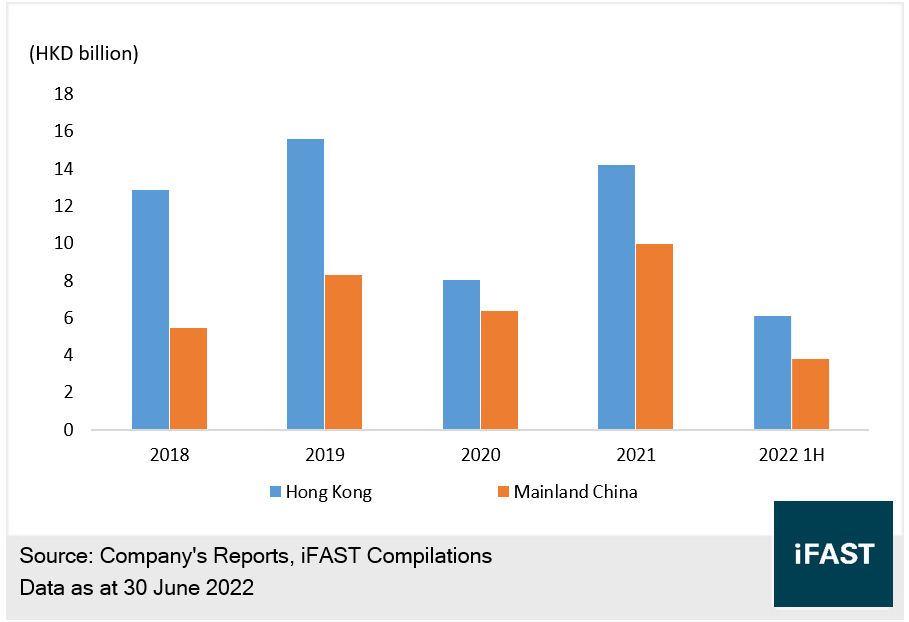
In the first of 2022, Henderson Land’s attributable contracted sales were HKD 9.92 billion (Chart 2), decreased by 28% YoY, mainly dragged down by the COVID-19 and lock-down measures in China (the attributable contracted sales in China plunged 36% YoY to HKD 3.81 billion), and the fifth wave of COVID-19 in Hong Kong, which affected sales performance.
Besides, the Group's contracted sales performances were volatile in the past due to the different timing of new project launches and the concentration of large project sales in certain periods. However, we still expect that the Group will be able to record annual attributable contracted sales of around HKD 15 billion to HKD 20 billion, which could support its future results.
Chart 2: Henderson Land’s Recent Sales Performance
Fundamentals Remain Robust
For other segments, Henderson Land recorded total rental revenues (including the attributable parts of JVs and associates) of around HKD 4.29 billion in the first half of 2022, almost flat YoY. Amongst these, Hong Kong and Mainland China account for 75% and 25% of revenues respectively. The performance is quite stable.
The Hong Kong and China Gas’s net profit attributable to shareholders (excluding the change in fair value of investment properties) declined by 20% YoY to HKD 820 million. It was mainly due to higher costs associated with higher natural gas prices, which were not passed on to customers. With the continued tight supply of natural gas, we do not see any sign of easing, and only a modest increase of about 4.4% in the standard tariff in Hong Kong from August, this part of profit is expected to remain under pressure.
For the first half of 2022, Henderson Land's operating profit (excluding profit attributable to JVs and associates) declined by 13% YoY to HKD 3.53 billion, mainly because of higher administrative, distribution and marketing expenses. The core net profit attributable to shareholders also dropped 34% YoY to HKD 5.14 billion. The recent operating performance was mediocre as operating costs increased, resulting in lower earnings. The fundamentals still remain robust.
The Developer with the Largest Amount of Agricultural Land in Hong Kong, the Biggest Potential Beneficiary under Policy
We have mentioned the Government’s Northern Metropolis Development Strategy in “Idea of the Week: New World Development – A Hong Kong Developer with A Grand Plan”. We believe that this strategy will help developers to negotiate with the government to accelerate the conversion of their agricultural land and replenish their land bank. This will benefit their middle-to-long-term development.
As shown in Table 1, Henderson Land has 14.8 million sq. ft. of properties held for or under development and unsold units, which could be used for current development or sales. More importantly, the Group has up to 45.1 million sq. ft. of agricultural land. It is the developer with the largest amount of agricultural land in Hong Kong, which could be considered as the “King of Agricultural Land” in the New Territories. It probably is the biggest potential beneficiary under the policy.
Table 1: Henderson Land’s Land Bank in Hong Kong
|
Land Type |
Area |
Estimated Salable Resources |
|
Properties Held for/Under Development and Unsold Units |
Attributable GFA: 14.8 million sq. ft. |
HKD 178.0 billion to 207.0 billion |
|
Agricultural Land** |
Attributable Land Area: 45.1 million sq. ft. |
HKD 2.27 trillion to 4.04 trillion |
|
*Assume the plot ratio of 6 times to 8 times, the efficiency rate (salable floor area to gross floor area) of 70% to 80% and average selling price of HKD 12,000 to HKD 14,000 per square feet **Assume all in situ exchange Source: Company’s report, iFAST compilations Data as at 30 June 2022 |
||
We estimate that Henderson Land currently has salable resources of around HKD 178.0 billion to HKD 207.0 billion. The potential estimated salable resources related to agricultural land were up to HKD 2.27 trillion to 4.04 trillion. Based on the Group's contracted sales of around HKD 10 billion to HKD 15 billion in Hong Kong in recent years, these land bank is sufficient to meet the Group's development needs in Hong Kong for 10 or even 20 years or more.
In addition to land purchases and application of agricultural land conversion, the Group also tends to acquire urban redevelopment projects. This kind of development model has features of low inventory turnover and high uncertainty. But it has the advantage of being more flexible in terms of cost, a low entry barrier and a wider choice of locations, so the Group will also use this method to replenish its land bank.
On the China side, as at the end of June 2022, the Group has around 18.8 million square feet of attributable GFA, with a land bank to sales ratio (based on sales area in China in the first half of 2022) of 5.5 times, which is sufficient for development needs in the next few years.
CIFI Group Event should have an Limited Impact on Henderson Land
Since the Chinese real estate debt crisis, many developers lacked funds to operate and build their projects, resulting in a series of issues. If the project partner is in liquidity crunch, this would increase the operating pressure of another party.
The main Henderson Land's partner in China is CIFI Group, which is the partner in the Group’s most joint development projects. CIFI Group defaulted on its trust loans and offshore bonds, which might affect Henderson Land, including the need for Henderson Land to invest more funds in the partnered projects, the tightening of regulatory pre-sales proceeds requirement, a negative impact on the project development loan financing, the lower sell-through speed in the projects and even the needs to merge and acquire some uncompleted partnered projects.
However, after CIFI Group defaulted on its debts, its total contracted sales in October only dropped 9.2% MoM to RMB 9.1 billion, which is still a slight decline. Therefore, it still has some sales capacity.
CIFI Group also adopts an “onshore first” strategy, which means that it puts the funds into project deliveries and repayment of onshore debts first (including bank loans, trust loans and onshore bonds etc.). We also take reference of the name list about abandoned projects and refusing to repay mortgage on the internet. CIFI Group’s and Henderson Land’s projects are not included in the list.
Hence, we believe most of the partnered projects of Henderson Land and CIFI Group can still be developed and operated normally (be the projects pre-sold uncompleted projects or unsold projects). Henderson Land does not necessarily have to take on more debts for CIFI Group. CIFI Group Event should have an limited impact on Henderson Land.
Sufficient Ability to Acquire Land with Sky-high Cost, with an Increase in Group’s Leverage Level
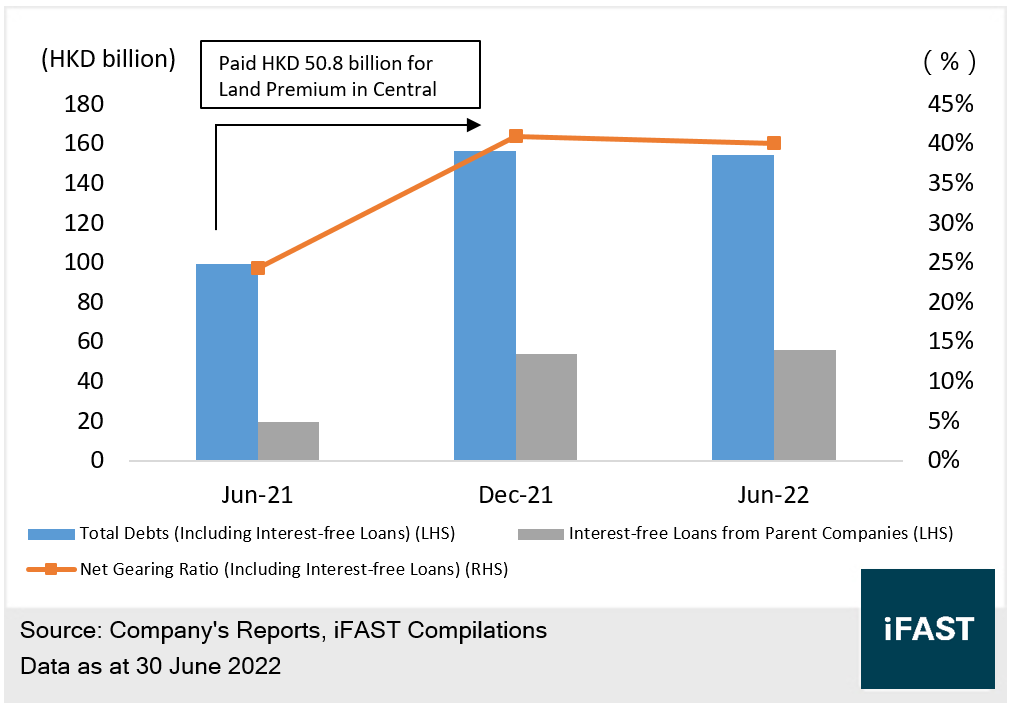
At the early December 2021, Henderson Land acquired the Site 3 of New Central Harbourfront at a "sky-high" cost of HKD 50.8 billion. The market worried that its gearing ratios will surge, which would increase the operating pressure and interest expenses.
However, this worry might not be valid, because the Group got financing for this major land acquisition mainly through the low interest rate loans from the parent company (with an associated new low interest rate loans of around HKD 34 billion). The Group only had to bear a small amount of interest expenses and construction costs, which the Group could easily handle.
Hence, we believe that the Group has sufficient ability to acquire the land with a "sky-high" cost, while this will indeed increase the Group’s leverage level on the book (the net gearing ratio increased from 24% to 40%) (see Chart 3), but the ratio is still at a manageable level. Together with 36% of the total debt coming from low interest rate loans from the parent company, this would undoubtedly not put much pressure on its operations.
Chart 3: The Group’s Total Debts and Net Gearing Ratios
Low Funding Cost and Huge Room for Refinancing
For other credit metrics, as shown in Table 2, as of end-June 2022, Henderson Land’s cost of borrowing was low at 1.5%. The funding cost was low. The interest coverage ratio was reduced a bit to 5.0 times, but the ratio was still at a very healthy level.
Although the adjusted cash to short-term debt ratio was only 0.48 times, it seems that liquidity is quite tight. However, if we look at the ratio in conjunction with other credit metrics, it actually shows the Group’s greater confidence in its refinancing ability. It is not necessary for the Group to keep too much idle cash on hand for any contingent issue. Indeed, the majority of its short-term debts come from bank loans, and the bank loan refinancing ratios were high as well. These mean that Group has huge room for refinancing. The overall credit risk is not high.
Table 2: Henderson Land’s Credit Metrics
|
June 2021 |
December 2021 |
June 2022 |
|
|
Short-term Debt (HKD billion) |
18.9 |
31.9 |
30.7 |
|
Total Cash (HKD billion) |
15.1 |
12.4 |
15.2 |
|
Adjusted Cash to Short-term Debt (times) |
0.78 |
0.37 |
0.48 |
|
Average Cost of Borrowing (%) |
1.8% |
1.7% |
1.5% |
|
Interest Coverage Ratio (times) |
9.0 |
8.0 |
5.0 |
|
Short-term Debt to Total Debt (%) |
19% |
20% |
20% |
|
Bank Loan to Short-term Debt (%) |
87% |
95% |
77% |
|
Bank Loan Refinancing Ratio (%) |
58% |
112% |
87% |
|
*Excluded Regulatory Pre-sales Proceeds Sources: Company’s Reports, iFAST compilations Data as of 30 June 2022 |
|||
Investors could Consider Short- to-Middle-term Bonds, with Yield To Maturity Reaching 5.3%
Based on Henderson Land’s good credit quality, massive land bank and stable rental revenues, we believe that investors could consider short- to-middle-term bonds (see Table 3). Both the 2024 HKD bond and 2025 USD bond reach 5.3% net yield to maturity, which have certain investment value.
Table 3: Henderson Land’s Bonds
|
Bond Name |
Currency |
Years to Maturity |
YTM (%) |
|
HKD |
1.6 |
5.4% |
|
|
USD |
2.5 |
5.3% |
|
|
Source: Bondsupermart Data as of 9 December 2022 |
|||
Compared to peers’ bonds with a similar maturity time, Henderson Land’s HKD bond has a slightly higher attractiveness (Table 4), close to Hang Lung Properties, but it obviously is higher than Sun Hung Kai Properties and Wheelock Marden.
Table 4: HKD Bonds Comparison
|
Bond Name |
Issuer / Guarantor |
Issuer / Guarantor Credit Rating (S&P / Fitch) |
Years to Maturity |
Net YTM (%) |
|
Henderson Land |
N.R / N.R |
1.6 |
5.4% |
|
|
Sun Hung Kai Properties |
A+ / A |
1.7 |
5.0% |
|
|
New World Development |
N.R / N.R |
1.3 |
5.7% |
|
|
Wheelock Marden |
N.R / N.R |
2.0 |
4.8% |
|
|
Hang Lung Properties |
N.R / N.R |
1.5 |
5.4% |
|
|
Source: Bondsupermart Data as of 9 December 2022 |
||||
Related Risk
Under the rate hike cycle, the refinancing cost of Henderson Land will be increased, which could increase its interest expenses. It would also affect the willingness for Hong Kong people to purchase residential units, which might lead to the Group’s discount promotion or lower sell-through rate.
In addition, there is a significant correction for Hong Kong property prices. The Centa-City Leading Index, which reflects Hong Kong property prices, has dropped 12.8% since year-to-date. This might put pressure on the Group's profit margin and affect the sentiment in the overall property market.
CIFI Group’s tight liquidity situation might result in the Group having to invest more capital to rescue the projects or even incur more debt, which might increase the Group's operational and credit risks.
A large portion of the Group's debts is from bank loans. If there are financial systemic risks or industry risks that may affect the renewal or refinancing of bank loans, the Group’s liquidity will be under pressure.
Now, about 36% of debts comes from the major shareholder, Mr. Lee Shau Kee family, through their private companies. If the major shareholder has their own financial issues, they might not able to provide more low interest rate loans to the Group, or they might charge high interest rates and even withdraw the loans. Under these circumstances, the Group’s financial pressure will be increased.
Conclusion
Henderson Land’s recent sales were dragged down by COVID-19, but we still expect the Group to generate around 15 billion to 20 billion in annual contracted sales. Its rental revenues are stable, but an increase in operating costs results in lower profits. However, its fundamentals remain robust.
The Group is a developer with the largest amount of agricultural land in Hong Kong, which could be the biggest potential beneficiary under the “Northern Metropolis” policy. The CIFI’s credit event might affect the Group, but the Group does not necessarily take on more debts for partners.
The Group has a sufficient ability to acquire land with sky-high costs, with the Group’s low funding cost and higher room for refinancing. The overall credit risk is low. Hence, investors could consider the short- to-middle-term bonds, with a yield to maturity reaching 5.3%.