Receive first-hand news on the latest bond issues, credit updates and special events when you join us on our Telegram channel at https://t.me/bondsupermart!
Highlights:
- Micron delivered rather good results in FY22 (from 29 Sep 2021 to 29 Sep 2022), with revenue and EBITDA rising by 11% and 24.8%, respectively, on a year-on-year basis. However, following the industry down cycle, the revenue for the coming two years is expected to be seen a downward movement. In long run, as a beneficiary of the "CHIPS and Science Act of 2022", Micron might maintain a stable development.
- Credit-wise, the company reports a small-sized debt amount and net cash status for consecutive years. Although the industry headwind may cause a blow to fundamentals, the credit quality is less significantly affected, and solvency remains decent.
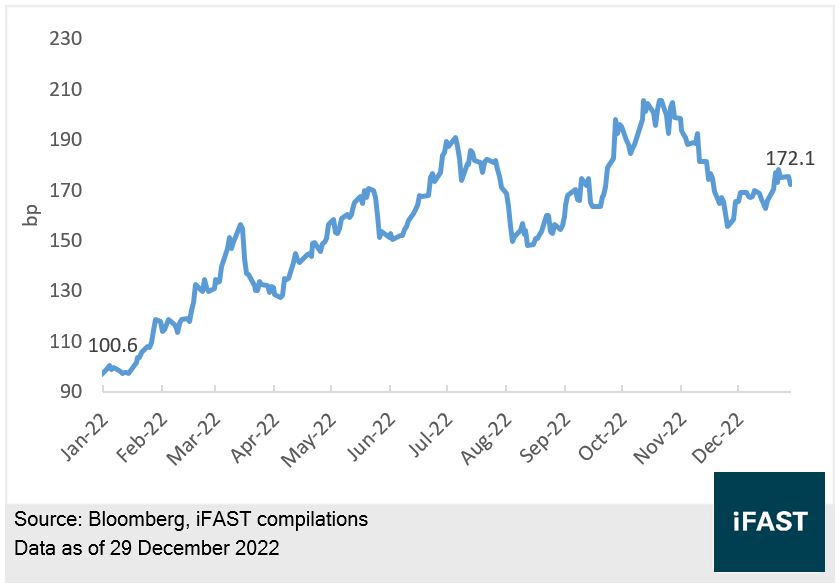
- The bond due in 2027 is currently yielding around 5.3%. The yield spread widened compared to the beginning of this year, making it more attractive for investment.
We have introduced the memory chip market before in our previous article “Idea of the Week: SK Hynix–A Korea-based Memory Semiconductor Leader”. In this Idea of the Week, let’s focus on Micron, a US-based memory chip giant.
Company Background
Micron was established in 1978 and is headquartered in Idaho, USA. The Company is currently listed on the New York Stock Exchange with stock code MU.US. The market capitalisation reached roughly USD 59 billion at the market close on 29 Dec 2022.
Micron’s major business comprises the production of memory chips which are mainly divided into memory (SDRAM) and storage chips (NAND Flashing Memory).
According to IC Insights, an authoritative research institution in the semiconductor industry, Micron Technology is the world's fifth-largest semiconductor company in terms of total sales in 2021 and the second-largest semiconductor company in the US, trailing behind Intel.
Current Operation Looks Stable, but Will be Dragged Down by the Industry Down Cycle
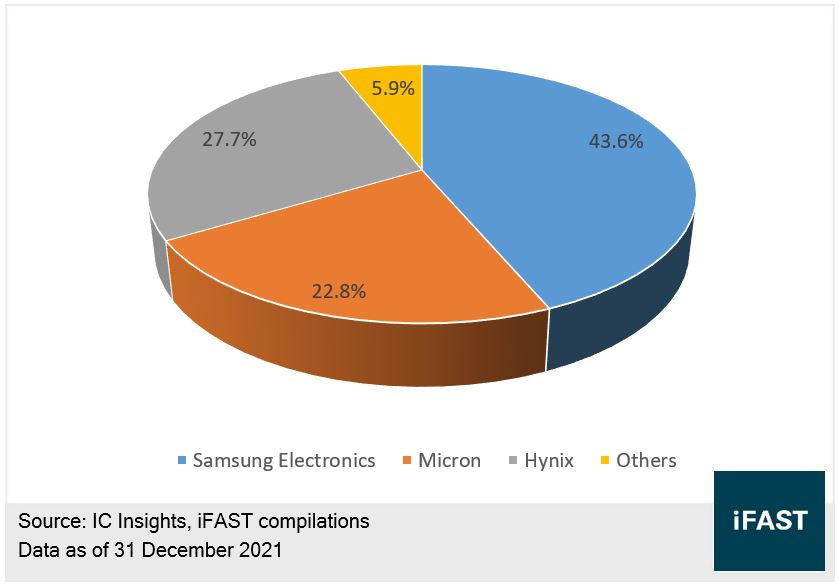
In the memory semiconductor sector, Samsung, SK Hynix, and Micron are in a three-way tie. In terms of SDRAM market share in 2021, Samsung and SK Hynix accounted for 43.6% and 27.7% respectively (Chart 1), followed by Micron with 22.8% of the market share.
It is noteworthy that the three chipmakers have close technology capabilities in spite of the differences in market share. For example, Micron announced the shipment of its 232-layer NAND memory (the higher the layer, the more advanced it is) in July, SK Hynix announced its 238-layer NAND memory in August, and Samsung launched its 236-layer NAND memory in November. In contrast, Chinese memory chip leader Yangtze Memory is just involved in 192-layer NAND memory. We thus believe that the global memory market will continue to be dominated by the "Big Three" in the future.
Chart 1: Market Share of DRAM
Owing to the rapid development of 5G devices, AI, as well as the Internet of things, the demand for memory has witnessed exponential growth, leading to favorable operation results for Micron (Table 1). FY21’s revenue rose by 29% YoY to USD 27.7 billion, and EBITDA reached 14.0 billion, surging by 54.0% YoY.
Table: Operation Results of Micron
|
(Billion USD) |
Revenue |
YoY Growth |
Adjusted EBITDA |
YoY Growth |
|
FY20 |
21.4 |
-8.3% |
9.1 |
-29.9% |
|
FY21 |
27.7 |
29.4% |
14.0 |
54.0% |
|
FY22 |
30.8 |
11.2% |
17.4 |
24.8% |
|
Source: Company reports, iFAST compilations Data as of 29 Sep 2022 |
||||
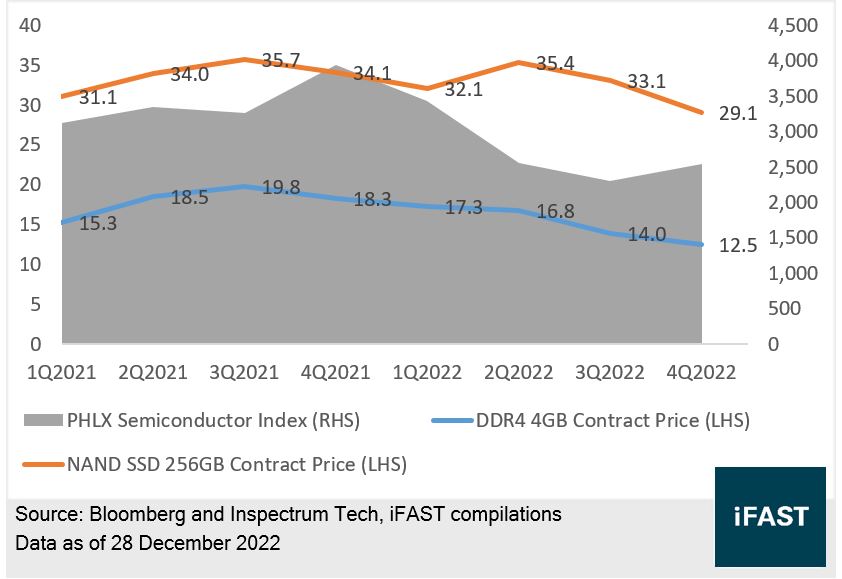
On the other hand, the semiconductor industry, a typical cyclic sector, started to enter the down cycle in the second half of this year after a long boom period of about three years. The price of DDR4 memory with 4GB capacity has dropped by more than 17% to USD 29.1 from USD 35.4 in the second quarter of this year, while the price of NAND SSD with 256GB capacity has also dropped by nearly 30% this year. In addition, PHLX Semiconductor Index, which evaluates semiconductor industry sentiment, has dropped sharply from a peak of roughly 3,900 Pts to roughly 2,600 Pts, reflecting the undisputed fact that the industry is entering a downtrend cycle.
Chart 2: Price of Memory Product and PHLX Semiconductor Index
As a consequence, the growth rate in revenue in FY22 is lowered to 11%, and adjusted EBITDA also experiences a remarkable decline. Particularly results in 4QFY22 (from 30 Jun 2022 to 29 Sep 2022) well depicted the downtrend, with revenue slumping by 19.7% YoY, and 23.1% QoQ. Given that the downtrend is expected to last one to two years, we believe that Micron's revenue will likely mark a double-digit decline in the coming quarters.
Looking ahead, research from IC Insights shows that the global memory market is expected to grow at a CAGR of approximately 10% by 2030, suggesting that Micron could be able to remain stable growth after coming out of the downtrend cycle.
A beneficiary of the CHIPS and Science Act
In September, the Biden administration signed the Chip and Science Act of 2022 (the "Chip Act") to enhance US semiconductor production and manufacturing capabilities. A USD 50 billion US. Chip Fund was also established to subsidize US chip companies. The Act also mentions a 25% tax credit for investments in semiconductor manufacturing, which we believe will facilitate the shift of semiconductor investment from East Asia to the US, with US-based semiconductor companies such as Intel, Micron and Qualcomm are expected to be among the largest beneficiaries.
Moreover, the U.S. Department of Commerce placed Yangtze Memory on the "Unverified List" on 7 Oct 2022 and may eventually place it on the "Entity List", with restrictions on U.S. citizens from engaging in semiconductor R&D and manufacturing in China. We think the sanction might have severe impact on China's growing memory semiconductor industry and alleviate potential competitive pressures on companies such as Micron, and to some extent strengthen Micron's position in the industry. To wrap up the points above, we are optimistic about Micron's further development after the implementation of the Chip Act and expect the company to narrow the market share gap against Korean rivals.
Small-sized Borrowings, with Adequate Cash Balance
As of 29 Sep2022, the cash and cash equivalents was around USD 9.3 billion, and total borrowings amounted to USD 6.9 billion, which translated into a net cash status and means that the company could fully repay all debt without external funding.
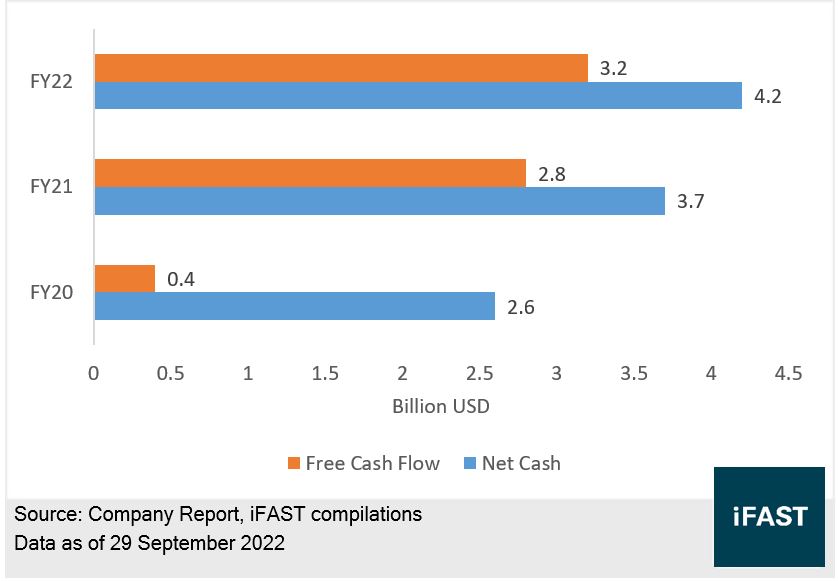
We see that the net cash is on the trend of increasing, from USD 2.6 billion in FY20 to USD 4.2 billion in FY22. Concurrently, the free cash flow has also seen an improvement, with USD 360.0 million, USD 2.8 billion, and USD 3.2 billion from FY20 to FY22, respectively. However, as the semiconductor industry enters a downtrend cycle, we expect Micron's net cash and free cash flow to shrink to varying degrees, but will likely remain positive.
In relation to gearing, as of 29 Sep 2022, Micron's total debt to EBITDA ratio was 0.4x, a slight drop from 0.5x in FY21, and the current gearing is one of the lowest levels in the industry. We expect the gearing to be managed at a decent level, even if the operation results get depressed due to the weak fundamentals.
Chart 3: Micron’s Net Cash and Free Cash Flow
Trim Down Capital Expenditure, Liquidity is Expected to Remain Ample
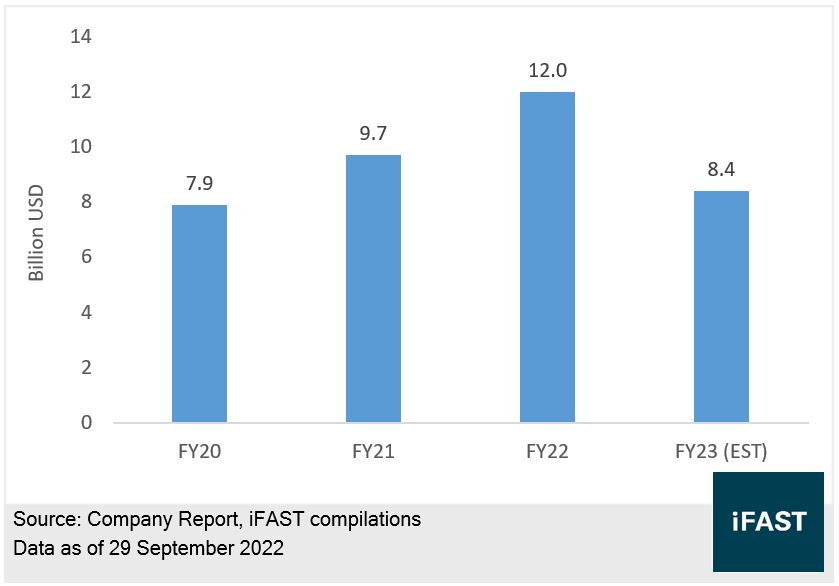
Chart 4 depicts that Micron's capital expenditure kept rising during the stage of the industry uptrend, from USD 7.9 billion in FY20 to USD 12.0 billion in FY22. In the midst of the industry downturn, Micron reacted quickly, announcing in September this year that it will reduce production by 20% and trim capital expenditures by 30% in FY23, or around USD 8.4 billion. We believe that the reduction in capital expenditures will help improve the company's liquidity, leading to stronger risk capacity.
Furthermore, as of 29 Sep 2022, the company owned the unused credit facility from banks of USD 2.5 billion and also owned marketable securities of USD 1.6 billion, which both could be looked at as potential sources of liquidity. Additionally, after Chip Act takes effect, the subsidies and tax credits will have positive impacts on Micron's liquidity. All in all, we estimate the liquidity to be at an ample level with solid credit quality.
Chart 4: Micron’s Capital Expenditure
Yield Spread Widens, Investment Attractiveness Increased
In terms of bond investment, one bond issued by Micron is tradeable on our platform. The credit rating is BBB- / BBB (S&P / Fitch). The details are shown below:
Table 2: Bond Issued by Micron
|
Bond |
Bond Credit Rating |
Years to Maturity |
Ask Price |
YTM |
|
MU 4.185% 15Feb2027 Corp (USD) |
BBB-/ BBB (S&P/Fitch) |
4.0 |
95.8 |
5.3% |
|
Source: Bondsupermart Data as of 29 Dec 2022 |
||||
Chart 5: Z-spread
Corporate Risk
Investors should be mindful of the following risk. Firstly, there are some uncertainties about the duration of the industry down cycle. If the down cycle lasts longer than expected, it would adversely affect the cash balance and credit profile.
Secondly, China is one of the major oversea markets of Micron, but the political tension between US and China continuously escalates, especially in the semiconductor sector. In comparison to Intel, Qualcomm, Micron is not that irreplaceable in china market, making it exposed to a higher political risk, such as a sales ban, which may affect the company's future development and debt repayment ability.
Conclusion
Micron delivered rather good results in FY22, with revenue and EBITDA rising by 11% and 24.8%, respectively, on a year-on-year basis. However, following the industry down cycle, the revenue for the coming two years is expected to be seen a downward movement. In long run, as a beneficiary of the "CHIPS and Science Act of 2022", Micron might maintain stable development.
Credit-wise, the company reports a small-sized debt amount and net cash status for consecutive years. Although the industry headwind may cause a blow to fundamentals, the credit quality is less significantly affected, and solvency remains decent.
Bond due in 2027 is currently yielding around 5.3%. The yield spread widened compared to the beginning of this year, making it more attractive for investment.
Declaration: For specific disclosure, at the time of publication of this report, IFPL (via its connected and associated entities) and the analyst who produced this report hold a NIL position in the abovementioned securities.
Our podcast series, Yield Hunters, is available on Spotify, iTunes Podcasts and Google Podcasts. We share our thoughts on new bond issues and hold discussions on the fixed income space. Listen to our latest episode below and follow us!