Receive first-hand news on the latest bond issues, credit updates and special events when you join us on our Telegram channel at https://t.me/bondsupermart!
Highlights:
- Influenced by geopolitical risk, Softbank’s holding on Chinese stocks posted a bearish performance, leading to a total investment loss of JPY 960.0 billion in the first half of FY23. Softbank fully realised its holding on Alibaba, and gained exposure to startups outside of China. Propelled by the Japanese stock rally, Softbank’s investment performance is expected to recoup significantly and return to a profitable position by FY24 at the earliest.
- The IPO of Arm generated a strong cash flow for Softbank, placing the cash balance at a record high. The leverage remains at a low level, and overall credit quality looks decent.
- Following the improvement in credit profile, bond yields are trending downward. Bond due in 2026 is currently yielding around 6.5%, which is a rather attractive choice among Japanese high-yield bonds.
Softbank Group recently revealed its results for the first half of FY23, and it is believed that many investors are wondering whether the company has shaken off its persistent losses. Are the company's bonds still worth considering? In today’s idea of the week, we will try to answer these questions by analysing Softbank's recent financial figures.
Softbank Moves into Post-China Era After the Breakup of Alibaba
Looking into the results of the first half of FY23, the net sales gained a bit to JPY 3.2 trillion, while the investment segment the company deeply relies on crashed further in comparison to 1HFY22, with a total investment loss of JPY 0.96 trillion and a net loss of JPY 1.4 trillion, significantly deeper losses than a year earlier.
Table 1: Softbank’s Revenue and Profit
|
(Trillion JPY) |
1HFY22 |
1HFY23 |
|
Net Sales |
3.18 |
3.22 |
|
Investment Loss |
0.85 |
0.96 |
|
Net Profit |
-0.13 |
-1.41 |
|
Source: Company reports, iFAST Compilations |
||
These figures show that Softbank’s operating performance has not improved, but rather deteriorated further. However, the truth of the matter is that Softbank’s investment losses in the Vision Fund in the first half of FY22 amounted to JPY 4.4 trillion, but it substantially reduced the share of Alibaba and generated an investment gain of JPY 4.6 trillion and offsetting some extent the huge investment loss from Softbank Vision Fund. In the first half of FY23, the performance of the Vision Fund indeed rebounded considerably, with two consecutive profitable quarters (Chart 1), of which the first quarter of FY23 recorded an investment gain of approximately USD 980 million.
Arm was successfully listed on NASDAQ, with a market capitalisation of nearly USD 70 billion. The equity value of Softbank’s holding is around JPY 7.5 trillion, which could translate into a Multiple of Invested Capital (MOIC) of 3.2x based on the initial investment of JPY 2.3 trillion. But it is worth noting that since Arm is still considered a subsidiary of Softbank, the capital surplus of about JPY 674.4 billion from the listing of the company is recorded in the equity section of the balance sheet, rather than on the income statement. This explains why there was no improvement in net profit in the first half of FY23 after the IPO.
Chart 1: Investment Gains of Vision Fund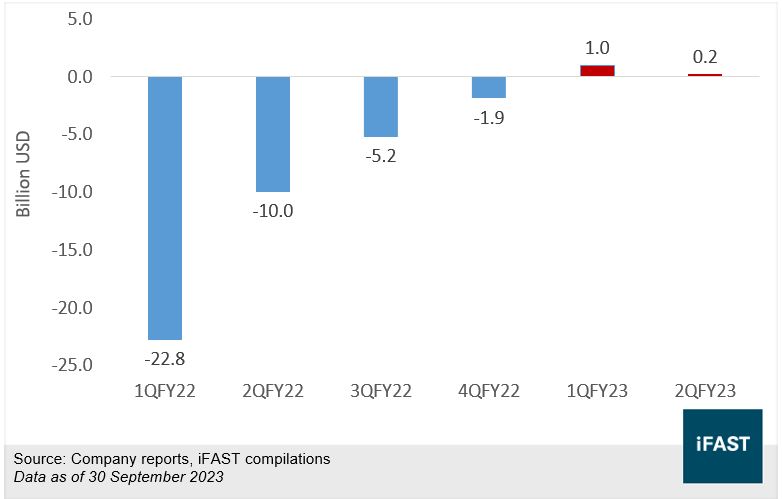
On the other hand, due to the Chinese government's strict regulation of tech companies and geopolitical risk considerations, Softbank started to lower its investment in Chinese startups in 2020, and the trend has accelerated in the last one or two years. We note that Alibaba, the most successful investment case of Softbank, delivered more than 1,300 times cumulative investment returns and accounted for as much as 59% of Softbank’s equity value in September 2020 (Chart 2). However, as of September 2023, the position sharply dropped to 0.03%, indicating that the company almost sold out of Alibaba shares.
Chart 2: Equity Value of Holdings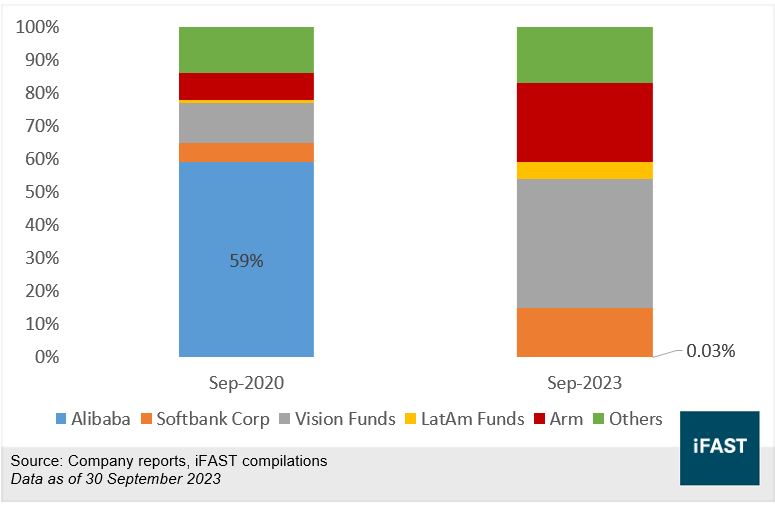 Meanwhile,
Softbank is adjusting its risk appetite to Chinese name companies which made up
only 9% of the group's investment positions as of September 2023, a far cry
from 30% ending March 2022. From the perspective of investment return, the
continuous downside pressure of the Chinese economy weighs on the performance
of Chinese startups, a reduction in investment in Chinese companies could be
able to avoid further investment loss.
Meanwhile,
Softbank is adjusting its risk appetite to Chinese name companies which made up
only 9% of the group's investment positions as of September 2023, a far cry
from 30% ending March 2022. From the perspective of investment return, the
continuous downside pressure of the Chinese economy weighs on the performance
of Chinese startups, a reduction in investment in Chinese companies could be
able to avoid further investment loss.
Chart 3: Breakdown of Equity Value of Holing by Geography 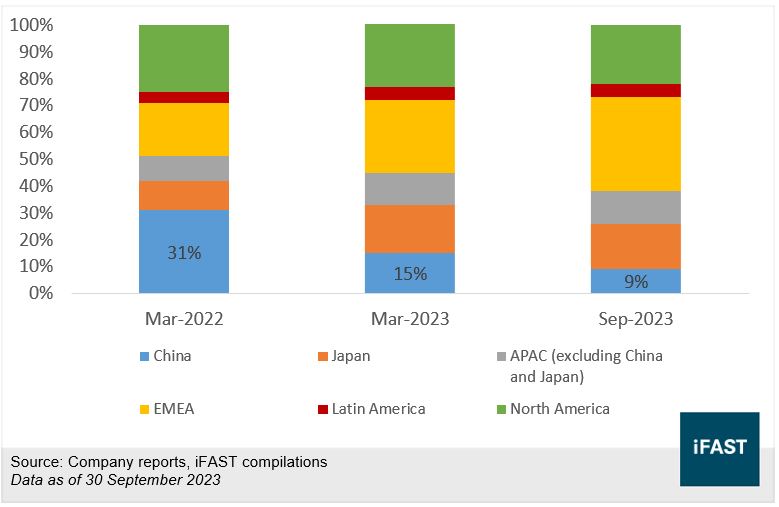
Duplicating Arm's success, Softbank Steps Up Investment in AI
Given the fruitful return from Arm and the frenzy of ChatGPT, Softbank is adamant that it will gain exposure to AI-related startups. As a result, the company turned its stance from defensive to offensive to make more investments in AI companies in the first half of FY23, including Stack AV, which engages in automated truck driving, Balyo, which specializes in logistics and warehouse automation solutions, and map and location-based positioning provider Mapbox, among others.
With interest rate hike cycles coming to an end for major economies, the stock markets are seeing a remarkable rebound. For example, the S&P 500 index rose roughly 25% in 2023, signaling the end of the bear market. In addition, Warren Buffett's increasing exposure to Japanese stocks led to favourable market sentiment, making Nikkei 225 index climb over approximately 30% in 2023, outperforming the major stock markets. We thus think that the current market sentiment is pretty favourable to tech startups and Softbank's equity investment segment will likely dramatically improve and return to a profitable position in FY24.
Leverage Continued to Be Low with Ample Cash Position
The company announced a defensive investment strategy in FY22, significantly reducing the investment amount, which resulted in its LTV ratio (Net debt/Equity value of holdings) declining to 8% in the first quarter of FY23. Following the ramp-up of AI investments by Softbank, the LTV ratio saw a slight rebounding to 10.6% ending 30 September 2023. The current LTV ratio is well below the 35% ceiling set by Softbank, reflecting a pretty healthy level of leverage.
Chart
4: LTV Ratio of Softbank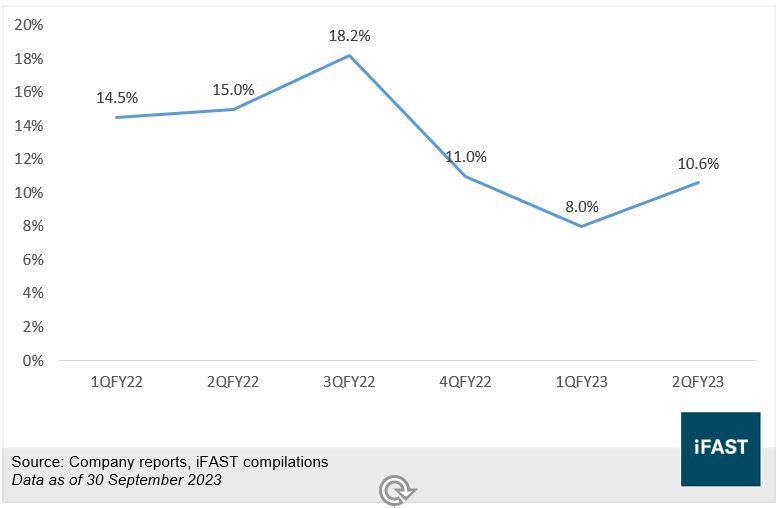 In terms of cash balance, although the IPO of Arm did not benefit Softbank’s
income statement, it had a very positive impact on the company's balance sheet,
adding up to a total of approximately JPY 745 billion in cash flow. As of 30
September, the cash and cash equivalents moved up from JPY 4.3 trillion in the
same period a year earlier, to JPY 5.1 trillion, indicating a marked
improvement in liquidity and sufficient to meet future debt repayment and
investment needs.
In terms of cash balance, although the IPO of Arm did not benefit Softbank’s
income statement, it had a very positive impact on the company's balance sheet,
adding up to a total of approximately JPY 745 billion in cash flow. As of 30
September, the cash and cash equivalents moved up from JPY 4.3 trillion in the
same period a year earlier, to JPY 5.1 trillion, indicating a marked
improvement in liquidity and sufficient to meet future debt repayment and
investment needs.
Meanwhile, the invested equity, which is a potential source of liquidity, is rebounding after the recovery of market sentiments, leading to further improvement in liquidity. To conclude, we think that Softbank notably improved in credit quality in the first half of FY23 and the credit risk will be manageable level in the short term.
Bond Yields Go Down, But Remain High Among Japanese Corporate Bonds
Recommendation-wise, Softbank issued quite a number of bonds, of which five of them are tradeable on our platform (Table 2). Their investment horizon ranges from 1 to 8 years. The credit rating is BB by S&P.
Table 2: Bonds Issued by Softbank
|
Bond |
Years to Maturity |
Ask Price |
YTM |
|
SOFTBK 3.125% 06JAN2025 CORP (USD) |
1.0 |
97.4 |
6.0% |
|
SOFTBK 4.000% 06JUL2026 CORP (USD) |
2.5 |
94.5 |
6.5% |
|
SOFTBK 5.125% 19SEP2027 CORP (USD) |
3.7 |
95.5 |
6.5% |
|
SOFTBK 4.625% 06JUL2028 CORP (USD) |
4.5 |
92.8 |
6.5% |
|
SOFTBK 5.250% 06JUL2031 CORP (USD) |
7.5 |
91.3 |
6.7% |
|
Source: Bondsupermart |
|||
Bond prices rallied by around $3 on average compared to mid-2023 as a result of improved corporate credit quality, driving bond yields down to varying degrees, albeit yields are still at the average level for BB-rated bonds. Given the relatively flat yield curve of Softbank bonds, which are concentrated around 6.0%-6.5%, we believe investors may give preference to bond due in 2026, which is capable of delivering a return of around 6.5% over an investment horizon of around 2.5 years, making it a reasonably attractive option among Japanese high-yield corporate bonds.
Corporate Risk
Investors should be mindful of the following risks. Firstly, in spite of the improvement in liquidity, the investment stance shifting from defensive to offensive might result in a larger amount of investment and weaker liquidity.
Secondly, although Softbank is reducing exposure to Chinese companies, it still invested in a number of Chinese technology companies such as Bytedance and Beike etc. Since the SEC is listing more Chinese companies under the "Holding Foreign Companies Accountable Act", these companies might be forced to delist from the US capital market. Besides, some startups that had planned to list on the US stock exchange may miss the opportunity to do so, resulting in a huge blow to Softbank Group.
Conclusion
Influenced by geopolitical risk, Softbank’s holding on Chinese stocks posted a bearish performance, leading to a total investment loss of JPY 960.0 billion in the first half of FY23. Softbank fully realized its holding on Alibaba, and gained exposure to startups outside of China. Propelled by the Japanese stock rally, Softbank’s investment performance is expected to recoup significantly and return to a profitable position by FY24 at the earliest.
The IPO of Arm generated a strong cash flow for Softbank, placing the cash balance at a record high. The leverage remains at a low level, and overall credit quality looks decent.
Following the improvement in credit profile, bond yields are trending downward. Bond due in 2026 is currently yielding around 6.5%, which is a rather attractive choice among Japanese high-yield bonds.
Declaration: For specific disclosure, at the time of publication of this report, IFPL (via its connected and associated entities) and the analyst who produced this report hold a NIL position in the abovementioned securities.
Our podcast series, Yield Hunters, is available on Spotify, iTunes Podcasts and Google Podcasts. We share our thoughts on new bond issues and hold discussions on the fixed income space. Listen to our latest episode below and follow us!