Receive first-hand news on the latest bond issues, credit updates and special events when you join us on our Telegram channel at https://t.me/bondsupermart!
Highlights:
- The investment loss from Softbank Vision Fund hit a record high in FY22 and might be out of red this year following the rebound of global stock markets, particularly the Japanese stock boom. The group is shifting its business strategy from defensive to offensive this year and is expected to be one of the beneficiaries of the AI revolution.
- Softbank almost sold off its stake in Alibaba, resulting in a dramatic increase of about 75% in the cash position, a significant improvement in liquidity, and a positive overall credit quality.
- Bond due in 2026 is yielding around 7%, a good choice among Japanese high-yield issuers.
Investment Loss Hit a New High, but Expected to Turn Around This Year
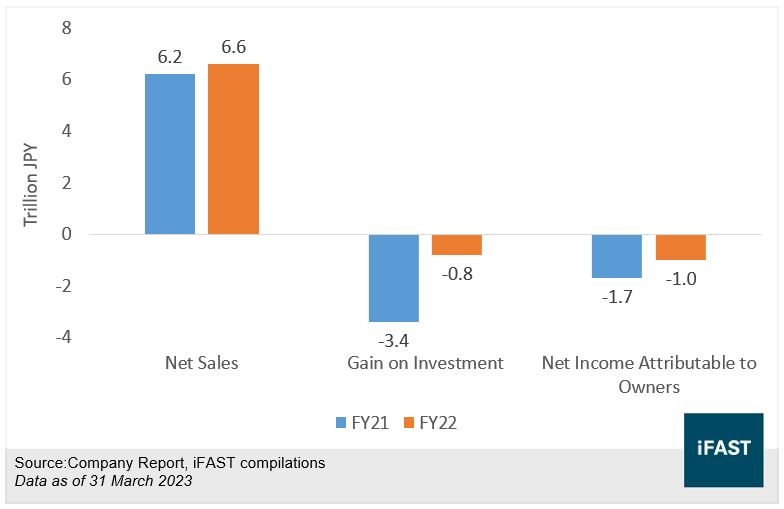
Looking into the equity investment segment, the Group recorded an investment loss of JPY 0.8 trillion in FY22, which markedly narrowed in comparison to FY21. However, the truth is that Softbank Vision Fund's investment loss hit a record high of JPY 5.3 trillion due to the bearish global stock markets and the adverse impacts of interest rate hikes cycle on growth companies, which resulted in a lower share price or lower valuation for startups Softbank holds. In the meanwhile, Softbank substantially reduced the share of Alibaba, generating an investment gain of JPY 4.6 trillion and offsetting some extent the huge investment loss from Softbank Vision Fund.
Chart 1: Operation Performance of Softbank Group
It is noteworthy that the Group's ownership on Alibaba shrank to less than 4% from a peak of over 30%, after the ongoing sales of the share. We believe the selloff is motivated by multi factors, including the China-US audit dispute and the Chinese government's tightening of regulations on technology companies. It also reflects that Softbank Group is adjusting its risk appetite to Chinese name companies which made up only 14% of the group's investment positions as of March 2023, a far cry from the peak of 50%.
With interest rate hike cycles coming to an end for major economies, the stock markets are seeing a remarkable rebound. For example, S&P 500 index rose roughly 20% from its trough in October last year, signaling the end of the bear market. In addition, Warren Buffett's increasing exposure to Japanese stocks led to favourable market sentiment, making Nikkei 225 index climb over approximately 30% from the beginning of this year, outperforming the major stock markets. We thus think that Softbank's equity investment segment will likely dramatically improve and turn around in the first quarter of FY23 at the earliest.
For non-investment business sectors, both revenues from telecom and ARM remain stable. The telecom business recorded revenue of JPY 6 .0 trillion, up 3.9% YoY. Revenue from ARM rose by 27.2% to JPY 381.8 billion (up 5.7% when excluding foreign exchange gain).
Investment Strategies Shift from Defensive to Offensive with Promising Future
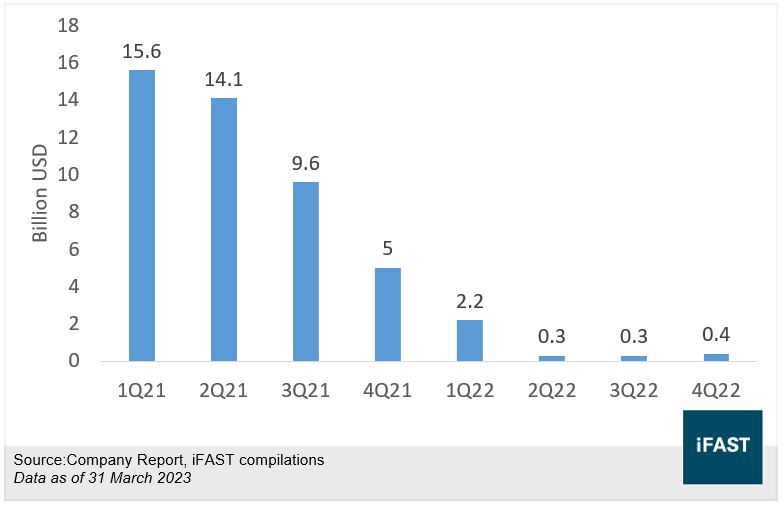
As mentioned by Masayoshi Son, the CEO of Softbank Group, Softbank Group turned to a defensive stance in investment and shrink the investment amount in the annual meeting of FY21. Chart 2 shows that the quarterly invested amount stood at USD 300-400 million from 2QFY22 to 4QFY22, well below the previous average of USD 10 billion.
Chart 2: Softbank Group’s Newly Made Investments
However, the Group makes a U-turn on its investment stance. Given the blistering development of artificial intelligence (AI) this year, Masayoshi Son stated that Softbank has long foreseen the development of artificial intelligence, as exemplified by its earlier investments in ARM and NIVIDA, and believes AI will remain its rapid growth pace. As a result, the Group turns its stance from defensive to offensive to make more investments in AI companies. In practice, given Softbank's investment in AI-linked companies, such as Alibaba and ARM, it considers itself an AI company, and the share price increased by 20% year-to-date amid this boom.
As the Softbank Group's AI "trump card", ARM plans to list on NASDAQ this year, with expected capital raise of USD 10 billion, making it the largest IPO of the year and one of the beneficiaries of the AI revolution with the huge return on investment for Softbank Group. All in all, we are bullish on Softbank's investment business this year and expect FY23 to be a clean sweep, recouping from the huge investment losses of the past two years.
Cash Position Goes Up with Lower Leverage, Overall Credit Quality Improved
From the perspective of credit profile, thanks to the monetization of Alibaba shares and conservation business strategy, cash position increased from JPY 2.9 trillion in FY 21 to JPY 5.1 trillion in FY22, even after a JPY 1.1 trillion share buyback last year.
The Group significantly reduced the interest-bearing debt in FY22 through bond redemptions, with short-term debt lowered to JPY 5.1 trillion from JPY 7.3 trillion in FY21, resulting in a marked improvement in overall liquidity.
Table 1: Credit Metrics of Softbank Group
(Trillion JPY) | FY21 | FY22 | Change |
LTV Ratio | 20.4% | 11.0% | -9.4 percentage points |
Cash Position | 2.9 | 5.1 | +75.9% |
Short-term Debt | 7.3 | 5.1 | -30.1% |
Long-term Debt | 14.1 | 14 | -0.7% |
Sources: Company Reports, iFAST Compilations Data as of 31 March 2023 | |||
The decreasing debt amount helped Softbank to reduce LTV ratio to 11% in 4QFY22, down 9.4% percentage points contraction from FY21, and the current LTV ratio is well below the 35% ceiling set by Softbank, reflecting a pretty healthy level of leverage.
Furthermore, the list of ARM this year is expected to generate several billions of cash inflows. Meanwhile, the invested equity, which is a potential source of liquidity, is rebounding after the recovery of market sentiments, leading to further improvement in liquidity. To conclude, we think that the rising cash position and declining leverage ratio indicate a notably improved in credit quality and the credit risk will be manageable level in the short term.
Bonds Are Attractive
Recommendation-wise, Softbank issued quite a number of bonds, of which six of them are tradeable on our platform (Table 2). Their investment horizon ranges from 1 to 8 years. The credit rating is BB by S&P.
Table 2: USD Bonds Issued by Softbank Group
Bond | Years to Maturity | Ask Price | YTM |
SOFTBK 4.750% 19SEP2024 CORP (USD) | 1.2 | 98.0 | 6.6% |
SOFTBK 3.125% 06JAN2025 CORP (USD) | 1.5 | 95.6 | 6.4% |
SOFTBK 4.000% 06JUL2026 CORP (USD) | 3.0 | 92.6 | 6.9% |
SOFTBK 5.125% 19SEP2027 CORP (USD) | 4.2 | 90.8 | 7.8% |
SOFTBK 4.625% 06JUL2028 CORP (USD) | 5.0 | 91.0 | 6.8% |
SOFTBK 5.250% 06JUL2031 CORP (USD) | 8.0 | 91.2 | 6.7% |
Sources: Bondsupermart Data as of 24 July 2023 | |||
Following the improvement in credit quality for Softbank, bonds with longer investment horizons could be considered for yield pick-up. Bond due in 2026 is trading at a price of $92.6 with a yield to maturity of roughly 6.9%, which is one of the highest levels among Japanese high-yield issuers, and investors interested in Japanese names can consider it.
Corporate Risk
Investors should be mindful of the following risk. Firstly, in spite of improvement in liquidity, the investment stance shifting from defensive to offensive might result in a larger amount of investment and weaker liquidity.
Secondly, Softbank has invested in a number of US-listed Chinese technology companies such as Alibaba, Beike and Dingdong, etc. Since SEC is listing more Chinese companies under the "Holding Foreign Companies Accountable Act", these companies might be forced to delist from the U.S. capital market. Besides, some startups that had planned to list on the U.S. stock exchange may miss the opportunity to do so, resulting in a huge blow to Softbank Group.
Conclusion
The investment loss from Softbank Vision Fund hit a record high in FY22 but might be out of red this year following the rebound of global stock markets, particularly the Japanese stock boom. The group is shifting its business strategy from defensive to offensive this year and is expected to be one of the beneficiaries of the AI revolution. Softbank almost sold off its stake in Alibaba, resulting in a dramatic increase of about 75% in the cash position, a significant improvement in liquidity, and a positive overall credit quality. Bond due in 2026 is yielding around 7%, a good choice among Japanese high-yield issuers.
Declaration: For specific disclosure, at the time of publication of this report, IFPL (via its connected and associated entities) and the analyst who produced this report hold a NIL position in the abovementioned securities.
Our podcast series, Yield Hunters, is available on Spotify, iTunes Podcasts and Google Podcasts. We share our thoughts on new bond issues and hold discussions on the fixed income space. Listen to our latest episode below and follow us!