- Deutsche Bank had undergone its “Compete to Win”
transformation plans to become a bank with a more diversified business profile.
- Moving ahead, it had set challenging goals for itself
for its “Global Hausbank” strategy extending until 2025.
- The bank sees improved results since the
transformation journey, benefitting from the rise in interest rates
- The credit profile remains stable and it should see
further organic growth to capital.
- We like the senior non-preferred DB 5.000% 05Sep2026 Corp (SGD) given a lower risk to risk absorption while providing yield pick-up over other SGD T2 papers.
Introduction
Deutsche Bank (“Deutsche”) is a leading German bank with strong European roots, alongside a vast global footprint. Well-established in major emerging markets, Deutsche is able to tap into the rapid growth of these fast-growing economies, including the Asia-Pacific region, Central and Eastern Europe and Latin America.
Deutsche primarily operates through its four business segments – Corporate Bank, Investment Bank, Private Bank, and lastly asset management through DWS. Based in Germany, the Corporate Bank serves the European region, addressing the needs of corporate clients, financial institutions, investors and issuers. For the Investment Bank, it offers services and strategic advice in financing, advisory, fixed income and currencies.
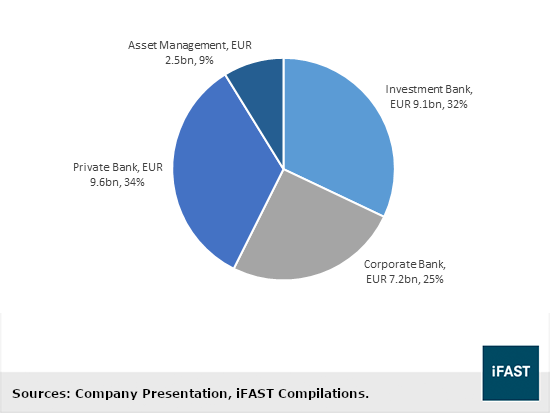
The Private Bank caters to private customers internationally across all segments and its Private Bank remains the market leader in Germany. Lastly, the asset management by DWS offers individuals and institutions access to Deutsche’s strong investment capabilities across all major asset classes. Across the segments, Private Bank contributes the majority of Deutsche’s net revenue at 34%, with Investment Bank and Corporate Bank contributing slightly lesser (Chart 1).
Chart 1
Net revenue by business segments for the last twelve months of 2Q23
Starting in 2019, Deutsche embarked on its “Compete to Win” plans – calling for a fundamental transformation of the bank and key financial targets by the end of 2022. It celebrated its achievement of the desired goals “despite facing unforeseen and significant challenges from the COVID-19 pandemic and the war in Ukraine” as indicated in its Annual Report 2022. As a testament to the improved performance post-transformation, Deutsche’s credit rating was upgraded by Fitch while the outlook by S&P was revised from stable to positive.
Of its numerous targets, the critical decisions that allowed for its successful transformation were –
- The strategic exit of non-core businesses, which includes exiting equities trading and transferring its Global Prime Finance business;
- Cutting costs successfully by reducing the cost-to-income ratio by 18 percentage points, amidst the transformation and additional costs related to it;
- Continued to invest in technology to support growth, which engaged in agreements with known brands in the technology sector such as Google Cloud and NVIDIA for the development of technological capabilities.
Moving ahead, Deutsche has established its new roadmap to 2025, “Global Hausbank”, which is adapting to the changes brought about by the geopolitical and macro-economic upheavals of 2022. Below we highlight several goals from the strategy:
- Leverage a more favourable interest rate environment, allocate capital to high-return growth opportunities;
- Reap further cost savings with technology and accelerate the transition to a digital bank;
- Act and improve on its efficiency, primarily on its various platforms – expected to deliver structural cost savings of more than EUR 2b between 2022 to 2025.
The key financial targets for FY2025 were to attain a post-tax Return on Tangible Equity (“RoTE”) of above 10%, a revenue CAGR of 3.5%~4.5% and a cost-to-income ratio of less than 62.5%. Additionally, it targets a Common Equity Tier 1 (“CET1”) Ratio of approximately 13% and a total payout ratio of 50% from 2025 onwards.
Will profits continue to go up?
“Deutsche Bank reports profit before tax of EUR 3.3b in the first half year of 2023, highest since 2011” – Deutsche’s Media Release, 26 July 2023
“Deutsche Bank today announced its highest annual profit (in 2022), both before and after tax, since 2007.” – Deutsche’s Media Release, 2 February 2023
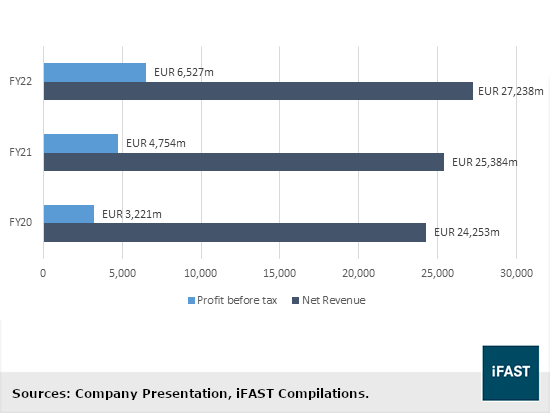
Deutsche continues to see strong performance, even after a remarkable year in 2022. For the full year ended 31 December 2022 (“FY22”), its profit before tax grew to EUR 6,527m in FY22, a significant 37% increase from EUR 4,754m in FY21. The growth (as observed in Chart 2) has been robust since Deutsche embarked on its “Compete to Win” strategy and the results reflect the successful change.
Chart 2
Profit
Before Tax and Net Revenue since FY20
For the half year ended 30 June 2023 (“1H23”), Deutsche saw improved net revenue and profit before tax at EUR 15.1b and EUR 3.3b respectively, against EUR 14.0b and EUR 3.2b respectively in 1H22. This reflected significantly higher contributions from Corporate Bank and Private Bank – where both segments saw much higher net interest margin (“NIM”) as compared to 1H22.
While Deutsche’s overall NIM rose marginally from 1.39% as of 1H22 to 1.51% as of 1H23, (1) Corporate Bank’s NIM rose significantly from 2.49% as of 1H22 to 4.20% as of 1H23, while (2) Private Bank’s NIM rose from 1.93% as of 1H22 to 2.32% as of 1H23. The increase in interest rates had benefitted Deutsche, particularly for these two business segments where the rate passthrough had remained low. While the trajectory of NIM appears to have flattened in 2023, Deutsche expects to positive NIM impact from interest rates for the remainder of the year.
Looking closer at the quarterly figures, for the three months ended 30 June 2022 (“2Q23”), profit before tax at EUR 1.9b had fallen 9% from 2Q22. The management had highlighted significantly higher non-operating costs at EUR 655m in 2Q23 as compared to EUR 102m in 2Q22, arising from (1) litigation charges at EUR 395m and (2) restructuring and severance costs at EUR 260m. As a result, cost-to-income was at 76% for 2Q23 – increasing from the 71% reported for 1Q23.
Deutsche’s provision for credit losses is expected to be within the range of 25 to 30 basis points (“bps”) of its average loans annualized. Since 2022, the share of provisions has gradually increased to 33 bps in 1H23 from 25 bps in FY22 – given a worsening macroeconomic outlook underscored by rising interest rates. While the current provisions are high as compared to the historical values, it is unlikely to see further significant increments.
Deutsche’s Outlook
Deutsche remains confident in attaining its “Global Hausbank” targets by 2025, with continuing expectations for 2023 to attain slightly higher overall revenue as compared to the previous year. On the other hand, while both Corporate Bank and Private Bank continue to benefit from the strong momentum in 1H23, contributions from Investment Bank are expected to reduce slightly given the expectation of lesser trading activities.
Although credit losses might be on the higher side of the range, Deutsche expects this to be driven by single-name losses instead of macroeconomic changes – which it does possess a well-diversified loan book that helps with reducing its risk exposure. The bank has a well-diversified loan book where the largest exposure is into German retail mortgages (within the Private Bank) at 32%.
We think Deutsche appears to be headed in the right direction. The overarching strategy is in line with the successful transformation of other major and regional banks, primarily focusing on using technology to improve efficiency and costs while tapping on the opportunity to thrive in the high interest rates environment. While cost reduction remains a challenge in the face of necessary investments into technology, Deutsche’s cost discipline is likely to help.
We are optimistic of Deutsche’s near-term earnings outlook with the execution of its strategy. The successful transformation through the “Compete to Win” strategy contributes to this optimism. We also think the “Global Hausbank” targets set by Deutsche look plausible given the current momentum. On a longer-term basis, we believe that tailwinds from the high interest rates are expected to fade, resulting in net interest income to soften – which the operating environment is likely to become more challenging for Deutsche to maintain its stated RoTE.
Credit and Liquidity Profile
The CET1 ratio for Deutsche increased to 13.8% as of 30 June 2023 from 13.4% as of 31 December 2022. The increase of 39 bps was primarily due to organic capital growth across the half-year, which was partially offset by a slight increment to the risk-weighted assets (“RWA”) due to loan growth in 1Q23. Institution-specific CET1 ratio requirement is 10.7%, which Deutsche holds an estimated 310 bps buffer over.
Moving forward, Deutsche plans to reduce RWA by EUR 15~20b through 2025, maintaining the CET1 ratio at approximately 13%. The plan to reduce RWA should allow for better management of its CET1 capital, given that it intends to carry out EUR 8b of capital redistributions across 2021-2025.
The Liquidity Coverage Ratio (“LCR”) and Net Stable Funding Ratio (“NSFR”) for Deutsche are at 137% and 119% respectively as of 30 June 2023, where both are well above the regulatory requirement of 100%. The liquidity reserves increased to EUR 244b in 2Q23, from EUR 241b in 1Q23 – of which EUR 204b are high-quality liquid assets (“HQLA”). HQLA reduced considerably from EUR 219b in FY22, mostly for TLTRO repayment (financing from European Central Bank), buyback of senior non-preferred issuances and April call of Tier 2 instrument. However, HQLA continues to cover a substantial proportion of the deposits at ~34%.
Overall, Deutsche’s credit profile looks stable. The sustained, organic growth in capital allowed for the improvements in capital and CET1 ratio, which is expected to continue in the near term with capital redistributions where possible. Other major banks might have stronger buffers, but Deutsche remains well-positioned to cushion any liquidity needs given the current ratios and assets. We believe the challenge for Deutsche is to find a balance between distributing capital to its shareholders or improve capital position, considering the ambiguous macroeconomic conditions.
At the same time, we would like to note that Deutsche plans on replacing its ‘senior non-preferred’ notes (previously Tier 3 under Basel II regulations), which satisfy the Total Loss Absorbing Capacity (“TLAC”) funding requirements, with ‘senior preferred’ notes that no longer satisfy the TLAC requirements under Deutsche’s reporting. Investors might need to pay more attention towards their total capital requirement, albeit it still remains at a healthy level.
Upgraded by Fitch, Positive Outlook by S&P
Beyond just the good results, Deutsche sees reasons to celebrate further. With the successful transformation reducing the reliance on income from trading activities, a series of credit rating actions affirm the trajectory Deutsche had been on.
On 3 July 2023, Fitch upgraded Deutsche’s long-term issuer default rating from ‘BBB+’ to ‘A-’. It attributed the upgrade mostly to the completion of the “Compete to Win” restructuring plans, which helped to improve cost-efficiency and evolve to a more diversified business profile. Fitch expects net interest income to further increase in 2023 and 2024, offsetting the decrease in revenue from Investment Bank and higher provisions. Capitalisation is expected to remain adequate, given slightly better capital generation. Liquidity might be affected in the near term due to the repayment of TLTRO loans while deposits are likely to remain stable.
On 31 May 2023, S&P revised Deutsche’s outlook to positive from stable. The revision had mostly been due to the transformation to a more sustainable business model, and now moving towards franchise growth based on the “Global Hausbank” targets. S&P reflected that a possible rating upgrade would rely upon further strategic discipline and earnings momentum, which should allow it to narrow the gap to global corporate and investment bank peers.
Recommendations
Table 1
SGD senior bank notes at similar credit
ratings
|
Issue |
Bond Seniority |
Ask Price |
Yield to Call/Maturity |
Years to Call/Maturity |
Bond Credit Rating |
|
DB 5.000% 05Sep2026 Corp (SGD) |
Senior non-preferred |
100.18 |
4.89%/5.13% |
2.11/3.11 |
BBB-/A- |
|
MQGAU 4.500% 18Aug2026 Corp (SGD) |
Senior unsecured |
100.67 |
4.17%/4.55% |
2.06/3.06 |
BBB+/A |
|
HSBC 4.500% 07Jun2029 Corp (SGD) |
Senior unsecured |
101.55 |
4.14%/4.28% |
4.87/5.87 |
A-/A+ |
|
Sources: Bloomberg Finance L.P., Bondsupermart, iFAST Compilations. Data as of 28 July 2023. |
|||||
Deutsche offers only DB 5.000% 05Sep2026 Corp (SGD) senior non-preferred paper that was categorized under Tier 3 (“T3”) previously under Basel II regulations. This is unlike most other senior unsecured papers where the risk of loss absorption remains present. For T3 bonds, there is lesser of such risk given that the CET1, Additional Tier 1 (“AT1”) and Tier 2 (“T2”) capital have to be wiped out before the senior non-preferred notes.
Given the yield to call at 4.89% with an ask price of 100.18, we see a considerable yield pick-up over other SGD senior papers. We feel this is justified given the risk of loss absorption and a slightly lower credit rating. Against SGD T2 subordinated notes, the preference for DB 5.000% 05Sep2026 Corp (SGD) is clear – a slightly high yield but a lower priority to loss absorption and a shorter tenor than most T2 notes.
We like Deutsche given the recent upgrades on its rating and outlook, which we have been able to see the results of the past transformation taking effect. In the meantime, we believe that Deutsche is capable of leveraging on the high interest rates environment to cushion the impact of an uncertain economic outlook, while continuing to work on its 2025 targets.
Our podcast series, Yield Hunters, is available on Spotify, iTunes Podcasts and Google Podcasts. We share our thoughts on new bond issues and hold discussions on the fixed income space. Listen to our latest episode below and follow us!