Receive first-hand news on the latest bond issues, credit updates and special events when you join us on our Telegram channel at https://t.me/bondsupermart!
Highlights:
- Vital Energy is a small US oil and gas company with oil fields located in the Permian-Midland Basin and annual production of around 27 million MMboe. The operating performance is gradually improving after the change in the management of the company. The company would reduce the hedging exposures and increase the crude oil exposure going forward.
- The company’s credit profile has a large room for improvement. Its debt reduction pace is expected to be accelerated. The company's short- to medium-term credit risk remains manageable.
- Investors could consider its shorter-term bond, with a yield to maturity of 8.6% for the January 2025 bond. Investors can enter the bond at the minimum investment nominal amount of USD 2,000.
We discussed the outlooks for the oil market in "Idea of the Week: Anton Oilfield Services – Capturing High Yield Opportunity in Oilfield Service" and the US natural gas in “Idea of the Week: Southwestern Energy—Moving Towards Investment Grade”. Investors who are interested could take a look.
Under the high oil price environment, most oil and gas companies are improving their credit profiles significantly, including some with lower credit ratings. In this article, we introduce an oil and gas company, called Vital Energy (formerly Laredo Petroleum). The bonds are worth considering since their yields are higher under the high-yield category.
Vital Energy is a small US oil and gas company with oil fields located in Howard County, W. Glasscock and Eastern in the Permian-Midland Basin of the US. The company currently produces around 27 million barrels of oil equivalent (MMboe) per year and around 74 Mboe/d, with oil, natural gas and natural gas liquid accounting for around 46%, 27% and 27% of its total production respectively.
The company is listed on New York Stock Exchange (Stock Code: VTLE.US), with a current market capitalisation of around USD 920 million (same currency below).
After New Management’s Step In, Operating Performance is Gradually Improving
In the past, Vital Energy (Laredo Petroleum) had a number of problems, including a single location for oil production, a high gearing level, a poor cash flow, a high cost of debt, higher capital expenditures, poor asset quality, a large discount to the market price for products sold and lower-than-expected production etc. These could be attributed to the decision-making of the former CEO, Randy Foutch, and the company’s inherent poor quality.
However, after Jason Pigott, the current CEO, took over the company in 2019, the management tried to tackle these issues, including improving the cash flow performance, acquiring higher-quality oil assets and adopting high-end technology, equipment and instruments to boost oil production etc. They also indicated that they would give higher priority to debt reduction.
As seen in Chart 1, the company's Adjusted EBITDA and free cash flow for the first three quarters of 2022 were $720 million and $180 million, respectively, with free cash flow exceeding $100 million or more for the first time in years.
Chart 1: Vital Energy’s Adjusted EBITDA, Free Cash Flow and Reinvestment Rate
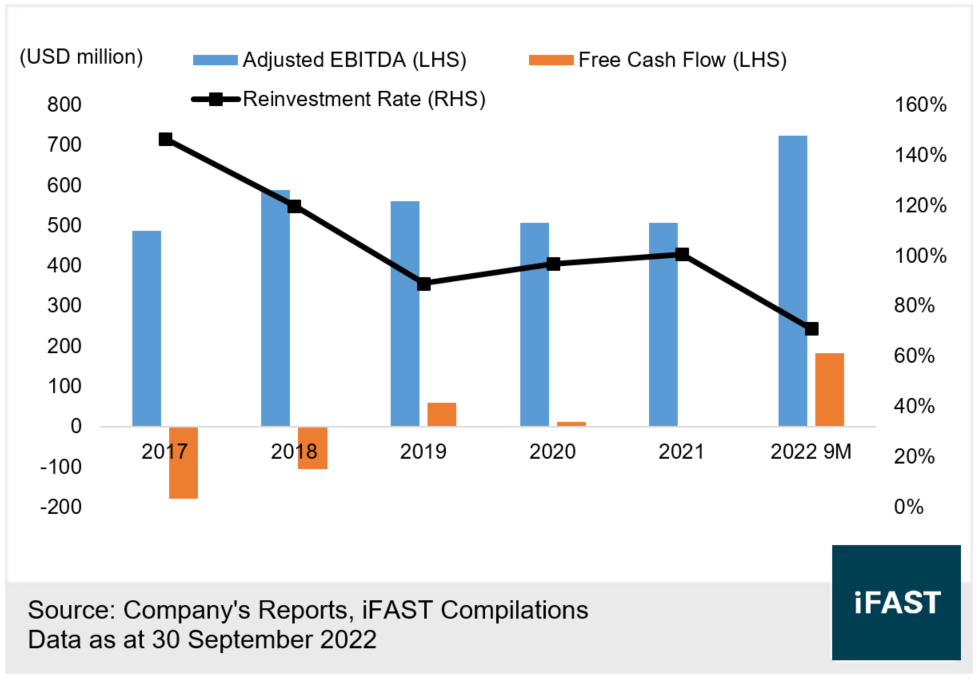
Besides, since Jason Pigott's arrival, it is clear that the free cash flows, which had been negative for a long time in the past (2015-2018), gradually improved to a rough balance between operating cash flow and capital expenditures. The company started generating a decent cash flow last year under the environment of high oil prices. The company's reinvestment rate (capital expenditure / operating cash flow) is showing a downward trend. The operating performance is gradually improving.
A Reduction in Hedging Exposures and Increase in Exposure to Crude Oil Production
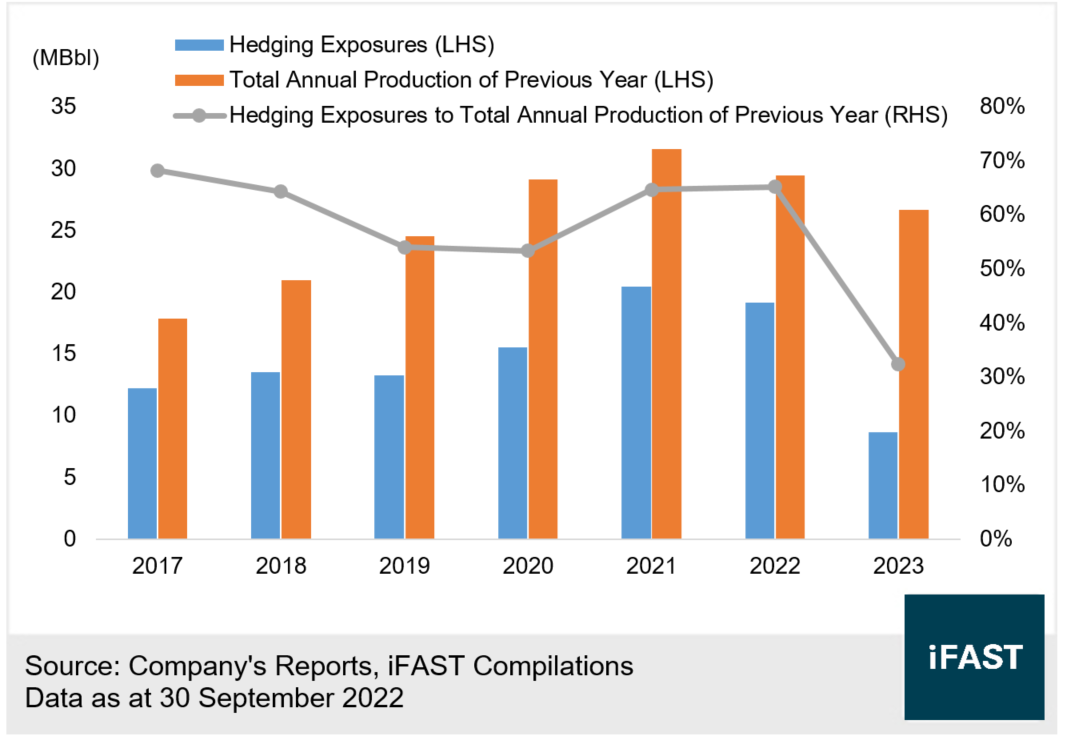
It is highlighted that Vital Energy hedged 50% to 70% of its production ahead of time in the past (Chart 2). However, the management has indicated that it would reduce the hedging exposures in the future (in line with debt reduction). For example, the hedging position might be reduced to around 32% in 2023 (as of the end of September 2022) to take advantage of the high oil price environment, where the company could enjoy a good margin and strong cash flows. If the high oil price environment continues, this could significantly boost the company's profit and cash flow performance.
Chart 2: Vital Energy’s Hedging Exposures and Annual Total Production
On
the other hand, the company is trying to improve its product mix with a view to
increasing its exposures of crude oil production. Given that Permian basin has
a relatively more frequent oversupply of natural gas or natural gas liquids and
that the company does not have an advantage in energy transportation and
exports, the company sold natural gas and natural gas liquids at a significant
discount to market prices for many years (see Table 1).
If the company succeeds in increasing the exposure to crude oil production in the future, this could help improve its margins and lower its overall break-even point, making it more resilient to the next downturn.
Table 1: Vital Energy’s Realised Prices of Crude Oil, Natural Gas and Natural Gas Liquids (Excluding Derivatives)
|
2017 |
2018 |
2019 |
2020 |
2021 |
|
|
Crude Oil ($/BBl) |
46.3 |
59.3 |
52.1 |
37.7 |
66.4 |
|
- % of Benchmark Price |
97% |
96% |
100% |
105% |
105% |
|
Natural Gas ($/Mcf) |
2.06 |
1.38 |
0.53 |
0.79 |
2.61 |
|
- % of Benchmark Price |
78% |
78% |
61% |
65% |
78% |
|
Natural Gas Liquids ($/BBl) |
18.5 |
21.4 |
12.2 |
7.4 |
22.9 |
|
- % of Benchmark Price |
71% |
68% |
58% |
45% |
66% |
|
Sources: Company’s Reports, iFAST Compilations Data as at 31 December 2021 |
|||||
Company’s Credit Profile has Large Room for Improvement; Its Debt Reduction Pace is Expected to be Accelerated
As shown in Table 2, Vital Energy's total debt was $1.18 billion at the end of September 2022, a decrease of 18% from the end of 2021. The company's net debt / adjusted EBITDA and net debt / free cash flow were 1.4x and 5.9x, respectively. The leverage continues to improve. Overall, the company's credit profile still has large room for improvement.
Table 2: Vital Energy’s Main Credit Indicators
|
Dec 20 |
Dec 21 |
Sep 22 |
|
|
Total Debts (USD million) |
1,200 |
1,440 |
1,180 |
|
Total Cash (USD million) |
50 |
10 |
30 |
|
Undrawn Credit Facility (USD million) |
480 |
580 |
960 |
|
Net Debt / Adjusted EBITDA (times) |
2.5x |
3.0x |
1.4x |
|
Net Debt / Free Cash Flow (times) |
103.6x |
-v.e FCF |
5.9x |
|
Net Debt / Market Capitalisation (%) |
528% |
146% |
115% |
|
Interest Coverage Ratio (times) |
4.8x |
4.5x |
7.1x |
|
Average Cost of Borrowings (%) |
8.7% |
8.6% |
9.8% |
|
Sources: Company’s Reports, iFAST Compilations Data as at 30 September 2022 |
|||
The company could place and issue new shares to raise capital, such as a share placement of around 1.44 million to raise around $72.5 million in 2021. The company could continue to do this in the future to improve its overall liquidity, which might benefit its credit profile.
Along with the persistence of the high oil price environment and the company's intention to reduce the debt level and hedging position, we expect the company's balance sheet to improve significantly in the coming period. The company could accelerate its debt reduction pace. Overall, while the company's credit indicators are not as decent as those of its peers, the company's short- to medium-term credit risk still remains manageable.
Investors could Consider its Shorter-term Bond, with a Yield to Maturity of 8.6% for January 2025 Bond
Vital Energy currently has an issuer credit rating of B (S&P) and a bond credit rating of B+ (S&P), both of which are non-investment grade.
We believe that the company's short- to medium-term credit risk is manageable, so investors could consider its shorter-term bonds. Referring to its debt maturity profile (Chart 3), the next maturity is in January 2025, with a principal amount of around $460 million. The company has two years to prepare for repayment, including taking advantage of the free cash flow generated during the two-year period (estimated to be around $300-500 million in total), as well as issuing new bonds and placing shares to replenish the funds.
Chart 3: Vital Energy’s Debt Maturity Profile
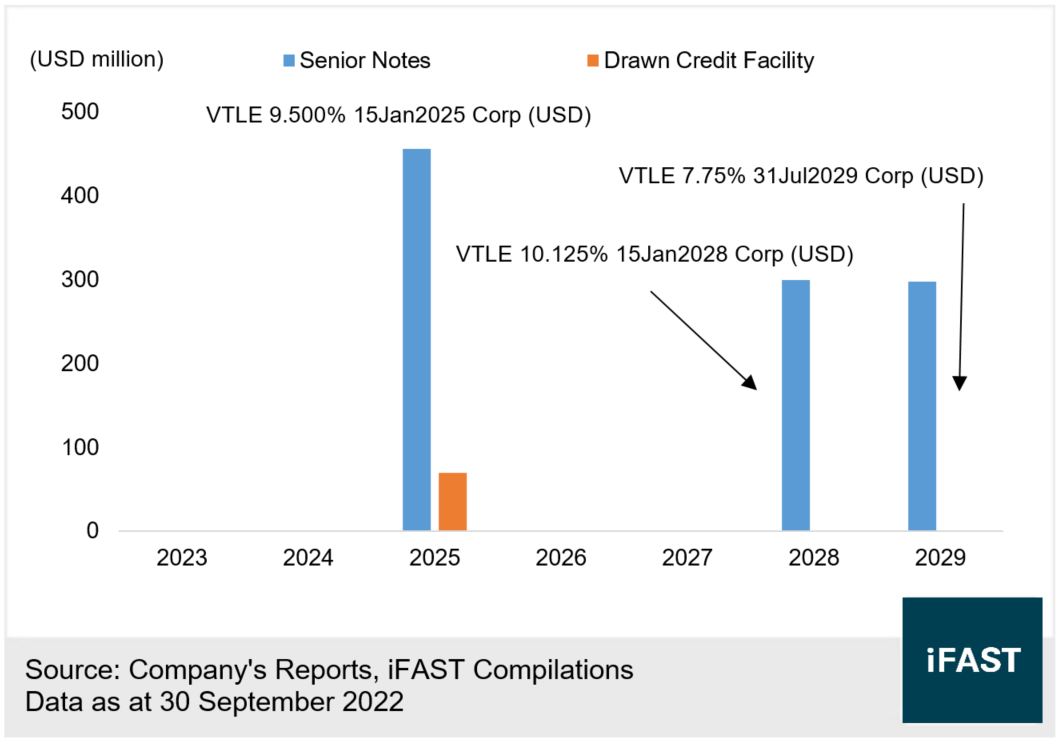
The bond, VTLE 9.500% 15Jan2025 Corp (USD), is due in January 2025, with a yield to maturity of 8.6% (Table 3). It is worth investor’s consideration.
For longer-term bonds, we believe investors should take a wait-and-see approach towards longer-term bonds, because of the volatility of oil prices and the uncertainty of long-term supply and demand pictures for conventional energy. Also, the company has yet to provide strong evidence that it can handle the next downturn.
Table 3: Vital Energy’s Bonds
|
Bond Name |
Years To Maturity |
Yield To Maturity (%) |
Yield to Call (%) |
Minimum Investment Nominal Amount |
|
2.0 |
8.6% |
7.3% (January 2024) |
USD 2,000 |
|
|
5.0 |
10.4% |
10.3% (January 2026) |
USD 2,000 |
|
|
VTLE 7.75% 31Jul2029 Corp (USD) |
6.5 |
9.8% |
9.4% (July 2026) |
USD 2,000 |
|
Sources: Bondsupermart Data as at 3 February 2023 |
||||
Related Risk
The company's revenues are primarily from the sale of crude oil and natural gas, which are highly volatile. This could result in its revenues to be volatile as well.
The company hedged heavily in the past when oil prices were low, resulting in low cash flows. In the future, the company may misjudge oil price trends again, implying a higher execution risk. As a result, the company's profit and cash flows might be weaker than its peers.
In addition, the company's oil fields are all located in the Permian-Midland Basin, where there is a greater chance of short-term oversupply of natural gas and natural gas liquids. Moreover, the company does not have significant advantage in energy transportation and exports, and its realised prices of natural gas and natural gas liquids are generally much lower than the market prices. During the oil downturn, these could seriously affect the company's operating performance.
Conclusion
Vital Energy is a small US oil and gas company with oil fields located in the Permian-Midland Basin and annual production of around 27 million MMboe. The operating performance is gradually improving after the changes in the management of the company. The company would reduce the hedging exposures and increase the crude oil exposure going forward.
The company’s credit profile has a large room for improvement. Its debt reduction pace is expected to be accelerated. The company's short- to medium-term credit risk remains manageable.
Investors could consider its shorter-term bond, with a yield to maturity of 8.6% for the January 2025 bond. Investors can enter the bond at the minimum investment nominal amount of USD 2,000.
Declaration: For specific disclosure, at the time of publication of this report, IFPL (via its connected and associated entities) and the analyst who produced this report hold a NIL position in the abovementioned securities.
Our podcast series, Yield Hunters, is available on Spotify, iTunes Podcasts and Google Podcasts. We share our thoughts on new bond issues and hold discussions on the fixed income space. Listen to our latest episode below and follow us!