Highlights:
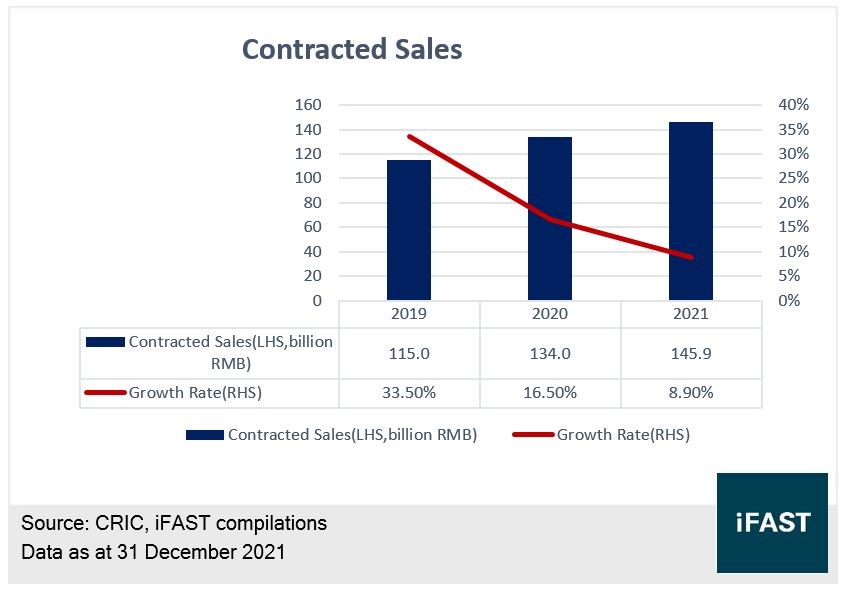
- While the market sentiment of the Chinese property market is on the downside, due to its adequate sellable resources, CIFI reported a full-year attributable contracted sales of RMB 145.9 billion (same currency below, unless otherwise specified) in 2021, up 8.9% YoY, and outperformed most large-sized peers.
- In respect to credit profile, despite engaging in plenty of collaborative property projects, the company maintains its off-balance-sheet debt at a reasonable level. Owing to its considerable cash balance, after reclassifying guaranteed joint ventures/associated companies’ debt and perpetual bonds into short-term debt, the adjusted ratio of cash to short-term debt spiked to 1.4x, hinting decent liquidity.
- As it has a decent credit profile, CIFI’s short-duration USD bonds are trading at around 90, which yields attractive investment values.
As Chinese property issuers started to face credit risks in the second half of last year, a huge plunge in the bond prices was triggered. Most of the high yield bonds are currently trading at below 50. However, we noticed that CIFI Holdings (Group) Co. Ltd. (“CIFI” hereafter) was an exception (see chart 1), its short-term bonds are still trading at around 90. Why can the company be immune amidst the volatile Chinese property bond market?
Contracted Sales in 2021 Retains Growth, and Growth Rate has outstood the Large-sized Developers
The contracted sales of CIFI amounted to RMB 145.9 billion (see chart 1), rising by 8.9% from the RMB 134.0 billion in 2020. Although the growth rate was relatively slow compared with the performance in the previous years, it was still commendable under the property market downturn and the spate of credit events in 2021.
Chart 1: Contracted Sales
In comparison to the large-sized peers (see chart 2), CIFI’s growth rate of the attributable contracted sales has been outstanding in 2021. It was only surpassed by a few peers, such as Logan and Gemdal. How did the company achieve such excellent performance?
Chart 2: Growth Rate of Large-sized Developers
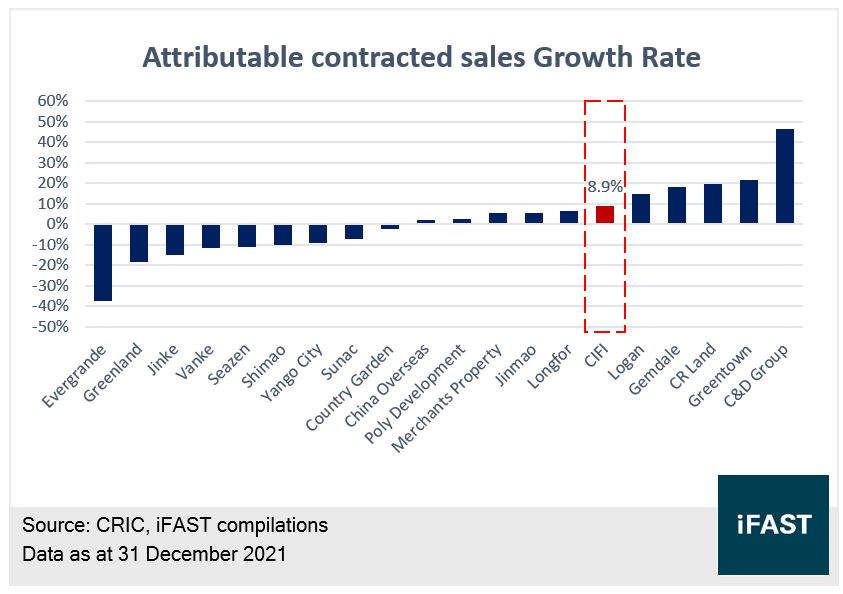
We believe that the decent sales results could be explained by the location of sold projects, over 80% of those are in tier-one and tier-two cities of China. Moreover, CIFI released abundant sellable resources in 2021, of which RMB 260 billion is for 2H2021, propping the final sales result up to some extent.
Desirable Location of Land Bank, Conservative Land Purchasing in 2021
As at 30 June 2021, the total land bank owned by CIFI has been amounted to 32.0 million sq. m, which is equivalent to RMB 540.0 billion on the basis of the current selling price of RMB 17,000 per sq. m, suggesting that the land bank is relatively adequate. From the perspective of the land bank structure, most of them are located in tier-one and tier-two cities, which may provide strong support to future sales growth after the turnaround of the property market.
It is worth mentioning that CIFI has turned conservative on land purchase. While the land spending has reached RMB 23.8 billion in 1H2021, it was only RMB 5.4 billion in 2H2021. However, it is undoubtedly a pretty wise choice to spend wisely and save diligently when the refinancing rules have been tightened.
Numerous Collaborative Projects, But Off-balance-sheet Risk is Manageable
In our previous article “Idea of the Week: How does CIFI Sustain Rapid Growth and a Decent Credit Profile at the Same Time?”, we mentioned that CIFI adopts a cooperation-oriented business strategy, meaning that the company co-develops with other property developers. Under this business model, a portion of projects is not consolidated into CIFI’s financial statement, which suggests CIFI may have off-balance-sheet debts. So how much off-balance-sheet debt does CIFI actually have?
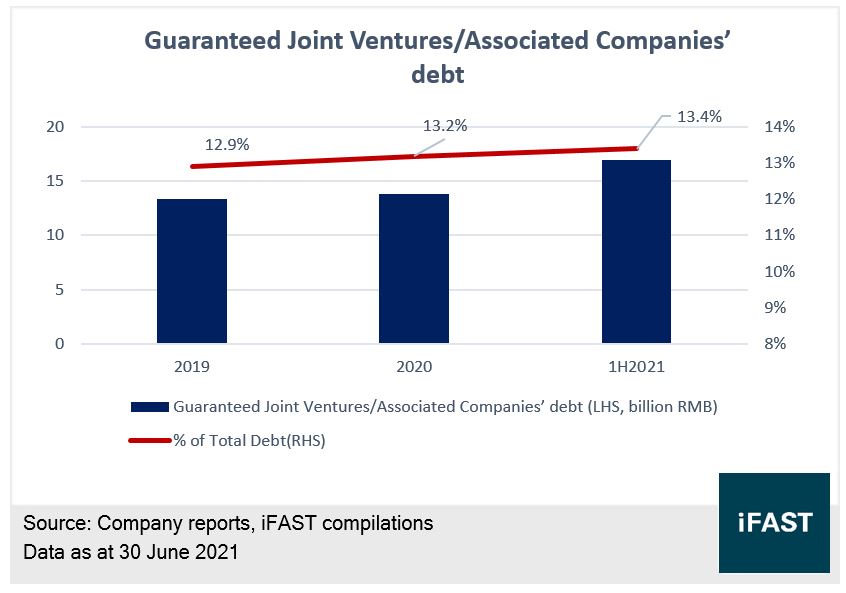
In fact, differing from other developers, CIFI usually discloses the amount of guaranteed joint ventures/associated companies’ debt to the public. We see that guaranteed joint ventures/associated companies’ debts were RMB 13.4 billion, RMB 13.8 billion and RMB 17.0 billion respectively in 2019, 2020 and the first half of 2021, making up approximately 13% of the total debt (see chart 3).
Chart 3: Guaranteed Joint Ventures/Associated Companies’ Debts
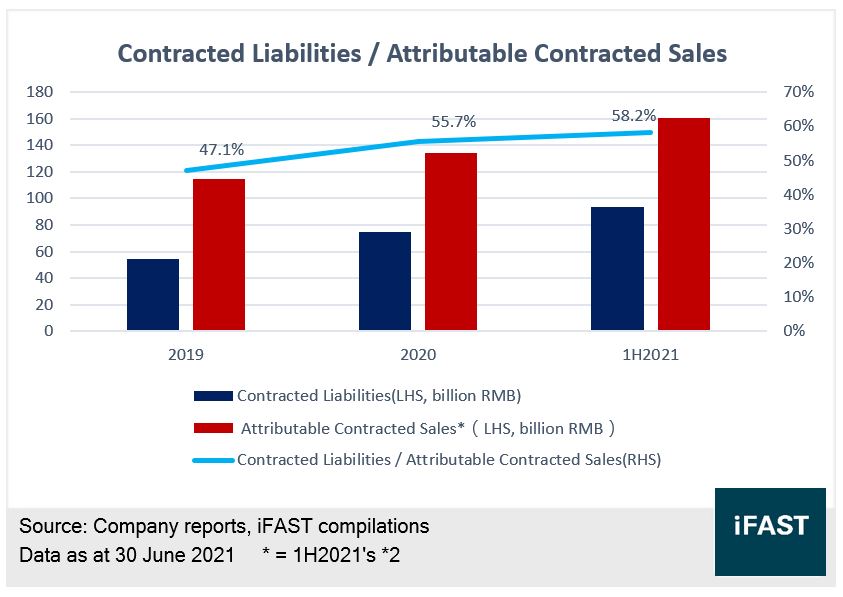
Besides, we observe that the ratio of contracted liabilities to attributable contracted sales rose from 47.1% in 2019 to 58.2% in 1H2021(see chart 4), implying there is an increase in the proportion of collaborative projects that are consolidated into financial statements, which alleviates concerns on off-balance-sheet risks.
Chart 4: Contracted Liabilities to Attributable Contracted Sales
In terms of other credit metrics for off-balance sheet debts, CIFI’s estimated consolidated ratio stood at 45%, which is 14% lower than its guided consolidated ratio. It suggests that off-balance-sheet credit status is similar to Sunac’s, but weaker than that of Country Garden (see table 1). We think the overall off-balance-sheet risk is manageable.
Table 1: Guided Consolidated Ratio and Estimated Consolidated Ratio
CIFI | Sunac | Country Garden | |
Estimated Consolidated Ratio | 45% | 49% | 75% |
Guided Consolidated Ratio | 59% | 63% | 71% |
Difference between Consolidated Ratio | 14% | 14% | 4% |
Sources: Company reports and CRIC Data as at 30 June 2021 | |||
Manageable Short-term Debt with Adequate Cash in Hand
As at 30 June 2021, CIFI’s debt structure is desirable, with RMB 19.6 billion of short-term debt and RMB 91.2 billion of long-term debt. Concurrently, cash and cash equivalents amounted to RMB 52.3 billion, the ratio of cash to short-term debt is 2.7x. The number was considerably higher than the required number of 1.0x from the Three Red Line policy.
However, from the past experience, the ratio of cash to short-term debt may not reflect the company’s actual liquidity, as the off-balance-sheet debt may lead to a cash outflow, worsening the debt repayment capability. In the worst-case scenario, even if we classify all guaranteed joint ventures/associated companies’ debt and perpetual bonds into short-term debts, the adjusted ratio of cash to short-term debt would decline to 1.4x, it would still meet the requirement.
Besides, CIFI’s net gearing ratio moved downwards from 64% at the end of 2020 to 60.4% in mid-2021, and the adjusted liability to asset ratio was 72.1%. The latter failed to meet the regulatory requirement. As a consequence, CIFI remains in the yellow zone.
Table 2: Credit Metrics
Credit Metrics | Jun-21 | Three Red Lines Requirements |
Short-term Debt | 195.6 | / |
Long-term Debt | 911.8 | / |
Cash and Cash Equivalents | 523.0 | / |
Ratio of Cash to Short-term Debt | 2.7 | >1.0倍 |
Adjusted Ratio of Cash to Short-term Debt | 1.4 | / |
Net Gearing Ratio | 60.4% | <100% |
Adjusted Liability to Asset Ratio | 72.1% | <70% |
Weighted Average Borrowing Cost | 5.1% | / |
Sources: Company reports Data as at 30 June 2021 | ||
Onshore Refinancing Restores, Overall Liquidity Looks Desirable
CIFI proactively strengthens the liquidity buffer, even though it has adequate cash in hand. For example, CIFI has recently monetised 30% of the share in the Pudong, Shanghai project. We also noticed that CIFI made substantive progress on repairing its onshore refinancing channel. As reported on 11 Feb, the company’s scheme of RMB 5 billion MTN from the interbank market has been approved by the regulator. In fact, since the real estate debt crisis in 2H2021, only a few state-owned or central government-owned developers still have access to the interbank bonds market. As CIFI is a non-stated-own developer, it shows that the interbank market favors its solvency.
Generally speaking, the commercial paper rate of subsidiaries also can reflect a company’s liquidity. According to our checking, the commercial paper rate of CIFI’s subsidiaries is priced around 16%, revealing its liquidity is desirable when compared to a central government-owned company, China Resource’s 20% rate.
Due to its desirable liquidity, the rating agency, Fitch, affirms CIFI at “BB” at the end of January this year, with a stable outlook and removing all the ratings from Under Criteria Observation (UCO). On the whole, CIFI’s credit risk from both the balance sheet and off-balance sheet is manageable. As a result, the company can be basically immune from the volatility of the Chinese bond market.
Give Priority to Short-duration Bond for Investment
As of now, there are eight bonds issued by CIFI on our platform, with years to maturity ranging from 0.9 to 6.2 years. From the table below, we can see that long-duration bonds make up the majority. Due to the contractive policies, the Chinese property market may face an unpromising future, hence investors may give priority to short-duration bonds. Its 2023 USD bond is currently trading around 90 with a yield to maturity of 17.8%. Given its decent liquidity, we think the bond is fairly priced. Investors who believe CIFI has development potential can consider investing in it.
Table: CIFI USD Bonds
Bond | Years to Maturity | Ask Price | YTM |
0.9 | 90.3 | 17.8% | |
2.7 | 76.8 | 17.7% | |
3.4 | 72.9 | 16.8% | |
3.7 | 72.9 | 16.1% | |
4.2 | 71.0 | 14.8% | |
4.5 | 70.7 | 13.4% | |
5.1 | 69.9 | 12.5% | |
6.2 | 69.9 | 11.8% | |
Sources: BSM, data as at 4 Mar 2022 | |||
Corporate Risk
As at 30 June 2021, CIFI’s floating-rate debt has amounted to RMB 55.6 billion, which is about 50.2% of total debt. It is important to note that most of the floating-rate debt is denominated in non-CNY, then the debt amount will likely expand along with the interest rate hike cycle (excluding China) and CIFI will have higher debt repayment stress as a result.
Secondly, CIFI adopts a cooperation-oriented business strategy, meaning that the operation undoubtedly generates a large number of receivables and payables. If the CIFI could not convert the receivables into cash timely, the shortage of liquidity would increase and thus causing the credit profile to deteriorate.
Conclusion
While the market sentiment of Chinese property market is on the downside, due to its adequate sellable resources, CIFI reported a full-year attributable contracted sales of RMB 145.9 billion in 2021, up 8.9% YoY, and outperformed most large-sized peers.
In respect to credit profile, despite engaging in plenty of collaborative property projects, the company maintains its off-balance-sheet debt at a reasonable level. Owing to its considerable cash balance, after reclassifying guaranteed joint ventures/associated companies’ debt and perpetual bonds into short-term debt, the adjusted ratio of cash to short-term debt spiked to 1.4x, hinting a decent liquidity.
As it has a decent credit profile, CIFI’s short-duration USD bonds are trading at around 90, and yields an attractive investment value.
Declaration: For or specific disclosure, at the time of publication of this report, IFPL (via its connected and associated entities) and the analyst who produced this report hold a NIL position in the abovementioned securities.