Receive first-hand news on the latest bond issues, credit updates and special events when you join us on our Telegram channel at https://t.me/bondsupermart!
Highlights:
- Influenced by the valuation slump of Coupang and Didi, Softbank Group’s vision fund marked a large investment loss, then resulting in a net loss of approximately JPY 1.7 trillion in FY2021. Softbank Group continued its poor performance in the first quarter of FY2022 as global stock market sentiment remained depressed this year. Non-investment segments remain stable.
- Credit-wise, the huge investment loss has limited impacts on Softbank Group’s cash flow, and current leverage trends down. The overall credit profile remains decent.
- Bond due 2024 is yielding over 7% which makes it a good choice among BB-rated bonds.
We have introduced Softbank Group in our article “Bond Focus: Softbank Group USD Bond” two years ago. At that time, those bonds’ return is rather unattractive, mostly less than 4%. However, bond yields have now move up and investment value is exhibited.
Equity Investment Segment Dragged Down Softbank Group’s Performance
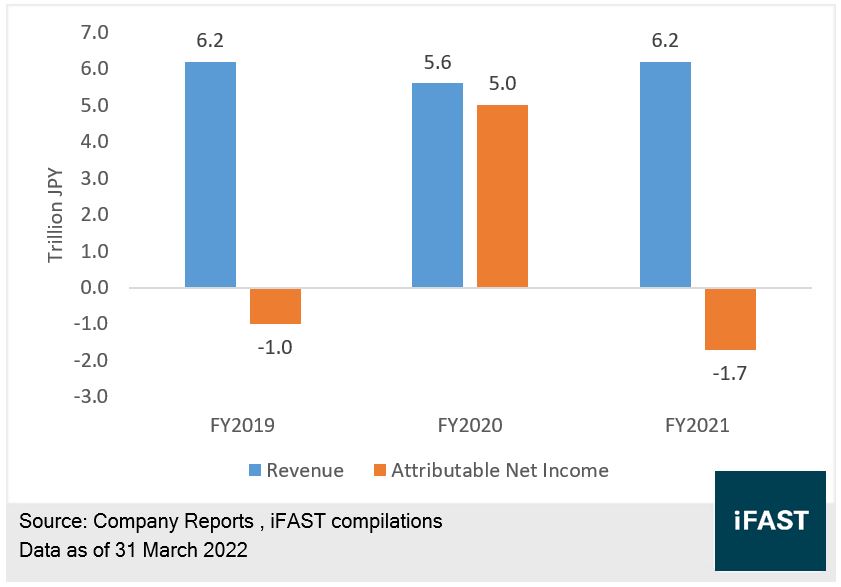
From Chart 1, Softbank Group remarked revenue of JPY 6.2 trillion in FY2021 (from 1 Apr 2021 to 31 Dec 2022), which is a 10.7% increase YoY. Net income attributable to owners of the parent company amounted to JPY 5.0 trillion in FY 2020 but it was JYP -1.7 trillion in FY2021. Why is there such a significant discrepancy?
Chart 1: Revenue and Profit
As a matter of fact, Softbank Group’s equity investment segment gave rise to its poor profitability. The company recognised an investment loss of JPY 3.4 trillion in FY2021, a far cry from the investment gain in FY2020 (JPY 7.5 trillion). The huge investment loss is in fact correlated with Softbank Group’s Vision Fund. In 2016, Softbank Group set up Vision Fund to promote its venture capital business. As of March 2022, Vision Fund has invested in a total of 330 startups, including 36 listed companies.
Due to the bearish market sentiment in FY2021, a lot of startups experienced a significant value decline. For example, the share price of Coupang, a Korea-based E-commerce company, fell from $50 to $17 after its listing on the NYSE in March 2021, inflicting an investment loss of JPY 1.6 trillion. Additionally, China's e-hailing tycoon Didi, which is exposed to regulation risk, has also reported a plummet in its share price, resulting in another investment loss of JPY 0.9 trillion. In summary, the total investment loss of Vision Fund stood at JPY 3.7 trillion.
Table 1: Softbank Group’s Income from Equity Investment
|
(Trillion JPY) |
Vision Fund |
Investment Business of Holding Companies |
Latin America Funds |
Other Investment |
Total |
|
FY2020 |
6.3 |
0.9 |
0.2 |
0.1 |
7.5 |
|
FY2021 |
-3.7 |
0.1 |
0.1 |
0.1 |
-3.4 |
|
Source: Company reports, iFAST compilations Data as of 31 March 2022 |
|||||
The bearish market drives up Softbank Group’s investment loss to JPY 2.9 trillion for the first quarter of FY2022, and the company’s net loss reached a record high of JPY 3.2 trillion. As the bearish performance continues, and the impact of interest rate hikes is much bigger on companies that are growing. We thus expect Softbank Group to face further investment loss.
Non-investment Segments Remain Stable
With regard to the non-investment segment, income generated from the telecommunications business (including Softbank Corporation, Yahoo! Japan, and ARM etc.) was JPY 5.7 trillion, which rose by 9.3% compared to last year. EBITDA amounted to JPY 1.6 trillion, increased by 3.8% YoY. This signals a stable operating performance.
Softbank Group acquired the semiconductor design company ARM several years ago and planned to sell it to display card giant NVIDIA in 2020. Yet, the deal crashed earlier this year because the Softbank Group failed to get approval from regulatory authorities. Alternatively, Softbank plans to list it on both the UK and US capital markets. As of March 2021, Softbank Group owned about 75% of ARM, which is valued at around USD 60 billion. If the IPO goes smoothly, it would be quite a profit for the Softbank Group.
Turn to Defensive Stance in Investment, Leverage Moves Downward
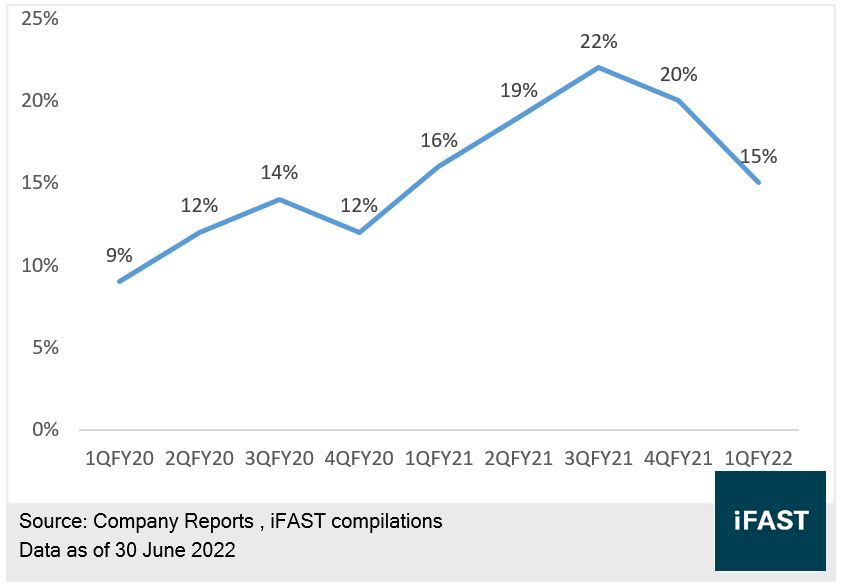
The interest-bearing debt of Softbank upsizes alongside the equity investment amount, which climbed from USD 14.2 billion in FY2019 to USD 46.6 billion in FY2021. As a result, the LTV ratio (Net debt/Equity value of holdings) is on an upward trend, showing expanding leverage.
However, as mentioned by Masayoshi Son, the CEO of Softbank Group, Softbank Group will turn to a defensive stance in investment selection and shrink the investment amount as the world is entering into chaos, and would also consider investing more in startups with less than USD100 million each, rather than unicorns with over USD 1 billion. Given that most of the major economies have entered the interest rate hike cycle, the environment is less favorable for growth companies. It thus makes sense, for Softbank Group, to tighten investment amounts.
The effect of investment downsizing by Softbank Group is immediately evident, as the LTV ratio has dropped to 15% in the first quarter of FY22, and the current LTV ratio is still way below the upper limit of 35%, suggesting that the leverage ratio is at a healthy level.
Chart 2: Softbank Group’s LTV Ratio
Ample Liquidity and Decent Solvency
Softbank Group's interest-bearing borrowings amounted to JPY 21.4 trillion at the end of June 2022, roughly unchanged from end of March 2022. Short-term borrowings declined from JPY 7.3 trillion to JPY 6.6 trillion, representing an optimization of the debt structure.
Although the Softbank Group experienced huge investment losses, it is important to note that these losses were mainly due to the decline in financial asset prices (Unrealized loss) and did not result in any change in the company's cash flow. Besides, Softbank sold some of its holding with losses, which could offset the tax liability by tax harvest and reduce cash outflows.
As of June 30, 2022, Softbank Group's cash and cash equivalents stood at JPY 6.1 trillion, up significantly from JPY 5.1 trillion at the end of March, but still slightly below the company's short-term debt. Even so, we are still optimistic about the liquidity because invested equity could be a potential source of liquidity. As of June 2022, the net asset value of equity holdings totaled JPY 18.5 trillion; the potential market value might be at JPY 9.2 trillion based on the 50% discount rate, which could be enough to close the funding gap.
It is a common practice of the Softbank Group to monetise holding equity for liquidity. For example, its "JPY 4.5 Trillion Program" in March 2020 disposed JPY 4.5 trillion assets for share repurchase and replenishing liquidity via sales and monetisation of invested equity such as Alibaba, Softbank Corporation, and T-Mobile.
On the other hand, Softbank Group announced its plan on repurchasing JPY 1 trillion worth of company shares within one year last November. As of July 2022, the company has already repurchased JPY 0.7 trillion worth of shares, the remaining JPY 0.3 trillion will be completed by November this year, demonstrating ample liquidity and a decent credit profile.
Short-duration Bonds Are Attractive
For bond investment, Softbank issued quite a number of bonds, of which seven of them are tradeable on our platform (Table 2). Their investment horizon ranges from 0.5 to 9 years. The credit rating is BB+ by S&P.
Table 2: Bonds issued by Softbank Group
|
Bond |
Year to Maturity |
Ask Price |
YTM |
|
SOFTBK 5.500% 20APR2023 CORP (USD) |
0.5 |
100.0 |
5.5% |
|
SOFTBK 4.750% 19SEP2024 CORP (USD) |
1.9 |
95.4 |
7.4% |
|
SOFTBK 3.125% 06JAN2025 CORP (USD) |
2.2 |
91.6 |
7.4% |
|
SOFTBK 4.000% 06JUL2026 CORP (USD) |
3.7 |
85.8 |
8.6% |
|
SOFTBK 5.125% 19SEP2027 CORP (USD) |
4.9 |
83.2 |
8.9% |
|
SOFTBK 4.625% 06JUL2028 CORP (USD) |
5.7 |
81.2 |
9.0% |
|
SOFTBK 5.250% 06JUL2031 CORP (USD) |
8.7 |
78.5 |
9.0% |
|
Sources: Bondsupermart |
|||
After shrinking the investment amount, although Softbank delivered poor operation results, the overall credit profile remains decent and there is still a certain safety margin. From table 2, the yield curve of USD bonds is pretty flat—the yields on short- and longer-duration bonds are both at around 7%-9%.
Given the weak performance of the global equity market, Softbank Group, which invests mainly in technology companies, may continue to face losses in the future and its long-term uncertainty has increased. Investors thus can give priority to short-duration bonds, like ‘SOFTBK 4.750% 19SEP2024 CORP (USD)’. The bond has a moderate investment horizon and yield to maturity of 7.1%, which is rather attractive for investment.
Corporate Risk
Investors should be aware of the following risk. Firstly, Softbank is exposed to high exchange risk because of the depreciation of JPY. In view of Japan’s central bank’s ongoing ultra-loose monetary policy, JPY has depreciated against the USD by over 30% year to date. Softbank will face increasing debt repayment pressure if JPY continues to depreciate, given that a big portion of the debt is USD-denominated.
Secondly, Softbank has invested in a number of US-listed Chinese technology companies such as Alibaba, Beike and Dingdong etc. Since SEC is listing more Chinese companies under the "Holding Foreign Companies Accountable Act", these companies might be forced to delist from the U.S capital market. Besides, some startups that had planned to list on the U.S. stock exchange may miss the opportunity to do so, resulting in a huge blow to Softbank Group.
Conclusion
Influenced by the valuation slump of Coupang and Didi, Softbank Group’s vision fund remarked a is a large investment loss, then resulting in a net loss of approximately JPY 1.7 trillion in FY2021. Softbank Group continued its poor performance in the first quarter of FY22 as global stock market sentiment remained depressed this year. Non-investment segments remain stable. Credit-wise, the huge investment loss has limited impacts on Softbank Group’s cash flow, and current leverage trends down. The overall credit profile remains decent. Bond due 2024 is yielding over 7% which makes it a good choice among BB-rated bonds.
Declaration: For specific disclosure, at the time of publication of this report, IFPL (via its connected and associated entities) and the analyst who produced this report hold a NIL position in the abovementioned securities.
Our podcast series, Yield Hunters, is available on Spotify, iTunes Podcasts and Google Podcasts. We share our thoughts on new bond issues and hold discussions on the fixed income space. Listen to our latest episode below and follow us!