Industrial properties are seeing healthy leasing demand against a backdrop of higher ecommerce activity.
Market fundamentals in overseas logistics markets like Australia are strong and improving.
Perpetual notes of industrial REITS with less than two years to call are trading at a reasonable yield in light of their healthy credit profiles.
Industrial and logistics properties are still going strong in the midst of the pandemic. Despite the challenging business environment, many tenants in the industrial sector have continued to operate and provide essential services to customers. As a result, leasing demand for industrial warehouses has been quite resilient.
The pandemic has upended many economic activities including working arrangements and how consumers purchase goods and services. Even though social distancing requirements have been eased, a large part of these requirements are still in place. More consumers are spending less time at the malls and purchasing goods online - fuelling the adoption of e-commerce and driving the demand for logistics facilities.
Meanwhile, more employees are working remotely from home and spending less time in the office, prompting employers to rethink their office space requirements. If Covid-19 turns into an endemic, corporate tenants in the central business districts could decide to cut their rental costs and opt for larger spaces in the city-fringes or possibly explore rental solutions in industrial buildings.
Either way, we believe that the global economy is still recovering and industrial REITs are well-positioned to ride on the growth of the logistics and ecommerce sectors. All in all, vacancy and rental rates are likely to remain stable given the current favourable market-supply dynamics of the industrial real estate market.
Could this be the start of an uptrend in industrial property prices?
With a greater proportion of people spending time at home, coupled with construction manpower shortages, border closures and low housing supply, the Singapore residential property price index for all residential properties has soared to a record high in June (Figure 1). Housing prices have exceeded the previous high in 2013, and market observers think that more cooling measures may be on the cards, although the MAS did comment that the property market was not overheated in June.
Figure 1: Singapore industrial and residential property prices
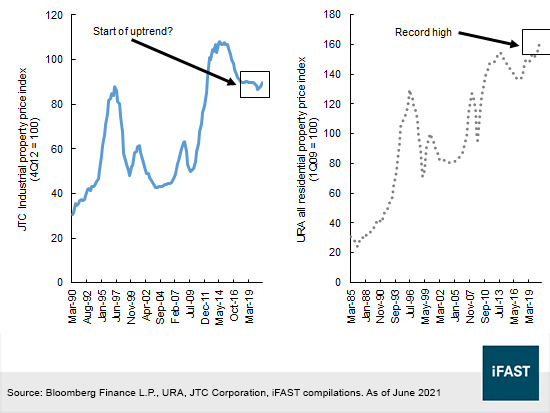
Residential properties may be transacting at higher prices between 2016 and 2020 but the same cannot be said for industrial properties. They have yet to catch up with their residential peers. As a matter of fact, industrial property prices peaked in 2014 and dropped to a low in June 2020, coinciding with economic headwinds stemming from the onset of the coronavirus outbreak. During the second quarter of 2020, transaction volumes for industrial properties plunged as more investors kept their cash parked on the side lines.
Figure 2: Number of JTC caveats lodged and aggregate vacancy rate since 2018
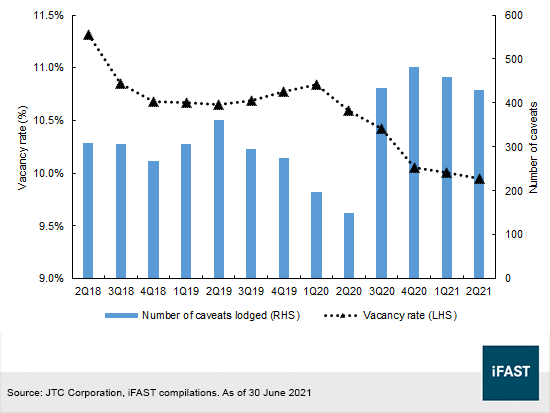
However, after falling to a low in June last year, transaction volumes tracked by the number of caveats lodged with JTC, quickly rebounded in the second half of 2020 (Figure 2). Transaction volumes have since remained at an elevated level, consistently staying above the 300 level and reaching volume levels last seen in 2015. Concurrently, the vacancy rate for industrial properties continued to improve, declining from 11.3% in June 2018 (“2Q18”) to 9.9% in 2Q21.
Looking ahead, the industrial property market will see more supply as 1.74m square metres (“sqm”) of new industrial properties will be completed in the second half of 2021 (see Figure 3). Most of these completed properties consist of single-user factory spaces while warehouse and business parks comprise the remaining 31% and 22% respectively. According to JTC projections, an additional 3.0m sqm of industrial space will be completed in 2022 and 2024, and this would exceed the average annual demand of 0.8m sqm over the past three years.
Figure 3: JTC projections on upcoming industrial property supply
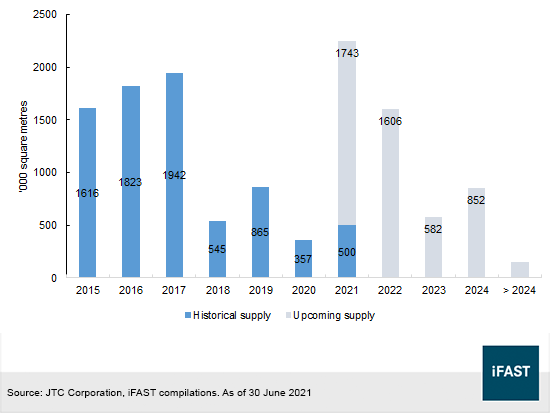
With the improving supply situation in mind, we suspect future Singapore industrial property prices may not be as robust as the last few reporting periods. Unless we see a sustainable and significant pickup in demand over the upcoming quarters, prices will likely continue increasing in 2H21 and 2022 at a slow and gradual pace.
However, many of the industrial REIT bond issuers are not restricted to operations within Singapore. Some of them such as ARA LOGOS Logistics Trust (“ALLTSP”) also operate in Australia. On this note, ALLTSP said in their recent presentation that “leasing enquiries for industrial and logistics space across Australia saw a 20-year high” in the first quarter of 2021.
Market fundamentals within the industrial space in Australia have improved with high levels of renewals and leasing activity. Frasers Property Limited also mentioned in their 9MFY21 update, that its Australian industrial and logistics portfolio is “100% occupied with a quality tenant profile”.
Industrial REIT perpetual notes with near term call dates still provide a reasonable level of yield to investors
Given our outlook for higher industrial property prices and falling vacancy rates, investors may consider investing in the perpetual notes of industrial REITs, particularly those that are callable in one to two years.
EREIT 4.600% Perpetual Corp (SGD) for example, has an indicative yield-to-call (“YTC”) of 5.30%. The first call date for this perpetual note coincides with the first reset date on 3 November 2022. If the issuer (ESR-REIT) does not redeem the note in November 2022, the distribution rate will reset to the prevailing 5-year SGD Swap Offer Rate (“SOR”) + 2.6%.
As mentioned in our earlier article in July – “ESR-REIT announces 5Y SGD bonds at 2.75% IPG after launching preferential offering”, ESR-REIT has a healthy gearing ratio and adequate sources of liquidity to service its expiring short-term debt. Additionally, there is some allowance for the company to take on more debt should it require for acquisitions or other working capital needs.
The current yield for the EREIT 4.6% perps may be a reflection of its non-call risk give that the reset rate is at presently at 3.53% (0.93% SOR + 2.6%) but we think that this risk is low as the issuer still have a good ability to access capital markets to raise funds. Recently, the REIT managed to secure SGD 150m through a preferential offering and SGD 100m through a private placement in May.
Figure 4: Relative valuation of non-bank SGD perpetual notes with less than two years to call
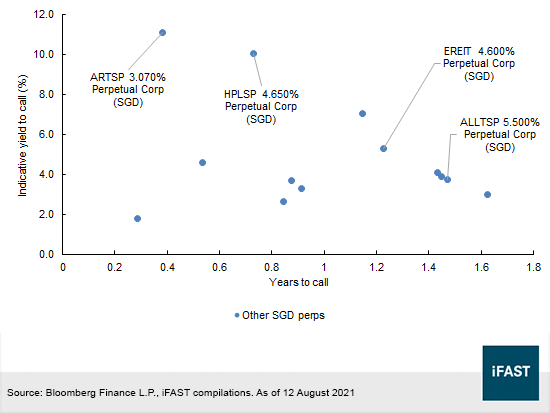
Referring to Figure 4, we observed that there are certain SGD perpetual notes that are trading below par with less than 1 year to call. These bonds have a higher non-call risk as compared to those issued by industrial REITs, and would be suitable for investors with higher risk appetites. For instance, the ARTSP 3.070% Perpetual Corp (SGD) is callable on 30 December 2021 and is trading at an ask price of 97.11 (YTC: 11.09%).
Ascott Residence Trust registered ~SGD 1.17 billion of available funds (made up of ~SGD 470 of cash and ~SGD 695m of available credit facilities) on 30 June 2021. According to its recent update, the trust had been re-deploying its divestment proceeds into higher-yielding investments such as rental housing and student accommodation units.
Revenue was down 11% year-on-year to SGD 185.0m while portfolio RevPAU (Revenue per available unit) dropped 14% to SGD 60. With SGD 103.0m of direct expenses during the first-half of 2021 and a SGD 250m sized perpetual note up for redemption, we think a December 2021 call is unlikely as the outlook for hospitality is still murky.
However, lenders are still supportive towards the company’s refinancing needs and we stand by our positive outlook on the issuer as mentioned in our last update – “As governments gradually ease travel restrictions, is it time to buy Ascott Residence Trust's bonds?”. Back then, we expected the issuer to call the perps in June 2021 but hospitality operators are still facing challenging business headwinds, which extend into 2022. At the present ask of 97.11, we think that the projected yield-to-call in December 2023 of 4.36% is still attractive.
Likewise, the HPLSP 4.650% Perpetual Corp (SGD) is trading at a high YTC of 10.04%, and that is reflective of its heightened non-call risk. If Hotel Properties Ltd does not redeem the perps on 5 May 2022, the distribution rate will fall to the 5-year SOR + initial spread of 2.685%.
At this juncture, we think that a non-call event is unlikely as Hotel Properties may resort to equity financing in future. Separately, they may divest assets to meet financial repayment obligations. The issuer’s investment properties and shop units along Orchard Road, had a carrying value of SGD 681.3m as at the end of December 2020. Together with SGD 753.5m of freehold and leasehold buildings, the combined value of SGD 1.43 billion would cover the SGD 946.1m of interest bearing liabilities due in 2 to 5 years.
ARA LOGOS Logistics Trust
Apart from the EREIT 4.600% Perpetual Corp (SGD), we also recommend the ALLTSP 5.500% Perpetual Corp (SGD), which is trading at an indicative YTC of 3.75%. The perps are callable on 1 February 2023 and on every distribution date thereafter. If the issuer, ARA LOGOS Logistics Trust (ALLTSP) does not redeem the notes on the first call date, the distribution rate will be stepped down to the prevailing 5-year SOR + initial spread of 3.58%.
In our article – “ARA LOGOS Logistics Trust – a rewarding choice in the SGD bond space” in March, we had already highlighted the attractiveness of the ALLTAP 5.5% notes when it was trading at a YTC of 4.34%.
Compared to ESR-REIT, ALLTSP oversees a smaller real estate portfolio with SGD 1.8 billion of assets under management. However, the occupancy rate of ALLTSP’s portfolio is higher and it improved from 97.0% in June 2020 to 98.2% in June 2021, exceeding that of ESR-REIT’s occupancy rate of 91.7%. ALLTSP also achieved a positive rental reversion of 2.4% in 1HFY2021 (six month period ended 30 June 2021) whereas ESR-REIT witnessed rental reversions of -1.6% during the same timeframe.
Between the two perpetual notes, the current lower yield of the ALLTSP 5.5% perps is not surprising as ALLTSP outperformed ESR-REIT in other credit aspects. Referring to Table 1, ALLTSP’s portfolio has a longer weighted average lease expiry than ESR-REIT.
In addition, ALLTSP had a higher interest coverage multiple of ~3.1x, estimated by its 1HFY2021 EBITDA to interest expense (including distributions to perpetual securities). Treating perpetual notes as debt, ALLTSP also recorded a lower gearing than ESR-REIT, which is defined as the ratio of debt to total assets.
Table 1: Latest financial results and credit metrics of the two industrial REITs
Source: Company filings, iFAST compilations. As of the six-month period ended 30 June 2021.|
|
ALLTSP |
ESR-REIT |
|
Gross revenue (SGD m) |
66.6 |
119.8 |
|
Net property income (SGD m) |
51.4 |
87.0 |
|
Average financing cost |
2.92% |
3.24% |
|
Debt to total asset ratio (treating perpetual notes as debt) |
~39.2% |
~42.7% |
|
EBITDA to interest expense multiple (including distributions to perpetual securities) |
~3.1x |
~2.5x |
|
Portfolio weighted average lease expiry |
4.0 years |
2.8 years |
|
Portfolio valuation |
SGD 1.8 billion |
SGD 3.2 billion |
|
Portfolio occupancy rate |
98.2% |
91.7% |
| Source: Company filings, iFAST compilations. As of the six-month period ended 30 June 2021 | ||
Conclusion
Broadly speaking, the outlook for companies within the industrial property segment is still positive. With the digitalisation trend and the shift towards online shopping, the need for warehouse space have increased. If working from home becomes a permanent trend, we could see more corporations shifting their head-offices to the city-fringes, relocating to possibly larger industrial buildings with lower rental costs.
Taken as a whole, we believe that the bonds of industrial REITS are worth investing, especially those that are callable in less than two years and providing a reasonably high yield to investors. Such examples would be the EREIT 4.600% Perpetual Corp (SGD) and ALLTSP 5.500% Perpetual Corp (SGD). Our confidence in these notes stems from the issuers’ strong recurring income streams and overall healthy balance sheets.
Declaration:
For specific disclosure, at the time of publication of this report, IFPL (via its connected and associated entities) holds a position in ARTSP 3.070% Perpetual Corp (SGD). The analyst who produced this report hold a NIL position in the abovementioned securities.
Our podcast series, Yield Hunters, is available on Spotify and iTunes Podcasts and Google Podcasts. We share our thoughts on new bond issues and hold discussions on the fixed income space. Listen to our latest episode below and follow us!