What’s happening?
Tropicana Corporation Berhad (TRCB:MK) has recently lodged an Islamic Medium-Term Notes Programme with the Securities Commission. The company subsequently issued two sukuks under the programme totalling RM 589 million. Utilisation of proceeds will be for repayment of existing borrowings to unencumber secured properties, funding of capital expenditure, and working capital requirements, among others.
The deal has two tranches—three-year and five-year sukuks with a coupon rate of 5.50% and 5.65% respectively.[1] In this article, we explore the risk-return dynamics of Tropicana’s new issuance to see if there’s an interesting investment opportunity for prospective investors.
Malaysia’s property market
Property overhang in Malaysia
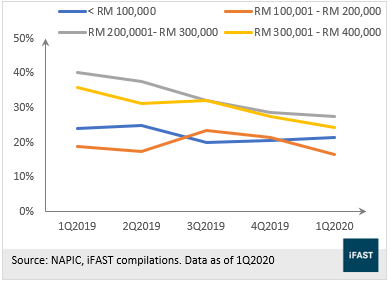
We have broken down the residential sector into three parts, namely the low-end, the mid-section, and the high-end segments. The low-end segment (under RM 400,000 in value) seemed to have benefited from 2019’s Home Ownership Campaign (“HOC”), as overhang across all sub-segments of this category had been falling. This trend is illustrated in the graph below.
Figure 1: Property overhang for properties of value under RM 400,000
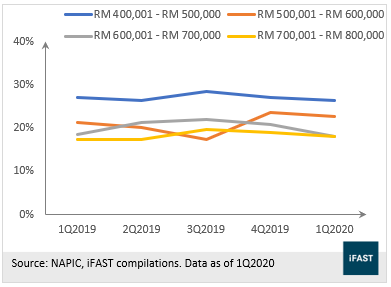
The same cannot be said for the mid-section of the market, however. Overhang in the mid-section of the property market had been flat since 1Q2019. Overhang in the RM 500,001 to RM 600,000 range even trended upwards, due to either an increase in supply or the lack of demand in the segment. The trend is illustrated in the graph below.
Figure 2: Property overhang for properties between RM 400,001 and RM 800,000
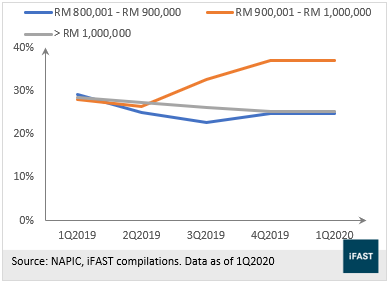
The results are similarly mixed at the top range of the residential property segment. Nonetheless, the overall sentiment seems to point to a decrease in property overhang, with the RM 900,001 to RM 1,000,000 sub-segment proving to be the only outlier that has a significant percentage of inventory remaining unsold. This trend is illustrated in the graph below.
Figure 3: Property overhang for properties over RM 800,000
Government policies to spur growth
The most notable government policy that impacts the property market is the HOC, which was launched in 2019 and ended on 31st December of the same year.
The initiative was first designed to pave the way for homebuyers to purchase properties, with several initiatives designed to ease the burden of homebuyers. On the supply side of things, it was designed to clear the stock of unsold properties in the country, given the ongoing oversupply.
While the initial plan was to cap the HOC initiative at a year, the COVID-19 pandemic and its associated adverse economic impacts have led to the reboot of the HOC initiative. The reintroduction of HOC was part of Malaysia’s economic stimulus programme, the Short-Term Economic Recovery Plan (PENJANA), aimed to support businesses and help soften the blow of an economic contraction.
Given the positive impact from the campaign we have seen last year, this should bode well for property developers.
Tropicana’s latest numbers
In June, Tropicana released its 1QFY2020 results. As many anticipated, the results were underwhelming, owing much to the COVID-19 outbreak, which has halted businesses due to the government-imposed Movement Control Order (“MCO”) since 18 March 2020. Year-on-year revenue dropped by a whopping 31.96%, reflecting lower progress billing and lower on-site completion, as the property sector was not allowed to operate under the MCO. That being said, the quarter’s operating margin still remained in the positive double-digit region (18.85%), in line with previous quarters.
To put into context Tropicana’s latest numbers, we have “smoothened” out the first quarter’s impact by using adjusted trailing-twelve-month (“TTM”) numbers, and to compare them against the industry average. The industry average in this case is the median value across all listed property developers on the Kuala Lumpur Stock Exchange.
Operating Margin
Figure 4: Tropicana's adjusted EBIT/Revenue as of TTM 1Q2020 vs industry average
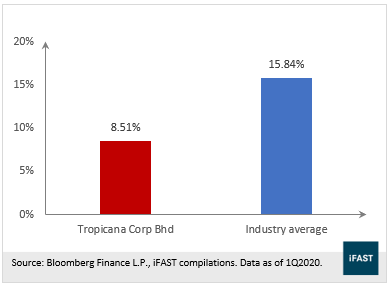
Despite 1Q2020’s encouraging operating margin (EBIT over revenue), the TTM operating margin of Tropicana was hampered by the previous quarter’s (4QFY2019) bulging “other operating expense”. Before adjustments, it appeared that the company recorded a strong operating margin in 4Q2019. But upon further inspection, much of that was due to a recognition of negative goodwill – an accounting line item that we believe should be a non-operating item. Tropicana’s adjusted operating margin in TTM 1Q2020, as illustrated by the graph above, was almost half the industry’s average.
Gearing
Figure 5: Tropicana's adjusted debt/equity vs industry average
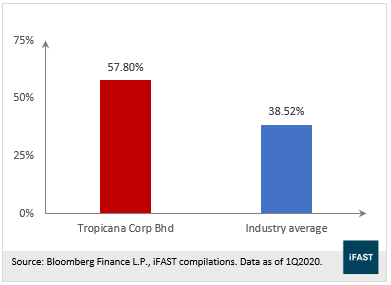
Tropicana’s gearing (debt over equity) stood at 57.80% as of 1QFY2020. While it does appear to be above the industry average of 38.52%, we are of the opinion that the company is still moderately geared and in line with other bigger property developers such as SP Setia, UEM Sunrise, and Eco World Development Group. SP Setia, UEM Sunrise, and Eco World Development Group have gearing ratios of 70.82%, 44.45%, and 76.85% respectively.
Issue structure
Tropicana’s new sukuks were issued under its RM 1.5 billion programme based on the shariah principle of Wakalah Bi Al-Istithmar. The programme and the three-year sukuk are rated A+ by local rating agency MARC.
The DJCMK 5.500% 30Jun2023 Corp (MYR) sukuk carries a coupon of 5.5% per annum and is ranked senior secured. The sukuk is secured by land and existing properties. In addition to the security afforded to the sukuk, the entire programme is subject to a financial covenant that specifies that the debt over equity of Tropicana shall not exceed 1.25x throughout the tenure of the sukuk programme. As mentioned above, the debt-to-equity ratio of Tropicana was 0.58x in 1QFY2020.
Valuation of Tropicana’s 3Y 5.5%
Figure 6: 3Y A+ rated Islamic corporate bond yields vs 3Y GII yields
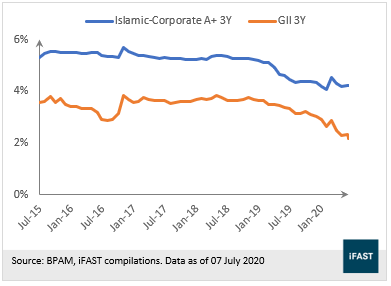
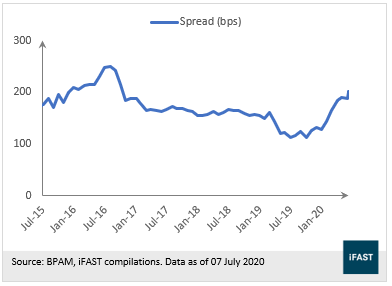
Figure 7: Spread between 3Y A+ rated Islamic corporate bonds and 3Y GII
With the global easing of monetary policies, it should come as no surprise that bond yields have been experiencing a downward trend. Bank Negara Malaysia has cut rates four times this year by a cumulative 125 bps to bring the overnight policy rate down to 1.75%, the lowest level historically.
While
the risk-off sentiment seems to have tapered off since the initial outbreak of
COVID-19, credit spreads remain elevated at three-year highs. This is largely
because of investors’ expectation of a lower-for-longer interest rate
environment, which led to investors bidding up the price of MGS and GII
(resulting in lower yields). The
introduction of MGS/GII to be part of the banking capital structure adds to
the thesis of a lower MGS/GII yield. Last but not least, the elevated spreads are partly
due to the illiquid nature of corporate bonds in Malaysia.
On average, A+ rated Islamic corporate bonds in Malaysia offer a spread of 202 bps (post rate cut) as of 7th July2020, as illustrated in the graph above. With reference to the credit rating of Tropicana, we think the risk-return of the DJCMK 5.500% 30Jun2023 Corp (MYR), with its spread of 294 bps (priced at ask price of 101 as of 7th July), is generous and well above similar-rated peers.
Declaration: For specific disclosure, at the time of publication of this report, IFC (via its connected and associated entities have a principal position in the securities mentioned in the report. The analyst who produced this report holds a NIL quantity in the securities mentioned in the report.