Oxley Holdings Limited (“Oxley”) is launching a three-year bond at an initial price guidance (“IPG”) of 6.75%. Recently, we dialed in to a fixed income investor conference call to find out more details about the new issue and the company’s latest financials.
Oxley MTN Pte Ltd is the issuer of the bond. The parent company Oxley unconditionally and irrevocably guarantees the due payments of the note. Holders of the senior unsecured bond will have the option to put the bonds back to the issuer in the event of a change of control (at 101) or cessation of trading (at par), as specified in the bond’s offering documents. The size of the issue is capped at S$100m.
Brief overview of Oxley and portfolio
In the years since going public in October 2010, the Oxley group expanded its presence from Singapore to over nine geographical markets including the United Kingdom, Ireland and Australia. Oxley has established a reputation of building quality homes and commercial developments. The three main principal business activities of the firm are 1) real estate development, 2) property investments and 3) hospitality.
According to the company, the group had a land bank of approximately 495,000 square meters (“sqm”) that may be used for future development. As at 31 Dec 19, Oxley recorded 17 property development projects in the pipeline, in Singapore and other countries. Collectively, the estimated gross development value of the portfolio added to a total value of S$23 billion.
If the opportunity arises, Oxley acquires investment properties to provide recurring income to the firm. In addition to property investments, the group holds an 18.8% interest in Galliard, a leading UK property developer, and Pindan, an Australian property construction company that would soon become a wholly-owned subsidiary of the group.
Recurring income from investment properties
The positive aspect of Oxley’s property investment business is that the company has made strides in strengthening its recurring income base from these assets. Referring to details in the recent roadshow presentation, recurring income increased by nearly eight times to S$77.5m between FY16 and FY19. Recurring income to the group stems from a variety of sources within the portfolio. These include tenants at 1) Space@Tampines, 2) eleven retail units from the hotels along Stevens Road, 3) 29 retail units in The Rise @ Oxley, 4) 26 retail units in Floravista and 5) room bookings in the Novotel and Mercure hotels.
Oxley is expanding its hospitality portfolio to include three hotels under development, namely SO Sofitel Kuala Lumpur Hotel in Malaysia, and Shangri-La Hotel in Phnom Penh, Cambodia. Shangri-La Cambodia and SO Sofitel Kuala Lumpur will start receiving guests in 2021 and 2022 respectively. Additionally, Oxley plans to build a hotel in Limassol, Cyprus, which has seen a record number of tourist arrivals in January.
Financial highlights — income statement
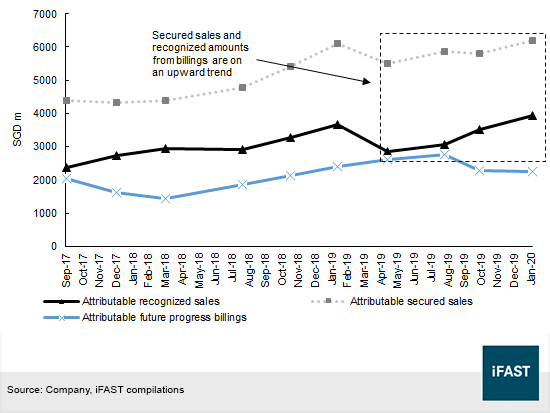
In the six months ended December 2019 (“1HFY20”), group revenue increased by 13% YoY to S$594m. The improvement in sales resulted from development projects in Singapore and Dublin, as well as positive contributions from the Australian subsidiary. Total revenue is likely to continue increasing given the recent upward momentum in secured sales (Figure 1) and improved real estate sentiment.
Net profit dropped from S$34m in 1HFY19 to S$13m in 1HFY20, on the back of a 135% YoY increase in administrative expenses. This was because of higher consultancy fees incurred in overseas projects and the inclusion of three-month expenses from Pindan Group, following the consolidation of the Australian subsidiary.
Figure 1: Attributable secured sales
Net cash flows from operating activities (“Net CFO”) remained negative in 1HFY20 at -S$87m, albeit improved from –S$348m in 1HFY19. Net cash flows used in operating activities were mainly weighed down by changes in working capital as a result of reduction in trade and other payables in Singapore, Australia, the United Kingdom and Cambodia.
Profit before tax dropped from a restated S$49m in 1HFY19 to S$23m in 1HFY20. Cash proceeds from the disposal of investment securities and the sale of investment properties amounted to S$343m and S$238m respectively. During the last six months of 2019, Oxley sold an investment property in Dublin and divested its shares in United Engineers Limited.
Credit discussion
According to our estimates, group tangible assets dropped from S$6.2 billion at the end of FY19 to S$5.7 billion in 1HFY20, while total borrowings declined from S$3.6 billion to S$3.1 billion. Financial covenants in Oxley’s medium term note program restrict the proportion of indebtedness to 70% of consolidated total assets. Total borrowings over total assets decreased to 54.4% as at 31 Dec 19, suggesting that the firm still has headroom to increase its debt. Assuming an issue size of S$100m for the new bond, we estimate that Oxley’s ratio of total borrowings over total assets would increase to 55.2%.
In spite of the possibility of a higher debt load, the property developer guided that gearing should fall to 1.50x by the end of the year, during our recent meeting. Group gearing, defined as net debt over equity, had been on a decline as it dropped from 2.20x in FY19 to 1.94x in 1HFY20.
Even as Oxley targets to pare down its indebtedness, the company’s ability to service its interest expense deteriorated between 1HFY19 and 1HFY20. EBIT (earnings before interest and taxes) over interest expense dropped from 1.69x in the six months ended 31 Dec 18 to 1.28x for the six months ended 31 Dec 19. Using an adjusted measure of EBIT by excluding the share of results from associates and joint ventures, we estimated that adjusted EBIT over interest expense similarly weakened from 1.75x to 1.13x over the same period.
As a result of the adoption of new accounting standards in July 2019, financing costs relating to development properties that were previously capitalised are now expensed in the income statement. Interest costs in 1HFY19 were restated upward from S$48.8m to S$71.1m. An increase in borrowings to fund the group’s development and investment projects, as well as for advances to joint ventures, led to a 14% YoY jump in interest expenses to S$80.9m in 1HFY20.
Loan details and breakdown at the subsidiary level
Oxley recorded a total debt of $3.1 billion at the end of December, out of which S$1.75 billion is listed in Table 1. These loans were issued for a range of purposes, including refinancing, acquisitions, development and general working capital commitments. HSBC, possibly the largest lender to Oxley in the table, helped to refinance loans relating to the Mercure and Novotel hotels. OCBC, the next biggest creditor by exposure, provided funding for the Kent Ridge Hill Residences project.
Table 1: Bank loans
|
Entity |
Lender / facility agent |
Outstanding amount as at 1HFY20 |
Maturity |
Purpose |
|
Oxley Holdings Limited |
Credit Suisse AG |
S$100m |
30 Oct 20 |
General corporate purposes |
|
Oxley Holdings Limited |
Deutsch Bank AG |
S$180m |
29 Nov 20 |
General corporate purposes |
|
Oxley Holdings Limited |
Credit Suisse AG |
S$100m |
13 Mar 21 |
General corporate purposes |
|
Oxley Bliss Pte. Ltd. |
Malayan Banking Berhad |
S$116.31m |
August 2027 |
Refinance outstanding loan at 18 Tampines Industrial Crescent Space and general working capital purpose |
|
Oxley Gem Pte. Ltd. |
Hongkong and Shanghai Banking Corporation Limited |
S$620m |
Facility A – 31 Oct 22 Facility B – 30 Apr 20 |
Refinance outstanding loan at Novotel Singapore and Mercure Singapore on Stevens and for general working capital purpose |
|
Oxley Spinel Pte. Ltd. |
Overseas-Chinese Banking Corporation Limited |
S$384.68m |
Earliest of 25 Jul 23, 6 months from the TOP Date and 30 Sep 23 |
Finance acquisition and development of Kent Ridge Hill Residences |
|
Citrine Property Pte. Ltd. |
Malayan Banking Berhad |
S$130.15m |
Earliest of 5 Dec 22, 6 months from the TOP Date and 31 Dec 22 |
Finance acquisition and development of Mayfair Garden |
|
Citrine Property Pte. Ltd. |
Hongkong and Shanghai Banking Corporation Limited |
S$119.85 |
Earliest of 5 Dec 22, 6 months from the TOP Date and 31 Dec 22 |
Finance acquisition and development of Mayfair Modern |
|
Source: Company, iFAST compilation |
||||
Debt maturity profile and liquidity discussion
Oxley’s S$324m cash position looks meager relative to its S$828m of current borrowings but the group assured us that it is able to maintain an adequate liquidity profile in the next few years. As per company’s guidance, future progress billings from Singapore and overseas projects totaled S$2.2 billion at the end of December. If Oxley manages to sell all remaining units within its Singapore portfolio, future progress billings would increase to S$3.5 billion, which will exceed the level of its total borrowings of S$3.1 billion.
Within the shorter time frame up till the end of 2020, Oxley projected that it will pay back creditors using proceeds from developments that will achieve temporary occupation permit (“TOP”) in 2020, together with divestment proceeds from the disposal of Chevron House following the handover to the buyer. In 2021, the group expects to pay down debt using remaining payments from projects that will be completed in that year (see Figure 2).
Figure 2: Debt maturity schedule till 2021
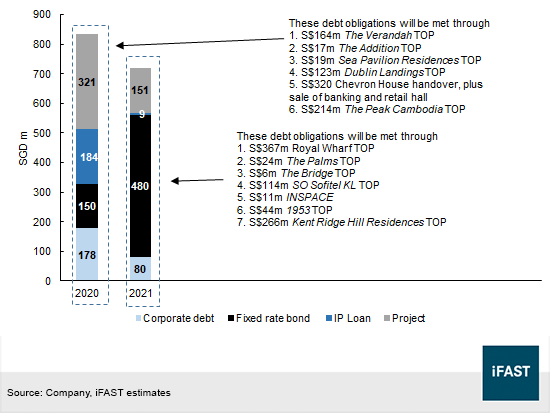
Our projections of Oxley’s future cash flows are laid out in Figures 2 and 3, which should be interpreted in conjunction with the information in Table 2. After 2021, we assume that Oxley would receive project revenues from the company’s developments scheduled to be completed in 2022, which should be sufficient to cover its project debt and bonds. In addition, Oxley should be able to refinance loans associated with the Novotel and Mercure hotels.
Figure 3: Debt maturity schedule in 2022 and beyond
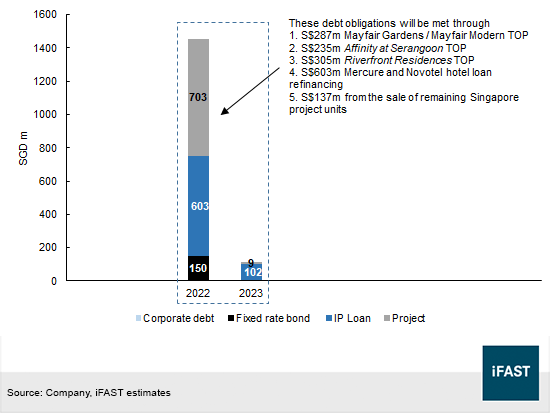
One caveat to our cash-flow estimates is that pre-sales contracts may be subjected to buyer cancellations and forfeitures, both of which may be driven up by a sharp deterioration in the macro environment. Customer deposits forfeitures were S$757,000 in FY18 but more than doubled to S$1.7m in FY19. At the moment, we do not view the recent increase in the level of forfeitures as a point of concern yet, but we will monitor its trend moving forward.
Oxley’s development portfolio as at 31 Dec 19
Table 2: Residential and commercial projects
|
Project |
Location |
Expected number of residential units |
Expected number of other units |
Units sold (%) |
Attributable future progress billings |
TOP |
|
1953 |
Singapore |
58 |
14 shops |
64 |
S$44m |
4Q21 |
|
Affinity at Serangoon |
Singapore |
1,052 |
5 shops |
64 |
S$235m |
3Q22 |
|
Mayfair Gardens / Mayfair Modern |
Singapore |
386 |
- |
56 |
S$287m |
4Q21 |
|
Riverfront Residences |
Singapore |
1,472 |
6 shops |
83 |
S$305m |
3Q22 |
|
Kent Ridge Hill Residences |
Singapore |
548 |
- |
51 |
S$266m |
4Q21 |
|
The Verandah |
Singapore |
170 |
- |
99 |
S$164m |
4Q20 |
|
The Addition |
Singapore |
26 |
- |
100 |
S$17m |
2Q20 |
|
Sea Pavilion Residences |
Singapore |
24 |
- |
100 |
S$19m |
1Q20 |
|
Sixteen35 Residences |
Singapore |
60 |
- |
98 |
S$38m |
4Q20 |
|
Royal Wharf – Phase 1A |
North Woolwich, London |
1,333 |
- |
99 |
S$367m |
2020 |
|
Royal Wharf – Phase 2 |
North Woolwich, London |
1,146 |
- |
97 |
2020 |
|
|
Royal Wharf – Phase 3 |
North Woolwich, London |
965 |
- |
84 |
2020 |
|
|
Dublin Landings |
72 to 80 North Wall Quay, Dublin |
273 |
N.A |
100 |
S$123m |
2020* |
|
The Peak – Phase 1 |
Phnom Penh |
507 |
- |
89 |
S$214m |
2020 – 2021 |
|
The Peak – Phase 2 |
Phnom Penh |
507 |
- |
98 |
2020 - 2021 |
|
|
The Peak retail mall |
Phnom Penh |
150 shops |
75 |
2020 – 2021 |
||
|
The Peak office units |
Phnom Penh |
250 offices |
100 |
2020 - 2021 |
||
|
The Palms - Villas |
Mean Chey District, Cambodia |
16 |
100 |
S$24m |
2020 |
|
|
The Palms – cluster housing |
Mean Chey District, Cambodia |
204 |
25 |
2020 |
||
|
The Bridge |
Chamkarmorn District, Cambodia |
2,477 |
97 |
S$6m |
4Q18 |
|
|
Oxley Towers Kuala Lumpur (residential) |
Malaysia |
590 |
17 |
S$114m |
2021 |
|
|
Gaobeidian |
Hebei, China |
15,800 |
24 |
S$7m |
TBA |
|
|
INSPACE |
Singapore |
84 Light industrial units |
14 |
S$11m |
4Q21 |
|
|
Total |
S$2241 |
|||||
|
Source: Company, iFAST compilation |
||||||
Bond valuation
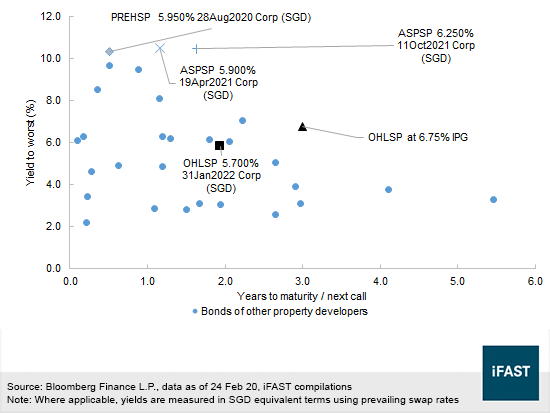
In view of Oxley’s lower gearing and manageable liquidity profile, we think that the company’s new three-year note is attractively priced at the IPG of 6.75%. This represents a pickup of 95 basis points over the OHLSP 5.700% 31Jan2022 Corp (SGD) (ask yield to maturity (“YTM”): 5.80%), and provides good value, in our view, among peer credits of similar maturities (Figure 4).
Figure 4: Bond valuation
Oxley has a track record of ramping up leverage quickly to take advantage of market opportunities, then de-gearing and paying down debt with sales proceeds. With this new issuance of up to S$100m, Oxley should not have difficulty paying off the S$150m OHLSP 5.150% 18May2020 Corp (SGD) - Retail, which is trading at a YTM of 3.42%.
Although the 6.75% IPG may be lower than bonds of Perennial Real Estate Holdings Ltd (“Perennial”) and Aspial Treasury Pte Ltd (“Aspial”), we think the credit quality of the latter two issuers are weaker than Oxley. We had elaborated on Aspial’s issuer profile in a recent credit update — see “Aspial Corp: Credit Update 20 Jan 2020”, while Perennial is facing tight liquidity and low operating cash flows. We are monitoring Perennial’s refinancing and debt repayment progress as the group recorded S$120m of cash against short-term debt of S$1.3 billion in its recent filing.
Declaration:
For specific disclosure, at the time of publication of this report, IFPL (via its connected and associated entities) has principal positions in OHLSP 6.375% 21Apr2021 Corp (USD), OHLSP 5.150% 18May2020 Corp (SGD) – Retail and PREHSP 4.550% 29Apr2020 Corp (SGD) - Retail. The analyst who produced this report hold a NIL position in the abovementioned securities.