Soilbuild REIT completed its privatisation on 12 April 2021 after being listed on the SGX for 8 years. After resetting its perpetual notes, should investors continue to invest in Soilbuild REIT?
About Soilbuild REIT
Soilbuild Business Space REIT (“SBREIT”) is a real estate investment trust (“REIT”) comprising of business parks and industrial properties in their portfolio. Some of its tenants include manufacturing, engineering, logistic, warehousing, oil & gas sectors. Since disposing its 3 Australian assets, SBREIT has 2 business parks and 8 industrial properties in Singapore.
The sponsor of the REIT is Soilbuild Group Holdings Limited and is wholly-owned by Mr Lim Chap Huat. Mr Lim Chap Huat and his immediate family members hold an aggregate 30.44% of direct and deemed interest of the total amount of units outstanding as at 12 April 2021.
Privatisation of Soilbuild REIT
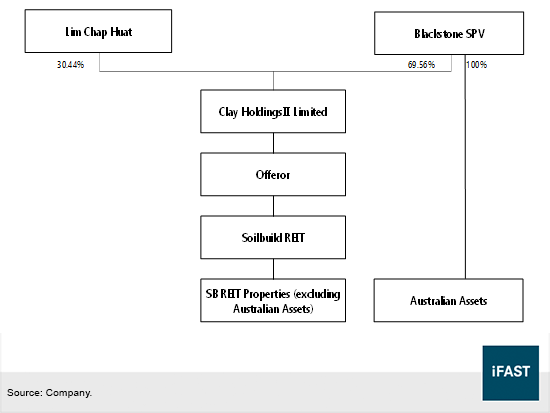
The buyout and privatisation of SBREIT was first proposed on 14 December 2020 and was completed on 12 April 2021. The privatisation of SBREIT was effected by way of a trust scheme of arrangement whereby all issued Soilbuild Units held by Soilbuild Unitholders was acquired by Clay Holdings II Limited and the sale of all the assets in Australia was sold to entities controlled by Blackstone. From Figure 1, after the transaction, Mr Lim Chap Huat and family will hold 30.44% of SB REIT while a Blackstone special purpose vehicle (“Blackstone SPV”) will hold 69.56%.
Figure 1: Post-transaction structure of SBREIT
For debt investors, we find the transaction to be credit negative as earnings visibility has declined following the privatization. Bondholders may not receive timely updates about the company and shareholders now have greater flexibility and control over the operations of the firm. With the disposal of Australian assets, we also expect gross revenues for SBREIT to decrease.
As part of the buyout of SBREIT, all of the assets in Australia were sold to entities controlled by Blackstone SPV, via the sale of units in Soilbuild Australia Trust. These Australian assets – which consisted of the properties on 14 Mort Street, Canberra, 25 Grenfell Street, Adelaide and Inghams Burton in South Australia have been offloaded from the trust.
Furthermore, SBREIT’s ability to gain credit lines from bank loans may be affected. Due to the privatisation of the REIT, future financial statements may not be frequently reported by the company. This makes projecting future growth and the credit profile of SBREIT to be less transparent to investors.
FY2020 Financial Results
For the 2020 full year financial results ended 31 December 2020 (“FY20”), SBREIT reported gross revenues of SGD 93.44m, representing a 4.9% increase from SGD 89.07m in FY19. Net property income (“NPI”) grew 2.1% from SGD 71.02m in FY19 to SGD 72.49m in FY20.
The increase in gross revenue and NPI for the fourth quarter ended 31 December 2020 (“4Q20”) was due to 25 Grenfell Street (which was acquired in 2019) and higher occupancy rate for West Park BizCentral. We expect gross revenue and NPI to fall after the privatisation due to the reduction in contributions from SBREIT’s Australian assets.
In 4Q20, SBREIT recorded negative rental reversion for new leases of 24.5% due to the signing of a new anchor tenant at 39 Senoko Way while lease renewals recorded positive rental reversion of 1.3%.
Valuation of its portfolio recorded a revaluation loss of SGD 58.1m due to revaluation losses in 2 Pioneer Sector 1, Solaris, West Park BizCentral, Eightrium and Bukit Batok Connection. 2 Pioneer Sector 1 is undergoing redevelopment and is expected to be completed in 1Q22.
In our view, future growth in SBREIT will slow down due to the disposal of its Australian assets, although this loss will be mitigated by lower rent rebates and lower provision for rent waivers in the coming quarters.
Portfolio occupancy for its properties stood resilient increasing 1.4% to 94.3% in 4Q20. The Manager of SBREIT renewed more than 191,000 sq. ft. of renewals and new leases in 4Q20.
Credit profile
As of 31 December 2020, SBREIT has cash and bank balances of SGD 16.4m while net cash flows from operations of SGD 54.4m. We expect cash and cash equivalents to fall in 2Q21 due to the redemption of its fixed rate SGD 88.0m 3.600% notes due in 08 Apr 2021.
Total borrowings for SBREIT amounted to SGD 508.1m (not including perpetual notes of SGD 65.7m). When excluding SGD 88.0m of fixed rate medium term notes (“MTN”) that was redeemed in 8 April 2021 and including SGD 65.7m of perpetual notes, total borrowings is estimated to be SGD 486.6m.
A large proportion of SBREIT’s borrowings are term loan facilities from banks and will be due for refinancing in 2022 and 2023. From Figure 2, SGD 205.3m of bank loans will be due in 2022 and SGD 176.3m will be due in 2023. Given the short time and spread of debt maturing in the next 2 years, we find SBREIT to have high refinancing risk and it depends on whether SBREIT will be able to secure new bank facilities to refinance these borrowings.
Figure 2: Debt Maturity Profile
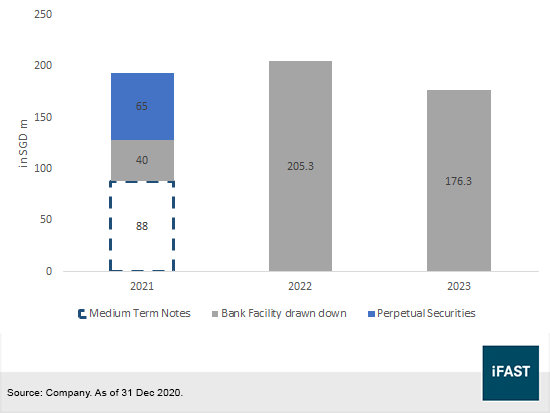
On 12 April 2021, SBREIT entered into an unsecured SGD 130m facility agreement with DBS Trustee Limited. We expect that SBREIT would draw down on this loan to refinance its borrowings due 2022 as it is secured against Solaris.
While interest coverage for SBREIT is at 4.2x and aggregate leverage is at 38.9%, SBREIT has only SGD 16.4m in cash and payment for its borrowings largely depends on bank loans. Thus, we feel that SBREIT faces high refinancing risk within the next 2 years.
Our recommendation
Currently, SBREIT only has 1 outstanding perpetual issue - SBREIT 4.645% Perpetual Corp (SGD) and it was not redeemed on its reset date on 27 September 2021. The original coupon payment was 6.00% and the distribution rate was reset at the prevailing 3Y SGD Swap Offer Rate (“SOR”) + initial Spread of 3.790% to 4.645%. The next reset date will be on 27 September 2024 and will reset every three years thereafter. The perpetual has no cessation put option and will thus continue to be traded in the secondary market.
Given the weak credits of SBREIT and also the privatisation of the trust, we are underweight the SBREIT 4.645% Perpetual Corp (SGD) and do not recommend investing in the notes. We will not cover the issuer moving forward as there is no assurance that the company will provide frequent updates to noteholders. Additionally, the perpetual notes will pay a lower rate of 4.645% as compared to its original coupon of 6.00%.
Figure 3: Relative valuation among SGD perpetual notes of other industrial REITs
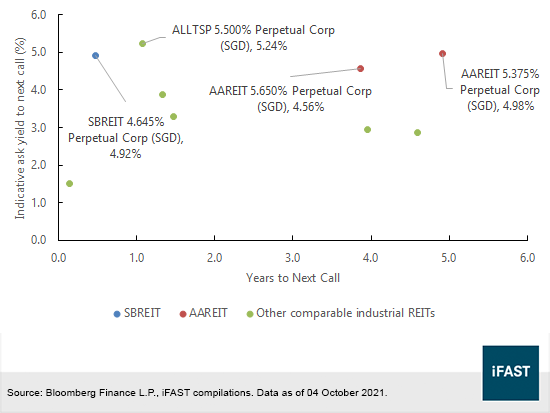
From Figure 3, SBREIT 4.645% perps currently have an indicative yield to next call of 4.92%. When compared with other perpetual notes issued by other Singapore industrial REITs, ALLTSP 5.500% Perpetual Corp (SGD) has a higher yield to next call of 5.24%. ALLTSP 5.5% perpetual notes are issued by ARA LOGOS Logistics Trust. Investors may read our view on industrial REITs here.
Looking at securities with longer dated call dates, AAREIT 5.375% Perpetual Corp (SGD) is an attractive option with an indicative yield to next call of 4.98%. Additionally, AAREIT has better credit ratios as compared to SBREIT with interest coverage of 4.3x and an aggregate leverage ratio of 34.3%. Its debt maturity profile is also more spread out and have sufficient undrawn committed facilities to refinance its 2021 and 2022 debt ahead of time. Investors may read more of our views on AIMS APAC REIT here.
Declaration: For specific disclosure, at the time of publication of this report, IFPL (via its connected and associated entities) holds a position in AAREIT 5.375% Perpetual Corp (SGD) and the analyst who produced this report holds a NIL position in the abovementioned securities.
Our podcast series, Yield Hunters, is available on Spotify, iTunes Podcasts and Google Podcasts. We share our thoughts on new bond issues and hold discussions on the fixed income space. Listen to our latest episode below and follow us!