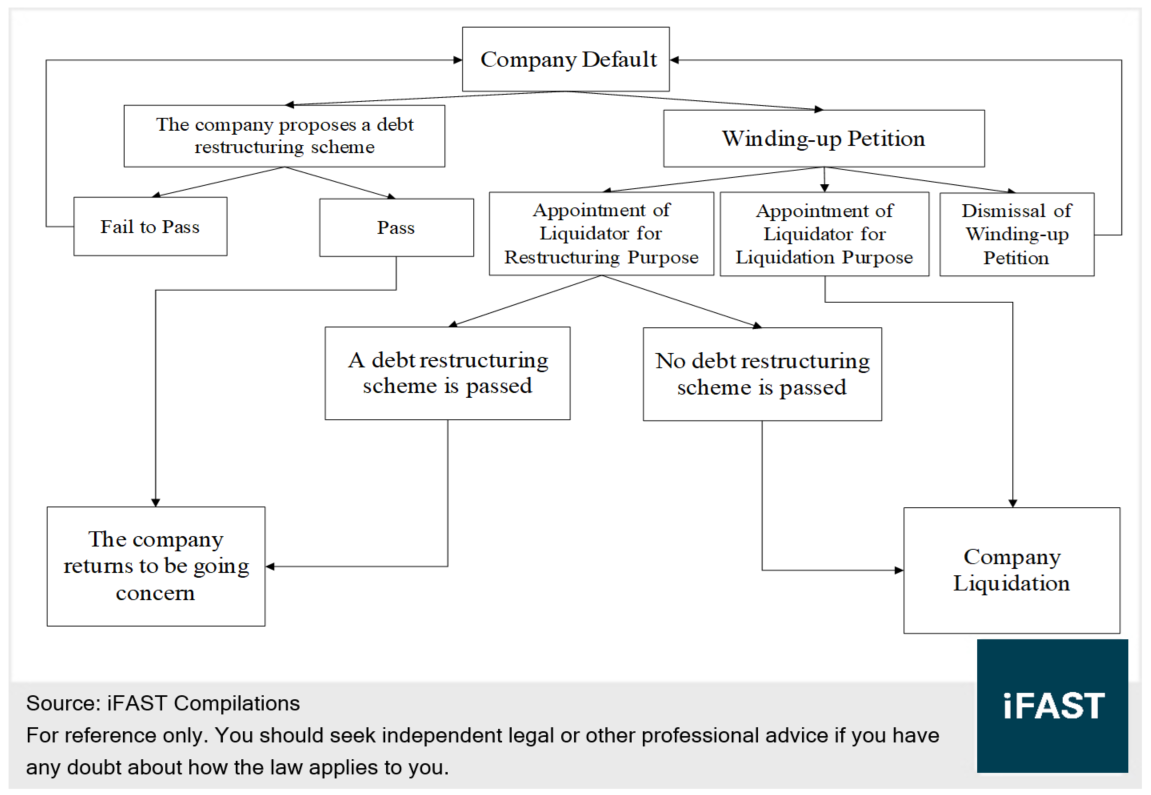
There are two main types of ongoing developments following a company's default: a successful debt restructuring (either initiated by the company or the appointment of liquidator(s) for the restructuring purpose), which allows the company to be going concern, or a compulsory liquidation (see Chart 1).
Chart 1: Ongoing Development After Company’s Defaults
In this article, we will introduce some common debt restructuring methods and explain more about company liquidation:
Debt Restructuring
For Chinese real estate developers, their debt restructuring methods include debt maturity extension, debt-to-equity swap, unlisted asset package, equity-linked debt instruments / derivatives and direct haircut:
1. Debt Maturity Extension
- This is the most common debt restructuring method. The old bonds will be replaced with new bonds of a longer maturity. The company would have more time to improve the operational performance. The coupon of new bonds will be made in “payment in kind” for an initial period of one to several years. The amount of new bonds usually step up with the tenor of the new bonds. In other words, bondholders will receive new bonds with different tenors, with a greater proportion of longer-term new bonds.
- The company might suggest several credit enhancement, such as adding additional subsidiaries as guarantors or/and placing collaterals. The company might commit to use the cash flows generated by some subsidiaries or collaterals (including the operating cash flow and/or proceeds from the disposal) to repay the new bonds.
2. Debt-to-equity Swap:
- This is a common way of debt restructuring in foreign countries. It was included in the restructuring plans of some Chinese real estate developers, including Evergrande, Sunac, and Fantansia. Generally, the companies issue new shares or use shares of listed subsidiaries to offset part of the debt.
- It involves the share conversion price. The lower the conversion price, the better it is for creditors. This is because when the conversion price is lower, same amount of debt would be converted into more shares and shares received would be more valuable, assuming the market value of the company is constant.
- From this perspective, bondholders will be in a better position than existing shareholders. In the case of a large new share issue, the value of existing shares is likely to be significantly diluted or even reduced to nearly zero. In addition, if the company’s prospects improve significantly as a result of the debt restructuring, resulting in a large increase in the market value, the old bondholders who own the new shares will also benefit.
- In general, the conversion price would be higher than the stock price after debt restructuring. Therefore, investors would be inevitably subject to an indirect principal haircut.
3. Unlisted Asset Package:
- This is a less common debt restructuring method. However, it was adopted by a Chinese real estate developer (China Fortune Land). The company would combine certain assets into an asset package and give its partial or full ownership to creditors in order to offset the debt.
- It is hard to measure the true value of the asset package. Although the company might engage a third party to estimate the value of the asset package, the estimation often involve a lot of assumptions and optimistic expectation, which might distort the estimated valuation, not to mention a discrepancy between the valuation and the offset debt. Thus, it is equivalent to an indirect principal haircut.
4. Equity-linked Debt Instruments / Derivatives:
- This is a complicated debt restructuring, including issuing convertible bonds, mandatory convertible bonds, security-linked notes or equity options. Investors can pay attention to the conversion trigger conditions of these instruments and actively or passively convert into shares at the appropriate time.
- Generally, for convertible bonds, the holders could convert into shares at a specified conversion price during the conversion period, but the issuer will repay the principal at maturity.
- The value of these equity-linked debt instruments / derivatives will be highly correlated to the company’s share price. Since the conversion price is highly likely to be higher than the share price, the investor is subject to a degree of an indirect principal haircut in the event that he or she receives shares.
5. Direct Principal Haircut
- This is also a common debt restructuring method in foreign countries. Although there is no principal reduction directly proposed in the restructuring plans of Chinese real estate developers, we cannot rule out the possibility of the developers which adopt this method one after another.
- Simply put, the principal amount of the bond will be directly reduced and the investor will suffer a direct loss. However, this method may also be welcomed by some investors who buy the bonds at low prices, since the remaining principal amount of the bond may be paid in cash, or exchanged for new bonds / shares / asset packages in a better term.
| Debt Maturity Extension | Debt-to-Equity Swap | Unlisted Asset Package | Equity-linked Debt instruments / Derivatives | Direct Principal Haircut | |
| China Evergrande | ✓ | ✓ | |||
| Scenery Journey / Tianji Holdings | ✓ | ||||
| Sunac China | ✓ | ✓ | ✓ | ||
| Fantansia | ✓ | ✓ | |||
| China Fortune Land | ✓ | ✓ | |||
| Modern Land | ✓ | ||||
| Shinsun | ✓ | ||||
| E-house | ✓ | ||||
| Source: Company's Announcements, iFAST Compilations Data as of 17 May 2023 |
|||||
Winding-up Petition
(The following is for reference only. You should seek independent legal or other professional advice if you have any doubt about how the law applies to you.)
Creditors could file a winding-up petition in different courts against the company as a result of default events. Depending on the situation, the judge decides whether to assist in the company restructuring (appointment of liquidator(s) for a restructuring purpose), or to issue a winding up order (appointment of liquidator(s) for a liquidation purpose), or to dismiss the winding-up petition. Thus, the so-called "winding-up petitions" can be divided into two types in practice:
1. Appointment of Liquidator(s) for Restructuring Purpose
- This is more common for the winding-up petition in the Grand Court of the Cayman Islands and the Bermuda Courts. The court, creditor(s) or company could appoint liquidator(s) for the restructuring purpose (which requires court’s recognition). Under a “soft-touch” basis, the company tries to undergo a debt restructuring, which could allow the company to return to be going concern.
- The Law of Hong Kong does not include this type of provision. Hence, it might not be applicable to the winding-up petitions filed in the Hong Kong Courts.
- However, if the Grand Court of the Cayman Islands or the Bermuda Courts already recognizes the liquidator(s) (for the restructuring purpose), it is likely that the Hong Kong Courts will assist in the company’s restructuring in conjunction with judicial proceedings in other jurisdictions, but there will be a high uncertainty involved in the process.
2. Appointment of Liquidator(s) for Liquidation Purpose
- This implies that the company is brought to an end. The company’s assets (including land, properties, securities etc.) would be disposed for cash as soon as possible, and the cash will be distributed in the following order (Table 2).
| Priority | Types of Payment |
| 1 (The Highest Priority) | Creditors of secured debt |
| 2 | Liquidation expenses, including liquidator’s remuneration |
| 3 | Some senior payment, including employee benefits, government debt, taxes and payables |
| 4 | Creditors of senior unsecured debt |
| 5 | Debt interest expenses during the company’s liquidation |
| 6 | Creditors of subordinated debt |
| 7 (The Lowest Priority) | Company’s shareholders |
| Source:
Latham & Watkins LLP, iFAST Compilations For reference only. You should seek independent legal or other professional advice if you have any doubt about how the law applies to you. |
|
- Investors might worry that the winding-up order (for liquidation purpose), issued by Hong Kong Courts, the Grand Court of the Cayman Islands or the Bermuda Courts, might not be applicable to the Mainland China, resulting in being unable to liquidate the onshore assets of those Chinese real estate developers. In fact, according to “Record of Meeting of the Supreme People’s Court and the Government of the Hong Kong Special Administrative Region on Mutual Recognition of and Assistance to Bankruptcy (Insolvency) Proceedings between the Courts of the Mainland and of the Hong Kong Special Administrative Region”, the liquidator in Hong Kong could apply to People’s Courts (Shanghai, Xiamen, Shenzhen and other pilot cities) for the recognition of the liquidation procedures in Hong Kong. After People’s Courts’ recognition, People’s Courts could authorize the Hong Kong liquidator to control the onshore companies’ assets and accounts etc.
The Recovery Value of Chinese Real Estate Bonds Under Liquidation
The USD bonds of Chinese real estate developers are offshore debts at the level of the parent controlling company. Most of them are senior unsecured. Therefore, they will be lower in claim orders than payables, taxes, onshore creditors, secured creditors and some senior payments (Table 2).
Referring to the estimation of the recovery value under liquidation of Chinese real estate bonds done by third parties, the highest uncertainty in the financial models is the land bank of developers (or land use rights). The land bank might eventually be repossessed by the government without any compensation, sold at discount or successfully sod at the market value. These dominate the ultimate recovery value of the bonds. At the moment, it is difficult to effectively estimate the value of these assets. If most of the company's land can be sold at book value or even at a premium, the recovery value of the bond will be higher, and vice versa.
As such, there is a great deal of uncertainty about the recovery value of Chinese real estate bonds under liquidation, but bondholders are not necessarily left with nothing. However, investors should be aware that liquidation generally takes a long time, perhaps even five to ten years. The ultimate recovery value might be low.
Conclusion
The industry outlook is not yet clear. The defaulted developers do not have great improvement in sales, financing or asset disposal. Thus, we believe that investors should take a more conservative approach towards Chinese real estate bonds. For every new investment into defaulted real estate bonds, the potential loss of investment could be as high as 100%.
However, for investors who already hold these bonds, there is nothing wrong with waiting for the companies to do restructuring or be liquidated, as the bond recovery value might not be as low as the current market expectation after doing restructuring or liquidation, not to mention the fact that some of the Chinese real estate developers might be able to gradually repay their debts after restructuring.
Last but not least, the newly issued bonds due to debt restructuring still carry a high default risk. If the Chinese real estate developers default again in a few years, then they might not be able to come up with a debt restructuring scheme which has a similar quality to this debt restructuring (e.g. the debt-to-equity swap etc.). Therefore, investors need to take this factor into consideration when selecting the option of debt restructuring (if any).
Related Articles
A List of 30 Key Chinese Developers’ Latest Development
The Restructuring Plan from Evergrande
Scenery Journey and Tianji’s Restructuring Plans
Sunac China Published Restructuring Plan
Fantasia Rolled Out Restructuring Plan
E-House Comes Up With A New Restructuring Plan
Declaration: For specific disclosure, at the time of publication of this report, IFPL (via its connected and associated entities) holds positions in EHOUSE 7.625% 18Apr2022 Corp (USD), EVERRE 8.250% 23Mar2022 Corp (USD), EVERRE 7.500% 28Jun2023 Corp (USD), FTHDGR 6.950% 17Dec2021 Corp (USD), FTHDGR 7.950% 05Jul2022 Corp (USD) and SUNAC 5.950% 26Apr2024 Corp (USD) and the analyst who produced this report holds a NIL position in the abovementioned securities.