Highlights:
- The Hong Kong Government announced cancellation of all tightening measures related to the stamp duty in the property market, together with HKMA’s mortgage relaxation. This would relieve the purchase cost of potential homebuyers and increase their purchasing power. We expect more transaction volumes and stable prices in the Hong Kong property market in the near-term.
- The price discount between second-hand and first-hand properties could narrow. The increase rate in the trading volume of first-hand properties should be higher than that of second-hand properties. Hence, the property developers could be benefited more from the relaxation of property cooling measures.
- The situation that buying housing by mortgage is more expensive than rent is expected to be reversed. Hong Kong residential property prices are expected to be bottom out and stabilised. It is conducive to developers liquidating their projects.
- Hong Kong developers have a number of advantages. They could reach a high sell-through rate for their new pre-sales projects. Besides, they adopt a business model with “low liability, low leverage and slow turnover”. Thus, investors do not need to worry too much about the Hong Kong developers’ liquidity. Most of the credit risks of the medium-sized or large Hong Kong developers are still under control.
Scrapping All Tightening Measures would Relieve Purchase Cost and Increase Purchasing Power
In the end of February, the Hong Kong Government announced cancellation of all tightening measures related to the stamp duty in the property market, together with HKMA’s mortgage relaxation (See Table 1). This would relieve the purchase cost of potential homebuyers and increase their purchasing power. The market sentiment is significantly improved.
Table 1: Update on Hong Kong Real Estate Policy
|
Hong Kong Real Estate Policy |
Content |
Main Beneficiaries |
|
Cancel Special Stamp Duty (SSD) |
|
Homeowners who have bought properties in recent years and intend to trade up their properties Short-term property investors |
|
Cancel Buyer's Stamp Duty (BSD) |
|
Non-Hong Kong permanent residents Institutional Investors |
|
Cancel New Residential Stamp Duty (NRSD) |
|
Non-Hong Kong residents Hong Kong residents who want to own more than one residential property |
|
Suspend Mortgage Stress Test |
|
Investors with recurring income |
|
Raise Loan To Value (LTV) Caps |
|
All homebuyers who take out a mortgage |
|
Source: Hong Kong Budget 2024-25, HKMA, WuChatProp, iFAST Compilations Data as at 28 February 2024 |
||
After scrapping all tightening measures, the market reaction was good. More than 1,500 first-hand property transactions were recorded within the 10 days (equivalent to 14% of 2023 first-hand property transactions). We expect more transaction volumes and stable prices in the Hong Kong property market in the near-term.
Property Developers could be Benefited More from Relaxation of Property Cooling Measures
In terms of industry outlook, Hong Kong's property market is undergoing a down cycle. The trading turnover of first-hand residential properties or second-hand residential properties declined around 35% to 40%, compared to the period during 2017 to 2020, falling back to the level of the period between 2011 and 2016.
Chart 1: The Trading Turnover of First-hand Residential Properties and Second-hand Residential Properties and Total Trading Volume
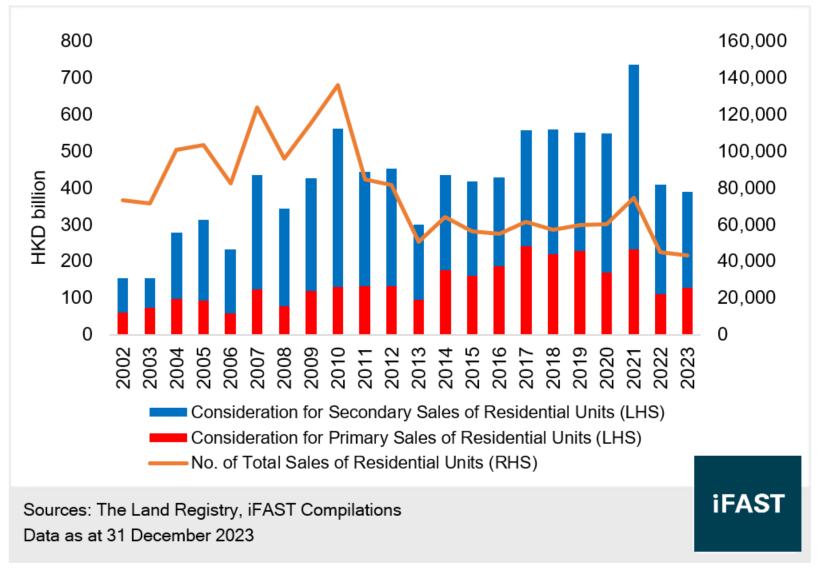
During the previous upturns in the property market, the first-hand residential properties obviously commanded a higher premium than second-hand residential properties in the same district, with premiums ranging from 20% to 40%. For buyers, purchasing first-hand or second-hand residential properties has its own advantages. Hence, the trends of trading volumes for both types of residential properties are generally consistent.
Large developers are now willing to adopt the strategy of lowering prices in exchange for higher volumes (See Table 1). In one to two years’ time, developers accepted the reality, meaning that they reduced the prices under new pre-sales property projects by at least 20% or above, based on our estimation. We believe that the price discount between second-hand and first-hand properties could narrow, so the increase rate in the trading volume of first-hand properties should be higher than that of second-hand properties. Hence, the property developers could be benefited more from the relaxation of property cooling measures.
Table 1: The Strategy of Lowering Prices in exchange for Higher Volumes Adopted by Developers
|
New Pre-sales Project in 2023 |
Main Developer(s) |
First Sales |
Average Discounted Price per sq. ft.* |
Place |
Comparable New Pre-sales Projects in 2020 to 2022 |
Average Discounted Price per sq. ft.* |
Place |
Estimated Discount* |
|
THE COAST LINE I |
CK Asset |
Aug 23 |
HKD 13,100 to 16,500 |
Tung Yuen Street, Yau Tong |
Chill Residence |
HKD 16,800 to 20,800 |
29 Ko Chiu Road, Yau Tong |
20% to 25% |
|
Koko Hills Phase 3A Koko Rosso |
Wheelock |
Feb 23 and Apr 23 |
HKD 17,200 to 24,200 |
Sin Fat Road, Cha Kwo Ling |
KOKO RESERVE |
HKD 22,600 to 27,600 |
Ko Ling Road, Cha Kwo Ling |
20% |
|
YOHO WEST |
Sun Hung Kai Properties |
Dec 23 |
HKD 10,000 to 12,800 |
No. 1, Tin Yan Road, Tin Shui Wai |
Wetland Seasons Park (Phase 3) |
HKD 12,100 to 14,700 |
No. 9 Wetland Park, Tin Shui Wai |
20% to 25% |
|
Wetland Seasons Bay (Phase 3) |
HKD 13,000 to 16,300 |
No. 1 Wetland Park, Tin Shui Wai |
||||||
|
The Knightsbridge |
JVs & Associates |
May 23 |
HKD 13,400 to 18,700 |
22 Shing Fung Road, Kai Tak |
One Victoria |
HKD 19,900 to 26,200 |
21 Shing Fung Road, Kai Tak |
Around 25% |
|
KT Marina |
JVs & Associates |
Nov 23 |
HKD 18,000 to 26,400 |
15 Shing Fung Road, Kai Tak |
10% |
|||
|
THE PADDINGTON |
Henderson |
Nov 23 |
HKD 15,800 to 19,800 |
No. 456, Sai Yeung Choi Street North, Sham Shui Po |
J Loft |
HKD 18,900 to 21,700 |
No. 93 Apliu Street, Sham Shui Po |
10% to 20% |
|
*For reference only Source: Centaline Property Hong Kong, Ricacorp Properties, Internet Resources, iFAST Compilations Data as at 31 December 2023 |
||||||||
It is noted that the gross margin of Hong Kong development projects was generally as high as 40% to 60% in the past. Even with a price reduction of 20% to 25%, the gross margin of the projects is expected to be maintained at a range of 20% to 50%. These developers have the condition to lower the prices in exchange of more volumes, instead of selling the properties below the project costs.
That Buying Housing by Mortgage is More Expensive than Rent is Expected to be Reversed, Conducive to Developers Liquidating Projects
In terms of property prices, the Centa-City Leading Index CCL (see Chart 2), a proxy for Hong Kong residential property prices, dropped by more than 20% cumulatively from its high in mid-August 2021 to the current level of 147. The decline was attributable to lots of factors, including an increase in mortgage interest rate, unattractive rental yield, poor performances of stocks and bonds in the global market, the downward pressure on both China and Hong Kong economies, the net outflow of Hong Kong’s population and an expect increase in the residential housing supply in the coming years.
Chart 2: Centa-City Leading Index CCL and Spread Between Rental Yield and Mortgage Rate
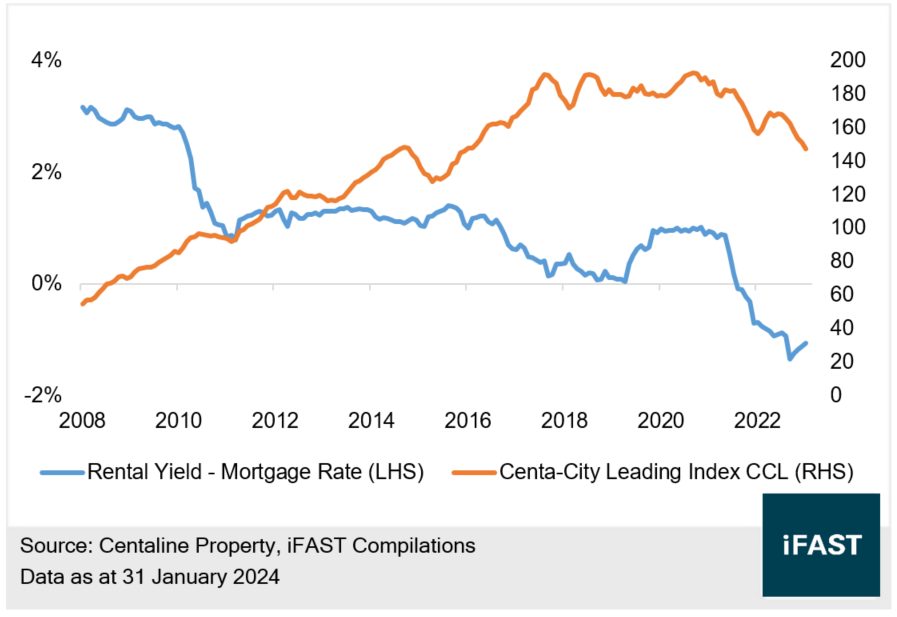
We believe that the core factor to determine the price movement of Hong Kong properties is the spread between rental yield and mortgage rate (see Chart 2 and Chart 3). It is the perspective from the cost of living and cash flows to compare the rental cost and monthly mortgage interest payment part. If the spread between them is positive (rental yield greater than mortgage rate), it represents buying housing by mortgage is cheaper than rent, vice versa.
When the spread is positive, the residential property prices generally have greater upward momentum. When Fed started the rate hike cycle since 2022, the Hong Kong Interbank Offered Rate (HIBOR) rose significantly, resulting in the mortgage rate to rise to the mortgage cap rate, which is determined by the loan prime rate. Subsequently, under the pressure of capital, banks raised the loan prime rate, driving up the mortgage rate to a higher level. The spread between rental yield and mortgage rate even reached -1.1% at present, resulting in a situation where property prices were likely to fall instead of going up.
Chart 3: Centa-City Rental Index CRL, Rental Yield and Mortgage Rate
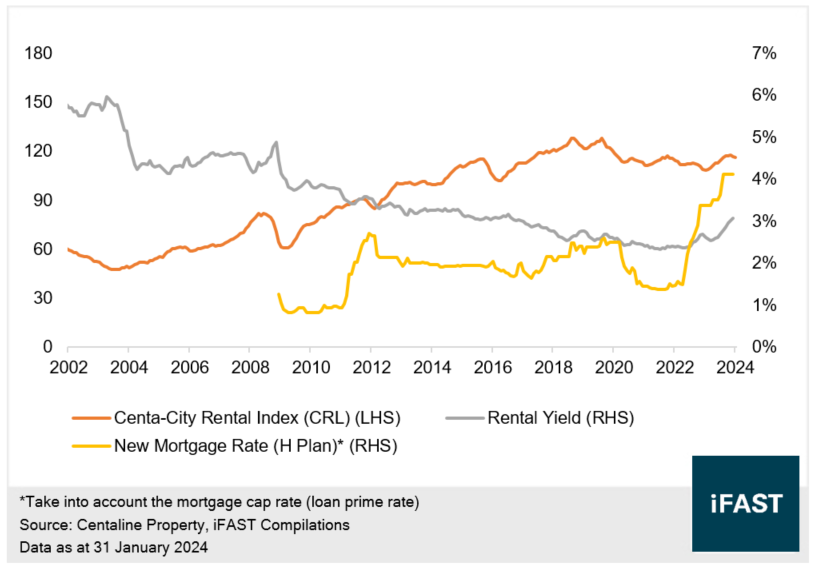
Nevertheless, the residential rent continued to rebound, with the Centa-City Rental Index (CRL) for 2023 surging by 7.4% YoY to 116 (Chart 3). We believe that it is related to the Hong Kong Government’s Top Talent Pass Scheme (TTPS). Since the implementation of the scheme in 2023, a total of 720 million people came and settle in Hong Kong (half are scheme applicants and half are dependents). The population inflows from TTPS should be a new momentum in the residential rental market, which is expected to support the slow upward movement of residential rents and boost the rental yield, and ultimately support the property prices.
With the rate hike cycle coming to an end, the mortgage rate is expected to down this year or next year, which could, to certain extent, restore the above-mentioned spread.
Despite a number of uncertainties, the situation where buying housing by mortgage is more expensive than rent is expected to be reversed, as the core factor, the spread between rental yield and mortgage rate, could be restored from negative to 0%. This means that Hong Kong residential property prices are expected to be bottom out and stabilised. It is conducive to developers liquidating their property projects.
Investors do not need to worry too much about the Hong Kong Developers’ Liquidity
We mentioned Hong Kong developers have a number of advantages, including higher gross margin of Hong Kong development projects, lower leverage levels, being more conservative in acquiring land or investing in new projects, stronger financing ability and many investment properties for rental, long-term appreciation and pledging purposes. Their credit positions are generally robust.
At the moment, developers could reach a high sell-through rate for their new pre-sales projects. It is not difficult for them to liquidate their projects in Hong Kong. With the sales and operations as usual, the banks in Hong Kong would still provide stronger support to developers in financing. The actual liquidity pressure on developers is still not high.
At the same time, Hong Kong developers adopt a business model with “low liability, low leverage and slow turnover”, which is completely different from the "high liability, high leverage, fast turnover" model adopted by Chinese developers. The latter is more likely to expose to the risk of capital chain rupture. It also explains why most non-SOE developers in China defaulted their debts while none of the medium-sized or large Hong Kong developers defaulted their debts.
It is worth mentioning that for Hong Kong developers, most of their pre-sales residential units are paid and settled by Stage Payment Plan, which means the developers only receive the upfront deposit (~10% of the property prices) first and receive the remaining part when they deliver the units. Their cash balance tends to be underestimate in the balance sheet. Conversely, the pre-sales projects of Chinese developers are paid and settled by Cash Payment Plan in general. Within a few months after the completion of transactions, the developers already receive a larger portion or even the full amount of cash. This overdraws the pre-sales project which is not yet delivered until one to two years later, resulting in an inflated cash level on the balance sheet.
Thus, investors do not need to worry too much about the Hong Kong developers’ liquidity. Most of the credit risks of the medium-sized or large Hong Kong developers are still under control. Investors could consider their bonds (see Table 2). Surely, investors should still pay attention to the credit profiles of individual issuers.
Table 2: Some Hong Kong Real Estate Bonds which we are Bullish On
|
Bond Name |
Issuer / Guarantor |
Ask Price (Investors Buy) |
Yield To Maturity |
Related Articles |
|
SUNHUN 2.875% 21Jan2030 Corp (USD) |
Sun Hung Kai Properties |
89.0 |
5.1% |
/ |
|
WHEELK 2.375% 25Jan2026 Corp
(USD) |
Wheelock |
94.5 |
5.5% |
/ |
|
HENLND 2.375% 27May2025 Corp (USD) |
Henderson Land |
96.3 |
5.4% |
Click Here |
| NWDEVL 4.750% 23Jan2027 Corp
(USD) |
New World Development |
88.5 |
9.5% |
Click Here |
|
CCLAND 5.200% 20Sep2025 Corp
(USD) |
C C Land |
93.7 |
9.8% |
Click Here |
|
CSIPRO 5.450% 21Jul2025 Corp
(USD) |
CSI Properties |
90.2 |
13.8% |
Click Here |
|
Sources: Bondsupermart Data as of 14 March 2024 |
||||