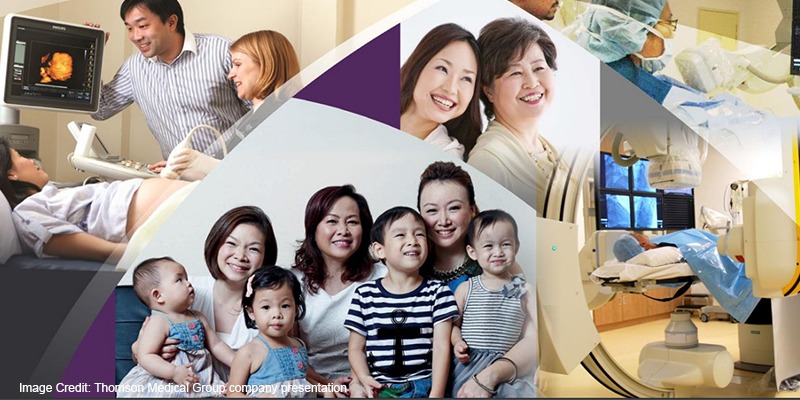
Thomson Medical Group Limited (“TMG”) is well positioned to benefit from rising private healthcare spending in the region. Demand for private hospitals has increased due to strong economic growth, expanding income levels and supply constraints. Healthcare expenditure per capita in Singapore and Malaysia will catch up to levels in developed nations, and the ratio of hospital beds per population is still well below that of more developed or mature economies.
About Thomson Medical Group
In 1999, Thomson Medical Group was first incorporated as asp Holdings Pte Ltd, an information technology training and software development company. The firm was later renamed aspnetcentre Pte Ltd., and filed its initial public offering in July 2002. After a year, aspnetcentre took on a new name –Rowsley Ltd – and repositioned itself as an investment company, slowly discontinuing its information technology business over time.
Following a series of investments, Rowsley acquired Iskandar Land and RSP Architects for S$581m to pursue its plan of becoming a major real estate player in the Iskandar region. The plan was to transform a piece of land just a kilometer away from the Johor Causeway into Vantage Bay Healthcare City, an integrated health and wellness development with medical and educational facilities.
In December 2017, the group decided to focus on its healthcare portfolio and proceeded to purchase the entire share capital of Sasteria Pte Ltd, the parent company of Thomson Medical Pte Ltd and TMC Life Sciences Berhad (“TMCLS”). Thomson Medical Pte Ltd manages Thomson Medical Centre (“TMC”), a private hospital in Singapore that specializes in gynecology and vitro fertilization. TMCLS is a listed healthcare group that oversees the Thomson Hospital Kota Damansara (“THKD”) in Selangor. TMCLS will also operate the Thomson Iskandar Medical Hub in Johor Bahru, which is currently under development.
After the Sasteria acquisition, Rowsley Ltd was renamed Thomson Medical Group Limited. TMG then divested its real estate arm but kept Vantage Bay Healthcare City (held through Vantage Bay JB Sdn Bhd). On 14 Feb 19, TMG acquired Smartparents Pte Ltd to extend its reach to young parents. The current group structure is displayed in Figure 1.
Figure 1: TMG corporate structure
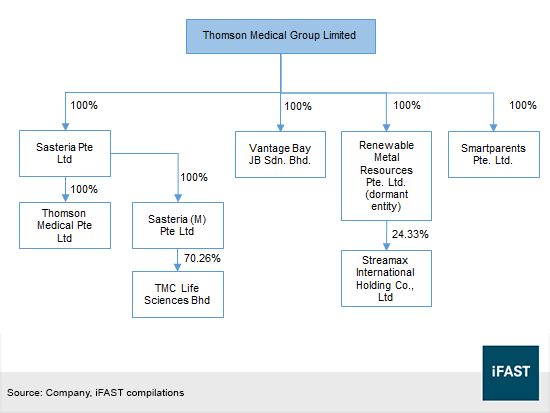
Vantage Bay JB Sdn Bhd is primarily engaged in the property development of Thomson Iskandar Medical Hub. Located just a few minutes away from the Woodlands Causeway and the proposed Rapid Transit System station at Bukit Chagar, the medical hub will host a 500-bed hospital and 33-storey commercial tower once the facility is completed by early 2024.
Thomson Medical’s cash-generating units
Group revenue is mainly recognized through two hospital assets, Thomson Medical Centre, a 187-bedder; and Thomson Hospital Kota Damansara, a 205-bedder that is undergoing expansion. THKD is famous for in vitro fertilization procedures, and the hospital is under renovation to accommodate future medical demand from the broader middle class within the Klang Valley. Once upgraded, THKD will have a capacity of 600 beds, 11 operating theatres and more than 150 specialist clinics by the end of the year.
Unlike its larger sister hospital in Kuala Lumpur, TMC largely specializes in obstetrics and gynecology services. The center had 31 doctors and 3 resident medical officers as at 31 Mar 19. Medical practitioners sign leases to use the space and facilities at TMC, which is also available to some 1,100 other non-resident specialists.
Shareholding information
Mr Lim Eng Hock or Peter Lim is the ultimate controlling shareholder of TMG. After the Sasteria acquisition, Mr Lim increased his interest in the firm from ~45% in 2017 to nearly 89%. At a consideration sum of S$1.6 billion, the transaction was satisfied through the issuance of new equity at S$0.075 per share.
We estimated that TMG paid ~S$5.9m of dividends to the ultimate controlling shareholder in 2019, which was almost two times the group’s net profit from continuing operations in the same year. In view of the lack of institutional ownership and the highly concentrated shareholding of the firm, it may not be surprising if TMG embarks on debt-financed acquisitions or dividends. A higher debt burden and increased dividend payout would be credit negative to existing bondholders.
Financial highlights
A higher patient load and larger average bill size led to an increase in group revenue from S$216m in 2018 to S$230m in 2019. Geographically, 70% of total revenue came from Singapore with the remainder from operations in Malaysia. Group EBITDA climbed 13% YoY to S$55m as a result of lower rental expenses and the adoption of SFRS(I) 16. Excluding the effect of SFRS(I) 16 and a property impairment loss in the previous year, group EBITDA would have declined by 6% YoY.
Higher finance, labor and depreciation expenses weighed on earnings. Borrowing costs were up 41% YoY due to bank borrowings taken for the acquisition of the healthcare businesses, higher interest rates and recognition of lease-related interest expenses. As a result of these higher expenses, net profit from continuing operations dropped from S$15m in 2018 to S$3m in 12M2019.
Liquidity discussion
TMG’s cash position of S$111m was more than sufficient to cover its current borrowings (including lease liabilities) of S$21m. Short-term financial obligations consisted of S$8m of lease liabilities and S$13m of interest bearing loans.
Total debt dropped to S$571m at the end of 2019 from S$578m a year ago. TMG issued the TMGSP 4.800% 18Jul2022 Corp (SGD) on 18 Jul 19, using proceeds from the notes to refinance the group’s existing borrowings. The debt maturity profile of the firm was extended and the group’s short-term debt dropped from S$237m in 2Q19 to S$13m in 3Q19.
Secured bank loans made up S$347m of total debt. According to the company, the bank loans are secured by a charge over certain shares and assets of subsidiaries as well as corporate guarantees provided by the company and a subsidiary. Tangible assets, on the other hand, had an estimated carrying value of S$684m, comprising of S$391m of property and equipment (“PPE”), S$150m of investment properties and S$143m of development property.
The investment property sits on a 9.23 hectare piece of land located within the Iskandar Development Region, Johor Bahru, Malaysia. TMG had pledged the property, which accounted for 51.31% of the total land area, as collateral for interest-bearing loans and borrowings. Likewise, the development property is the combined value of land and residential properties within the Iskandar Development Region.
TMG may have headroom for more secured financing as the ratio of secured debt to tangible assets dropped from 90% in 2018 to 51% in 2019. However, we think there is no need to raise capital at this point as the group has kept a healthy liquidity profile and maintained positive operating cash flows. During 2018 and 2019, net cash flows from operating activities were S$68m and S$41m respectively.
Free cash flow, which takes into account capital expenditures, also remained positive in 2019. Net operating cash flows of S$68m surpassed capex of S$57m during the year. Purchase of PPE totaled S$23m in 4Q19, nearly five times more than S$5m in 4Q18. We suspect this is related to cash outlays from the upgrading of THKD and construction of Thomson Iskandar Medical Hub.
Industry discussion
In Singapore, TMC competes with Mount Alvernia Hospital (“Mt Alvernia”), Raffles Medical Group (“RMG”) and IHH Healthcare Berhad (“IHH”), a conglomerate that owns the Parkway, Gleneagles and Mount Elizabeth hospitals. In Malaysia, KPJ Healthcare Berhad (“KPJ”) and IHH are among TMCLS’s largest competitors.
TMG’s credit profile is partly dependent on the market positions of TMC and THKD. Top-line growth will be driven by the hospital’s reputation and treatment success rates, as well as its ability to attract specialists and patient admission trend. Over time, a hospital’s reputation for quality care and breath of service will increase as more talented doctors join the group.
The majority of the doctors in Singapore and Malaysia are independent medical practitioners who lease clinic space at hospitals. Doctors are not obligated to maintain a clinic presence in the hospital, nor are they required to use the operator’s facilities to treat their patients. If doctors leave and choose to treat patients at other hospitals, patient admissions may drop and service revenue will decline.
The reasons are many and varied but medical practitioners are often lured to a hospital for its well-equipped facilities with state-of-the-art diagnostic tools including new medical technology fittings and large operating theatres. Therefore, hospital operators will constantly need to invest in the latest infrastructure to attract physicians and maintain their competitive advantage.
It is equally important to retain talented healthcare employees such as nurses and pharmacists to ensure a professional level of service is provided at the clinics and health centres. A tight labour market of medically trained nurses may increase staff costs as there would be a need to raise wages to keep workers employed at the company.
By building a mega health hub in Johor, TMG is betting that more Singaporeans will travel to Malaysia for hospital treatments. The idea may seem far-fetched but the venture would make sense from another standpoint as Malaysia has a larger population, higher birth rate and bigger growth potential over the long term. According to the Ministries of Health in both countries, Malaysia recorded 1.1m of private hospital admissions in 2018, nearly nine times higher than Singapore. Based upon the results of a Mercer Marsh Benefits survey, although medical fees are supposedly lower than Singapore, healthcare costs are projected to increase at a faster rate in Malaysia.
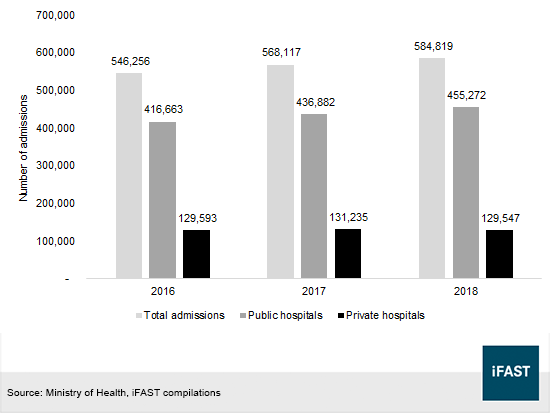
Private hospital admissions in Singapore were largely unchanged during the last few years, although the total number of admissions nationwide had increased to 584,819 in 2018 (Figure 2). In view of the low patient load, we do not foresee a strong pickup in Singapore private hospital admissions as the country’s standard of healthcare in public hospitals is comparable to private hospitals, yet the cost of public health care is meaningfully lower.
Figure 2: Hospital admissions in Singapore
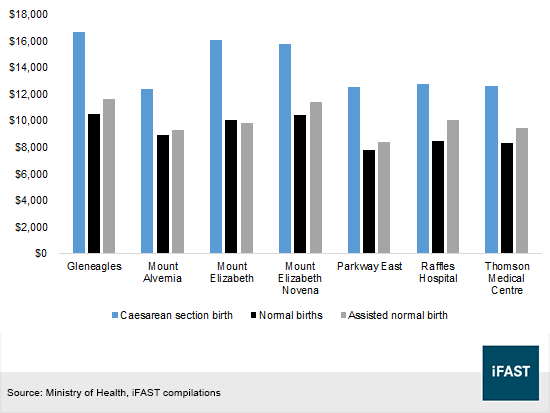
Once recognized as one of the leading providers for women and children, TMC is facing fierce competition in the antenatal and postnatal market in Singapore. Parents now have a wide selection of choices for neonatal care. For instance, Parkway East Hospital, operating under Parkway Pantai Limited (subsidiary of IHH), is offering the lowest cost options for childbirths (Figure 3).
Based on the median hospital bill for a normal childbirth (in a one-bedded ward) between July 2018 and June 2019, most patients paid more during their stays at TMC (S$8,285) than those who chose Parkway East (S$7,754). Patients who stayed in a 4-bedded ward also paid more in TMC (S$6,270) than in Parkway East (S$5,388).
With 76,459 and 76,917 patient admissions in 2017 and 2018 respectively, the Parkway hospitals accounted for more than 50% of nationwide private sector hospital admissions, making IHH the largest healthcare provider in Singapore. Although TMG does not disclose details on hospital admissions, the number of childbirths at TMC may have declined in the years through 2018, as Mt Alvernia, which has a similar price point as TMC, reported a decreasing trend of delivered babies in its hospital.
Figure 3: Median hospital bill for one-bedded ward
In view of the COVID-19 situation, hospital patients of TMG may be postponing non-essential and non-urgent procedures. A prolonged scenario of the virus epidemic would hamper the company’s business activities and affect its top line. Moreover, if an outbreak occurs at any of the clinics or centres, the affected facility will be temporarily shut down and a quarantine order may be imposed on all affected staffs.
However, despite the current coronavirus headwind and depressed birth rates, we see ageing demographics, medical tourism and rising affluence underpinning demand for private healthcare in Singapore. Running a hospital chain remains a lucrative business, as operating margins are decent. In 2019, RMG, TMG, KPJ and IHH registered operating profit margins of 14.6%, 16.3%, 8.3% and 11.7% respectively. Barring any significant worsening of the virus outbreak, TMG’s management guided that the group would remain profitable this year.
Credit review
We find TMG’s credit profile weakest among selected peers, but we emphasize that the company has ample liquidity. The company’s operating margins are the highest at 16.3% in 2019, but its interest cover is the lowest at 1.7x. We think this is because of the group’s high borrowing cost. Interest rates on TMG’s outstanding bonds ranged from 4.05% to 4.80%, while floating rates on its bank loans were between 4.05% and 4.31% in 2018. As at 31 Dec 18, the effective interest rates of loans at the subsidiary level were between 3.26% and 5.11%.
In contrast, KPJ and IHH managed to borrow at lower costs as they are linked to institutions of higher credit quality. IHH is majority owned by Mitsui & Co. Ltd, an issuer with a provisional (P) A3 rating by Moody’s, while Johor Corporation is the parent company of KPJ. RMG also had access to low financing costs; the company’s unsecured SGD loan due 2021 carried an interest rate of 65 basis points (“bps”) over SGD swaps.
With a 43% gearing ratio (debt over total assets), TMG’s debt proportion is among the highest among hospital operators. We think the elevated debt percentage is partly related to the group’s borrowings for project financing and asset enhancements in Malaysia. So as long as the Thomson Iskandar Medical Hub is under construction, we suspect the group’s gearing profile will remain at a high level.
On the other hand, we note that the hospital group is far from breaching its financial covenants. Under the terms of the medium term note program dated 28 Jun 19, TMG is required to keep a minimum total equity value of S$450m (31 Dec 19: S$657m) and adhere to a net debt over equity limit of 1.5x (31 Dec 19: 0.7x).
As mentioned earlier, capital expenditures are needed for a hospital to maintain the quality of patient care and market position. The percentage point differences between the ratios of net CFO (cash flow from operating activities) over debt and FCF (free cash flow) over debt in Table 1 highlight the magnitude of PPE spending for each firm. For instance, after subtracting PPE, RMG’s FCF in 2019 covered 8% of its debt, representing a significant drop from 55% of net CFO over debt. Owing to its expanding presence in Shanghai and Chongqing, RMG increased capex for the year.
Regrettably, TMG’s FCF-to-debt ratio is the lowest among the peer group at just 2%. We think the company’s FCF over debt could decline further this year, as both debt and capex spending are likely to remain high. However, the group may resort to cost-cutting measures in the form of job cuts to improve operating cash flow if business conditions worsen. Staff costs are one of the largest cost components as they constituted nearly 30% of annual revenue.
Table 1: Credit metrics in 2019
|
Entity |
Operating margin |
EBIT / Interest expense |
Debt / total assets |
Net CFO / Debt |
FCF / Debt |
|
TMG |
16.3% |
1.7x |
43% |
12% |
2% |
|
IHH |
11.7% |
2.1x |
25% |
22% |
13% |
|
KPJ |
8.3% |
2.5x |
50% |
20% |
7% |
|
RMG |
14.6% |
40.1x |
16% |
55% |
8% |
|
Source: Company filings, iFAST estimates |
|||||
Bond valuation
Following the terms of the medium term note program, the TMGSP 4.800% 18Jul2022 Corp (SGD) and TMGSP 4.050% 28Jan2025 Corp (SGD) are secured by an interest service reserve account. As specified in the bond offering documents, TMG may set aside an amount equivalent to at least one interest payment, which will be kept in the interest service reserve account.
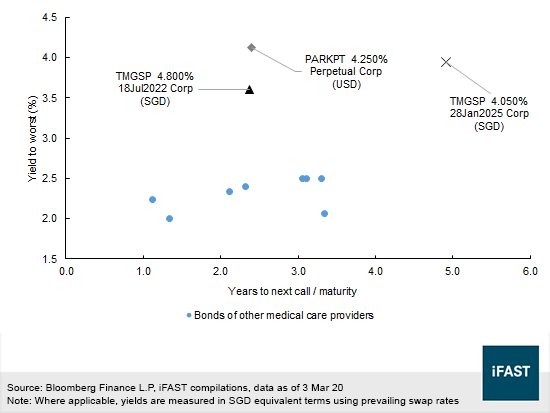
In our view, TMG’s outstanding bonds are attractively priced (Figure 4). The TMGSP 4.8% ’22s and TMGSP 4.05% ’25s had ask yields to maturity of 3.61% and 3.95% respectively on 3 Mar 20, which represent a credit spread of nearly 300bps over SGD swaps. We prefer the TMGSP 4.8% ’22s over TMGSP 4.05% ’25s as we think the yield pickup of 34bps from the latter is insufficient for a 2.5-year maturity difference.
Investors looking to invest in the healthcare sector may also consider the PARKPT 4.250% Perpetual Corp (USD), a perpetual security issued by Parkway Pantai Limited – an IHH subsidiary. The perpetual note (first callable in July 2022) had a yield to worst of 4.13%. IHH is owned by a Japanese industrial conglomerate with a diversified portfolio of hospitals in Singapore, Malaysia, Turkey and India.
Figure 4: Relative valuation
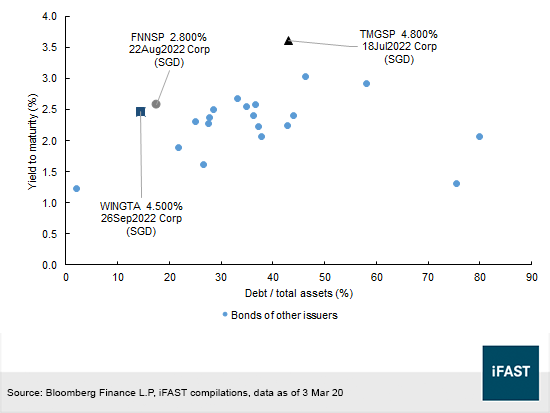
The TMGSP 4.800% 18Jul2022 Corp (SGD) has an appealing valuation compared to other SGD credits of similar maturities (Figure 5). We think that the bond yield is reasonable at this level and noteholders are well compensated given the issuer’s 43% gearing ratio and manageable liquidity profile. Bondholders who are sector agnostic and looking for credits of lower leverage may contemplate investing in the WINGTA 4.500% 26Sep2022 Corp (SGD) or FNNSP 2.800% 22Aug2022 Corp (SGD).
Figure 5: TMGSP 4.8% '22s versus other SGD notes due 2022
In summary
Regional medical tourism will grow and TMG is poised to benefit from increased medical tourist arrivals. There is an underlying appeal for private health care as more baby boomers seek higher material comfort in their retirement years. The number of hospital beds per population in Singapore is low relative to other countries. In addition, price-sensitive patients in Singapore may travel elsewhere to seek medical treatment, which should benefit TMG’s operations in Malaysia.
Even though TMG’s business could be negatively affected by the coronavirus outbreak, the impact is likely to be temporary. Hospital admissions should resume its upward trend once the virus outbreak simmers.
Project-related capital expenditures could place short-term pressure on cash flows, and it may take time for the hospital to turn profitable, but TMG may still restructure its costs to manage liquidity. The upside is that the group’s financial obligations maturing in 2020 are of a small amount, which should be easily met through its operating cash flows. Taking into account the long-term upside potential of the private healthcare sector, we recommend investors to buy the bonds of Thomson Medical Group at their current pricing level.
Recommended bond: TMGSP 4.800% 18Jul2022 Corp (SGD)
Declaration:
For specific disclosure, at the time of publication of this report, IFPL (via its connected and associated entities) and the analyst who produced this report hold a NIL position in the abovementioned securities.