- Growth strategy was made necessary by events in 2020
- Recovering revenue with expansion into Japan is further helping the top-line
- Prudent cash management will be key towards maintaining its cash position
- Social bond with a guarantee is an interesting prospect over the SGS
- Perps have a strong reason to be called before reset - rising interest rates causing reset rate to be a costly borrowing, existing perps being a limiting factor to them to issue more debt, and relatively small issue size making it easier to be called
- However, investors have to carefully consider the liquidity risk on the perps
- We
believe investors can strongly consider the two issues - FIRTSP 3.250% 07Apr2027 Corp (SGD) and FIRTSP 4.9817% Perpetual Corp (SGD)
Brief background
First Real Estate Investment Trust (“First REIT”) focuses on real estate in the healthcare sector in Asia. Prior to 2022, the assets are primarily situated in Indonesia, with a smaller proportion in Singapore and other locations. In 2022, First REIT initiated its expansion into Japan as part of its First REIT 2.0 Growth Strategy, where it acquired 12 nursing homes for the diversification of its portfolio into healthcare and healthcare-related assets. Most recently in September, it successfully acquired another two nursing homes in Japan, along with the divestment of Siloam Hospital Surabaya at SGD 40.9m.
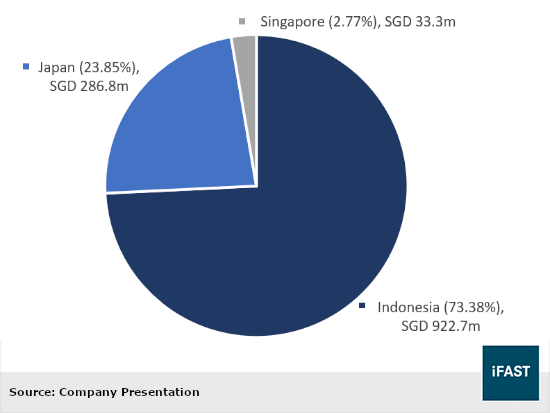
As of October 2022, the assets in Indonesia remain the bulk of its assets under management (“AUM”) at 73.38%, followed by assets in Japan at 23.85%, and lastly, assets in Singapore at 2.77%. As part of its strategy, First REIT intends to further diversify its portfolio into the developed markets over the next 3 to 5 years to more than 50% of its AUM.
Chart 1: Asset Under Management
A critical event for First REIT was the restructuring of the Master Lease Agreements (“MLA”) in 2020 with its operator PT Lippo Karawaci Tbk. The restructuring was necessitated by the COVID-19 pandemic which severely hit the hospital earnings, where more details can be found here “First REIT: Credit Update 30 Jul 20”. 2020 inadvertently became an important year for First REIT to note, with both its revenue and valuation of assets heavily affected by the pandemic and further cementing the case for its 2.0 Growth Strategy and the need for diversification.
A recovering statement from 2020
Revenue for First REIT appears to have mostly recovered in FY21 at SGD 102.35m, a 28.5% increase over FY20 at SGD 79.62m but slightly lower than the pre-pandemic 2019 revenue at SGD 116.20m. However, it ought to be noted that due to the restructured MLAs, the minimum of 4.5% annual escalation on the rental income from the Indonesia assets is recognised on an adjusted straight-line basis for accounting purposes. Therefore, the top-line will appear slightly inflated in contrast to the operating cash flow, although the top-line is expected to remain consistent from this adjustment.
For the half year ended 30 June 2022 (“1H22”), the inclusion of the revenue from the Japan nursing homes since the acquisition in March has helped with the overall revenue at SGD 53.79m, a 38.2% year-over-year (“YoY”) increase compared to SGD 38.93m in 1H21. However, accounting for the decrease in property valuation and losses attributable to foreign exchange, the total return for the period before income tax was only 12.7% higher at SGD 28.48m in 1H22 versus SGD 25.27m in 1H21. Given that JPY/SGD fell by 17.98% year-to-date, and IDR/SGD by 5.10%, we are expecting the numbers to improve further with the stabilisation of the currency exchanges.
For the nine months ended 30 September 2022 (“9M22”), the revenue was announced to have increased to SGD 80.9m, an increase of 39.2% YoY from SGD 58.1m in 9M21, which is in line with the expectations of the results in 1H22.
While the value of the investment properties was bolstered up to a total of SGD 1,198m in 9M22 with the inclusion of the 14 nursing homes (FY21: SGD 962m), the acquisition included JPY borrowings which increased its total debt from SGD 349.2m in FY21 to SGD 445.4m in 9M22. Notably, the acquisition was funded primarily through the issuance of units, the second time since the initial issuance in 2020 in this recent period.
With the exception of 2020, First REIT has been consistently growing its cash position since 2018 – having a cash and cash equivalent of SGD 78.82m as of 1H22. Free cash flow increased significantly in 1H22 to SGD 63.32m as compared to 1H21 at SGD 30.51m, though it is mostly due to the trade and other receivables attributable to the acquisition of Japan nursing homes (SGD 40.98m) and other non-financial liabilities (SGD 7.21m). Accounting for the straight-line adjustment in rental, the cashflow is expected to improve as the lease continues.
First REIT’s debt situation
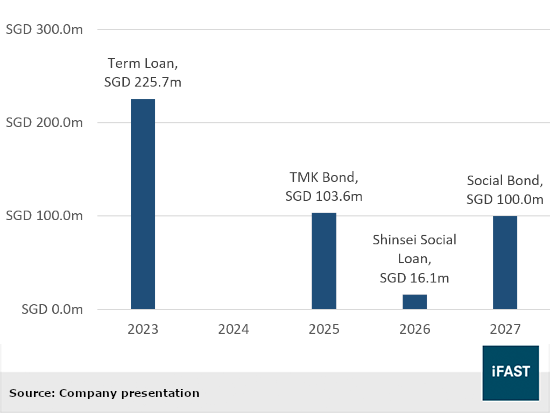
As of 30 September 2022, First REIT’s total debt before transaction cost of SGD 445.4m includes a term loan due March 2023 (SGD 225.7m), a TMK bond for the Japan nursing homes due May 2025 (SGD 103.6m), a Shinsei Social Loan due September 2026 (SGD 16.1m) and a CGIF-guaranteed social bond due April 2027 (SGD 100.0m). While the previous interest rate swap contracts for the hedging of interest rates expired on 1 March 2022, First REIT has entered into interest rate swaps of SGD 85m in September and interest rate caps of SGD 90m in November this year.
Chart 2: Debt Maturity Profile
The acquisition of the Japan nursing homes was beneficial in managing its average cost of debt - due to JPY borrowings tied to the assets, its cost of debt lowered from 4.2% in FY21 to 4.0% in 9M22. For reference, Japan’s short term policy rate as maintained by the Bank of Japan is at -0.1% which is forecasted to remain unchanged. Though its total debt increased with the acquisition, the gearing ratio (based on gross debt to deposited property) increased marginally from 33.6% in 2021 to 35.6% in 9M22. Its interest cover ratio changed mostly due to the increase in debt, falling from 5.7x in FY21 to 5.2x in 9M22.
Based on existing publications, negotiations for the refinancing of the term loan are ongoing. Even so, assuming the likely success of the refinancing, we expect a higher cost of borrowing from the rise in interest rates.
On 2 September 2022, First REIT completed its tender offer for the SGD 60m existing perpetual securities, which was offered at 70 per cent. The offer was relatively well received, with an approximately 45% acceptance rate resulting in a remainder of SGD 33.25m outstanding issue. The offer provided an opportunity for the bondholders to recycle its capital in an otherwise illiquid holding, whereby before the announcement on 22 August 2022, the bond was trading at an ask price of 55.
Expansion might be limited in the recent years
Operating margin since 2017 has been relatively stable with minor variations (FY21: 0.711), with the inevitable exception in FY20 at 0.572. Before 2022, First REIT’s focus on developing markets has been the key driver of its revenue and operating income. However, with the entry into developed markets, there are expectations of a drop in the overall operating margin – considering the reduced risk associated with developed markets as to developing markets.
Despite the Japan assets being responsible for 21.4% of its overall AUM in 1H22, it only contributed to 8.4% of the net operating income. Even after adjusting for the four months’ operation to semi-annual basis, the proportion of net operating income from Japan assets will come to only 12.1% - far from the 21.4% to be on par in terms of proportionate contribution with the Indonesia assets. Although the net operating margin for 1H22 still stands at 0.711, we are expecting it to fall with the continuous expansion in the developed markets for diversification.
On the other hand, First REIT has limited means towards supporting the 2.0 Growth Strategy. From the current gearing of 35.6% as of 9M22, it has an extremely limited headroom of only SGD 170.8m and SGD 307.7m respectively to reach net gearing ratios of 45% and 50% respectively – any increase from the current gearing is already unlikely to be looked kindly upon by investors. In addition, the existing interest rate environment meant that any new financing will be relatively costly.
Under such circumstances, further diversification of
its portfolio would have to come from the divestment of its assets or using its
free cash flow. For the former, the recent divestment of Siloam Hospitals
Surabaya represents such a case, where the matured asset provided a good
opportunity for the company to divest. For the latter, despite a growing cash
position, the growth is unlikely to be able to support much of the diversification,
considering its cash and cash equivalent is only 6.48% in proportion to its
total asset value in 1H22. Given rising interest rates and volatile currency
exchanges, we believe the company will become more cautious in utilising its
cash.
Social bond and perp offering its unique proposition
FIRTSP 3.250% 07Apr2027 Corp (SGD) is a straightforward consideration given that it is guaranteed by CGIF, a trust fund of the Asian Development Bank and the first of its kind healthcare social bond in Singapore. With an indicative yield to maturity at 4.26% on ask price of 96, and 4.41 years to maturity, the bond is a strong consideration over the 5Y SGS with a yield of 3.36% as of 8 November 2022, especially with the guarantee falling on CGIF rather than a related entity as observed in other guaranteed bonds of similar yields.
On the contrary, the concerns for FIRTSP 4.9817% Perpetual Corp (SGD) are more complex. With an ask price of 70, the yield to next reset (when called on reset date) is sitting at 16.44% and a current yield of 7.12%. The bond features a reset every five years, the next being 8 July 2026, with a reset rate of the 5Y SGD SOR plus an initial spread of 392.5 basis points (“bps”).
The ask price at 70 is based on the reference to the recent tender offer, as the perp is currently highly illiquid with no suitable indication of trading price. Given the understanding that yields have increased since the tender, it is likely that an ask price truly representative of the market conditions should be lower.
The major concern is how the yield changes drastically with the change in interest rate, which similarly would influence the decision of the company to allow it to reset or to call the remainder of SGD 33.25m.
An important point to note prior to the analysis is that the initial spread of 392.5 bps on the reset rate causes the borrowing to be a costly one. Due to the high reset spread of 392.5 bps, this will result in higher borrowing costs for the issuer. The current coupon of 4.9817% is already considerably higher than its average cost of debt at 4.0% - though refinancing on the existing term loans is likely to see this number increase. Thus, we will see a high probability that the perps will reset at a much higher coupon rate as long as the 5Y SGD SOR stays above 1.06%.
Chart 3: Relationship between 5Y SGD SOR and 5Y SGD SGS
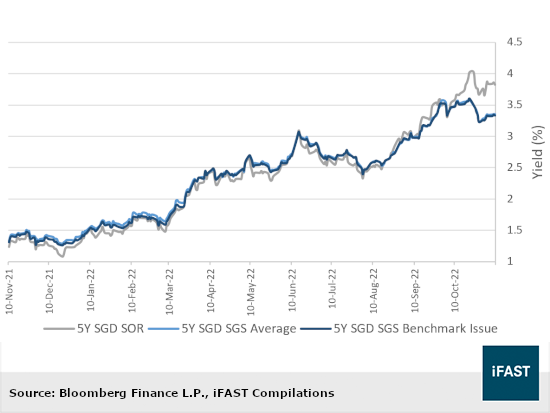
From Chart 3, it is clear that the interest rate of reference (5Y SGD SGS Average and Benchmark Issue) is highly correlated to the 5Y SGD SOR and mostly lies at similar rates. Due to the rising inflation rates, various central banks across the world have been hiking their interest rates to manage the situation. Correspondingly, in Singapore, the 5Y SOR and 5Y SGS increased substantially from a year ago. With inflation expected to remain elevated across 2023, interest rates are unlikely to come down before 2024 with the near-term interest rates expected to increase even beyond the current level.
Various scenarios for the FIRTSP 4.9817% perp
The possibility of it being called on reset: As mentioned previously, for the perp to reset above 4.9817%, the 5Y SGD SOR simply needs to hit 1.06%, giving the current yield of at least 7.1% and higher. Given the cost of funds aggregated in JPY and SGD to unlikely be above this amount, investors that have faith in interest rates staying high can consider the possible yield to next reset at 16.44%. In such a situation, it becomes more practical for the company to refinance the perps with a lower cost of funds. However, the interest coverage ratio would be affected given that the perpetual securities are categorized under equity.
In the event that the perp is still not called on reset,
The reset happens at a lower reset rate in falling interest rates environment: At a lower coupon rate, pricing on the perp is likely to increase to adjust for the yield. As such, if the 5Y SGD SOR does lower significantly, even though there would be a lower reset rate, the perps are likely to inch closer to par value depending on the degree of the change in interest rates. In this scenario, the yield on selling rises depending on the value (if sold at par on reset date, the yield on selling is equivalent to the yield to next reset of 16.44%).
The reset happens at a higher reset rate in rising interest rates environment: While the higher interest rates likely provide for a higher reset and coupon rate, pricing on the bond would decrease to adjust for the yield. In this scenario, investors would lose out should they sell the bond on the secondary market, although their yield to call will remain quite substantial given the redemption will be at par value. On the other hand, investors would be able to enjoy a higher coupon yield based on the ask price of 70, if the perp resets at higher than the current coupon rate of 4.9817%.
There are two important conditions to consider for investment.
Firstly, the credit risk of the company should remain relatively stable for the potential gains to be possible. For this, First REIT has placed itself in a relatively secure position given the recent results and the upcoming plans to further diversify its income sources rather than placing most of the risk in Indonesia.
Secondly, the liquidity of the perps needs to be well considered. The liquidity risk of the issue is a key concern for the potential yield on the bond, particularly in the event of wanting to sell the bond when the interest rate falls. The potentially higher yield on selling in a falling interest rate environment will only be actualised when the bond is sold at the increased price. Given the remaining issue of only SGD 33.25m, it might be difficult to trade the perps. The inability to sell at a suitable time will subject investors to unnecessary interest rate risks and fluctuations.
Our recommendation
We believe that First REIT has strong considerations to call the perps, rather than the potential scenarios where the perps are not called. As mentioned previously, the rising interest rate environment has a substantial impact on their interest expense, and likely even more so if they do allow the perps to reset on 8 July 2026.
On the other hand, considering the capital funding structure and the plans to expand into the developed markets, just divestments alone would restrict its ability to diversify – First REIT has a substantial reason to issue more debts to support further property investments. Given that they have missed their initial call on the perps, not calling the perps will severely restrict their ability to tap into the perpetual security market.
Lastly, given the relatively small issue size left of SGD 33.25m on the perp, it is not difficult for them to tap into their cash or divestments for them to commit to the redemption at par value. As such, we have strong reasons to believe that First REIT will be more likely to call the perps than to allow the reset to happen.
We believe investors can strongly consider the two issues - FIRTSP 3.250% 07Apr2027 Corp (SGD) for those looking for stability amidst the current volatility in interest rates, yet wishes to take a small risk premium over the current SGS; FIRTSP 4.9817% Perpetual Corp (SGD) for those that strongly believe in a rising interest rate environment pushing for an issuer call by First REIT, where the rising interest rates causes the reset rate to be costly, the existing perps limits its ability to issue more debt, and the small issue size would be relatively easy to be called.
Given the First REIT’s record in maintaining prudence in its management of finances and a relatively small remaining issue size of SGD 33.25m on the perps, the risk of defaulting on the perps is low. With the 2.0 Growth Strategy and diversification into developed markets in mind, we believe First REIT is on route to a rebound to pre-COVID-19 levels.
Declaration: For specific disclosure, at the time of publication of this report, IFPL (via its connected and associated entities) holds a position in FIRTSP 3.250% 07Apr2027 Corp (SGD) and FIRTSP 4.9817% Perpetual Corp (SGD), and the analyst who produced this report holds a NIL position in the abovementioned securities.
Our podcast series, Yield Hunters, is available on Spotify, iTunes Podcasts and Google Podcasts. We share our thoughts on new bond issues and hold discussions on the fixed income space. Listen to our latest episode below and follow us!