
- Intel’s revenue for the first 3Q of 2026 rose about 18% YoY to US$46.2 billion, and Data Center and AI (DCAI) revenue has already exceeded its full-year 2025 total. However, the memory shortage weighed on the PC business, Q4revenue guidance fell well short of expectations, and the share price plunged nearly 30% in a single day.
- Full-year 2026 Capex has been raised to US$20 billion and will rise sharply again in 2027. Although management reiterated that it would keep deleveraging in 2027, free cash flow is coming under pressure again after its recent improvement, and deleveraging may be slower than expected.
- A US$23 billion equity raise has moved Intel into a net cash position, giving it ample short-term debt-servicing capacity. Investors should favour short- to medium-dated bonds and stay cautious on long-dated bonds.
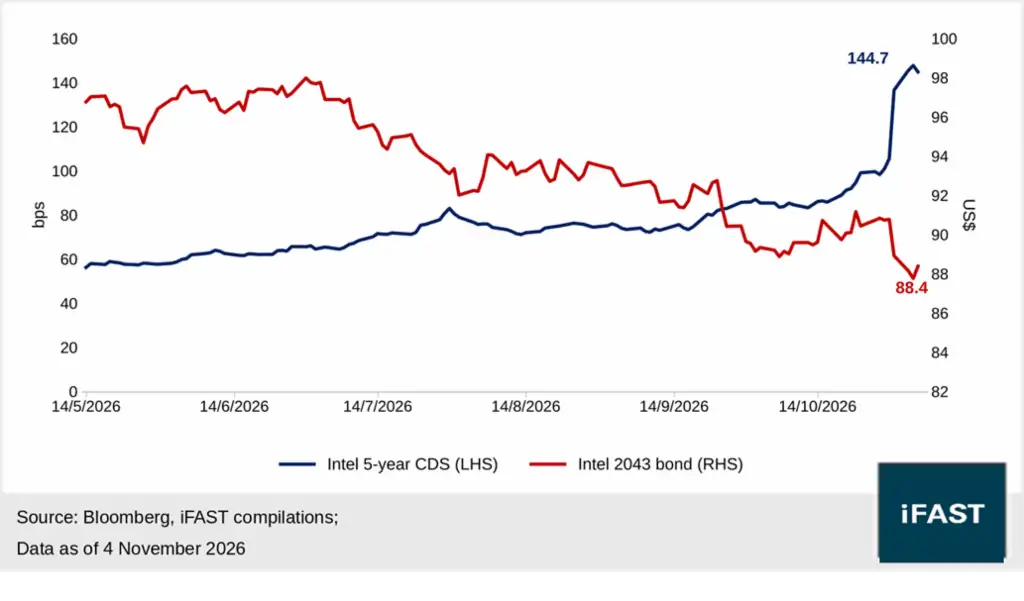
In our May article “Intel’s Darkest Hour Is Over — Powered by AI and Foundry: Recovery Opportunity or Hidden Risk?”, we noted that Intel’s turnaround was starting to show results, with improving free cash flow and credit fundamentals. Intel reported Q3 results on 29 October: revenue and gross margin beat expectations, but Q4 guidance fell well short of market expectations. The share price plunged 28.6% the next day, its worst one-day drop since 1974, and the five-year credit default swap (CDS) spread widened to a record 145 basis points (see Chart 1).
Chart 1: Intel’s CDS and bond price
 Was the sell-off
after earnings beat a passing emotional reaction, or a turning point in Intel’s
credit story? This article first reviews Intel’s operating performance in the
first nine months of 2026 and its Q4outlook, then analyses the changes in its
cash flow, debt and liquidity, and updates the views we set out in May.
AI momentum beats expectations while the PC business weakens quarter by quarter
In the first nine months of 2026, Intel’s revenue totalled US$46.2 billion, up about 18% YoY, with growth accelerating from 7% in the first quarter to 25% and 21% in the second and third quarters. Profitability recovered as well: Intel posted an operating profit of US$1.18 billion in the first nine months, reversing an operating loss of US$2.79 billion a year earlier. In the third quarter alone, the operating margin rose from 5.0% a year earlier to 15.3%, and the gross margin rose from 39.4% in the first quarter to 43.0%.
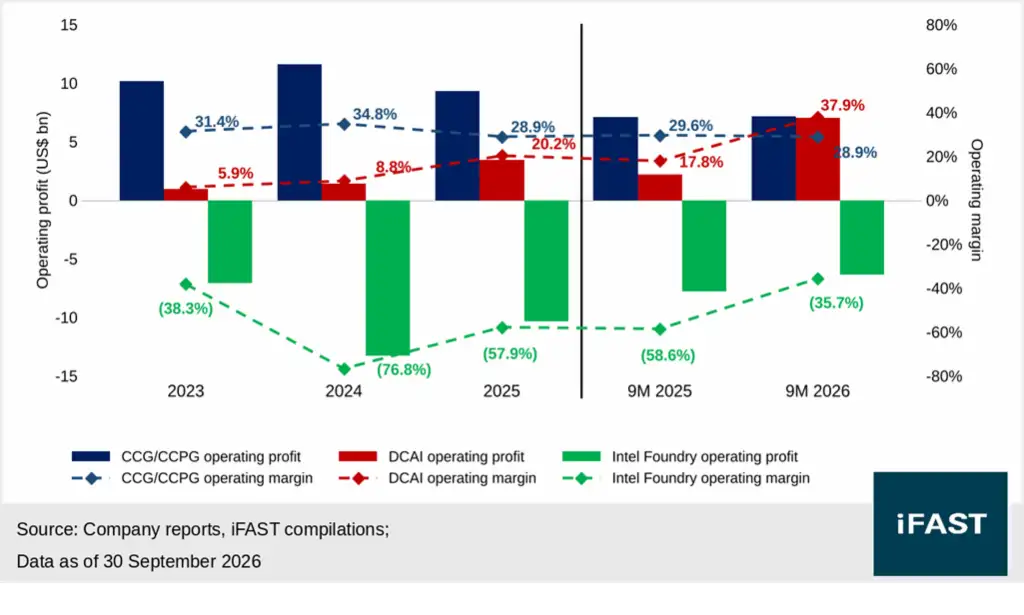
Data Center and AI (DCAI) were the main driver of growth and of the improvement in profitability. Revenue for the first nine months reached US$18.6 billion, up 53% YoY and already above the full-year 2025 total of US$16.9 billion. Operating profit jumped from US$2.17 billion a year earlier to US$7.06 billion, and the operating margin rose from 17.8% to 37.9%, so DCAI now contributes about as much profit as the PC business. Management described the third quarter as its strongest data centre growth in 15 years. In May, we noted that the shift in AI computing from training to inference and agentic AI was driving CPU demand; the first nine months show that this momentum is even stronger than expected (see Chart 2).
Chart 2: Intel’s operating profit by segment
 In contrast, the client computing business
(renamed from CCG to CCPG, the Client Computing and Physical AI Group) posted
revenue of US$24.7 billion in the first nine months, up only about 3% YoY, with
operating profit of US$7.14 billion, roughly flat on a year earlier. The trend
has also weakened quarter by quarter: revenue grew 13% YoY in the second
quarter but fell 5% to US$8.1 billion in the third, reflecting the drop in PC
demand caused by the surge in memory prices in the second half.
Intel Foundry’s segment revenue for the first nine months was US$17.9 billion, up about 34% YoY. Its operating loss narrowed from US$7.81 billion a year earlier to US$6.38 billion, and the loss margin narrowed from 59% to 36%. The Q3loss of US$1.85 billion was the smallest quarterly loss since 2025. The narrowing was broadly in line with our expectations in May, but revenue from external customers is still at an early stage.
Q4guidance: not enough PC demand, not enough DCAI supply
Q4revenue guidance of US$15–16 billion was below the market expectation of about US$17.1 billion. The shortfall arose mainly because DCAI growth could not fully offset the decline in CCPG. Lower utilisation from reduced PC chip production, together with the accident at the Kiryat Gat plant in Israel, brought adjusted gross margin guidance down to just 38.0%, far below the market expectation of 42.8%.
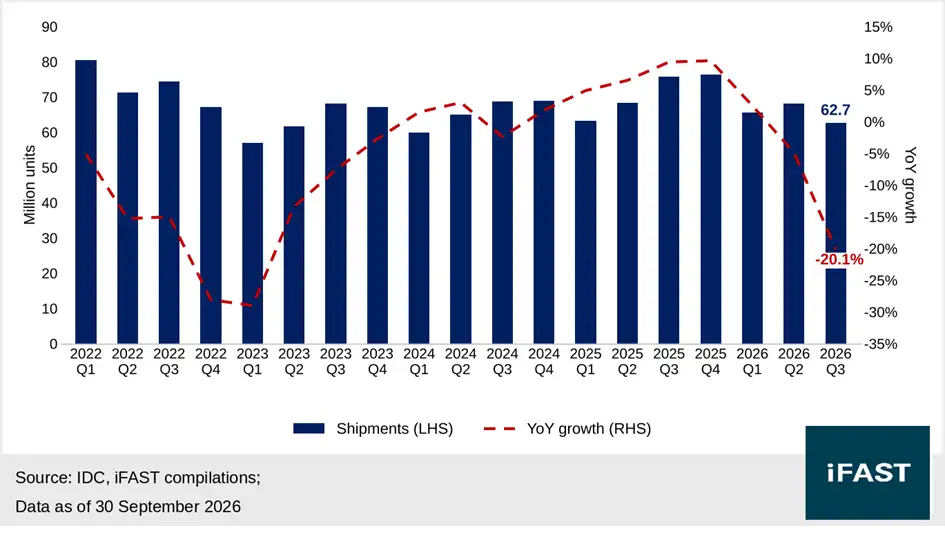
DRAM and NAND memory prices remain high, pushing up PC prices and causing shipments to weaken markedly (see Chart 3). With demand expected to fall further in 2027, PC brands (OEMs) moved quickly to cut inventory, buying fewer chips than the number of PCs they sold. Management therefore expects Q4CCPG revenue to fall more than 20% quarter-on-quarter and expects PC shipments to drop about 12% this year and 10% next year, which will continue to weigh on CCPG revenue. That said, CCPG still kept an operating margin of about 28% in the third quarter, and client CPUs built on the 18A process rose from less than 5% of revenue at the start of the year to nearly one-third, showing that the products remain competitive and positioning the business for higher profits when volumes recover.
Chart 3: Global PC shipments
 Management said
demand for data centre chips continues to exceed supply and expects Q4DCAI
revenue to grow about 15% quarter-on-quarter to about US$8.4 billion. Growth is
slowing mainly because of shortages in both Intel 3 wafer capacity and the
organic substrates needed for EMIB advanced packaging. Intel is locking in
capacity through prepayments to suppliers and bringing in more suppliers to
raise substrate capacity by about 40%. According to industry sources, EMIB
substrate yields are currently only about 45%, and most of the new capacity
will not come on stream until the second half of 2027.
In addition, an accident at the Kiryat Gat plant in Israel, which mainly produces server chips, is expected to reduce Q4revenue by about US$300 million. Supply shortages also create a market-share risk: management admitted that its 2027 server market share will be “a function of supply”. Intel is therefore converting part of its 18A capacity in Oregon, previously used for PC chips, to the Intel 3 process used for server chips, although production will not start until the second half of 2027.
Intel Foundry: losses persist, external customers are key
Intel Foundry’s Q3 revenue was US$6.7 billion, but external revenue was only US$411 million, mostly from a non-recurring customer programme. Because internal revenue is eliminated on consolidation, the foundry business is not yet adding new revenue, yet it bears heavy fixed costs, including depreciation on new fabs and R&D spending to prepare 14A for risk production next year. Yields on the new processes are also still ramping although 18A costs are down about 40% from the first quarter, they are not yet at target levels. Management said the more mature Intel 7 is already profitable, and Intel 3 will turn profitable next year; in other words, the losses come mainly from new processes in their early production stages. With lower utilisation from reduced PC chip production in the fourth quarter, foundry losses are unlikely to narrow significantly in the near term (see Chart 4).
Chart 4: R&D and production timeline of Intel’s process nodes
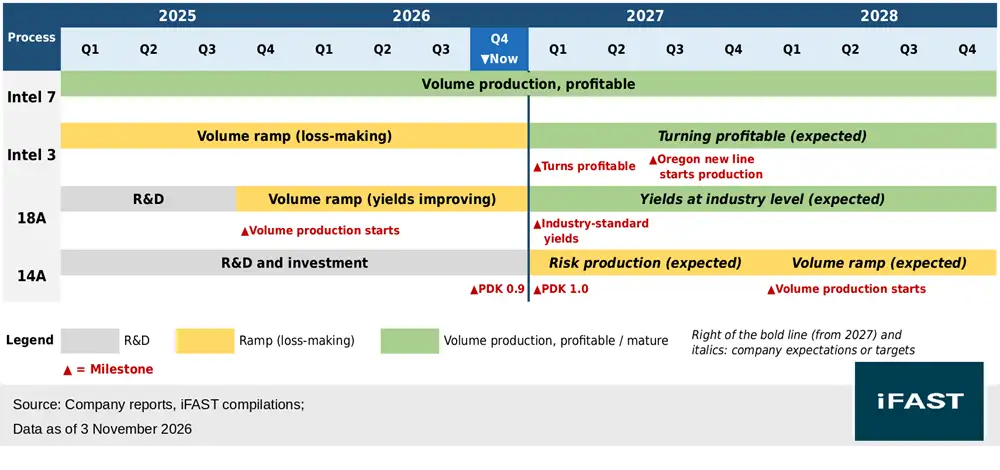
Notably, customer discussions on the 14A process have moved from evaluating the technology to discussing capacity, suggesting that customers have broadly accepted the technology and are a step closer to placing firm orders. 14A is expected to enter risk production in 2027 and volume production in 2028. CEO Lip-Bu Tan said a couple of customers will be ready to announce over the next two quarters. However, the CFO said in August that the foundry business is still targeting operating breakeven by the end of 2027 but admitted that if external customers grow faster than expected, higher up-front costs could push breakeven out to the end of 2028.
Free cash flow may come under pressure again
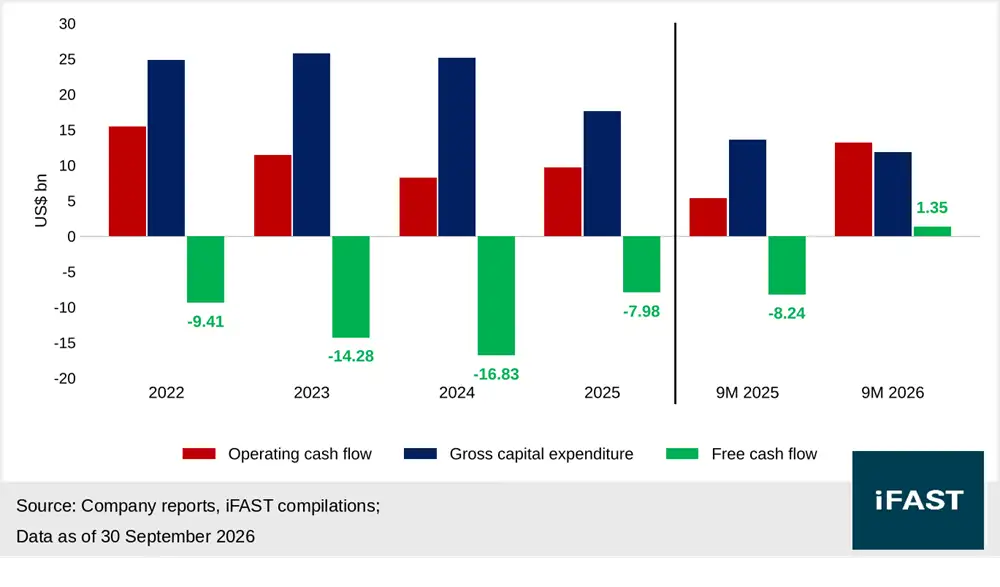
Intel’s operating cash flow for the first nine months was US$13.2 billion and gross Capex was about US$11.8 billion, leaving free cash flow of about US$1.35 billion, a clear improvement on 2025; the third quarter alone contributed about US$860 million. At the start of the year, management expected 2026 capex to be like 2025’s US$17.7 billion. But as server CPU demand surged, Intel needed to expand capacity, and in the second quarter it raised full-year capex to about US$20 billion. On that basis, Q4capex would be about US$8.2 billion, nearly twice the Q3level. Combined with lower Q4earnings guidance, free cash flow may turn negative in the fourth quarter, and the full-year chart could swing from positive to negative (see Chart 5).
Chart 5: Intel’s free cash flow
CFO Dave Zinsner said that with 18A, Intel 3 and 14A all ramping at the same time, along with construction of the Ohio fab, there is “probably not a dynamic where we are going to have positive free cash flow next year”, though he gave no specific chart. Assuming the market estimate of about US$30 billion in capex and operating cash flow like 2026 (about US$17 billion), the 2027 free cash flow gap could reach about US$13 billion. Note that management’s comment is on an adjusted basis that includes partner contributions; on this article’s basis, the gap could be even larger.
Equity raise brings net cash and ample debt-servicing capacity
In May, the market worried that Intel’s debt would rise after it bought back the 49% stake in Fab 34 for US$14.2 billion. However, Intel completed a US$23 billion public equity offering in the third quarter, lifting its cash and short-term investments from US$32.8 billion at the end of March to US$54 billion at the end of September, on top of a US$15 billion revolving credit facility. Against total debt of US$50.1 billion, Intel has moved from net debt of about US$12.2 billion at the end of March to net cash of about US$3.9 billion. These ample cash reserves are sufficient to cover next year’s free cash flow gap, and as Intel’s debt consists mainly of long-term bonds, near-term repayment pressure is limited.
In the long run, Intel’s credit quality depends on whether its foundry business achieves a breakthrough. The US government’s stake of about 8%, together with Nvidia’s equity investment and partnership, underlines Intel’s strategic position in the US semiconductor supply chain. However, new processes such as 14A require sustained heavy investment. If external customers fail to materialise, the capex may not generate returns and asset impairments could follow, pushing up debt levels, with a larger impact on longer-dated bonds.
Bond investment
Overall, Intel’s near-term credit quality is solid. Its US$54 billion of cash is enough to cover near-term debt maturities and the free cash flow gap, and the US government, as a major shareholder, provides further support. The spread widening after the results mainly reflects market sentiment rather than imminent repayment risk. However, the capex cycle is expanding again: although management reiterated that it will keep deleveraging in 2027, free cash flow is coming under pressure again after its recent improvement, and deleveraging may be slower than expected.
There are currently 8 US-dollar bonds issued by Intel on our platform, rated BBB/BBB (S&P/Fitch), i.e. investment grade (see Table 1). We prefer the short- to medium-dated “INTC 2.450% 15Nov2029 Corp (USD)” and “INTC 5.200% 10Feb2033 Corp (USD)” as more defensive ways to participate in Intel’s turnaround. Long-dated bonds offer higher yields, but their prices are more sensitive to changes in credit and interest rates, and their returns depend largely on whether the foundry business achieves a breakthrough, so they are better suited to investors with a higher risk tolerance.
Table 1: Intel’s bonds
|
Bond Name |
Tenor (Years) |
Investor Buy Price |
Yield to Maturity |
|
3.03 |
91.84 |
5.40% |
|
|
6.27 |
95.42 |
6.11% |
|
|
INTC
5.625% 10Feb2043 Corp (USD) |
16.28 |
89.39 |
6.71% |
|
18.74 |
77.43 |
7.00% |
|
|
25.77 |
75.48 |
7.04% |
|
|
26.28 |
84.02 |
7.06% |
|
|
27.31 |
82.83 |
7.00% |
|
|
34.79 |
51.12 |
6.91% |
|
|
Source: FSM Global |
|||
Risk
The key risk for Intel is how long the memory shortage lasts. Management expects PC shipments to fall about 12% this year and 10% next year, and the market is unlikely to recover sustainably until memory supply and prices stabilise. If memory prices stay high for longer than expected, CCPG revenue will remain under pressure, and lower utilisation will weigh on the group’s overall gross margin.
Second, the risk of a mismatch between capex and cash flow is rising. Capex will be “up strongly” in 2027, and firm equipment orders placed in the third quarter rose nearly 40% quarter-on-quarter, so much of the spending is already hard to cut. If the earnings recovery is slower than expected, the free cash flow gap could be larger than expected and net debt could rise faster, pushing credit metrics off the deleveraging path that the rating agencies expect.
Third, foundry execution risk remains significant. External 14A customers have not yet formally signed. If they do not materialise as planned, the heavy investment may not generate returns and could even lead to asset impairments. Meanwhile, if shortages of substrates and Intel 3 capacity persist, Intel may be unable to capture AI demand, pushing customers towards AMD and Arm-based products.
Finally, with interest rates likely to stay high for longer, longer-dated bonds carry greater price risk. Market sentiment towards AI infrastructure and technology credit has been volatile, and with Intel’s five-year CDS already at a record high, its bond spreads could widen further.
Conclusion
Intel’s revenue for the first nine months of 2026 rose about 18% YoYto US$46.2 billion, and Data Center and AI (DCAI) revenue has already exceeded its full-year 2025 total. However, the memory shortage weighed on the PC business, Q4revenue guidance fell well short of expectations, and the share price plunged nearly 30% in a single day.
Full-year 2026 Capexhas been raised to US$20 billion and will rise sharply again in 2027. Although management reiterated that it will keep deleveraging in 2027, free cash flow is coming under pressure again after its recent improvement, and deleveraging may be slower than expected.
A US$23 billion equity raise has moved Intel into a net cash position, giving it ample short-term debt-servicing capacity. Investors should favour short- to medium-dated bonds and stay cautious on long-dated bonds.
Declaration: For specific disclosure, at the time of publication of this report, IFPL (via its connected and associated entities) holds INTC 5.625% 10Feb2043 Corp (USD) and the analyst who produced this report holds NIL positions in the abovementioned securities. This research report was prepared with the assistance of artificial intelligence (AI) tools. iFAST Financial Pte Ltd does not rely exclusively on AI for content generation; the content of this report – including all investment theses, ratings, price targets and conclusions – has been independently reviewed and verified by the research analyst(s) to ensure accuracy and professional integrity.
Key risks of investing in bond
|
Key risks of investing in high-yield bonds
|
| Bonds with special features Some bonds may contain special features and risks that warrant special attention. These include bonds:
|
Remarks
|