
Key Points
- Strong Government Backing: Wholly owned by the Australian government, with an essential role in the country's broadband infrastructure.
- Stable Business Model: Regulated pricing and a wholesale-only model support predictable revenue and cash flow.
- Improving Financial Performance: FY2026 EBITDA rose 5.3% YoY, while free cash flow increased to AUD1.18 billion.
- High but Manageable Leverage: Net debt-to-EBITDA improved to 8.9x, supported by healthy cash flow and a strong liquidity buffer.
- Enticing Bond Yields: Selected AA+ rated AUD bonds offer yields up to 6%, presenting opportunities for investors seeking income.
NBN Co (National Broadband Network Company) is a 100% Australian government-owned corporation responsible for designing, building and operating Australia’s national wholesale broadband network. Since its launch in 2009, NBN Co has focused on providing homes and businesses across Australia with access to high-speed internet, helping bridge the digital divide between metropolitan and regional areas.
The company operates nationwide, covering 12.65 million premises across every state and territory through a mix of technologies, including FTTP, HFC, fixed wireless and satellite. As of June 2026, NBN Co serves more than 8.65 million connected homes and businesses.
Following our previous update on 1HFY2026, it has now released its FY2026 financials. Considering that there have been no material changes since our previous article 2 months ago, the latest developments in this article will be bolded.
Previous article:
Secure 5.6% YTM from NBN Co – A Government-Owned Network Operator
A Highly Sustainable and Regulated Business Model
As a wholesale network provider, NBN Co does not sell directly to households. Instead, it provides wholesale network access to retail providers such as Telstra, Optus, TPG Telecom and Aussie Broadband, which then package and sell broadband services to end users. This wholesale-only model allows NBN Co to generate revenue regardless of which RSP a customer chooses, while avoiding the customer acquisition costs, churn risk and intense price competition typically associated with the retail telecommunications market.
This provides NBN Co with a relatively stable source of revenue, as customers switching between retail providers may continue using the same NBN network. As a result, NBN Co is less affected by competition between retail providers, supporting more predictable earnings and cash flow.
NBN Co’s business is supported by long-term government policy, making it highly sustainable. A key example is the Regional Broadband Scheme (RBS), which requires eligible fixed-line broadband network operators, including NBN Co, to contribute a monthly levy to fund NBN Co's loss-making regional wireless and satellite services.
While NBN Co accounts for approximately 95% of the scheme's contributions, its main levy obligation is offset against the funding it is entitled to receive as the scheme's only eligible funding recipient. In contrast, competing network operators must pay their contributions, which are used to support NBN Co's regional operations. This creates an additional cost for competitors, making it less attractive to build duplicate broadband networks in areas already served by NBN Co.
We view this as supportive of NBN Co's market position. Together with the substantial upfront investment required to build a competing broadband network, the scheme creates an additional barrier to competition, helping NBN Co maintain its customer base and generate more predictable revenue and cash flow.
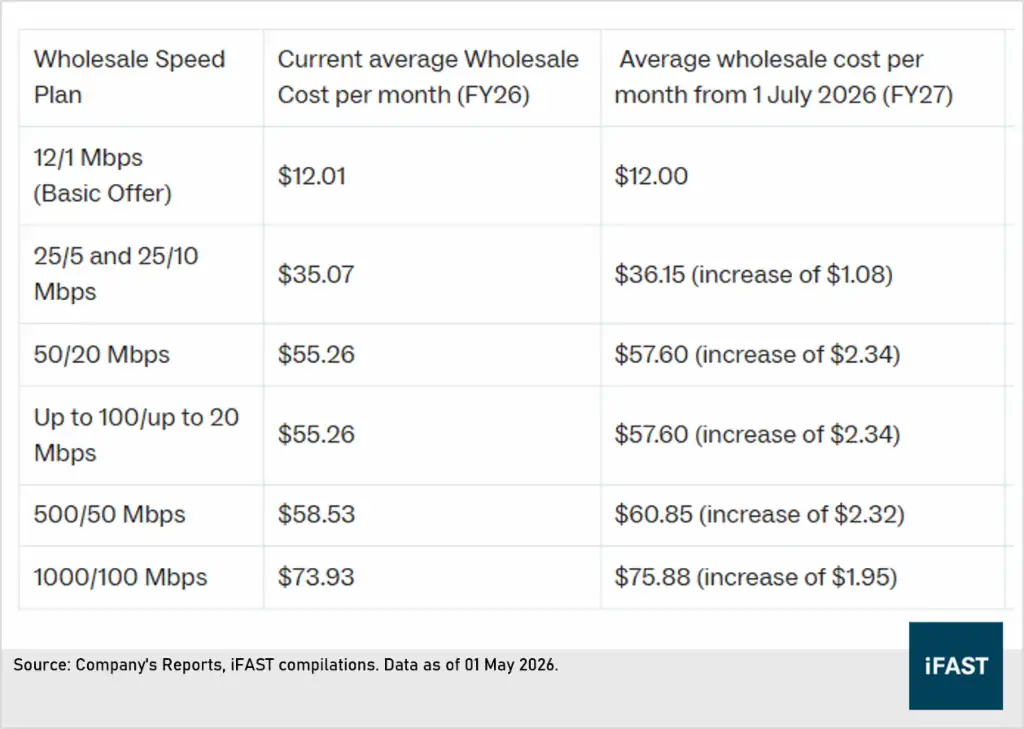
NBN Co’s operations are also highly regulated. The prices it charges retail providers are overseen by the Australian Competition and Consumer Commission (ACCC) under a long-term agreement known as the Special Access Undertaking (SAU). This structure promotes pricing transparency and revenue stability, with annual adjustments typically linked to CPI inflation. The next adjustment is scheduled for July 2026 (as shown in the chart below)
Chart 1: Price adjustment
In September 2025, NBN Co launched the Accelerate Great programme, giving FTTP (Fibre to the Premises) and HFC (Hybrid Fibre Coaxial) customers access to significantly faster speed plans at a modest additional cost. The programme drove a substantial uplift in higher-speed adoption, with 47% of customers on plans of 100 Mbps or above, up from 32% in FY2025, while 37% subscribed to 500 Mbps plans or higher, compared with just 4% in FY2025, while the subscription prices remained unchanged.
Financial Highlights
-In FY2026, Nbn Co’s total revenue up by 3.4% YoY to AUD5,917 million, primarily driven by slight uptick of 4% YoY in telecommunication revenue due to a AUD 2 uplift in residential Average Revenue Per User (ARPU) as a result of by greater customer demand for higher-speed tier plans and the application of CPI-linked regulated pricing changes effective on 1st July 2025.
- EBITDA grew by 5.3% YoY, outpacing revenue growth, driven by ongoing cost-efficiency initiatives that more than offset inflationary cost pressures. Earnings were further supported by higher revenue from increased adoption of higher-speed broadband plans and wholesale price increases, alongside lower operating expenses from improved network reliability and reduced maintenance costs. The fact that earnings grew faster than revenue indicates that NBN Co is managing its operating costs more efficiently. This is positive for its credit profile, as stronger earnings provide greater capacity to cover interest expenses and support future debt repayments.
- Despite this, NBN Co still reported a loss before tax (LBT) of $811 million. As shown in Table 1, the company has consistently recorded LBT in recent years. We do not view this as a major concern, as the losses are primarily driven by non-cash depreciation and amortisation expenses related to its nationwide infrastructure investments. Excluding these non-cash charges, the company would have been profitable.
-Looking forward, we expect Nbn Co continue to experience modest revenue growth, supported by the CPI-linked price adjustments effective on 1 July 2026. Together with continued demand for higher-speed broadband plans and ongoing cost-efficiency measures, this should support gradual earnings growth and help strengthen its ability to service debt.
Table 1: Profitability indicators (AUD million)
|
|
2023 |
2024 |
2025 |
2026 |
% Change |
|
Revenue |
5,269 |
5,501 |
5,722 |
5,917 |
3.4% |
|
EBITDA |
3,628 |
3,968 |
4,284 |
4,510 |
5.3% |
|
Depreciation and amortisation expense |
(3,082) |
(3,209) |
(3,275) |
(3,256) |
-0.6% |
|
Loss before income tax |
(1,109) |
(1,071) |
(963) |
(811) |
-15.8% |
Credit Highlights
Despite the losses recorded in the PnL statement, NBN Co has consistently maintained positive operating cash flow, which stood at $4,417 million as of June 2026 (FY26).
More encouragingly, free cash flow, which represents the cash remaining after capital expenditure, improved to AUD1,179 million in FY2026, from AUD772 million in FY2025. This was supported by higher operating cash flow and lower spending on network infrastructure.
Table 2: Cash Flow (AUD million)
|
|
FY2021 |
FY2022 |
FY2023 |
FY2024 |
FY2025 |
FY2026 |
|
Operating cash flow |
1,234 |
3,369 |
3,341 |
3,665 |
4,242 |
4,417 |
|
CAPEX |
(3,140) |
(2,618) |
(3,000) |
(3,793) |
(3,470) |
(3,238) |
|
Free cash flow |
(1,906) |
751 |
341 |
(128) |
772 |
1,179 |
In terms of gearing, the company remains highly leveraged, with net debt-to-EBITDA at 8.9x in FY2026, a slight improvement from 9.4x in FY2025. The elevated gearing level is mainly attributable to the substantial investment required to build its nationwide broadband infrastructure.
While the improvement is encouraging, NBN Co still carries a substantial amount of debt relative to its earnings. This limits its financial flexibility, particularly if borrowing costs increase or earnings weaken. Nevertheless, we expect continued earnings growth and stronger free cash flow to support gradual improvements in its debt position over time.
Despite the higher gearing ratio, we are of the view that the company credit risk is still manageable considering interest coverage ratio (EBITDA / Interest Expenses) has remained broadly stable at around 2.18x, underpinned by its solid earnings profile. Also, the company has a strong liquidity buffer, with undrawn committed bank facilities of AUD11.2 billion.
Table 3: Credit metrics (AUD million, unless otherwise stated)
|
|
FY2021 |
FY2022 |
FY2023 |
FY2024 |
FY2025 |
FY2026 |
|
Total borrowings (excluding lease liabilities) |
24,009 |
24,669 |
20,334 |
26,912 |
28,320 |
27,472 |
|
Operating cash flow |
1,234 |
3,369 |
3,341 |
3,665 |
4,242 |
4,417 |
|
Net Debt to EBITDA (x) (including lease liabilities) |
13.2x |
11.2x |
8.8x |
9.8x |
9.4x |
8.9x |
|
Interest Coverage Ratio (x) |
0.26x |
2.12x |
2.17x |
2.14x |
2.15x |
2.18x |
Key risks
i) Concentration Risk – NBN Co remains heavily reliant on a small group of major RSPs, with Telstra, TPG Telecom, Optus, Vocus Group and Aussie Broadband collectively contributing around 86% of total revenue. As such, any financial distress, consolidation, or departure of a major RSP could materially affect earnings.
However, we believe this risk is partly reduced by NBN Co's wholesale-only business model. Even if a major retail provider loses customers to another provider, those customers may continue using NBN Co's network. Therefore, a change in retail provider does not necessarily result in lost revenue for NBN Co. The greater concern would be financial difficulties at a major provider or customers switching to alternative broadband networks, which could affect NBN Co's revenue and cash flow.
ii) Technology Substitution Risk – Competition from Low Earth Orbit (LEO) satellite providers has emerged as a growing threat, particularly in regional and rural markets. Starlink offers lower latency and faster speeds than NBN Co’s legacy Sky Muster satellite services. In response, NBN Co recently partnered with Amazon’s Project Kuiper in late 2025/early 2026 to upgrade its satellite network to LEO technology, improving speed and latency performance.
iii) Competition from 5G home broadband remains a potential risk to NBN Co - As major Australian telecom operators, including Telstra, Optus and TPG, are offering home broadband services through their own 5G networks. This allows them to bypass NBN Co's infrastructure and avoid paying wholesale access fees, potentially attracting customers away from NBN's network.
Nevertheless, the likelihood of significant customer migration remains relatively low in the near term, as 5G home broadband faces network capacity constraints, particularly during peak usage periods. Unlike fibre broadband, 5G relies on shared wireless capacity, which could affect connection speeds and reliability when more households use the service simultaneously. Furthermore, NBN Co continues to strengthen its competitiveness through ongoing fibre and fixed wireless network upgrades, offering faster broadband speeds, greater network capacity and more reliable connections to retain existing customers
iv) Refinancing Risk – NBN Co’s high leverage profile, with net debt-to-EBITDA of 8.9x, means the company is highly dependent on ongoing access to debt markets to refinance maturing bonds. As lower-cost legacy debt matures, refinancing is increasingly taking place at higher prevailing interest rates. For example, NBN Co’s 10-year Sustainability Notes issued in October 2026 carried a relatively high coupon rate of 6.1 %, which places additional pressure on net profit and future financing costs.
Our view
Overall, NBN Co’s earnings profile and operating cash flow remain healthy at this stage. We continue to maintain a positive view on NBN Co despite its highly leveraged balance sheet, mainly supported by:
i) its stable wholesale business model and regulated pricing framework, which provide more predictable revenue and cash flow;
ii) its improving free cash flow and strong liquidity buffer, including AUD11.2 billion in available committed bank facilities, which provide greater flexibility to meet debt obligations; and
iii) its status as a wholly Australian government-owned enterprise, which supports investor confidence given the company's importance to Australia's telecommunications infrastructure.
In short, the high leverage largely reflects the government-mandated nation-building project, which required substantial upfront borrowing to roll out fibre and copper networks nationwide.
Meanwhile, cash flow remains highly predictable, with around 80% of households relying on NBN Co’s network for internet access. As such, we remain comfortable with the company’s business model despite its elevated gearing.
More importantly, the improvement in free cash flow suggests that NBN Co is becoming better positioned to fund its operations and network investments without relying as heavily on additional borrowing. While its high debt levels and refinancing costs remain key risks, we believe these are partly offset by its essential infrastructure role, stable earnings and strong government relationship.
From a bondholder's perspective, these factors support our confidence in NBN Co's ability to continue meeting its interest payments and debt obligations. However, investors should also consider the maturity of each bond, as longer-dated bonds are generally more sensitive to changes in market interest rates
Against this backdrop, we recommend investors consider NBNAUS 5.350% 06Mar2035 Qsov (AUD) and NBNAUS 5.850% 19Mar2036 Qsov (AUD), offering yields to maturity (YTM) of 5.86% and 6.02% respectively.
For investors who prefer USD-denominated bonds and are comfortable with longer duration risk, the recently issued NBNAUS 6.100% 15Oct2036 Qsov (USD) may also be worth considering, offering a YTM of 5.66%.
Table 4: Existing issuances
|
Bonds |
Years to Maturity / Call |
Yield to Maturity / Call |
Credit Rating (Fitch) |
Min / Sub investment amount |
|
8.3 / 8.1 |
5.86% / 5.86% |
AA+ |
AUD 10,000 / 10,000 |
|
|
9.4 / 9.1 |
6.02% / 6.02% |
AA+ |
AUD 10,000 / 10,000 |
|
|
4.8 / 4.6 |
5.45% / 5.45% |
AA+ |
AUD 10,000 / 10,000 |
|
|
9.9 / 9.7 |
5.66% / 5.65% |
AA+ |
USD 200,000 / 200,000 |
Source: Company Reports, iFAST Compilations. Data as of 06 November 2026.