Singtel Group Treasury Pte Ltd, a wholly-owned subsidiary of Singapore Telecommunications Limited (“Singtel”), has launched a new ten-year USD-denominated bond at an initial price guidance (“IPG”) of around 2.4% (T+170bps). The bond is guaranteed by Singtel with an expected issue rating of ‘A’ and ‘A1’ by S&P and Moody’s respectively. Singtel has issuer ratings of ‘A’ (stable) by S&P and ‘A1’ (negative) by Moody’s.
An embedded make-whole call provision enables Singtel to redeem the bond at any time prior to three months before maturity in June 2030. Net proceeds from the bond will be used to fund the group’s general course of business. The bond is ranked senior unsecured. As at 11.40am, book orders have reached over USD 2.5 billion.
About Singtel
In a span of 140 years, Singtel has become one of Asia’s leading providers of communications, information and entertainment products and services. With a significant presence in Singapore and Australia, Singtel offers a comprehensive suite of voice, data and video services and solutions on its network, designed to meet the needs of consumers, businesses and government agencies.
The Singtel group has over 700m mobile customers in 21 countries. As at 27 May 19, Temasek Holdings (Private) Limited held 52.5% of the group’s issued share capital.
Singtel is made up of four business segments, namely Consumer, Enterprise, Digital Life and International Group. Group Consumer and Group Enterprise accounted for 54.0% and 40.0% of revenue in the three months ended March 2020. Singtel’s smaller operating divisions – Group Digital Life and International Group – made up 6.0% and 0.1% of total revenue in the same period.
Financial and credit discussion
Group revenue for the fiscal fourth quarter ended March (“4QFY20”) was S$3.9 billion, down from S$4.3 billion in 4QFY19. Net profit after tax declined from S$766.9m to S$571.5m, coinciding with a drop in contributions from associates and joint ventures. Bharti Airtel, Singtel’s India joint venture, is in dispute with various authorities regarding certain business transactions. The value of taxes, custom duties and demands under adjudication for disputes as at 31 Mar 20 added to approximately S$2.7 billion.
Sub-divisions consisting of Singapore Consumer, Australia Consumer and Group Enterprise generated S$181m, AUD 543m and S$397m of earnings before interest, depreciation and amortization (“EBITDA”) respectively in 4QFY20. However, Group Digital Life and International Group recorded negative EBITDA of -S$4m and -S$21m.
Overall, the group’s quarterly performance was marred by weak consumer and business sentiment given the overhang of the economic recession and the onset of the pandemic outbreak. EBITDA dropped 11.5% YoY to S$1.0 billion during 4QFY20 as revenues were adversely impacted by the 6% depreciation in the Australian dollar against the Singapore dollar.
Net cash from operating activities stayed high, reaching S$5.8 billion for FY20. Free cash flow, which takes into account operating cash flows and capital expenditures, was S$1.0 billion, down 6.9% from 4QFY19 due to lower EBITDA and higher capital spending.
Singtel may tap various liquidity sources to pay off its S$4.0 billion of short0term borrowings. For one, the group may use its S$999.6m of cash and cash equivalents, which have nearly doubled from S$512.7m in 4QFY19. Singtel may also drawdown on a recently established S$4.17 billion credit facility to refinance existing loan facilities. Additionally, NCS, a wholly-owned subsidiary, has yet to recognize an order book of S$3.2 billion that may be recorded on the income statement over the next few years.
If required, the company should be able to divest its interest in associates and joint ventures to meet debt obligations (Table 1). The difference between the market values and investments to date illustrates the potential amount of incremental capital that is available to the firm.
Table 1: Selected operational data of associates and joint ventures
|
|
Bharti Airtel |
Telkomsel |
AIS |
Intouch |
Globe |
|
Year of investment |
2000 |
2001 |
1999 |
2016 |
1993 |
|
Effective economic interest |
33.3% |
35.0% |
23.3% |
21.0% |
47.0% |
|
Investment to date |
S$ 5.1 billion |
S$ 1.9 billion |
S$ 1.2 billion |
S$ 1.6 billion |
S$ 1.0 billion |
|
Approximate market value of investment as at 31 Mar 20 |
S$15.12 billion |
N.A |
S$ 6.1 billion |
S$ 1.5 billion |
S$ 3.4 billion |
|
Mobile penetration rate |
88% |
120% |
140% |
N.M |
150% |
|
Market share |
28.4% |
59.3% |
45.2% |
N.M |
55.0% |
|
YoY percentage change in mobile customers (4QFY20) |
3.4% |
-3.6% |
-0.8% |
N.M |
7.0% |
|
Source: Company, iFAST compilations |
|||||
Singtel’s credit performance has weakened but remains healthy in our view. Total gross debt increased from S$10.6 billion in 4QFY19 to S$13.5 billion in 4QFY20. Gross debt gearing ratio, defined here as the percentage of gross debt over total capitalization, grew from 25.9% to 33.5%. Meanwhile, net debt gearing ratio climbed from 24.9% to 31.8%. Singtel’s interest coverage ability worsened as EBITDA and share of associates’ pre-tax profits over interest expense decreased from 16.2x to 13.8x.
In view of the sluggish economic environment, Singtel’s credit weakness is expected to continue. Reduced enterprise and consumer spending, together with increased competition from Disney and in its pay TV segment, may pressure earnings. However, Singtel has a healthy credit profile and it may explore a number of funding options to strengthen its capital structure. In addition, we think there is a high likelihood that Temasek would provide institutional support in times of stress.
Bond valuation
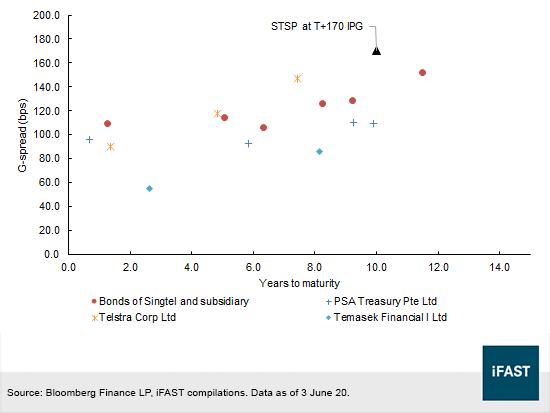
The IPG of T+170bps is an attractive valuation among comparable credits (Figure 1). Other issues, including those from Telstra Corp Ltd (“Telstra”) and sovereign-linked entities, are trading at a lower G-spread, a measure of credit spread over US Treasuries. Telstra is Australia’s largest telecommunications company and competes with Optus, Singtel’s operating unit in Australia.
Between the two companies, Singtel is more geographically diversified as its earnings mainly come from Singapore, Australia and emerging markets (“EM”). Telstra, on the other hand, operates mainly in Australia. In this aspect, we would prefer the credit profile of Singtel over Telstra for its diversified exposure and long-term EM growth potential.
Figure 1: Relative valuation
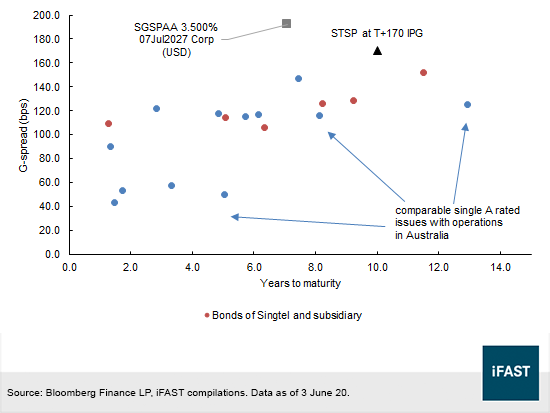
However, when compared with other single-A rated non-financial bonds issued by Australian entities, we note that the SGSPAA 3.500% 07Jul2027 Corp (USD) is trading at a higher spread and appears to be more attractive than the new Singtel USD issue (Figure 2). The SGSPAA 3.5% ‘27s have been assigned credit ratings of ‘A-’ (stable) by S&P and ‘A3’ (stable) by Moody’s.
SGSP (Australia) Assets Pty Ltd (SGSPAA) is a subsidiary of State Grid International Development Australia Investment Company Limited and Singapore Power International Pte Ltd. Through these entities, the State Grid Corporation of China and Temasek hold 60% and 40% deemed interests in SGSPAA.
As an electricity and gas provider, SGSPAA owns and operates a portfolio of energy assets across northern Australia and Australia's east coast. The group offers electricity and natural gas distribution services to businesses and individual households. Stable income seekers who are interested to invest in utility and infrastructure credits may consider the SDSPAA 3.5% ‘27s.
Figure 2: STSP vs single-A rated Australian credits
Declaration:
For specific disclosure, at the time of publication of this report, IFPL (via its connected and associated entities) and the analyst who produced this report hold a NIL position in the abovementioned securities.