The third quarter of 2021 is ending and has been rather eventful for fixed income markets. During the recent three-month period, China Evergrande Group took the spotlight in the Asian high yield market as the issuer was downgraded multiple times by credit rating agencies.
The onshore unit of China Evergrande likely resolved interest payment for the EVERCN 5.800% 23Sep2025 Corp (CNH), but has yet to pay interest for the EVERRE 8.250% 23Mar2022 Corp (USD) and EVERRE 9.500% 29Mar2024 Corp (USD), when they were due in September 2021. The offshore bonds are actively traded in the secondary markets and the situation remains very fluid.
Additionally, inflation fears have spread as prices from cars to houses are increasing at the fastest pace in a long time. The pandemic has shut borders and created bottlenecks in different supply chains. Central bankers are concerned and have turned more hawkish about monetary policy.
In the September Federal Open Market Committee meeting, Federal Reserve Chairman Jerome Powell reportedly said that the tapering of asset purchases could start in November and end as soon as middle of 2022. Fed officials however, have revised down their growth outlook for 2021 as more board members now expect a GDP growth rate of between 5.2% and 6.3%, much lower than their projections of 2021 real GDP growth of between 6.2% and 7.5% during the June meeting.
Figure 1: Active US Treasury securities
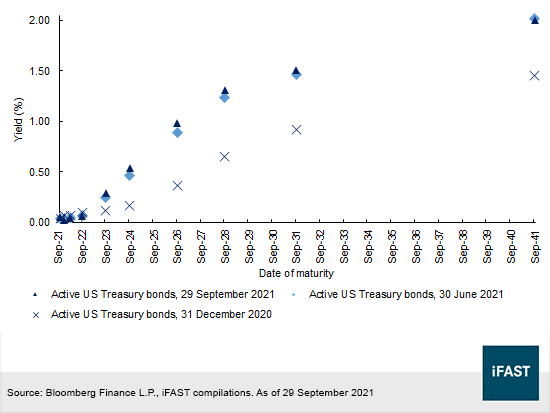
Long-term US Treasury yields actually fell in July but yields have risen back in August and September to where they were in June 2021 (Figure 1). As seen in the figure, the Treasury curve for 29 September 2021 is now trading at a level that is very close to that as at 30 June 2021. Long-term Treasury yields nevertheless are still higher compared to levels at the start of the year.
The 30-year US Treasury yield for example, was 1.66% on 31 December 2020 but increased to 2.05% on 29 September 2021. US Treasuries with maturities of 2-years or more have climbed between 17 basis points and 66 basis points. On the other hand, US Treasury instruments maturing in less than a year are more immune to price inflation and hawkish central bank speeches, due to their extremely low short duration and no changes in current Federal Fund rate.
Figure 2: Asian USD high yield index and option adjusted spreads
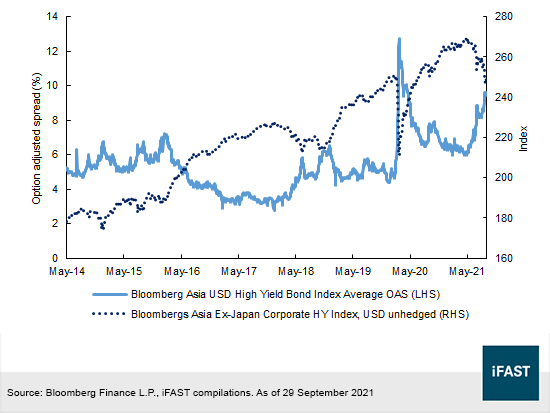
Moving on to the USD Asian high yield sector, the default of China Fortune Land Development and Sichuan Languang, coupled with the ongoing China Evergrande saga have led to a widening of option adjusted spreads in Asian high yield bonds. Historically, as displayed in Figure 2, the peaks of the option adjusted spreads have coincided with the drawdowns of the Asia ex-Japan USD high yield index.
On hindsight, investing in a portfolio of Asian high yield bonds in the midst of soaring option adjusted spreads would have been a profitable strategy. Credit spreads are approaching their historical highs and the aggregate valuation of the sector is getting more attractive by the day. To find out more about Asian high yields bonds, consider reading our article “3 Reasons to look at Asian High Yield Bonds today”.
What about SGD bonds?
We ranked 374 SGD bonds according to their total returns and listed the worst performing bonds in Table 1. The table shows the total returns of the worst performing SGD bonds over the past 3 months and 6 months. The recent quarter was rather unkind to long-term government bonds and quasi-sovereigns as they have dropped materially over the third quarter due to the recent rise in benchmark yields. As mentioned earlier, central banks have turned hawkish and the sovereign bond market, particularly in the longer end of the curve is pricing tighter monetary conditions in future.
Over the last 6-months, we observed that the LMRTSP 6.600% Perpetual Corp (SGD), FIRTSP 4.9817% Perpetual Corp (SGD) and HRINTH 3.800% 07Nov2025 Corp (SGD) have dropped more than 10%, albeit the former two have low liquidity and the total returns shown here may not be indicative of their actual market performance. (Investors may refer to “LMIRT to issue USD 5NC3 bond at 8.125% IPG” and “Siloam hospitals are leading the way for First REIT” for an update on LMRTSP and FIRTSP respectively)
With the worst performing bonds clocking total returns of -12.84% (6-months) and -4.29% (3-months), it is clear that SGD bonds did not drop as much as certain Chinese real estate USD bonds in the Asian high yield space.
Table 3: Worst performing SGD bonds
|
|
6 months total return (%) |
|
3 months total return (%) |
|
|
LMRTSP 6.600% Perpetual Corp (SGD) |
-12.84 |
SBREIT 4.645% Perpetual Corp (SGD) |
-4.29 |
|
|
FIRTSP 4.9817% Perpetual Corp (SGD) |
-12.50 |
HDBSP 1.300% 03Dec2035 Qsov (SGD) |
-3.59 |
|
|
HRINTH 3.800% 07Nov2025 Corp (SGD) |
-10.30 |
HDBSP 2.315% 18Sep2034 Qsov (SGD) |
-2.51 |
|
|
ASPSP 6.500% 20Mar2023 Corp (SGD) |
-3.48 |
WINGTP 4.350% Perpetual Corp (SGD) |
-2.42 |
|
|
SBREIT 4.645% Perpetual Corp (SGD) |
-2.87 |
HDBSP 1.265% 24Jun2030 Qsov (SGD) |
-1.47 |
|
|
HSBC Float 04Sep2030 Corp (SGD) |
-1.27 |
NA20100F; Coupon: 1.875%; Maturity: 01/03/2050 |
-1.30 |
|
|
CITSP 2.000% 16Jun2026 Corp (SGD) |
-0.95 |
HDBSP 2.545% 04Jul2031 Qsov (SGD) |
-1.24 |
|
|
GS Float 28Dec2032 Corp (SGD) |
-0.51 |
HDBSP 3.080% 31May2030 Qsov (SGD) |
-1.17 |
|
|
SINTEC 4.050% 02Dec2025 Corp (SGD) |
-0.09 |
HDBSP 2.270% 16Jul2029 Qsov (SGD) |
-1.03 |
|
|
ARASP 4.150% 23Apr2024 Corp (SGD) |
-0.01 |
ARASP 4.150% 23Apr2024 Corp (SGD) |
-1.00 |
|
| Source: Bondsupermart.com. As of 29 September 2021. | ||||
Here is a recollection of our SGD recommendations
We continue to favour high-yielding fixed income securities that are backed by issuers with healthy balance sheets and visible future cash flows. Among them, some of the higher conviction names include the ESRCAY 5.100% 26Feb2025 Corp (SGD), ESRCAY 5.650% Perpetual Corp (SGD), CS 5.625% Perpetual Corp (SGD), SOCGEN 6.125% Perpetual Corp (SGD), OHLSP 6.900% 08Jul2024 Corp (SGD), OHLSP 6.500% 28Feb2023 Corp (SGD) and OLAMSP 5.375% Perpetual Corp (SGD).
We believe that these bonds have a reasonable risk-reward ratio at their current valuation. Investors may refer to the corresponding article links in Table 2 for an update on the different issuers.
Table 2: Recommendations
|
Issuer |
Recommended bond |
Indicative yield to worst (%) |
Call date / maturity date |
Relevant article(s) |
|
ESR Cayman Ltd |
4.02 |
26 February 2025 |
ESR Cayman set to become APAC’s leading real estate manager, |
|
|
ESR Cayman Ltd |
5.13 |
2 March 2026 |
ESR Cayman set to become APAC’s leading real estate manager, |
|
|
Credit Suisse Group AG |
4.39 |
6 June 2024 |
Credit Suisse perps are the most attractive among Swiss banks notes |
|
|
Societe Generale SA |
4.00 |
16 April 2024 |
Societe Generale – one of the unnoticed high yield opportunities in Europe |
|
|
Oxley MTN Pte. Ltd. |
6.89 |
8 July 2024 |
Oxley announces potential re-tap of its existing 2024 bonds and tender offer exercise |
|
|
Oxley MTN Pte. Ltd. |
6.00 |
28 February 2023 |
Buy this SGD bond if you think property prices will keep going up |
|
|
Olam International Limited |
4.78 |
18 July 2026 |
||
| Source: Bondsupermart.com, Bloomberg Finance L.P., iFAST compilations. As of 29 September 2021. | ||||
With respect to Olam International Limited, the company is presently seeking a curve-out, demerger and initial public offering of Olam Food Ingredients (“OFI”), which is expected to list in the London and Singapore stock exchanges by the first half of 2022. OFI accounted for 29.7% of Olam’s revenue in the half-year period ended 30 June 2021 (“1H21”). As we understand, OFI will be demerged by Olam by way of a distribution in specie of shares in OFI to Olam shareholders. An IPO in 1H23 is likewise planned for Olam Global Agri, which accounted for 67.8% of consolidated 1H21 revenue.
Further details of the IPO impact on Olam has yet to be announced but the group generated SGD 935.5m of EBITDA (excluding exceptional items) and SGD 22,833.4m of revenue in its latest 1H21 period, up 34.4% YoY and 33.7% YoY respectively. Sales volume also grew 11.5% YoY to 22.4m metric tonnes due to a pickup in food service sector demand. Looking at 2H21, the company guided that it will incur certain one-off non-recurring expenses in the next reporting period but retained its positive outlook for 2021.
Olam has SGD 18.6b of available liquidity as at 1H21 - made up of SGD 3.5b of cash, SGD 5.5b of readily marketable inventories, SGD 1.9b of secured receivables and SGD 7.6b of unutilized bank lines to support working capital and meet financial obligations. Total borrowings added to SGD 15.0b, out of which SGD 6.7b are short-term borrowings. Olam has a comfortable liquidity profile as the amount of available liquidity is sufficient to cover its total borrowings and SGD 1.5b of perpetual notes. Furthermore, we believe that the group has good access to funding sources as it managed to raise JPY 9b in September via a private placement and USD 5.2b via loan facilities.
Nestled within the backdrop of high demand, low inventory supplies and inflationary prices pressures, we foresee higher interest rates and tighter monetary conditions for the remainder of the year. Growth may pick up in the fourth quarter heading into the holiday season and the falling case counts in the US may lift consumer sentiment and spending activity. We have not seen a marked deterioration of financial conditions yet and we think that SGD issuers may still access capital markets for their funding needs. If we were asked to single out a sector that we would be cautious on, it would be the construction sector. But we will elaborate on that in another credit update. As this juncture, we still keep an overall bright outlook for the SGD bond market.
Declaration:For specific disclosure, at the time of publication of this report, IFPL (via its connected and associated entities) holds a position in ESRCAY 5.650% Perpetual Corp (SGD), ESRCAY 6.750%% 01Feb2022 Corp (SGD), CS 5.625% Perpetual Corp (SGD), OLAMSP 5.375% Perpetual Corp (SGD), OLAMSP 6.000% 25Oct2022 Corp (SGD) and OHLSP 6.900% 08Jul2024 Corp (SGD). The analyst who produced this report hold a NIL position in the abovementioned securities.
Our podcast series, Yield Hunters, is available on Spotify, iTunes Podcasts and Google Podcasts. We share our thoughts on new bond issues and hold discussions on the fixed income space. Listen to our latest episode below and follow us!