Note: This is an edited version of an article published earlier on our affiliates on 8 May 20.
Highlights:
- The Group's revenue and pre-tax income hit a record high, and led the industry in profitability of PC and Smart Device business.
- Although the group’s borrowings are relatively small, the required payable part in current liabilities is high, leading to a tightened short-term liquidity.
- The recent issuance of the USD bond due 2025 with a coupon rate of 5.875% is worth paying attention to.
A recent Gartner report showed that global PC shipments declined 12.3% in the first quarter of 2020 due to the COVID-19 outbreak. Within the same period, Lenovo held 24.4% of global PC shipments’ market share. Although its size provides it with an advantage in the market, the group’s business will still be affected by the virus outbreak. In this article, we discuss Lenovo Group’s latest business overview and introduce its latest corporate USD bond. We have outlined the key information regarding the company's related bonds:
|
Bond Name |
Maturity Date |
Ask Yield To Maturity |
|
16 March 2022 |
3.686% |
|
|
29 March 2023 |
4.695% |
|
|
24 April 2025 |
5.287% |
Source: BSM Data as at 6 May 2020
Company Background
Lenovo Group, a subsidiary of Lenovo Holdings, was established in 1984. After the group acquired IBM's PC business in 2004, the group grew rapidly in the following decade and transformed into a global enterprise. It is currently the world's largest PC vendor.
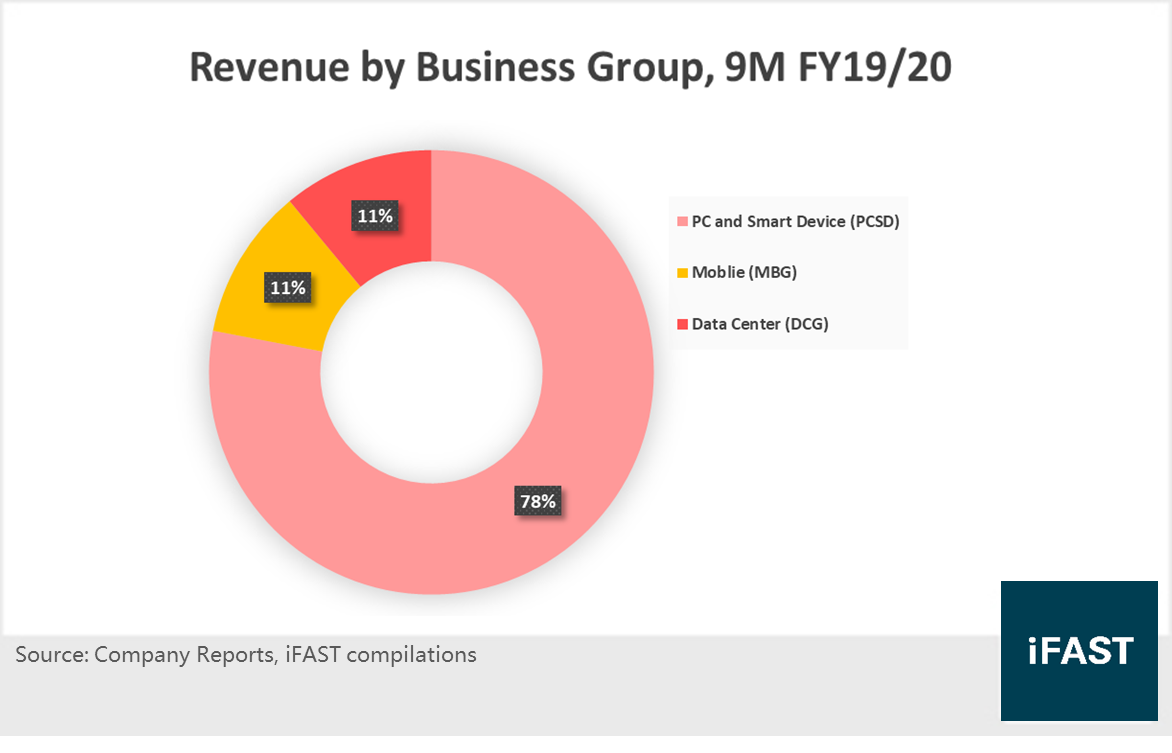
The business of Lenovo Group can be divided into two major segments, namely the Data Center Group (DCG) and the Intelligent Devices Group (IDG), which comprises of the PC and Smart Device (PCSD) Business and Mobile Group (MBG). In the first nine months of the 2019/20 fiscal year (i.e. March to December 2019), the PCSD business contributed nearly 80% of the group's revenue, while mobile and data center businesses contributed approximately 10% of income respectively.
Business Overview
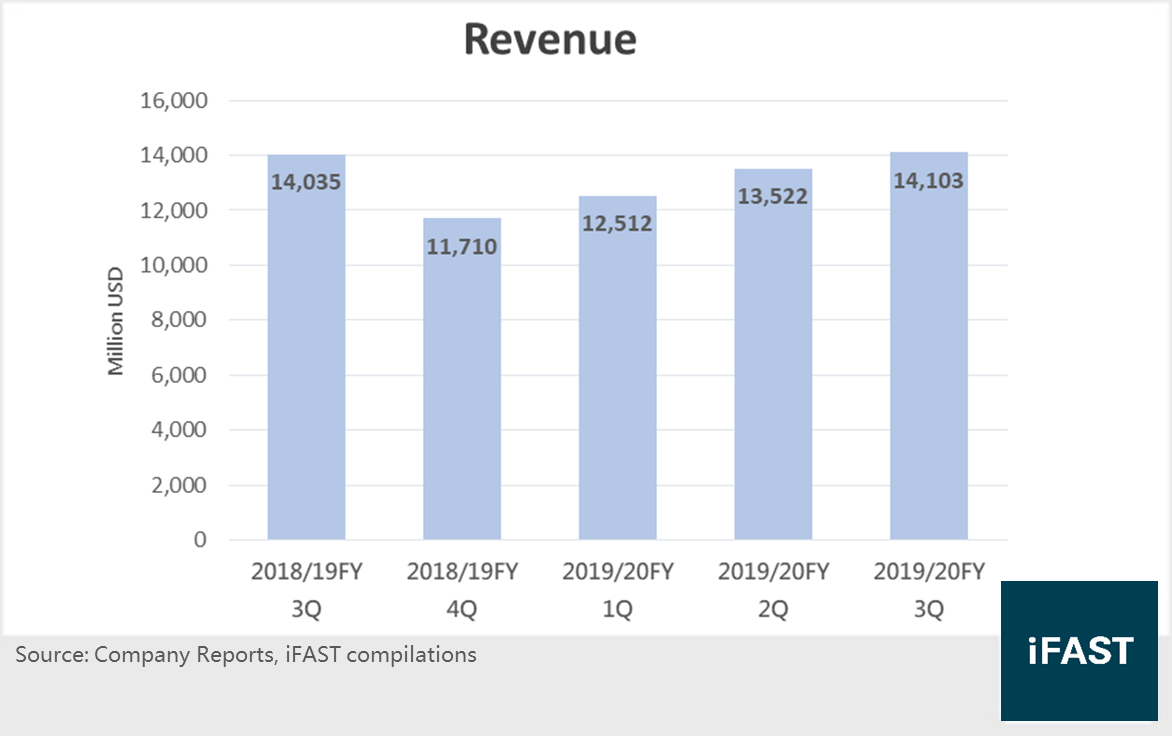
In the third quarter of fiscal year 2019/20 (i.e. October to December 2019), Lenovo Group recorded a revenue of USD 14.1 billion, and pre-tax income of USD 390 million. Both revenue and pre-tax income reached all-time highs. This is mainly due to sustained growth in sales of PC and Smart Device business, the Mobile business remaining profitable and the continued improvements in the Data Center Group’s business. As at the end of the first three quarters last year, the group's revenue was USD 40.1 billion, up by 2.1% YoY. The attributable profit was USD 623 million, up by 30.3% YoY, showing a strong growth performance.
Among the major businesses, profitability of the PC and Smart Device business remained ahead of the industry during the period. In Q3 2019/20, this business generated USD 11.07 billion of revenue, accounting for the largest part of the Group's revenue. At present, more than half of the revenue of PC and Smart Device business comes from high-growth and high-end market segments such as Workstation, Thin and Light and Gaming PC.
Due to the COVID-19 outbreak, domestic factories were closed early this year. Production and logistics services were limited. Furthermore, the group’s largest production base is located in Wuhan, which accounts for one-third of its global production capacity. Its mobile business and PC and smart device business have been greatly affected by the pandemic and we expect to see a decrease in the group’s revenue in the first quarter.
Although the group’s business might be affected by the pandemic in the short term, the situation has also encouraged a greater shift towards online education and work. This may lead to an increase in demand for personal computers.
Credit Overview
As at 31 December 2019, the group’s short-term borrowings (within one year) were about USD 2.7 billion, where cash and cash equivalents were USD 3.6 billion. It shows that the amount of cash is enough to cover short-term borrowings, reflecting that the amount of the group’s borrowings is relatively small.
The group's net debt stood at USD 1.2 billion as at end 2019; its total equity was approximately USD 4.3 billion, and hence its net debt ratio was 28.6%. Total debt / EBITDA has also improved to 1.8x in the past 12 months (2.0x in FY2018/19). After deducting capital expenditures, the EBITDA interest coverage ratio reached 7.8x, reflecting that the group has a strong ability to pay interest.
As the group’s borrowings are not large, the required cash on hand seems to be quite sufficient and allows its net debt ratio, total debt/EBITDA ratio and interest coverage ratio to be maintained at very healthy levels. However, the current ratio of the group has been at a level of less than 1x for a long time. As at the end of 2019, the group's current ratio was 0.85x, reflecting higher current liabilities.
From the debt structure, we found that nearly 80% of the group's current liabilities are accounts payable, and most of them are payments for finished products to suppliers. Therefore, the current liabilities of the group are higher than its cash level, and its liquidity seems relatively tight. However, we have noticed that Lenovo’s peers such as Dell and HP also have high asset liability ratios with low current ratios. We may conclude that high operating leverage is a characteristic of this industry.
From this perspective, the group's liabilities are mainly operating liabilities, where the portion of interest-bearing liabilities are relatively small. Considering that the group's business performance and financing capacity remains strong, and cash flow from operating activities maintain at a relatively stable level, we believe that the group's interest-bearing debts default are less likely.
Bond Review
|
Bond Name |
Maturity Date |
Ask YTM |
|
16 March 2022 |
3.686% |
|
|
29 March 2023 |
4.695% |
|
|
24 April 2025 |
5.287% |
Source: BSM Data as at 6 May 2020
On 17 April 2020, Lenovo Group issued a total of USD 650 million of five-year senior unsecured USD bonds with a coupon rate of 5.875% which will mature in 2025. As at 27 April 2020, LENOVO 5.875% 24APR2025 CORP (USD) bonds had a YTM of 5.561%. Both the coupon rates and YTM of the newly issued bond are more attractive than those of the bonds issued before.
|
Bond Name |
Bond Credit Rating |
Maturity Date |
YTM |
|
BBB-/ BBB- (S&P/Fitch) |
15 June 2026 |
4.434% |
|
|
BBB/ BBB+ (S&P/Fitch) |
15 October 2025 |
3.949% |
|
|
N.R/ N.R (S&P/Fitch) |
24 April 2025 |
5.287% |
Source: BSM Data as at 6 May 2020
Although the bonds issued by Lenovo Group have not been rated, based on their current credit status, we believe that Lenovo bonds are comparable to those issued by its peers such as Dell and HPE (which was spun off from HP) or other investment grade bonds (BBB range).
For comparison, we will refer to Dell’s 2026 bond DELL 6.020% 15Jun2026 Corp (USD) and HPE’s 2025 bond HPE 4.900% 15Oct2025 Corp (USD). As at 27 April 2020, the required YTM of Lenovo’s newly issued 2025 bond is 0.85% to 2.34% higher than that of the two bonds mentioned.
Lenovo Group issued its bonds in a highly uncertain environment. With a reasonable coupon rate, the newly issued 2025 bond presents a good investment opportunity. It is quite attractive to investors with low risk tolerance.
Corporate Risks
About 80% of Lenovo Group’s sales comes from PC and smart device business, while revenue contribution from other businesses is modest. Its revenue is supported by a single business with high short-term liabilities. Should the group face difficulties in maintaining or growing their sales, it might lead to cash flow problems and short-term liquidity which could give rise to potential financial risks.
In addition, industry competition is fierce as the Group needs to compete with new entrants and existing competitors in terms of products and prices in order to maintain its leading position. However, the deterioration of economic conditions and changes in the international political and economic environment may also lead to a reduction in consumption, or damage of supply chain operations, leaving business operations uncertain.
Conclusion
The business performance of Lenovo Group is satisfactory, given that its PC and Smart Device business is more profitable than that of its peers. Although the group’s borrowings are not large, the level of current liabilities is relatively high and short-term liquidity is relatively tight. However, we note that high-leverage operations are an industry characteristic. Considering that the group has strong financing capacity, it is believed that they have little difficulty in enhancing short-term liquidity. In consideration of the above, we find that the recent USD bond due 2025 is worth paying attention to.
Declaration:
For specific disclosure, at the time of publication of this report, IFPL (via its connected and associated entities) and the analyst who produced this report hold a NIL position in the abovementioned securities.