Metro Holdings is expanding its property portfolio in Australia and in Singapore.
The company’s top-line will also be lifted from higher retail spending during the year-end holiday period. Moreover, it has maintained a solid liquidity profile.
We think the METRO 4.300% 02Apr2024 Corp (SGD) are a buy.
The holiday season has arrived and Singapore shopping malls are bustling with activity. Coronavirus cases have dropped to the hundreds and authorities have allowed diners to eat in larger groups in restaurants.
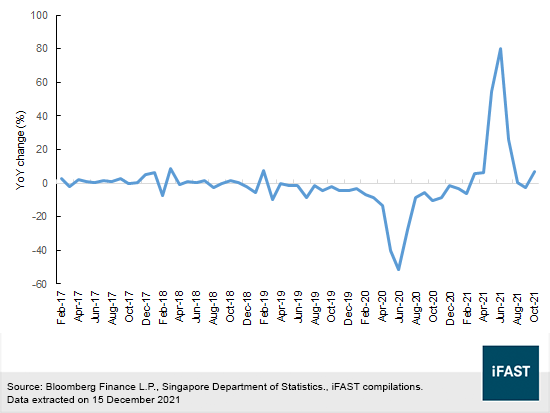
Singapore retail sales increased 7.5% year-on-year in October. Retail sales have been increasing since falling to a low in June 2020. At some point this year, retail sales were up more than 80% year-on-year.
Figure 1: Annual change in Singapore retail sales
Higher retail spending will provide a small boost to the bottom line of Metro Holdings, a company which recognises more than 80% of its revenue from the sale of retail products.
About Metro Holdings
Metro is a property investment and development group with a small portfolio of departmental stores. The company was first founded as a textile store in 1957 by the late Mr Ong Tjoe Kim. A few years later, the company was listed on the Singapore Exchange in 1973 and has since grown into a large diversified retailer and real estate developer. As of 14 December 2021, Metro Holdings was trading at a market value of SGD 629.31m.
Over the past decades, Metro built a household brand through a network of retail stores and partnerships. For example, the group worked with Cartier and Piaget to distribute luxury watches in Singapore. Between 1984 and 1993, the company also partnered with Toys “R” Us as well as Kmart Corporation (1993 – 1996) to open local stores.
Even though it was well recognised as a departmental store operator in prior years, Metro has been focusing on expanding its property business. Slowly, the company had downsized its retail operations, having just 2 stores in Paragon and Causeway Point as at September 2021. Prior to the Covid-19 outbreak, the group sold its Indonesian retail business and retains a trademark for licensing fees.
Regardless, customers may still purchase merchandise through its online presence via various digital platforms including Metro Online, LazMall, Shopee online Mall, Facebook and Amazon.com.
1HFY22 Financials
Figure 2: Breakdown of group revenue in 1HFY22
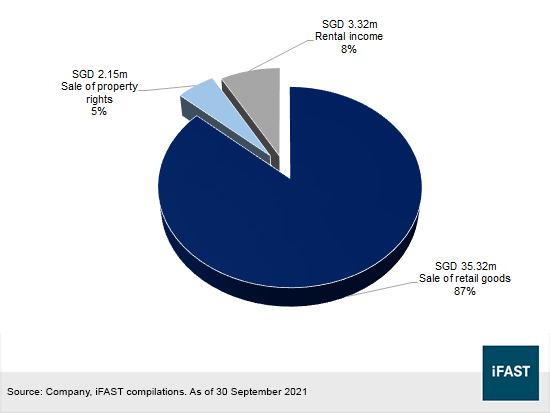
During the 6-months ended 30 September 2021 (“1HFY22”), the company made (i) SGD 35.32m of revenue from the sale of retail goods, (ii) SGD 2.15m of revenue from the sale of property rights. These relate to the transfer of rights for properties under development or completed properties that were purchased from the developer and (iii) SGD 3.32m of rental income from operating leases on investment properties. Of the three aforementioned segments, the sale of retail goods is the largest component of total revenue (Figure 2). Total revenues amounted to SGD 40.79m, an 11.1% increase from the year prior.
After deducting revenue costs, Metro recorded only SGD 5.00m of gross profits, which is a low amount and gross profit margins of 14.14% in 1HFY22. Gross margins are low and have dropped from 19.56% in 1HFY21.
Figure 3: Income statement waterfall
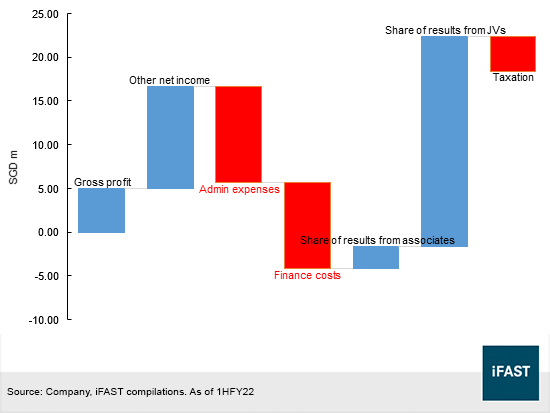
As seen in the Figure 3 waterfall diagram, other net income and results from joint ventures are significant contributors to Metro’s bottom-line (1HFY22: SGD 18.38m). Other net income amounted to SGD 11.66m in 1HFY22, which is derived from SGD 10.00m of interest income from financial instruments, SGD 4.47m of financial instrument dividends, SGD 4.32m of losses due to the poor performance of investments held at fair value, SGD 0.70m of FX losses and SGD 0.81m of sundry income.
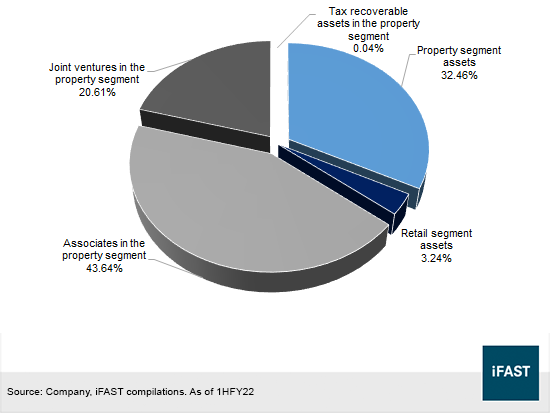
The other big driver of the group’s bottom-line is the results from associates and joint ventures. Associates and joint ventures are assets that form part of the group’s property portfolio. This is illustrated in Figure 4, which exhibits a breakdown of Metro’s total assets. As with most property developer and real estate investment companies, most of the group’s assets are made up of associates (43.64%) and joint ventures (20.61%).
Figure 4: Percentage breakdown of total assets
To have a better overview of the group’s property portfolio, Table 1 highlights a list of the group’s investments and properties. More of the portfolio is invested in Chinese real estate investment properties, some of which have occupancy rates of more than 90%. Occupancies have improved but the level of occupancies will probably follow broader economic conditions. On this note, China’s economy is projected to grow 8.0% in 2021 and 5.6% in 2022, although future economic growth is likely to be impeded by the recent defaults of Chinese real estate firms.
Apart from the real estate assets mentioned in Table 1, Metro also has some development properties that are under construction. One of them is Middlewood Locks, situated at Manchester City Centre that had a gross development value of GBP 700m at FY2021.
Following its update in September 2021, Phase 1 of the 571 units in Middlewood Locks has been fully sold. As we understand, the handover of 546 units of Phase 2 to Get-Living would have been completed by the end of December 2021.
Apart from the assets listed in Table 1 and development properties, Metro owns a 14.9% stake (as 31 March 2021) in the Top Spring Group. Top Spring is a Chinese developer had exposure to over 22 projects spread across 11 cities. Latest market headwinds in China and Hong Kong have said to negatively impacted Top Spring’s performance.
Table 1: Metro's property portfolio as at 31 March 2021 ("FY2021")
|
Property |
Property description |
Percentage owned by Metro |
Tenure |
Occupancy rate |
FY2021 Valuation (100%) |
Effective valuation at FY2021 |
|
GIE Tower, Guangzhou |
7-storey shopping podium and 35-storey Grade A office tower |
100% |
50-year from 1994 (23 years remaining) |
92.8% |
SGD 112.00m |
SGD 112.00m |
|
Metro City, Shanghai |
Lifestyle entertainment center with 9 levels of space |
60% |
36 years from 1993 (8 years remaining) |
98.3% |
SGD 187.00m |
SGD 112.20m |
|
Metro Tower, Shanghai |
Grade A office tower with 26 floors |
60% |
50-year from 1993 (22 years remaining) |
89.4% |
SGD 230.00m |
SGD 138.00m |
|
5 Chancery Lane, London |
Freehold office property in Central London |
50% |
Freehold |
100.0% |
SGD 148.00m |
SGD 74.00m |
|
Shanghai Plaza, Shanghai |
Mixed-use commercial building |
35% |
50-year from 1992 (21 years remaining) |
86.8% |
SGD 639.00m |
SGD 223.65m |
|
Bay Valley, Shanghai |
3 office buildings in the Yangpu District of Shanghai |
30% |
Land use rights ends in November 2058 |
100.0% |
SGD 318.00m |
SGD 95.40m |
|
Asia Green, Singapore |
2 blocks of office buildings |
50% |
99-year from 2007 (85 years remaining) |
78.1% |
SGD 405.00m |
SGD 202.50m |
|
Portfolio of industrial buildings, Singapore |
14 industrial, business park, high-spec industrial and logistics properties |
26% |
Average lease tenure 32 years |
99.0% |
Total consideration (26%) : SGD 76.60m |
SGD 76.60m |
|
The Atrium Mall, Chengdu |
2 blocks of office buildings |
25% |
40-year from 2007 (26 years remaining) |
82.3% |
SGD 357.00m |
SGD 89.25m |
|
Portfolio of purpose-built student accommodations |
Portfolio is acquired through the Paideia Capital UK Trust |
30% |
N.A. |
90.0% |
Total consideration: ~ SGD 95.46m |
SGD 95.46m |
|
Portfolio of office & retail properties, Australia |
15 office & retail properties |
20% |
Freehold |
94.8% |
SGD 935.00m |
SGD 187.00m |
|
Total |
- |
- |
- |
- |
SGD 3,503.06m |
SGD 1,406.06m |
| Source: Company, iFAST estimates. As of 31 March 2021 | ||||||
Performance since 2HFY18
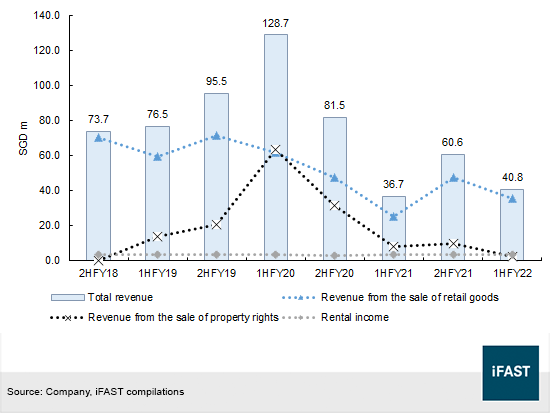
Group revenue has been on the decline since 1HFY20 due to the pandemic and social distancing requirements at malls. Retail sales have been poor and sales continue to remain below pre-pandemic levels. Represented by the sale of property right, sales of residential units at Trans Park Bekasi and Trans Park Bintaro, Indonesia have also been lacklustre. Construction of the residential towers were completed but some of the units remain unsold.
Looking ahead, we believe that stronger retail activity at the Singapore department stores and the loosening of social distancing measures in Indonesia will help boost revenue in 2HFY22. Referring to Figure 5, in most financial years, Metro’s revenue in the second-half of the financial year has been stronger than the first-half.
Figure 5: Revenue performance since 2HFY18
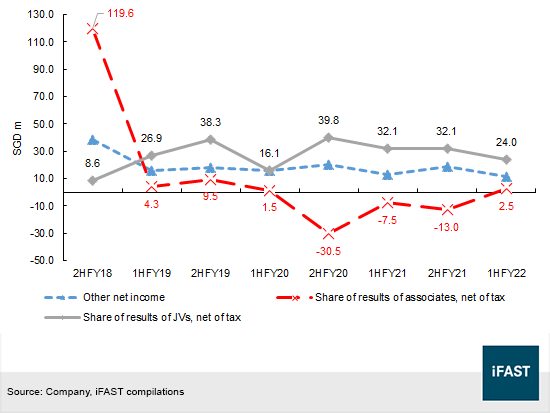
As mentioned earlier, the company’s bottom-line is also driven by other net income items and the results of its joint ventures. Denoted by the grey line in Figure 6, the joint ventures have been consistently providing between SGD 16m and SGD 39m to the group since 1HFY20.
Among them, Metro has a 60% stake in the joint venture companies - Shanghai Metro City Commercial Management Co. Ltd. and Shanghai Huimei Property Co Ltd but the entities are not accounted as subsidiaries. This is because under the agreement, all joint venture parties would have contractual joint control of the firms but still require unanimous consent for all major decisions over corporate activities.
Figure 6: Other income and results of associates and joint ventures
Credit highlights
Despite its low revenue and declining trend, Metro has kept a very strong liquidity profile. The amount of cash and cash equivalents as at September 2021 is more than sufficient to cover its current borrowings.
More than 50% of its SGD 357.47m cash position is comprised of fixed deposits but the deposits have a term of less than 6 months. The amount of liquidity would have dropped since September 2021 as Metro has redeemed the SGD 150m METRO 4.000% 25Oct2021 Corp (SGD) on 25 October 2021.
Excluding the METRO 4.000% 25Oct2021 Corp (SGD), the group is left with SGD 137.93m of current unsecured bank borrowings. During 1HFY22, Metro managed to refinance a part of its short-term bank loans, which resulted in an increased in non-current borrowings from SGD 199.13m in March 2021 to SGD 316.30m in September 2021.
Non-current borrowings are made up of the SGD 200m METRO 4.300% 02Apr2024 Corp (SGD) and SGD 117.03m of long term bank loans.
Total debt increased from SGD 503.48m in 1HFY21 to SGD 604.21m in 1HFY22, but the ratio of debt to total assets is healthy at ~24.4%. Net debt to equity is ~15.5% at 1HFY22, while net debt to trailing 12-month EBITDA is ~3.47x.
Metro has recently expanded its property portfolio in Australia and industrial buildings in Singapore. Given its low gearing and unencumbered debt profile, the group has the financial capability to invest in more real estate assets and may incur more debt going forward as it increases exposure to the capital-intensive property sector.
Net cash flows from operating activities were stable at SGD 24.26m in 1HFY22 and SGD 25.33m in 1HFY21. With a consistent EBITDA of around SGD 35m in 1HFY22 and 2HFY21, Metro’s interest servicing ability is also at a comfortable level. EBITDA/interest is estimated to be ~3.94x in 1HFY22, ~3.92x in 2HFY21 and ~4.08x in 1HFY21.
Relative valuation
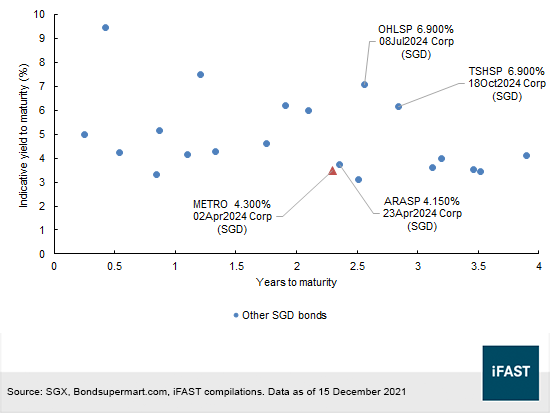
In view of its decent credit metrics, we recommend investing in the METRO 4.300% 02Apr2024 Corp (SGD) at its indicative yield-to-maturity of 3.50%. The bonds mature in 2.29 years and they have a reasonable yield among SGD credits.
Within the SGD space, the closest comparable would be the ARASP 4.150% 23Apr2024 Corp (SGD) issued by ARA Asset Management Ltd. The ARASP 4.15% 2024’s have a slightly higher yield of 3.74% but we think that it is reflective of the issuer’s status as a private company. ARA Asset Management is in the midst of an acquisition process and we feel that the Metro 4.3% 2024’s offer better value.
The Metro 2024 bonds trade at a lower yield compared to the TSHSP 6.900% 18Oct2024 Corp (SGD) and OHLSP 6.900% 08Jul2024 Corp (SGD), but this is due to the weaker credit profiles of the latter two companies. Investors may refer to the articles – “Tuan Sing launches new 3NC2 SGD bond at a FPG of 6.90%” and “Oxley announces potential re-tap of its existing 2024 bonds and tender offer exercise” for more details on Tuan Sing and Oxley respectively.
Figure 7: Relative valuation among plain vanilla SGD bonds
On the whole, we feel that the Metro’s bonds are worth considering in part because of the group’s diversified business portfolio. Its financial profile is supported by strong liquidity, an unencumbered balance sheet, and healthy credit metrics. On the flipside, a prolonged pandemic and a sharp slowdown in China would affect its results from joint ventures but at this moment, the portfolio is still holding up well.
Declaration: For specific disclosure, at the time of publication of this report, IFPL (via its connected and associated entities) holds a position in OHLSP 6.900% 08Jul2024 Corp (SGD), TSHSP 6.900% 18Oct2024 Corp (SGD) and ARASP 5.200% Perpetual Corp (SGD). The analyst who produced this report hold a NIL position in the abovementioned securities.