Deutsche Bank is Germany’s largest bank and classified as one of the globally systemically important banks.
The bank reported healthy profits for the second quarter and may be upgraded by Moody’s.
Perpetual notes have held up well in spite of widening credit spreads in the broader market
Second quarter earnings season has begun and we are seeing some decent numbers from the banking sector partly because of higher activity and lower credit loss provisions. Further to that, banks CEOs are also quite optimistic in their outlooks.
A rising interest rate environment is beneficial to banks as interest rate margins will improve. Jamie Dimon, who is the CEO of JP Morgan - the largest bank in the world said in an earnings release that the “consumer and wholesale balance sheets remain exceptionally strong as the economic outlook continues to improve.” James von Moltke, CFO of Deutsche Bank told CNBC that the lender is optimistic about its performance this year and in 2022.
Here are five great reasons to buy Deutsche Bank perpetual notes
1. Bank earnings are strong
Deutsche Bank reported a group profit before tax (“PBT”) of EUR 2.8 billion in the first half of 2021 (“1H21”), and that is seven times more than its PBT of EUR 0.4 billion in 1H20 (Figure 1). Total income increased from EUR 12.6 billion to EUR 13.5 billion thanks to a robust performance in its asset management business. In relation to the recent floods in Germany and other neighbouring countries, the lender said that it does not expect the floods to have a material impact on their third quarter results.
Figure 1: 1H21 total income and profit before tax of large European banks
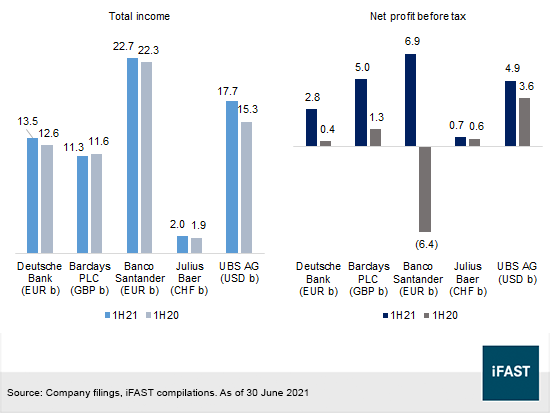
The top and bottom-line gains were in line with other large European banks who have reported results for the second quarter. Most other European banks reported a modest gain in total income in the first six months of the year on higher corporate activity.
Among them, we feel that the most consistent performer was UBS AG, which recorded a 15.3% YoY gain in total income and a 27.7% YoY gain in profit before tax. Other banks such as Banco Santander also witnessed an improvement in earnings. PBT for Banco Santander made a sharp turnaround as it swung from a loss of EUR 6.4 billion in 1H20 to a net profit of EUR 6.9 billion in 1H21. Barclays PLC, which also reported results on Wednesday (28 July), made sizable strides in its profits as group PBT climbed from GBP 1.3 billion in 1H20 to GBP 5.0 billion in 1H21.
2. Deutsche Bank has a comfortable solvency and liquidity profile
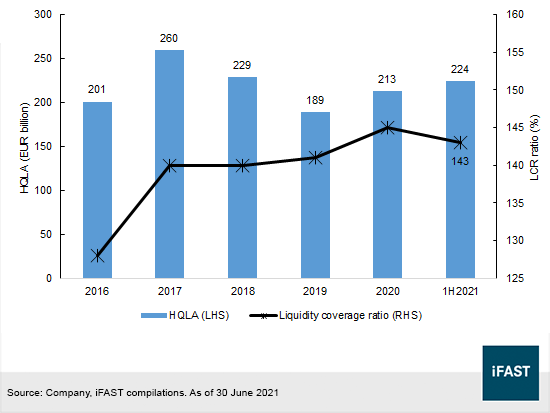
Regarded as a globally systemically important bank by the Financial Stability Board, Deutsche Bank is arguably “too big-to-fail”. The amount of high quality liquid assets (“HQLA”) on its balance sheet has been increasing since 2019 (Figure 2). Its liquidity coverage ratio, defined as the ratio of HQLA to cover cash outflows over a 30-day stress scenario, has likewise remained above regulatory requirement of 100%. As a result of its participation in the ECB’s longer-term refinancing operations (TLTRO III), Deutsche Bank registered about EUR 30 billion of highly liquid central bank assets and EUR 254.3 billion of total liquidity reserves as at 30 June 2021.
On a related note, its total loss absorbing capacity (“TLAC”) is satisfactory as it had EUR 108,144m of eligible TLAC instruments – EUR 37.3 billion above the total loss absorbing capacity minimum requirement.
Figure 2: Liquidity coverage ratio since 2016
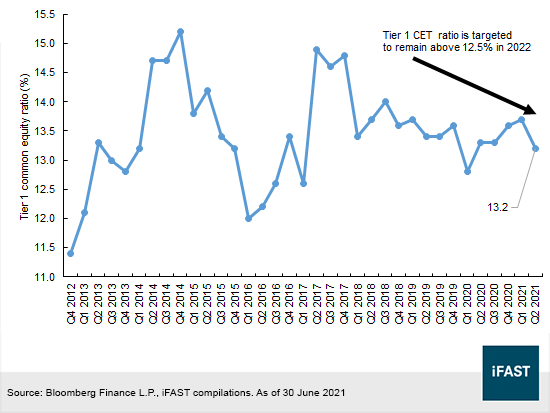
Tier 1 common equity ratio (“CET1”), which is a measure of the bank’s capital adequacy ratio, dropped to 13.2% in June 2021 but remains at an adequate level in our view. Secondly, Tier 1 common equity capital had improved, having increased from EUR 44.9 billion in December 2020 to EUR 45.5 billion in June 2021.
In spite of an increasing numerator, the CET1 ratio has been falling since 2017 and this is because of its higher denominator. In its most recent result, the bank had to increase its risk-weighted assets (“RWA”) due to the ECB’s assessment of the banks’ internal models used to calculate RWA and new Capital Requirements Regulation rules (“CRR”) that took effect from the second quarter of 2021.
Figure 3: CET1 ratio since 4Q12
3. Deutsche bank perps are among the highest yielding notes in the AT1 space
Some of Deutsche Bank’s perpetual notes are providing the highest (and therefore, most attractive) yields among European AT1s. These additional Tier 1 notes (also known as contingent convertibles or “CoCos”) are a subordinated class of bonds issued by financial institutions, and come packaged with certain clauses which could entail write-downs or an equity conversion in the event of a breach of specific capital ratios. They also have reset features found in most other perpetual notes.
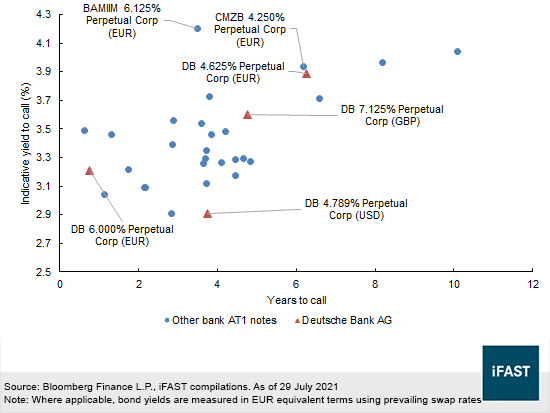
Referring to Figure 4 and keeping our choices within the top left of the chart, we would recommend the DB 4.625% Perpetual Corp (EUR) and the DB 4.789% Perpetual Corp (USD). As of 29 July 2021, the perps are trading at a yield-to-call (“YTC”) of 3.89% and 4.87% (EUR: ~2.91%) respectively.
DB 4.625% Perpetual Corp (EUR) and DB 4.789% Perpetual Corp (USD) are both rated ‘BB-‘/‘BB-‘/‘B1’ by S&P/Fitch/ Moody’s respectively. The former was issued in May 2021 under the terms of the prospectus dated 10 May 2021. If not called on 30 October 2027, the coupon resets to the 5-year euro swap rate + 4.747% on 30 April 2028.
Among notes that are callable around 4 years, we observed that there are other AT1s that are trading at a higher yield-to-call such as the BAMIIM 6.125% Perpetual Corp (EUR). However, the BAMIIM 6.125% perps (rated ‘B3’ by Moody’s) have a lower credit rating than the Deutsche Bank notes.
Even though we are recommending the two Deutsche Bank papers, we would however prefer the CMZB 4.250% Perpetual Corp (EUR) over the DB 4.625% Perpetual Corp (EUR) for its slightly higher YTC yet higher credit rating (S&P / Moody’s: ‘BB-‘/’Ba2’).
Figure 4: Relative valuation of European bank AT1 notes
4. Deutsche Bank perps have held up well in spite of recent volatility in Asian high yields
Figure 5: Credit spreads of DB 4.789% perps and Asia High Yield Index
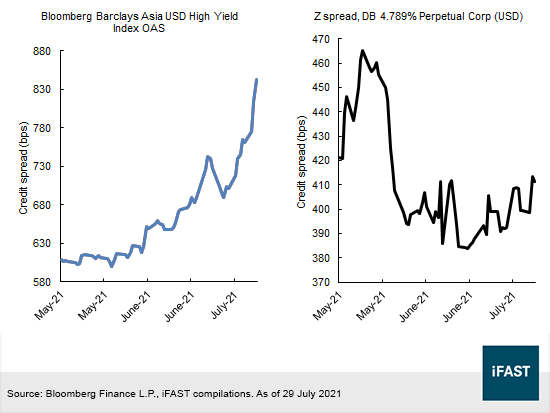
Asian high yield credits had been under pressure in the past few months in part due to the distressed situation of the Chinese real estate sector. Option-adjusted spreads (“OAS”) of Asian high yield bonds, in aggregate, have widened by more than 233 basis points (“bps”) between May and July this year (Figure 5). However, credit spreads for the DB 4.789% Perpetual Corp (USD) have narrowed by close to 10bps during this period.
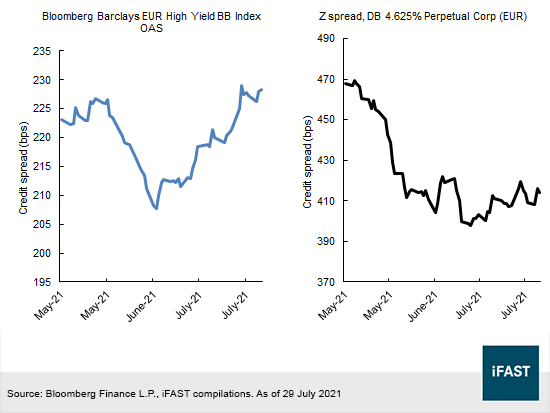
In the same manner, credit spreads for the DB 4.625% Perpetual Corp (EUR) widened by 5.26bps since June this year, but the OAS for EUR high yield BB rated bonds widened by a larger extent of 20.61bps (Figure 6). In our opinion, the narrowing of credit spreads in the Deutsche Bank perpetual notes highlights the resilient solvency profile of the bank.
Figure 6: Credit spreads of DB 4.789% perps and Asia High Yield Index
5. Moody’s is considering to upgrade the bank’s credit ratings
In May, Moody’s Investors Service announced that it is looking to upgrade the issuer’s credit ratings including its assessments on its short-term deposits to long-term unsecured junior bond ratings. The credit rating agency cited the bank’s “swift and pronounced progress towards its objective of achieving a more balanced and sustainable business model” as well as “regained earnings strength, lower operating costs, strong liquidity and reduced dependence on confidence-sensitive market funding”. An upgrade from Moody’s would lower the lender’s borrowing and refinancing costs and possibly result in higher profitability.
Why did the bank not call its notes in April 2020?
As with every investment, there are associated risks in purchasing the bank’s perpetual notes. The DB 4.789% Perpetual Corp (USD) was not redeemed on its first call date in April last year and the coupon on the note was stepped down from 6.25% to 4.789%. We suspect that the decision to skip call was because of the deterioration of the business environment coupled with the onset of the Coronavirus pandemic. That aside, prior to its April call date in December 2019, the ECB informed Deutsche Bank that it had to maintain a CET1 ratio of 11.58% due to the results of the 2019 Supervisory Review & Evaluation Process (“SREP”). On hindsight, the 11.58% minimum was not too distant to its CET1 ratio of 12.8% in March 2020 and that led the bank to conserve capital and skip call.
As mentioned in the prospectus for the DB 4.625% Perpetual Corp (EUR), investors should know that the “issuer may elect to cancel the payment of any Interest Payment on any interest payment date for any reason”. In addition, payments on these notes are non-cumulative meaning that any unpaid interest will not accrue and will not be paid at a later point in time. The lender may also be subjected to capital distribution restrictions if they do not meet their CET1 thresholds. As of 31 March 2021, the CET1 ratio of 13.7% is 330bps above the minimum CET1 ratio, below which a calculation of the Maximum Distributable Amount would be required.
Apart from a non-call risk, investors should be aware of interest rate risks as we foresee higher Treasury yields in future. Bond prices may fluctuate in reaction to sharp movements in benchmark rates.
Nonetheless, Deutsche Bank is in a stronger position than in April 2020 as its CET1 ratio had increased to 13.2% (31 March 2020: 12.8%). Additionally, the bank recorded higher Tier 1 common equity (2Q21: EUR 45,476m vs 1Q20: EUR 43,702m) and higher total equity (2Q21: EUR 65,228m vs 1Q20: EUR 63,360m) than in April 2020.
According to its announcement in July 2019, the group is restructuring its business to deliver sustainable profitability and returns to shareholders. To reach its performance targets in 2022, the bank is keeping to its plan to reduce operating costs and grow revenue within its core businesses. In particular, the bank aims to achieve a return on tangible equity of 8.0% in 2022 (2Q21: 6.5%) and cost to income ratio of 70% (2Q21: 78.5%). With a new streamlined bank in future, we maintain our positive view on the issuer and recommend investing in the DB 4.625% Perpetual Corp (EUR) and the DB 4.789% Perpetual Corp (USD).
Declaration:
For specific disclosure, at the time of publication of this report, IFPL (via its connected and associated entities) holds a position in CMZB 4.875% 01Mar2027 Corp (SGD). The analyst who produced this report hold a NIL position in the abovementioned securities.
Our podcast series, Yield Hunters, is available on Spotify and iTunes Podcasts and Google Podcasts. We share our thoughts on new bond issues and hold discussions on the fixed income space. Listen to our latest episode below and follow us!