There will be an inevitable reversal in interest rates within the next 2 years.
Fixed maturity bonds and perpetual bonds will fall in a rising rate environment.
However, not all SGD credits will be impacted equally by higher interest rates.
Investors should stay away from “fixed-for-life” perpetual notes and consider certain bank credits.
Earlier this week, the US Bureau of Labour Statistics announced that the consumer price index (“CPI”) increased 5.4% from a year ago, representing the steepest 12-month gain since August 2008. Core CPI, which excludes more volatile items such as food and energy remained at a 29-year high, having increased 4.5% year-on-year.
The sharp rise in inflation may lead to higher interest rates, as central banks aim to foster steady GDP growth with low and stable prices. If prices continue their upward path, central banks will tighten monetary policy by increasing interest rates. In an interview after the release of the US CPI figures, Federal Reserve Bank of San Francisco President Mary Daly, who is part of the 2021 Federal Reserve Committee said that the Fed could slow asset purchases if a strong economic recovery continues.
Our colleagues at Macro Research expect two inflation scenarios moving forward. In the central scenario (which is the more probable scenario), inflation continues to run at an elevated pace in the second half of the year before slowing down in 2022 and 2023. US Core PCE, or personal consumption expenditure price index (excluding food and energy), stays around 2% and 3% over the next two years but remains higher than the post-GFC (“Great Financial Crisis”) average of 1.6%.
In the hawkish scenario, inflation continues its hot running streak beyond 2022, causing core PCE to remain above 3%. Prices will extend beyond the Fed’s comfortable zone and the federal funds target rate will be increased by 4 to 5 times by end 2023. At this point, the 10-year US Treasury yield may reach as high as 4%.
On a related note, bear in mind that US Core PCE and US Core CPI are made up of different compositions but have broadly similar trends. Core PCE, published by the Bureau of Economic Analysis is the Fed’s measure of inflation.
In both the central and hawkish projections, we expect interest rates to start climbing in late 2022, leading to an end of a low interest rate environment. According to the team’s forecasts for the central scenario, the Fed is likely to implement one rate hike around end-2022 and two hikes in 2023. For the hawkish case, we may see two rate hikes in 2022, as well as two to three hikes in 2023.
Table 1: Our central and hawkish cases for US inflation
|
Within the next 2 years |
Inflation |
Policy rates |
Treasury yields |
|
Central scenario |
· Core PCE falls between 2-3% · No overshoot of inflation target |
· 3 rate hikes by end-2023 · Starts increasing rates in 2022 |
· 10-year US Treasury yield ranges between 2-3% |
|
Hawkish scenario |
· Core PCE exceeds 3% · Overshoots inflation target |
· 4-5 rate hikes by end-2023 · Starts increasing rates in 2022 |
· 10-year US Treasury yield rises to 3-4% |
| Source: iFAST Research estimates. Data as of July 2021 | |||
What will happen to bonds if interest rates go up?
SGD rates are closely affected by US interest rates thus a sharp move up in US Treasury yields will also result in higher SGD sovereign yields. To examine the impact of higher interest rates on corporate bonds, we looked at the modified duration of 209 plain vanilla issues with fixed maturity dates, and plotted them against the issuer’s estimated cash to short term debt ratio. To ensure a fair comparison, the ratios were based on their financial positions as at 31 Dec 2020 or 31 March 2021.
The bond’s modified duration is a measure of its price sensitivity to the change in interest rates. For example, a modified duration of 20 implies that the price drops by 20 cents on the dollar if interest rates increase by 1 percent, or 100 basis points (“bps”). Longer maturity bonds tend to have higher duration, and exhibit greater interest rate risk.
As seen in Figure 1 and using Bloomberg’s estimates, the bonds that are most sensitive to interest rates include the HPLSP 3.750% 31May2028 Corp (SGD), MAPLSP 3.150% 03Sep2031 Corp (SGD) and CAPITA 2.150% 07Dec2032 Corp (SGD). A 100bps shift in SGD sovereign rates may cause these bonds to lose up to 10 cents of their value.
In reality, price declines could extend beyond 10 cents. This is because there may be other selling pressure factors such as the lack of liquidity or credit related weakness associated with the issuer.
Furthermore, modified duration estimates the impact on bonds in a 100bps move. Considering our central scenario of 3 rate hikes by end 2023 and a 10-year yield of 3%, it is highly likely that bonds could fall by more than 10 cents.
Figure 1: Durations and short-term debt coverage ratios of plain vanilla, non-bank corporate SGD bonds
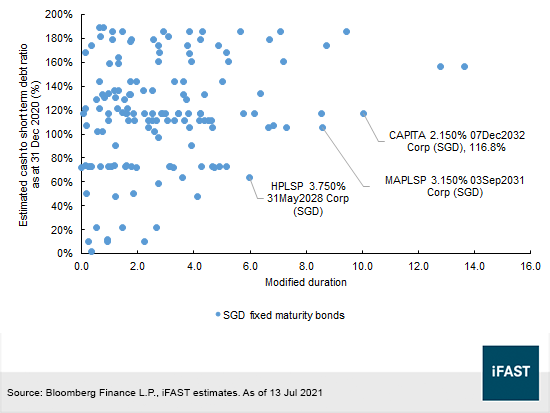
Referring to Figure 1, the HPLSP 3.750% 31May2028 Corp (SGD) is the weakest credit among the three bonds. The issuer - HPLSP, or Hotel Properties Limited, has been affected by the ongoing pandemic and the recent drop in tourist arrivals. With an estimated cash-to-short-term debt ratio of less than 100% on 31 Dec 2020, the group had a cash position of SGD 95.7m that was insufficient to cover its SGD 150.3m of short-term borrowings.
Other bonds such as the MAPLSP 3.150% 03Sep2031 Corp (SGD) – guaranteed by Mapletree Investments Pte Ltd, and the CAPITA 2.150% 07Dec2032 Corp (SGD) – guaranteed by CapitaLand Integrated Commercial Trust, have higher durations and could display a higher sensitivity to interest rates. However, unlike the HPLSP 3.750% 31May2028 Corp (SGD) issued by Hotel Properties Limited, the guarantors have stronger liquidity profiles and have adequate access to capital to cover their short-term borrowings.
What will happen to perpetual notes if interest rates go up?
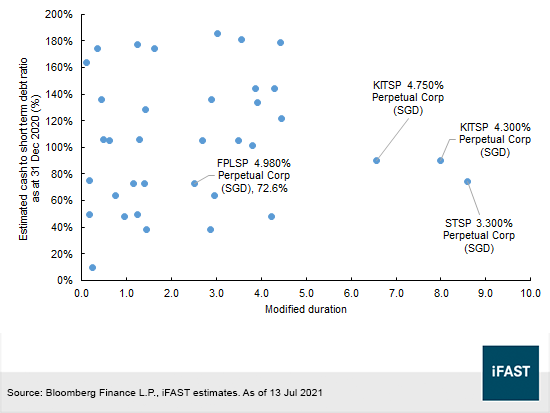
Figure 2: Modified durations and short-term debt coverage ratios of non-bank SGD perpetual notes
Intuitively, perpetual notes will also be impacted by rising interest rates. Unlike bonds with fixed maturities, these perpetual notes do not have maturity dates. Instead, the issuer has the option to redeem them on their call dates.
Considering all outstanding perpetual notes, we believe that the KITSP 4.750% Perpetual Corp (SGD), KITSP 4.300% Perpetual Corp (SGD) and STSP 3.300% Perpetual Corp (SGD) would be most sensitive to benchmark rates (Figure 2). If sovereign yields increase by 100bps, price fluctuations may range between 6 to 9 cents on the dollar, although in reality, price declines may extend beyond 9 cents due to the liquidity and credit factors mentioned earlier.
That being said, we continue to maintain a positive view on the credit profiles of these two issuers – KITSP (Keppel Infrastructure Trust) and STSP (Guarantor: Singtel). The estimated cash-to-short-term debt ratios of these issues may be less than 100% at this point, but as highlighted in our earlier articles – “Keppel Infrastructure Trust: Investors to reap returns from an upbeat sectoral outlook” and “Singtel to issue NC10.5 SGD perpetual notes at 3.6% IPG”, the companies still have good refinancing abilities.
Coupon reset features help to mitigate interest rate risk
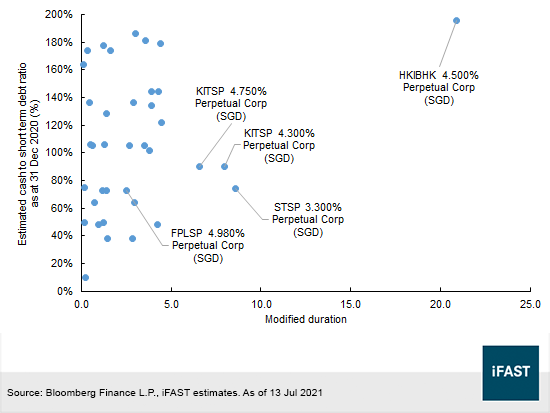
Not all perps will be impacted equally by higher interest rates. Certain perpetual securities such as the HKIBHK 4.500% Perpetual Corp (SGD) have a significantly higher modified duration of 20.9 (Figure 3). This high duration characteristic is commonly found among perps that do not have any reset features.
Figure 3: Modified durations and short-term debt coverage ratios of non-bank SGD perpetual notes
As explained in our earlier article “What You Need To Know Before Investing in Perpetual Bonds”, the reset feature is an integral construct of perpetual bonds. It has the dual function of mitigating interest rate risk for the bond investor, as well as serving as a possible disincentive for the issuer to keep the bonds outstanding.
For example, if the issuer does not redeem the KITSP 4.300% Perpetual Corp (SGD) on its first call date on 9 Jun 2031, the distribution rate on the note will ‘reset’ to the prevailing 10-year SGD Swap Offer Rate + initial spread of 2.735% + step-up margin of 100bps. If the 10-year SGD Swap Offer Rate rises to 3.5% in June 2031 from its current level of around 1.34%, the distribution rate on the KITSP 4.3% perps will increase to 7.235% (3.5%+2.735%+1%) from 4.3%.
From the issuer’s perspective, the interest expense on this note has expanded to 7.235% and the firm has an incentive to call back the perp in order to prevent incurring a higher financing cost. Concurrently, the investor is somewhat protected from higher interest rates because the note is likely to trade close to par (and not fluctuate too much) if the market believes that the issuer has a good ability to redeem the perps on its call date.
As alluded earlier, a perpetual bond has no fixed maturity date so interest rate risk can be significant if the perpetual bond does not have a coupon reset feature – such securities would fall under the category of "fixed-for-life" perpetuals. In this instance, the coupon rate remains the same in perpetuity and the absence of a coupon reset incentivises the issuer to keep the bonds outstanding if interest rates rise, while a decline in rates would see the issuer call the bonds early, leaving no duration benefit for the bondholder.
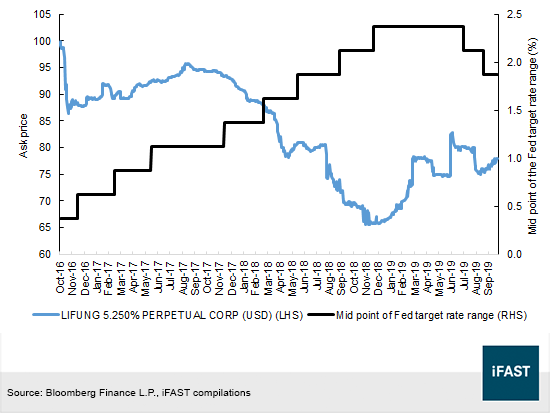
“Fixed-for-life” perpetuals can trade in a volatile fashion. Take for instance the LIFUNG 5.250% Perpetual Corp (USD), which was issued on 3 Nov 2016 and has a first call date on 3 Nov 2021. With a modified duration of 18.7 on 10 Nov 2016, ask prices for the notes fell by more than 30% from the high 90’s to as low as 65 in the midst of the last rate hike cycle between 2016 and 2019 (Figure 4). Having said that, investors should not purchase “fixed-for-life” perpetual securities considering that we might see a sharp rise in rates in future.
Figure 4: Prices of the LIFUNG 5.250% Perpetual Corp (USD) and US Fed funds rate
Credits with low duration
At the other end of the spectrum and referring back to Figures 2 and 3, there are certain perpetual notes, like the FPLSP 4.980% Perpetual Corp (SGD) that are less sensitive to interest rate movements. Frasers Property Limited has the option of redeeming the perps on 11 Apr 2024.
We believe that the group’s notes provide a reasonable return due to the guarantor’s high recurring income and the ongoing economic recovery. In March 2021, Frasers Property raised approximately SGD 1.16 billion from a rights issue, increasing its cash balances to SGD 2.22 billion. In April, the conglomerate also secured AUD 300 million in sustainability-linked loans through its Australian subsidiary. Together with SGD 4.93 billion of properties held for sale, the group has enough assets to cover its SGD 3.05 billion of current loans and borrowings.
What about bank instruments?
We think that bank perpetuals are a good bet in a rising yield environment. A steeper yield curve will allow banks to charge customers a higher rate on mortgages and other longer-dated variable loans while keeping their funding costs on shorter-dated deposits anchored at a relatively low short-term rate. The differential in the two rates will lead to higher net interest margins for banks.
Within credits in the sector, we had highlighted a few names from Deutsche bank in our earlier article – “How should bond investors handle the rising inflation concerns?”, and the CS 5.625% Perpetual Corp (SGD), which was the recommended SGD AT1 note in another article – “Credit Suisse bonds helped by bumper first quarter estimates”. With a yield to call of 4.46% on 15 Jul 2021, we maintain our view that the CS 5.625% perps are attractive.
Declaration:
For specific disclosure, at the time of publication of this report, IFPL (via its connected and associated entities) hold positions in FIRTSP 4.9817% Perpetual Corp (SGD), FPLSP 4.980% Perpetual Corp (SGD) and STSP 3.300% Perpetual Corp (SGD). The analyst who produced this report is a unitholder of Keppel Infrastructure Trust.
Our podcast series, Yield Hunters, is available on Spotify and iTunes Podcasts and Google Podcasts. We share our thoughts on new bond issues and hold discussions on the fixed income space. Listen to our latest episode below and follow us!