Receive first-hand news on the latest bond issues, credit updates and special events when you join us on our Telegram channel at https://t.me/bondsupermart!
SGS Bonds
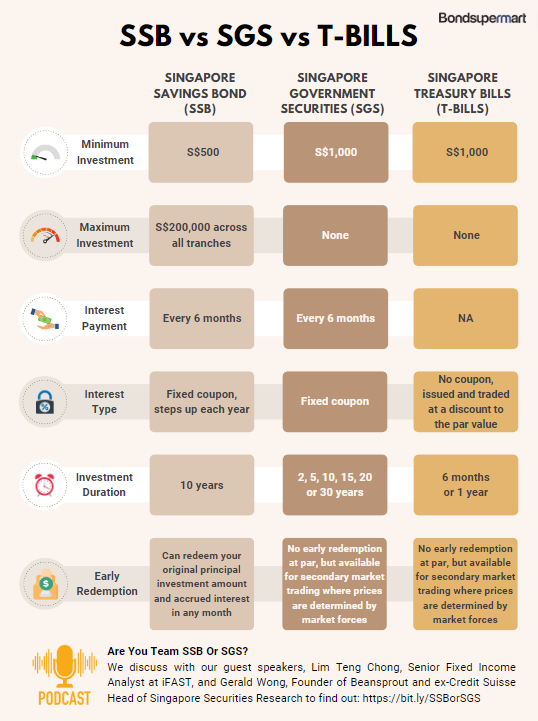
The Singapore Government Securities Bonds (“SGS Bonds”) are bonds that are fully backed by the Singapore Government. The bond has the strongest credit rating of AAA by major credit agencies. The SGS bonds pay a fixed interest rate with maturities between 2 to 50 years.
There are three different categories of SGS bonds – 1) SGS (Market Development), 2) SGS (Infrastructure) and 3) Green SGS (Infrastructure).
The key differences between the three types of SGS bonds would be the legislation that the SGS bond is issued under and its use of proceeds.
For investors who wish to invest in a safe asset between 1-2 years, the SGS bonds are suitable as it provides more yields as compared to the SSB. As of 4 October 2022, the yield for the 2 year SGS bond is around 3.39%. Even though there is a fixed maturity date for the SGS bonds, investors can still trade bonds on the secondary market. Investors may trade SGS bonds through an SGX broker.
One of the risks in buying SGS bonds is that the bonds are subjected to fluctuations in secondary market pricing. The value of the bond may be lower than its par value which may incur additional losses when sold before its maturity date. When interest rates rise, it will negatively impact a bond’s price, thus we think the SGS bonds are suitable for investors who are able to hold a short-term SGS bond till maturity.
|
|
SGS (Market Development) |
SGS (Infrastructure) |
Green SGS (Infrastructure) |
|
Legislation |
Government Securities (Debt Market and Investment) Act 1992 |
Significant Infrastructure Government Loan Act 2021 (SINGA) |
Significant Infrastructure Government Loan Act 2021 (SINGA) |
|
Objective |
To develop the domestic debt market |
To finance major, long-term infrastructure |
To finance major, long-term green infrastructure projects |
|
Tenor |
2, 5, 10, 15, 20, 30, or 50 years |
||
|
Frequency of issuance |
Monthly, for at least 5 years |
||
|
Minimum investment amount |
SGD 1,000, in multiples of SGD 1,000 |
||
|
Maximum investment amount |
Up to the allotment limit for auctions |
||
|
Buy using SRS and CPF funds? |
CPF and SRS |
||
|
Interest payment |
Every 6 months, starting from the month of issue |
||
|
Secondary market trading |
Yes |
||
T-bills
Treasury bills, or T-bills, are short-term Singapore Government Securities. T-bills are available in short-tenors of 6 months and 1-year. Unlike the SGS bonds, T-bills do not have interest payments but are issued at discount to its face value. Upon maturity, T-bills will be redeemed at its face value of 100.
For investors who wish to park their cash in a safe asset for a short period of time, the SGS T-Bills are suitable as it provides decent yields for only a short 6 months or 1 year period. It is also suitable for investors who are undecided and would like to wait out the volatility and uncertainty in the markets. As of 4 Oct 2022, the cut-off yield for the latest 6-month T-Bill auction was 3.32% which is a much better alternative to fixed deposits and bank deposit rates.
|
SGS T-Bills |
|
|
Tenor |
6 months or 1-year |
|
Frequency of issuance |
Quarterly |
|
Minimum investment amount |
SGD 1,000, in multiples of SGD 1,000 |
|
Maximum investment amount |
Up to the allotment limit for auctions |
|
Buy using SRS and CPF funds? |
SRS and CPF |
|
Interest payment |
N/A |
|
Secondary market trading |
Yes |
Singapore Savings Bonds
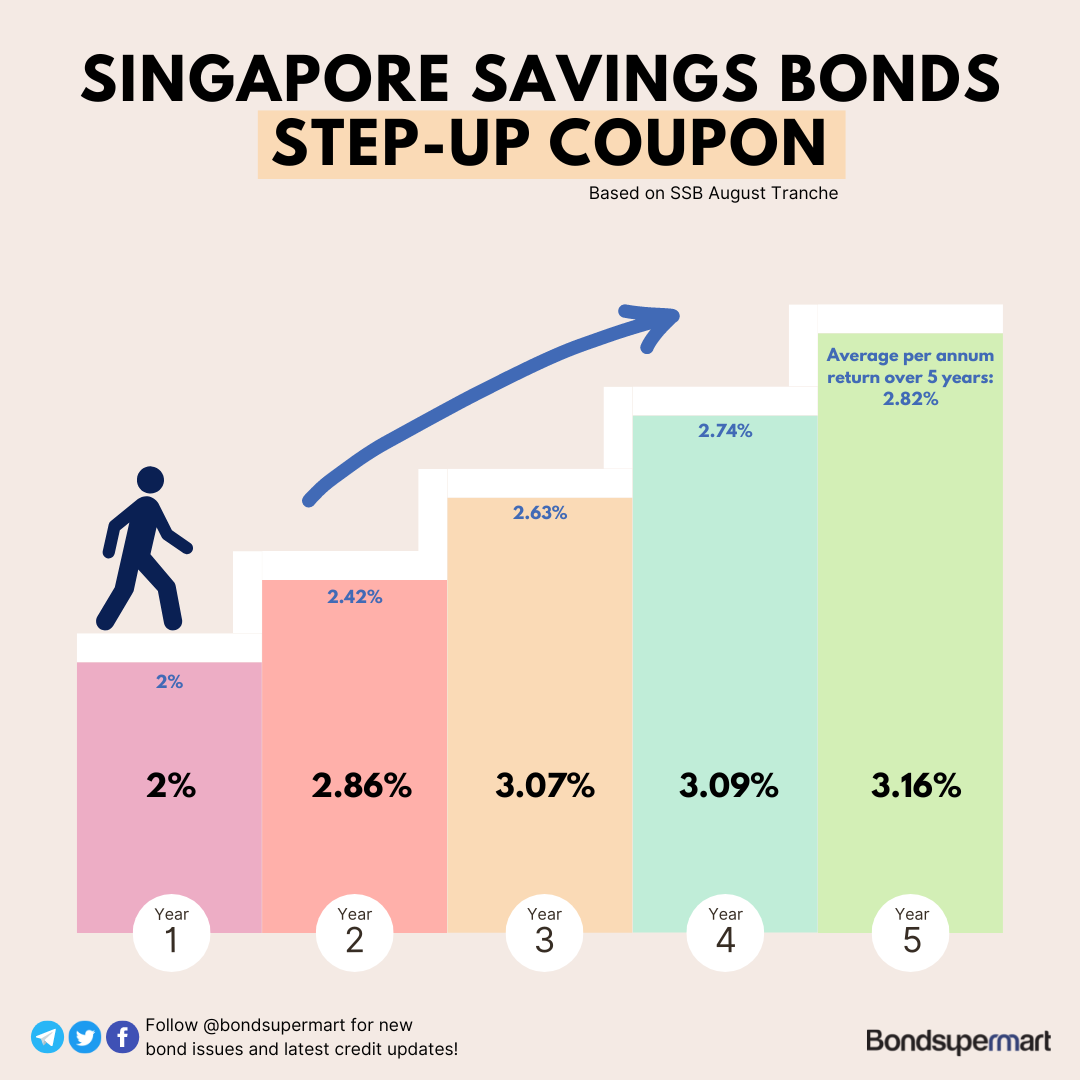
The Singapore Savings Bonds, or SSBs for short, are a special type of Singapore Government Securities. It has a tenor of up to 10 years and is issued monthly. Interest rates for the SSBs are determined based on the yield to maturity of the corresponding SGS bond. For example, the 5-year average return on the SSB should be equal to the yield of the 5-year SGS bond.
One unique feature of the SSB is that it gives investors increasing returns the longer you hold the SSB. Interest rates for the SSBs will “step-up” every year for as long as you hold the bond. This results in the total average returns of the SSB to increase each year as the next interest payment will be higher than the previous one.
In the event where short-term rates are higher than long-term rates (an inverted yield curve), MAS will apply adjustments to ensure that the coupons on the SSBs do not step-down at any point in time. MAS will ensure that the average 10-year return of the SSB (when held to maturity) will always equal to the yield of the 10-year SGS bond.
Another unique feature the SSB provides is the flexibility to redeem the bond at any point in time (during the tenor of 10 years). At any point in time, holders of the SSB can redeem their SSB and receive in full principal amount (including accrued interest) by the second business day of the next month.
SSBs are suitable for investors who wish to enjoy flexibility in their investments. There is no fixed tenor for the SSB, so investors can decide when to redeem the bond. Additionally, the SSB is not affected by secondary market trading which ensures less volatility in the bond. With that in mind, the lack of secondary market trading also removes the ability to earn capital appreciation in the bond when interest rates fall.
|
Singapore Savings Bonds |
|
|
Tenor |
Up to 10 Years |
|
Frequency of issuance |
Monthly, for at least 5 years |
|
Minimum investment amount |
SGD 500, in multiples of SGD 500 |
|
Maximum investment amount |
SGD 200,000 overall |
|
Buy using SRS and CPF funds? |
Only SRS |
|
Interest payment |
Every 6 months, starting from the month of issue |
|
Secondary market trading |
No |