Introduction
James Dyson — celebrated inventor of the Dual Cyclone bagless vacuum cleaner and founder of the eponymous firm Dyson Ltd — is not known for settling for anything less than the best. So it came as no surprise when it was announced that the British billionaire had acquired Singapore’s most pricey penthouse — a 21,108 square feet (‘sq ft’) apartment spanning three storeys in the prime district of Tanjong Pagar — for approximately S$73.8m. The purchase price comfortably dwarfed the more than S$60.0m that Facebook co-founder Eduardo Saverin had paid for another super penthouse at Sculptura Ardmore, a luxury development situated near the prime Orchard district.
Dyson’s latest acquisition is part of Wallich Residence, a GuocoLand development nested within Guoco Tower — arguably Singapore’s most imposing architectural structure spanning almost 300 meters high. From the apartment, visitors can soak in the panoramic view of the entire Greater Southern Waterfront, comprising the Central Business District, the Singapore Strait and even the tourist-friendly island of Sentosa.
If the visual feast fails to impress, a tour of Dyson’s immense apartment might just do the trick. One could luxuriate in the private pool, located on the 64th floor of the development. Or maybe take a stroll into the apartment’s wine cellar, which can hold 600 bottles, perfect accompaniments to a multi-course degustation that the owner might host in one of the apartment’s ornate dining rooms. Is a professional bartender needed to serve those drinks? The hotel-inspired, 24-hour Wallich Butler Service can help with almost any hospitality need.
With Dyson’s purchase making headlines worldwide and catapulting the project into fame, Wallich Residence is poised to become one of Singapore’s most iconic developments. But what is GuocoLand really about, and how did it end up creating Singapore’s most expensive penthouse? In the next section, we introduce GuocoLand: the firm behind Wallich Residence.
About GuocoLand
Listed on the Singapore stock exchange since 1978, GuocoLand Limited (‘GuocoLand’) is a property development company operating largely in Singapore, China, Malaysia and Vietnam. While property development is the core focus of the group, GuocoLand also generates revenue from property investment and hotel management.
GuocoLand’s core markets, as defined by the company, are Singapore and China. However, as we will see in the later part of this article, GuocoLand remains largely dependent on Singapore for the bulk of its business.
Despite the Asian-centric nature of its operations, the company has been focused on global expansion in recent years. In 2017, the company inked a strategic partnership agreement with Eco World Development Group Berhad to expand into new markets outside of Asia, with the joint venture concentrating on the United Kingdom and Australia.
The partnership agreement has since given birth to a listed joint venture — Eco World International Berhad (‘EWI’) — with a market capitalization of RM1.56 billion. GuocoLand and Eco World Development Group each holds a stake of 27% in the joint venture company, with other investors holding the rest.
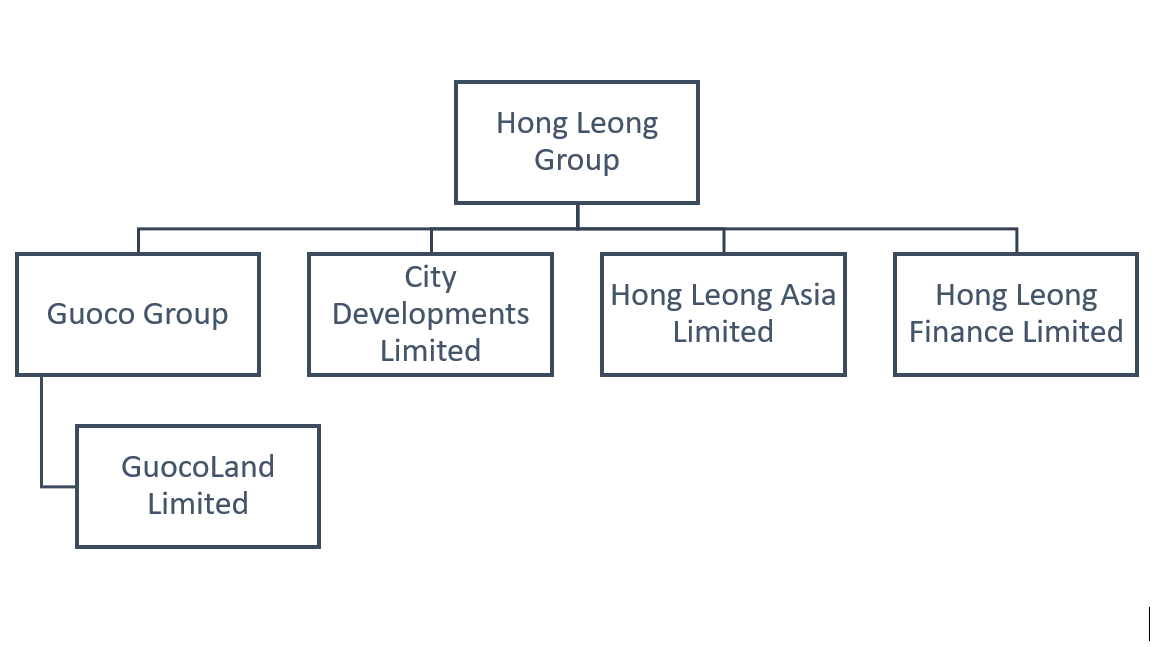
GuocoLand currently has a market capitalization of S$2.38 billion and total assets in excess of S$10 billion. Readers unconversant with GuocoLand may not know that it is actually part of a larger family, the Hong Leong Group. For ease of reference, their relationship is summarized in Figure 1.
Figure 1: Hong Leong Group summary group structure
Source: Company, Hong Leong Group
As the reader would readily observe, GuocoLand is one part of a sprawling conglomerate that is the Hong Leong Group. Established in 1963, Hong Leong Group is one of the most influential conglomerates in Southeast Asia, with business interests in industries such as banking, manufacturing, property development and hospitality and leisure. The group is headed by billionaires Quek Leng Chan and Kwek Leng Beng, who oversee the Malaysian and Singapore operations of the group respectively.
In the next section, we will look at some of GuocoLand’s most notable projects.
Major developments
In 2015, GuocoLand completed the construction of Leedon Residence, a luxury condominium located in a Good Class Bungalow enclave in District 10. Developed across five hectares of land, the sprawling development is one of Singapore’s largest condominium developments in the district, marked by an unusual abundance of greenery and open space. By the end of 2018, the group had finished selling the last of the development’s remaining units.
In 2017, GuocoLand launched Martin Modern, a 450-unit residential project located in the heart of Robinson Quay — popular among expatriates and claimed by some as Singapore’s most happening district. When the project is completed next year, Martin Modern will feature two residential towers snuggled within a lush botanic garden, whose design is inspired by the Singapore Botanic Gardens — a UNESCO heritage site. Martin Modern is close to almost everything that matters: the Central Business District, the Civic District, Marina Bay, as well as the prime shopping district of Orchard Road.
Informed readers would also know that GuocoLand is the developer of the integrated mixed-use development Tanjong Pagar Centre, comprised of five key elements: premium Grade A office space in Guoco Tower, a dynamic lifestyle and F&B retail space, luxury apartments at Wallich Residence, the five-star luxury hotel Sofitel Singapore City Centre and a 150,000 sq ft landscaped park. Let us briefly discuss some of these components in turn.
Guoco Tower provides office space for tenants seeking an exclusive, prestigious address to operate from. The key selling point is its central location — Guoco Tower is located directly above the Tanjong Pagar MRT station. As at end-June 2018, Guoco Tower had an occupancy rate of some 99%.
Across the first six floors, tenants can access the development’s retail space, which houses a curated mix of dining and lifestyle outlets. The retail component has also fared well since its opening, with GuocoLand reporting a healthy occupancy rate of 98%.
The hotel within Tanjong Pagar Centre is operated by Sofitel, a French hospitality giant with operations across the globe. Sofitel Singapore City Centre offers 223 luxurious guestrooms and suites, catering to tourists and business travelers alike. The hotel boasts 20,000 sq ft of meetings and events space, spread across 10 separate venues that can be dynamically resized to suit specific needs. As with the retail and residential components, hotel guests also enjoy direct access to Tanjong Pagar via three dedicated lifts.
Apart from the aforementioned developments, GuocoLand has developed many other quality properties around the region. It would, however, not be feasible to enumerate all of them. After all, the idea is to give our readers a sense of what GuocoLand does, and the general nature of its business.
At this juncture, we propose dedicating a bit of time to discussing two recent deals that GuocoLand has struck, which is the topic for our next section.
Recent developments
In early September, GuocoLand released details of the concept and design of Meyer Mansion, to be built on the site of the former Casa Meyfort condo, located in the vicinity of East Coast Park. GuocoLand had purchased the former Casa Meyfort site through an en-bloc acquisition for S$319.88m in 2018, which together with the estimated development charge of S$57.2m reportedly translated to approximately S$1,580 per square foot per plot ratio (‘psf ppr’).
According to an expert estimate reported by The Straits Times, the break-even price of Meyer Mansion would hover around S$2,400 psf. In fact, it is not unlikely that prices would comfortably go above S$2,500 psf, given that the nearby Amber Park has managed to sell 157 units in the first half of 2019 at an average selling price of more than S$2,450 psf. However, we think that given Singapore’s subdued residential market outlook, and the general economic slowdown that the country is facing, the launch price of Meyer Mansion is unlikely to stray too far from that range.
Meyer Mansion is slated to take the form of a 25-storey residential tower, which will comprise 200 units. The development will offer a range of 1- to 4-bedroom premium units, ranging from 484 sq ft to 2,142 sq ft. As with GuocoLand’s other properties, Meyer Mansion is likely to carry the developer’s signature luxury touches. GuocoLand has already released a number of units for sale, with the Meyer Mansion slated for completion in 2024.
Also in September this year, GuocoLand announced that it had emerged as the winner in a recent Government Land Sales (‘GLS’) tender exercise in relation to a site situated along Tan Quee Lan Street. The tender exercise, which saw only two bids submitted, closed on September 5. The successful bid for the site — submitted by a joint venture between GuocoLand and Hong Leong subsidiaries Intrepid Investments Pte Ltd and Hong Realty (Private) Limited — was S$800.19m, an amount which surpassed the other bid by a margin of 4.2%. The other unsuccessful bid was submitted by a joint venture of City Developments Limited and MCL Land, which put in a bid of some S$768m for the site.
GuocoLand’s S$800.2m bid for the Tan Quee Lan site (next to Bugis MRT station) translates to some S$1,535 psf ppr. The tender price is slightly higher than the top bid of S$1,458 psf ppr for the Middle Road GLS site, which is also in the vicinity of the Bugis MRT station. We think this signals GuocoLand’s continued optimism on the long-term prospects of the local residential sector.
Having covered GuocoLand’s major projects and recent developments, we move on to look at the company’s financials in the next section.
Financial highlights
For the fourth financial quarter ended 30 Jun 19 (‘4QFY19’), group revenue surged 81% year-on-year (‘YoY’) to S$325.5m (4QFY18: S$178.5m), on the back of increased revenue recognition from various residential projects in Singapore and Malaysia. Cost of sales associated to revenue increased to a greater extent to S$219.8m (4QFY18: S$103.9m), resulting in the group’s gross profit margin inching downwards from 42% to 32%.
In the period, other income increased by 44% YoY to S$212.3m. This was for the most part attributed to higher fair value gains from investment properties in Singapore. Other expenses increased from S$0.3m to S$24.3m due to losses incurred on derivative financial instruments held by the group. As a whole, the net income from other sources remained positive.
GuocoLand’s earnings before interest and taxes (‘EBIT’), excluding the group‘s share of loss/profit from associates and joint ventures, was S$261.2m for the quarter ended June 2019. This represents a 35.5% increase from S$192.8m in previous year’s corresponding period.
The interest coverage ratio — EBIT over finance costs — registered a slight decline from 10.74x in 4QFY18 to 9.77x in 4QFY19. However, stripping out other income and other expenses not related to GuocoLand’s core development operations, we find that the EBIT-to-finance costs ratio actually rose from 2.55x to 2.74x over the same period. The interest coverage ratio is a measure of the company’s ability to rely on operating earnings to service interest expense.
On the earnings front, GuocoLand continued to impress. Basic earnings per share grew from 12.81 cents in 4QFY18 to 16.09 cents in 4QFY19, up 25.6% YoY. Basic earnings per share are derived by taking the company’s net income, subtracting accrued distribution for perpetual securities and dividing the result by the weighted average number of ordinary shares.
We now move on to examine GuocoLand’s balance sheet: its assets and liabilities. Net asset value per share grew 1.77% YoY to reach 3.45 cents per share in the quarter ended June 2019.
Group liquidity has improved significantly. The current ratio, which is the firm’s current assets over current liabilities, reached 7.24x at the end of June 2019. The current ratio was just 2.17x a year before. The improvement in current ratio came despite the halving of trade and other receivables from S$307.3m last year to S$146.2m at the end of June this year.
The ratio of GuocoLand’s inventories to full-year sales in FY19 edged up slightly to 3.21x (FY18: 2.50x). This, of course, was to some degree a natural outcome of a residential market that lacks momentum. That said, if we were to look at inventories over quarterly sales (as opposed to full-year sales), we would see that the ratio actually declined from 16.01x (for the quarter ended June 2018) to 9.22x (for the quarter ended June 2019), indicating that sales relative to inventories remained robust or were improving for GuocoLand.
In terms of debt and gearing, GuocoLand maintained a gearing level — total debt excluding perpetual securities over assets — of 44.8% at the end of June, versus 47.3% the previous year. When perpetuals are included in the calculation of gearing, GuocoLand’s adjusted gearing ratio at the end of June was 48.8% (4QFY18: 51.1%).
At the end of June 2019, the aggregate value of property, plant and equipment (‘PPE’), investment properties and inventories was S$8.45 billion. Of this amount, S$6.53 billion — or some 77.2% — was pledged for borrowings.
In all likelihood, readers would find a brief description of GuocoLand’s cash-flow situation instructive. For the quarter ended June 2019, the group’s cash flow from operating activities (‘CFO’) swung to negative S$166.8m (4QFY18: inflow of S$211.6m), mostly because of additions to inventories of S$223.7m, following the completion of the Casa Meyfort freehold residential site acquisition. We note that before accounting for changes in working capital, GuocoLand’s CFO was S$83.9m, up 43.6% YoY (4QFY18: S$58.4m). Capital expenditures — defined as the additions to investment properties and PPE — remained low at S$27.6m (4QFY18: S$39.1m).
The GuocoLand bonds
In Figure 2, the reader will find the list of GuocoLand bonds currently outstanding.
Figure 2: GuocoLand’s bullet bonds
|
Bond
|
Maturity Date
|
Time to Maturity (Years) |
Ask Price
|
YTM (Ask; %)
|
Z-Spread (Ask; bps) |
|
GUOLSP 4.200% 05Feb2020 Corp (SGD) |
05 Feb 2020 |
0.4 |
100.63 |
2.32 |
62 |
|
GUOLSP 4.100% 13May2020 Corp (SGD) |
13 May 2020 |
0.6 |
100.94 |
2.53 |
86 |
|
GUOLSP 3.620% 30Mar2021 Corp (SGD) |
30 Mar 2021 |
1.5 |
100.94 |
2.97 |
135 |
|
GUOLSP 4.000% 31Jan2022 Corp (SGD) |
31 Jan 2022 |
2.3 |
101.42 |
3.36 |
177 |
|
GUOLSP 3.850% 15Feb2023 Corp (SGD) |
15 Feb 2023 |
3.4 |
101.54 |
3.36 |
179 |
|
Source: Bloomberg, iFAST compilation (prices as of 2 Oct 2019) |
|||||
In addition, GuocoLand has a perpetual bond — the S$400m GUOLSP 4.600% Perpetual Corp (SGD) issue — which has a first call date in January 2023 — and carries a yield to call of 4.60% at the ask price of 99.97. The coupon will reset in January 2025 (two years after the first call date) and every seven years thereafter, to the sum of the 7-year SGD swap offer rate, the initial spread of 260.9 basis points (‘bps’), plus a step-up margin of 100 bps.
For readers that might be unfamiliar with the mechanics of perpetual bond coupon resets, the 260.9 bps component is derived from the premium above the reference swap rate when the perpetual bond was first issued. The 100 bps component is known as the “step-up” feature, which compensates investors with additional interest for the bond not being called by the reset date.
The first thing that the astute reader might notice is that the first call date of the GUOLSP 4.600% Perpetual Corp (SGD) falls around the same time as the GUOLSP 3.850% 15Feb2023 Corp (SGD), with the two bonds yielding 4.60% and 3.36% respectively. If these bonds ‘mature’ at or around the same time, why would there be a significant yield difference of some 124 bps?
Simply put, the GUOLSP 4.600% Perpetual Corp (SGD) is a perpetual bond, which has no legal maturity date notwithstanding its first call date of January 2023. This means that the issuer has the option, but not the obligation, to call the bond in 2023. Thus, there is the possibility — or risk, depending on how one chooses to view the situation — that the bond might not be called at that time. In addition, the GUOLSP 4.6% perp has a subordinated ranking, while the GUOLSP 3.85% ‘23s are ranked senior unsecured.
Another way to think about a callable bond is to appreciate that because the issuer has the choice of whether to redeem the bond or not, there is an embedded call option that the bond holder provides to the issuer. Should interest rates or the cost of financing rise to the extent that makes it more attractive (even with the coupon step-up) for the issuer to continue to service the existing perpetual bond (as compared to refinancing it with new debt), the company would have a strong incentive not to call the bond.
The 124 bps yield pick-up on the GUOLSP 4.6% perp (versus the GUOLSP 3.85% ‘23s) essentially compensates investors for 1) extension risk, or the risk that the bond might not be called at the first call date; and 2) the subordinated ranking of the perp. Perpetual bond issuers often try to reassure investors that extension risk is mitigated through the use of devices such as the “step-up” component on reset date. In the case of the GUOLSP 4.6% perp, by ratcheting up the coupon by 100 bps at the reset date, the company will have a financial incentive to redeem the perpetual bond on first reset.
As a whole, we are of the opinion that the GUOLSP 4.600% Perpetual Corp (SGD) is substantially more attractive than the GUOLSP 3.85% ‘23s. The 124 bps yield premium provides a generous compensation for the incremental risks on the perp vis-à-vis the fixed-term bond maturing at around the same time.
The reader may wish to note that in relation to this perpetual bond, the first call date does not coincide with the reset date. The bond is first callable in January 2023, while the first reset date is in January 2025. Since the reset date, and by association the 100 bps coupon step-up, occurs at a later date, the issuer might have a weaker incentive to call the bond in 2023. Nevertheless, we think that a call in 2023 is still likely, given the accommodative interest rate environment that we are in and the reputational implications of not calling the bond.
With this in mind, we would recommend theGUOLSP 4.600% Perpetual Corp (SGD), compared with GuocoLand’s fixed-term notes.
Afterword
In January, Dyson Ltd announced plans to move its headquarters from Britain to Singapore, following the company’s much publicized intention to build the firm’s new electric car in the affluent city-state. Then came James Dyson’s purchase of the super penthouse at Wallich Residence. Parties were coy when contacted, but as reported by Reuters, a spokesman for the firm noted, “Given the decision to locate the headquarters in Singapore and the growing focus of the company’s business in the region, of course James Dyson has bought a property there.”
According to recent media reports, James Dyson might have his sights set on a second luxury property in Singapore. This might just be of interest to GuocoLand.
Recommended bond: GUOLSP 4.600% Perpetual Corp (SGD)