

- Westpac delivered a decent financial performance in 1H23 and 3Q23. The Group managed to grow net profit, helped by strong net interest income.
- However, the Group expected net profit after tax to decline in FY23. We see the likelihood for a rebound in FY24.
- The Group’s credit profile remains healthy with a strong capital and liquidity position as well as resilient asset quality. We also find the Group to be sufficiently provisioned.
- Among Westpac’s AUD Tier 2 subordinated bonds, we prefer WSTP 4.334% 16Aug2029 Corp (AUD).
About Westpac Banking Corporation
Westpac Banking Corporation (“Westpac”) is one of Australia’s largest and oldest banking institutions. It is also one of four major banking organisations in the country and one of the largest banks in New Zealand. The bank operates mainly across six divisions:
- Consumer: Providing banking products and services to customers in Australia under the brands of Westpac, St.George, BankSA, Bank of Melbourne, and RAMS.
- Business: Providing banking products and services to small/ medium businesses, commercial and agribusiness customers across Australia. This includes the private wealth business which supports the needs of high-net-worth individuals.
- Westpac Institutional Bank (“WIB”): Delivering a broad range of financial services to commercial, corporate, institutional, and government customers operating in, and with connections to, Australia and New Zealand.
- Westpac New Zealand: Providing banking, wealth, and insurance services to consumer, business, and institutional customers in New Zealand.
- Group Businesses: Comprising the head office and Australian support functions including treasury, technology, operations, property services, strategy, finance, risk, compliance, legal, human resources, and customer and corporate relations.
- Specialist Businesses: The Group’s non-core businesses that are designated to be divested. These include superannuation, wealth platforms and investments, Auto finance, and operations in Fiji and Papua New Guinea.
Based on statistics by Australian Prudential Regulation Authority (“APRA”), Westpac has the second largest market share in Australian mortgages and household deposits (as of March 2023). In addition, all three major credit rating agencies have stable outlook on the group, with ratings of ‘AA-‘ by Fitch, ‘Aa3’ by Moody’s and ‘A+‘ by Standard & Poor’s (as of 26 October 2023).
Financial Highlights for 1H23 and 3Q23
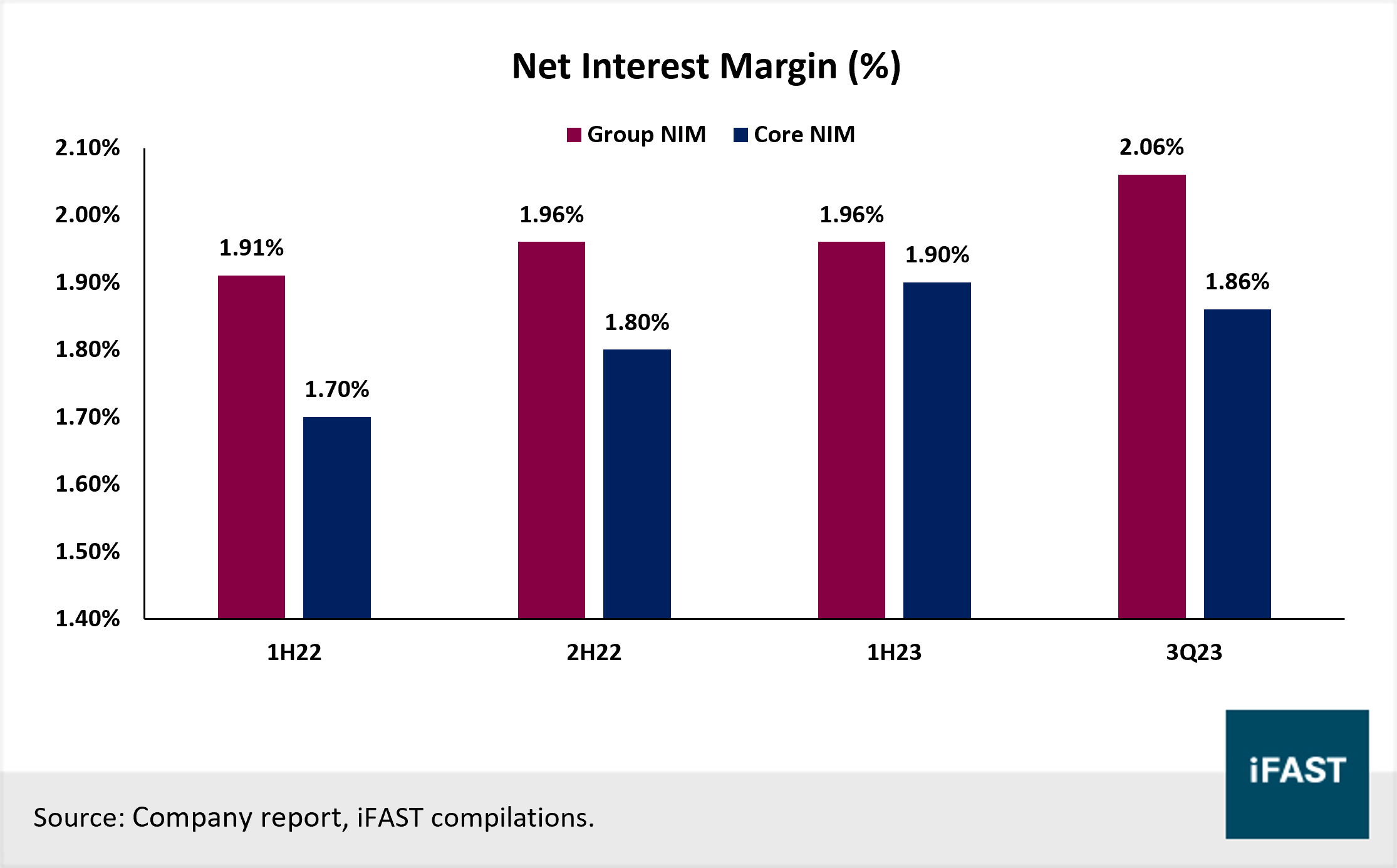
Westpac delivered a decent financial performance in the half year ended 31 March 2023 (1H23). Net operating income rose 8% year-on-year (“YoY”) to AUD$11,003M from AUD$10,230M, driven by a solid 10% YoY growth in net interest income (“NII”) which offset a -3% dip in non-interest income. NII growth was fueled by a 20% YoY growth in core operations as a result of larger deposit spreads and higher earnings on capital as well as hedged deposits. The Group’s NIM grew by 5bps to 1.96% from 1.91% largely due to a dramatic increase in deposit interest spreads and a mild increase in earnings on capital.
Operating expenses fell by 7% YoY to AUD$4,988M (1H23) from AUD$5,373M (1H22), reflecting the Group’s cost discipline where operating activities were simplified. Expenses fell across the board, including staff, occupancy, and technology expenses. This led to a fall in cost-to-income ratio to 45.0% (1H23) from 52.8% (1H22). Westpac recognised higher credit impairment charges of AUD $390M, an increase of AUD $251M from 1H22. Several factors prompted the Group to raise credit impairment charges, including weaker forward-looking economic indicators, rising early cycle delinquencies in consumer portfolios, and an increase in financial stress within New Zealand business portfolios. The Group also recognized higher income tax expense of AUD $1,620M, an increase of AUD $186M from 1H22 which ate into net income.
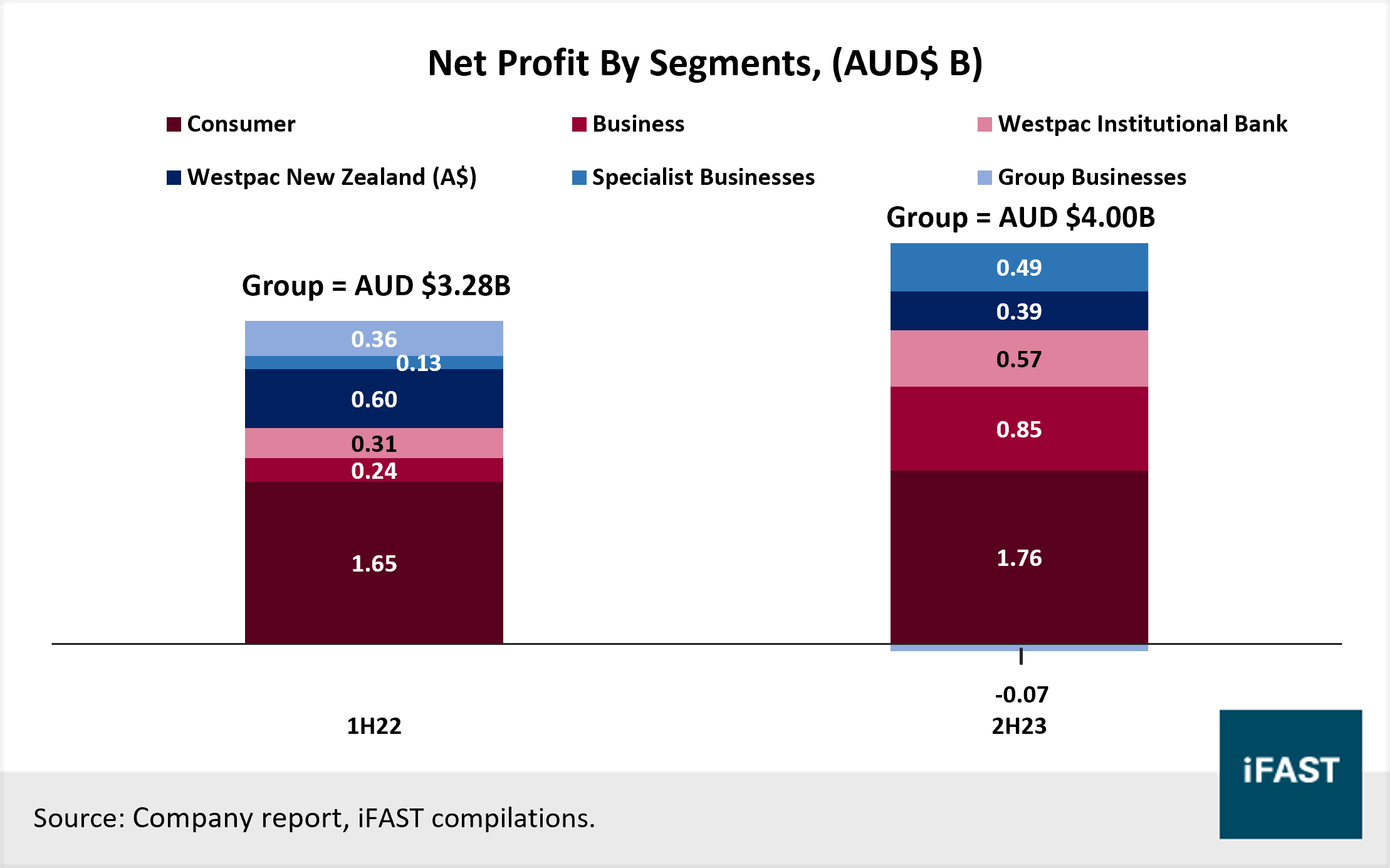
Despite higher credit impairment charges and income tax expense, 1H23 net profit rose 22% year-on-year (“YoY”) to AUD $4,001M from AUD $3,280M. By divisions, the consumer segment remains the earnings driver, generating the largest net profit at AUD $1,763M (Chart 1). The business segment follows closely, with a net profit of AUD $851M. Collectively, both the consumer and business banking segment grew 39% YoY to AUD $2,614M from AUD $1,885M.
Chart 1: Consumer segment remains the earnings driver
More recently, in the third quarter of 2023 (“3Q23”), the Group maintained its decent financial performance with a quarterly cash profit of AUD$1.8 billion, in line with consensus expectations. Management highlighted that operating revenue remain resilient, bolstered by ongoing disciplined margin management. The Group’s NIM for 3Q23 was 2.06%, up 10bps from 1H23, driven by higher hedging as well as improved treasury and market income (Chart 3). Expenses for 3Q23 are up approximately 5% YoY compared to 1H23. Expenses continued to rise given inflationary pressures on supplier costs, wages and salaries, and several one-off expenses. That said, management has expressed the desire to remain steadfast on cost discipline and has acted on several fronts, including a reduction of employees.
Chart 2: Net profit has improved in FY23 thus far…
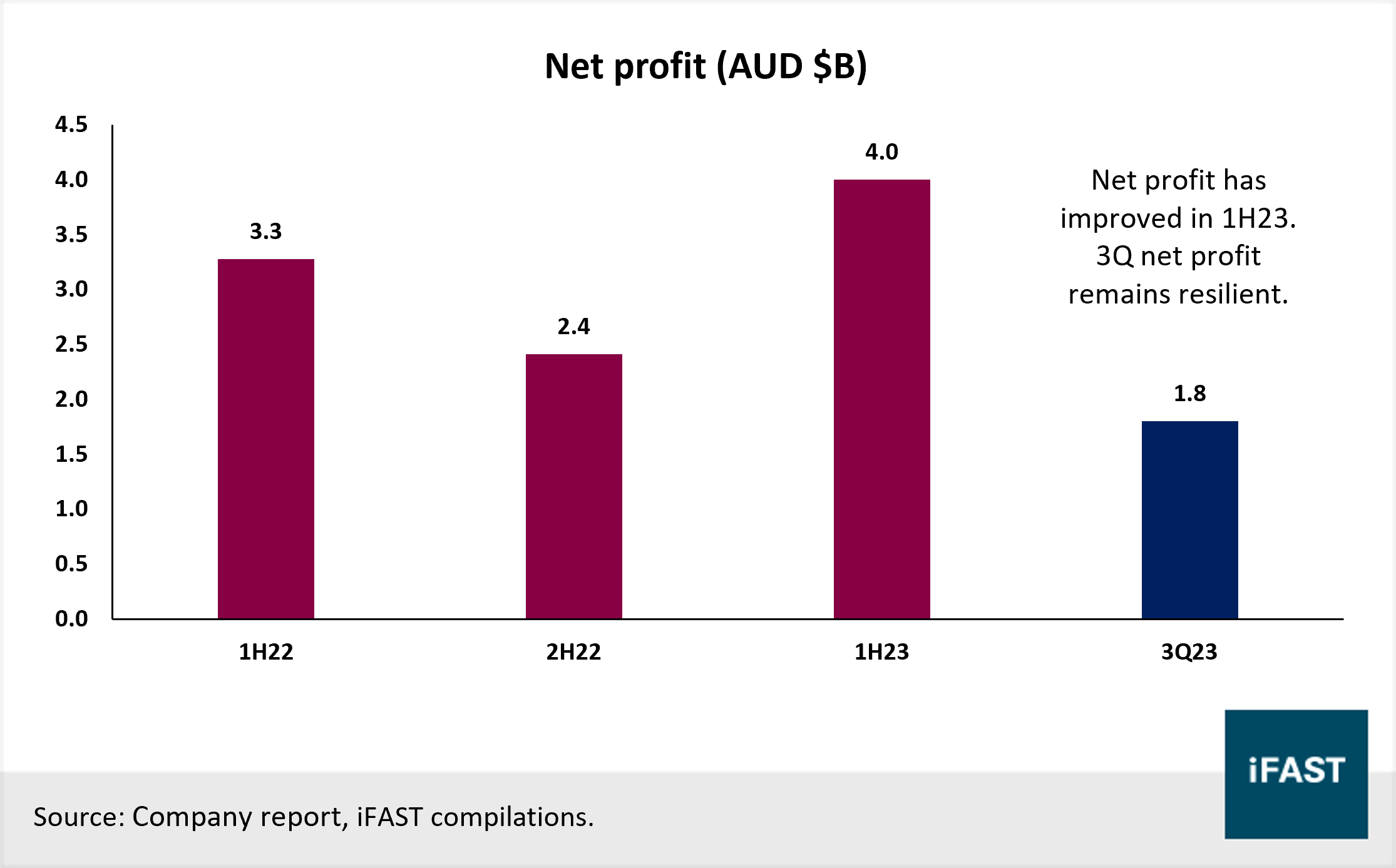
Chart 3: …Group NIM has also improved
Business Outlook
Similar to most large Australian banks, we expect Westpac’s NII to remain resilient in FY23 with NIM staying high due to the higher policy rates backdrop which has proven supportive for deposit spreads and earnings on capital. However, we see rising NIM headwinds in 2H23 and FY24 as margins from Australia mortgage (63% of total loans) are likely to compress given the intense industry competition.
Beyond FY23/24, the Group’s revenue outlook will likely be highly shaped by the success of its new strategic phase which was announced during the 1H23 earnings result. In this phase, the Group is expected to focus on both growth and increasing returns. We think it is the right direction after three years of structural changes which involved heavy cost-cutting and balance sheet cleanup. While it is early days to determine the impact of this strategic phase on Group revenue, we think greater growth lies in the Australian business and institutional banking segments.
We expect operating expenses to grow but at a slower pace as cost reduction efforts from the Group’s cost reset program gradually catches up to inflation pressure. While management has also highlighted its intention to remain discipline on cost, we are unlikely to see major cost reduction efforts given thinning profit margins.
Investment spending will be an exception and will likely to remain higher as the Group embark on its new strategic phase. Lastly, we also expect impairment expenses to pick up in 2H23 and FY24 given the tight financial conditions and moderating economic growth. However, this may moderate in the back half of FY24 if global growth recovers.
Looking forward, we expect weaker earnings in FY23. The Group has outlined its expectation for net profit after tax to decline by AUD $173M in FY23. We see the likelihood for a rebound in FY24, but magnitude will likely be held back by higher investment spending, impairment expenses, and possible margin pressure in 1H24. Beyond FY24, earnings are likely to further recover, fueled by Australia’s economic recovery and positives from the new strategic phase.
Credit highlights
1. Asset Quality
Overall, we find the Group’s asset quality resilient and well-provisioned. Stressed exposures remain low despite higher policy rates, at 1.16% of total committed exposures in 3Q23. Additionally, the exposure to impaired loans continues to stay muted, at 0.12% of total committed exposures, relatively unchanged over the past year (Chart 4).
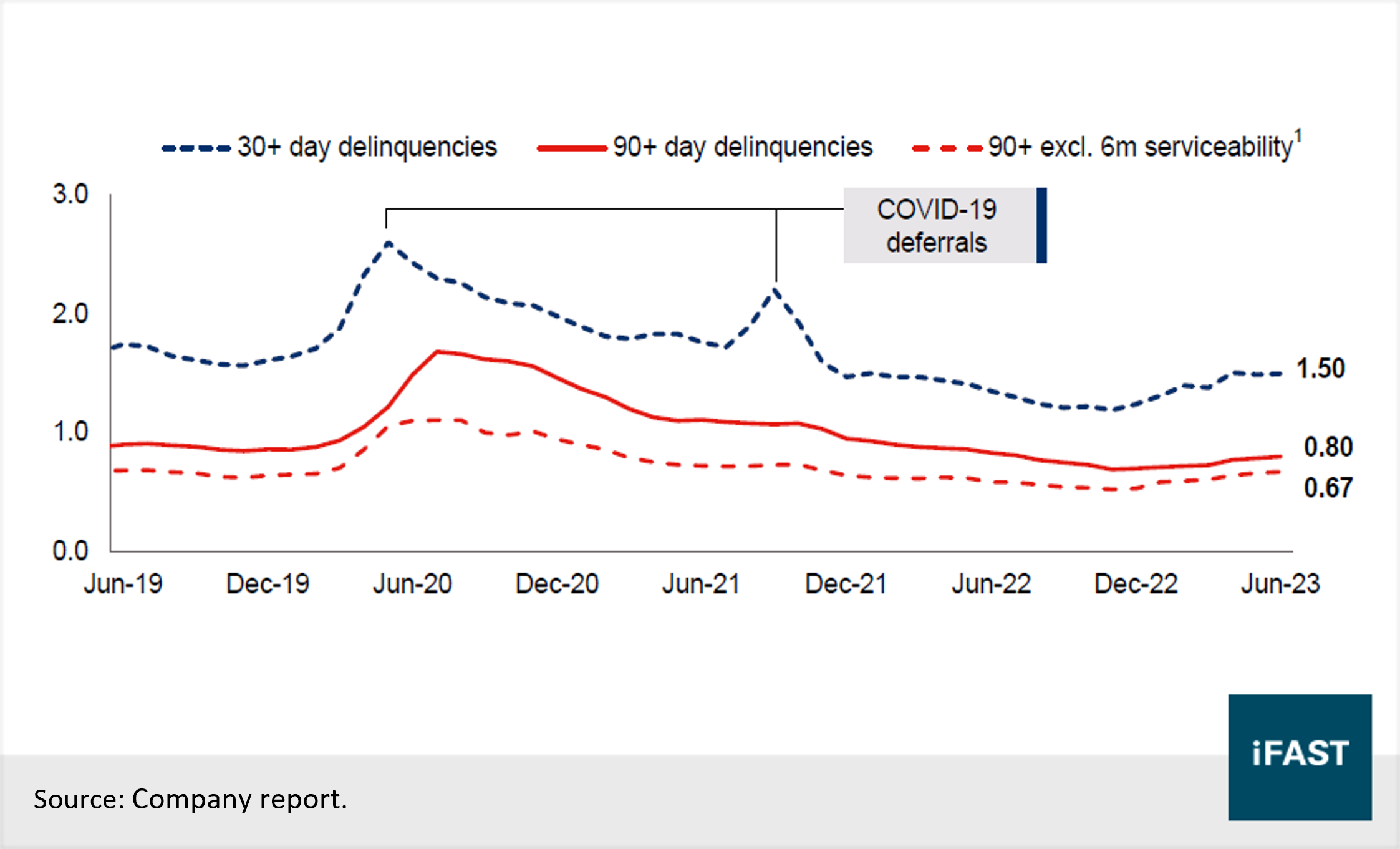
The Group also maintains an elevated exposure to high-quality non-mortgage loans. Based on the 1H23 results, 66.0% of non-mortgage loans are investment grade quality, of which 44.0% are of the highest “AAA” to “AA-“ rating. The quality of mortgage loans improved slightly as loans due past 90 days remained contained at 0.80% of mortgage loans (3Q23), up from 0.68% (1H23) but inline with 0.82% (1H22) (Chart 5).
Over the past year, the Group’s Australian housing weighted loan-to-value ratio (“LTV”) has also declined to 72% for loans at origination and 68% for new loans (1H23). This shows that borrowers have taken less loan, on average, relative to the property’s value. Generally, a lower LTV represents less risk to the bank.
That said, mortgage delinquencies will likely pick up given Australia’s steep rate hikes and a high proportion of variable rates loan. Early-cycle (30+ days) delinquencies have already seen a slight rise. With the Reserve Bank of Australia likely reaching peak rates, we expect the increase in mortgage delinquencies to be gradual and manageable for the well-provisioned bank. More recently, in 3Q23, the Group’s total provisions increased further to AUD $5.1B from AUD $4.9B (1H23), AUD$ 1.5 billion above its base case scenario. We think total provisions remain sufficiently strong, covering 42% of total committed exposures, and 149% of credit risk-weighted assets.
Chart 4: Stressed exposures (% of TCE) and total impairment provisions
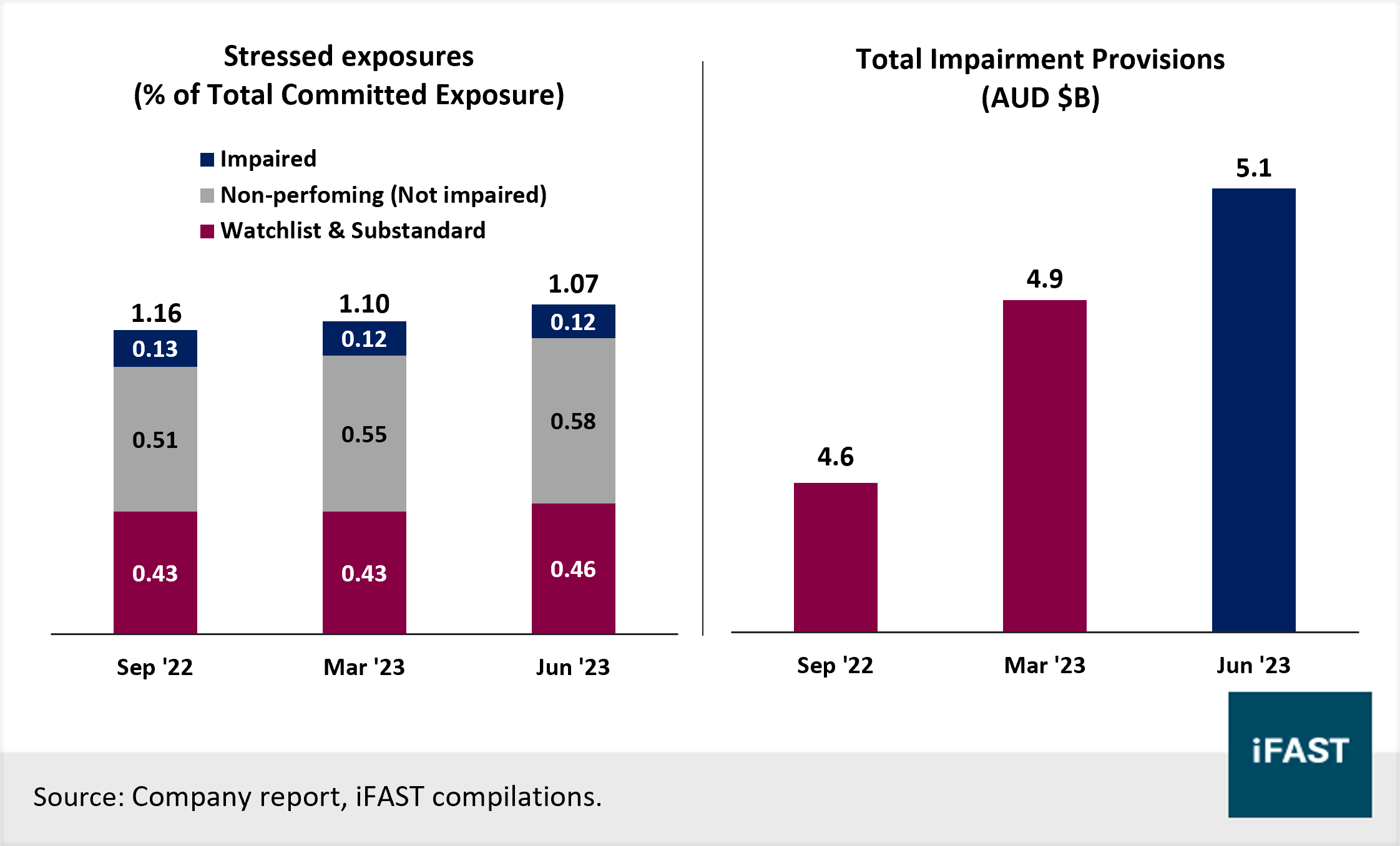
Chart 5: Australian mortgage delinquencies (%)
2. Capital Position and Liquidity
Capital position for Westpac remains strong and above regulatory minimum. The Group’s CET1 capital ratio was 11.9% in 3Q23, reflecting higher earnings for the quarter which offset 1H23 dividend payment. On an internationalised basis, the Group’s CET1 ratio stands at 17.9% (3Q23), up from 17.1% (3Q22), which is comparably high amongst global peers (Chart 6).
CET1 ratio continues to exceed the new regulatory minimum of 10.25% and the bank’s target range of 11.00-11.50%. Overall, total regulatory capital ratio maintained at 19.7% in 3Q23, in line with 1H23 and higher than 3Q22, mostly helped by higher Tier 2 capital. Leverage ratio for the Group also fell slightly to 5.4% (3Q23) from 5.5% (1H23).
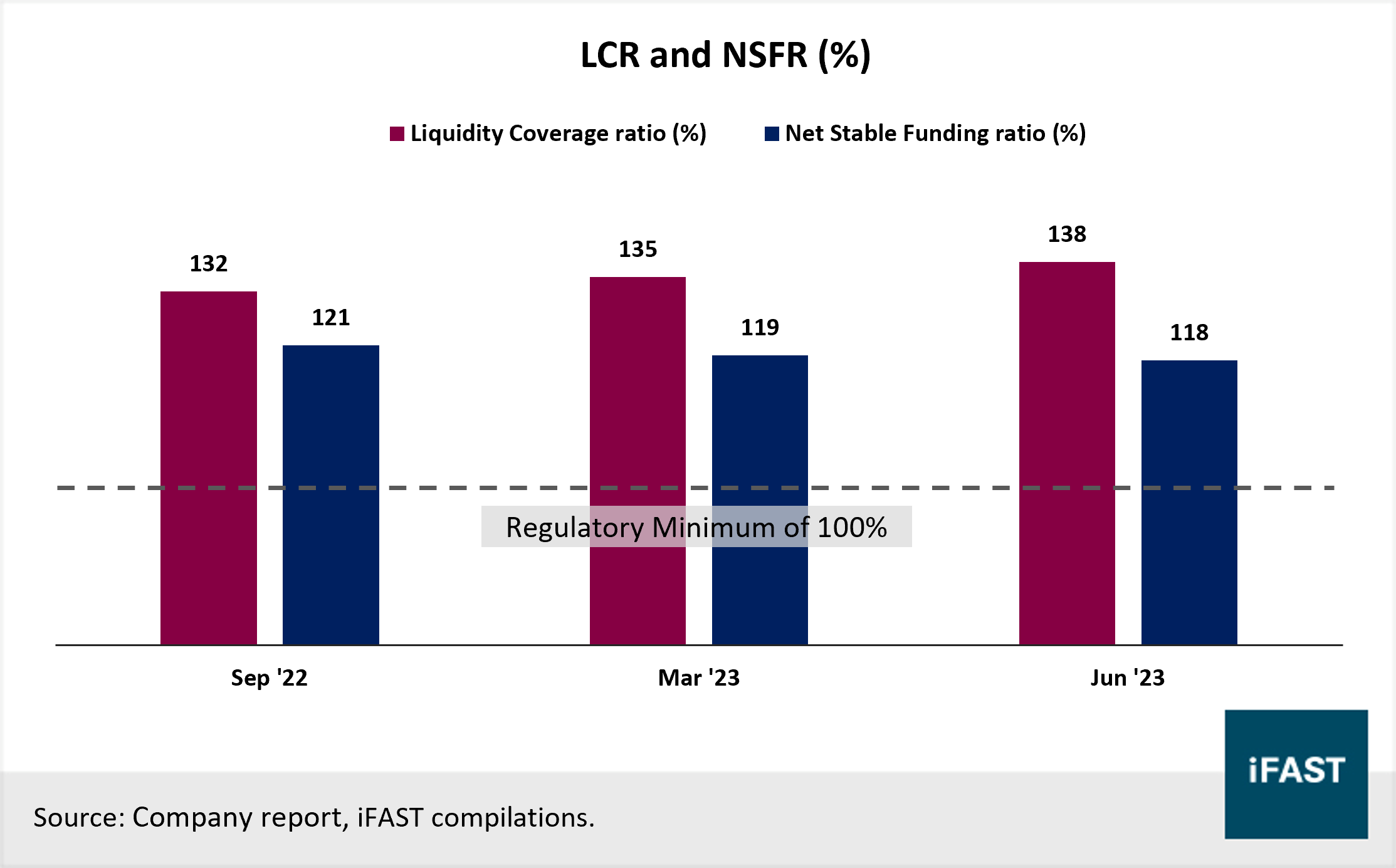
The Group also improved its liquidity position while funding remains resilient. Around 84.1% of net loans are funded by customer deposits, which are a more stable source of funding. Westpac was able to maintain high levels of liquidity as high-quality liquid asset (“HQLA”) grew over the quarter. The quarterly average liquidity coverage ratio (“LCR”) improved to 138% (3Q23) from 135% (1H23) (Chart7).
Meanwhile, the net stable funding ratio (“NSFR”) was 118% (3Q23), down slightly from 119% (1H23), returning to pre-COVID operating levels (Chart 7). The slight drop was due to an increase in required stable funding given upcoming maturities in FY24. Nonetheless, both ratios showed large buffers to the 100% minimum regulatory requirements.
Chart 6: CET1 ratio remains above regulatory minimum and the Group’s target
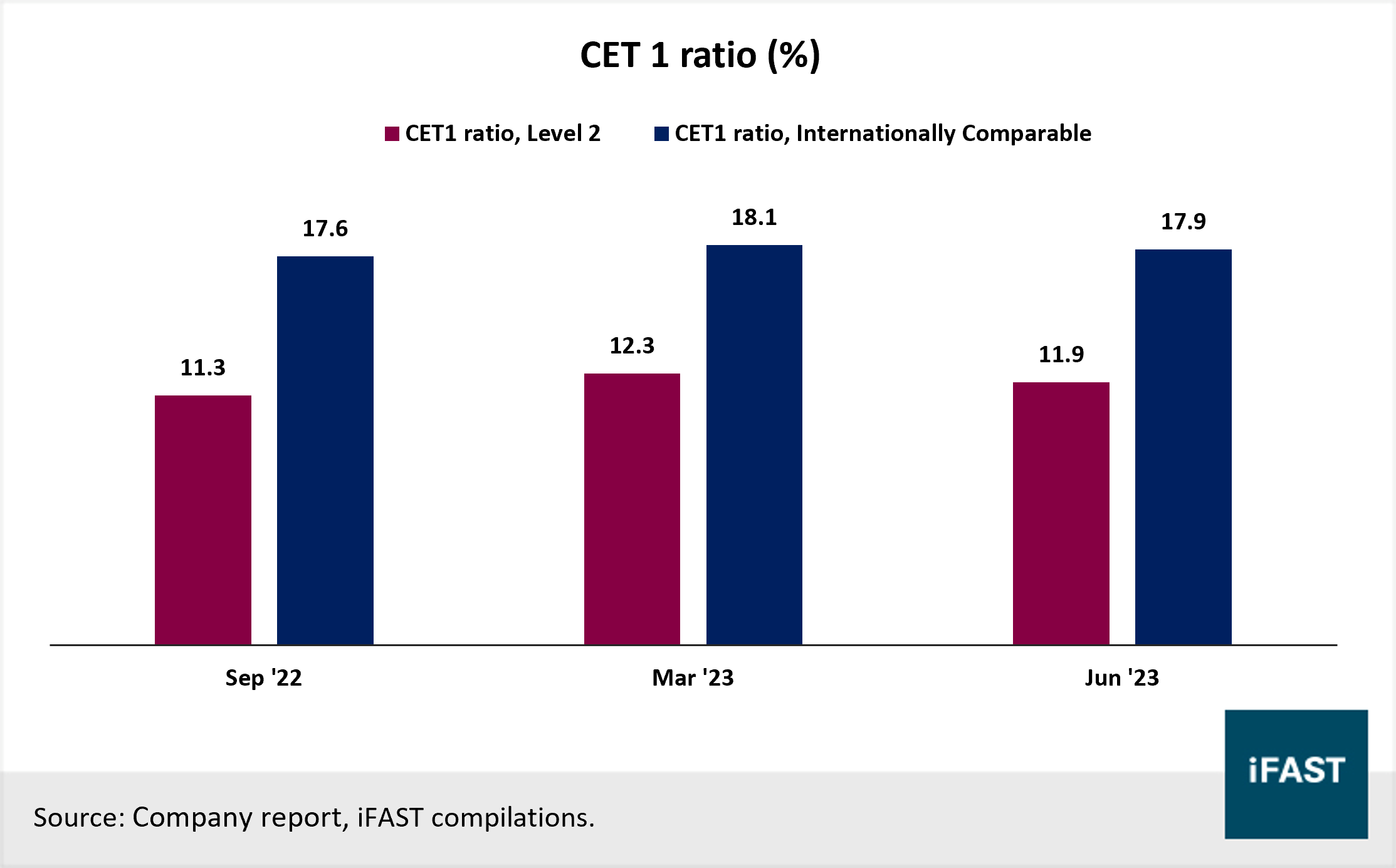
Chart 7: LCR and NSFR also remains above regulatory minimum
Recommendations
Table 1: Westpac Tier 2 Subordinated Issues
|
Issue |
Ask Price |
Yield to Maturity/ Yield to Call (%) |
Years to Maturity/ Years to Call |
Bond Credit Rating (S&P/Fitch) |
|
98.82 |
6.43/ 5.84 |
5.81 / 0.81 |
BBB+/ A- |
|
|
100.65 |
6.44/ 6.32 |
9.66 / 4.66 |
BBB+/ NR |
|
|
100.51 |
6.87/ 6.86 |
14.67 / 9.66 |
BBB+/ NR |
|
|
Sources: Bloomberg Finance L.P., Bondsupermart, iFAST Compilations. Data as of 26 October 2023. |
||||
Overall, Westpac’s credit profile remains healthy with a strong capital and liquidity position as well as resilient asset quality. We also find the Group to be sufficiently provisioned. While we see little area of risk for the Group but the Australian mortgage loan book remains an area that we are watching closely.
Among Westpac’s AUD Tier 2 subordinated bonds (Table 1), we prefer WSTP 4.334% 16Aug2029 Corp (AUD). We like the short remaining years to call (0.81 years) which is accompanied by an attractive 5.84% yield to call. In the event of a non-call, we also find the 6.43% yield to maturity attractive for a medium-tenor AUD bank bond (5.81 years left to maturity).
For longer-tenor AUD issues, we prefer NAB 5.000% 19Jan2032 Corp (AUD) and MQGAU 6.082% 07Jun2032 Corp (AUD). Both are tier 2 subordinated bonds which are also attractively priced but with longer maturity (8.2 – 8.6 years) and call date (3.2 - 3.6 years). Both National Australia Bank and Macquarie Bank also have strong credit profiles, complemented with positive earnings outlook.
Under the Basel III framework for Tier 2 capital, Tier 2 securities that remain uncalled past the first reset date will have to be amortized in the balance sheet of the company. This also means that there is an incentive for the banks to call back on their Tier 2 subordinated bonds and to re-issue new Tier 2 bonds to ensure capital remains sufficient on their balance sheet.
We would like to remind investors that Tier 2 subordinated bonds are ultimately subjected to loss absorption upon a trigger, although the CET1 and AT1 instruments would be utilised first prior to the activation of Tier 2 securities for loss absorption.
Related articles
Declaration: For specific disclosure, at the time of publication of this report, IFPL (via its connected and associated entities) and the analyst who produced this report holds a NIL position in the abovementioned securities.
Our podcast series, Yield Hunters, is available on Spotify, iTunes Podcasts and Google Podcasts. We share our thoughts on new bond issues and hold discussions on the fixed income space. Listen to our latest episode below and follow us!
time of publication of this report, IFPL (via its connected and associated entities) and the analyst who produced this report holds a NIL position in the abovementioned securities.