

Key Highlight
- Stable and Predictable Regulated Revenue: Ausgrid benefits from a regulated natural monopoly in New South Wales electricity distribution, supported by a 99-year network lease. As of FY2026, 92% of revenue is regulated under AER frameworks, with 86% recoverable through mechanisms for customer defaults.
- Revenue Growth with Stable Operating Margins: FY26 revenue increased 10% YoY to AUD3.2 billion, driven primarily by higher regulated distribution service revenue. The adjusted operating profit margin remained stable at 32%.
- Strong Operating Cash Flow Supports Debt Servicing: Operating cash flow rose 40% YoY to AUD1.0 billion, while total debt increased modestly by 3% to AUD13.9 billion. Debt-to-operating cash flow improved from 18 times to 14 times, supporting manageable debt-servicing capacity despite relatively high leverage.
- Manageable Leverage and Debt Profile: Total debt of AUD 13.9 billion is supported by AUD 18.9 billion in PPE and AUD 2.4 billion in cash and credit facilities, with ample refinancing capacity.
- Recommendation: We remain positive on Ausgrid’s outstanding bonds and recommend bondholders hold. Investors seeking exposure to a regulated utility with solid fundamentals may consider the AUSGF 5.277% 10 Dec 2030 Corp (AUD) and AUSGF 5.946% 10 Dec 2035 Corp (AUD), offering attractive yields to call of 5.7% and 6.3%, respectively.
Company Overview
Ausgrid is an Australian electricity infrastructure company headquartered in Sydney, Australia, operating in the regulated electricity distribution sector. As at 30 June 2026, the Group held a substantial infrastructure asset base, with property, plant and equipment (PPE) valued at AUD18.9 billion across New South Wales.
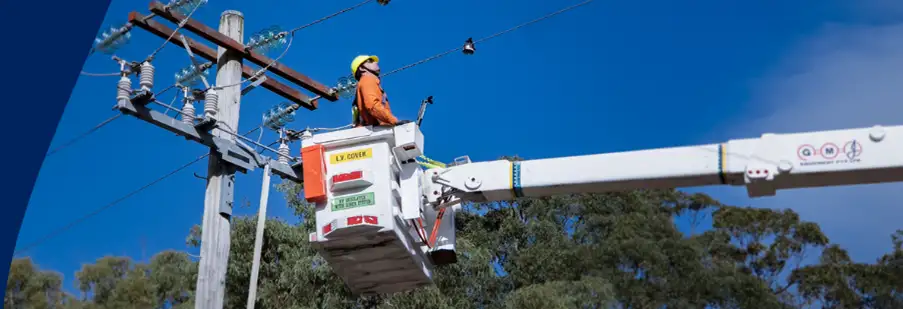
Ausgrid: Essential Electricity Infrastructure Across New South Wales
Source: Ausgrid, iFAST Compilation. Data as of 13 November 2026
Ausgrid's ownership structure includes the New South Wales Government (49.6%), IFM Investors (25.2%), APG Asset Management Group (16.8%) and AustralianSuper (8.4%). The state government's significant ownership enhances Ausgrid's creditworthiness by providing potential support and reinforcing its strategic importance to essential electricity distribution infrastructure.
For a more comprehensive introduction, please refer to the previous article via the link: Ausgrid: Stable Regulated Utility Offering Attractive AUD Bond Yields Between 5.3% to 5.9% | Bondsupermart
Stable and Predictable Revenue Supported by Regulatory Framework and Monopoly Position
As discussed in our previous credit article, Ausgrid benefits from a regulated natural monopoly in electricity distribution across New South Wales, supported by its long-term 99-year network lease, which commenced in December 2016. Revenue from its core electricity distribution services is governed by the Australian Energy Regulator’s (AER) under 5 years regulatory framework, providing earnings visibility and supporting relatively stable cash flows.
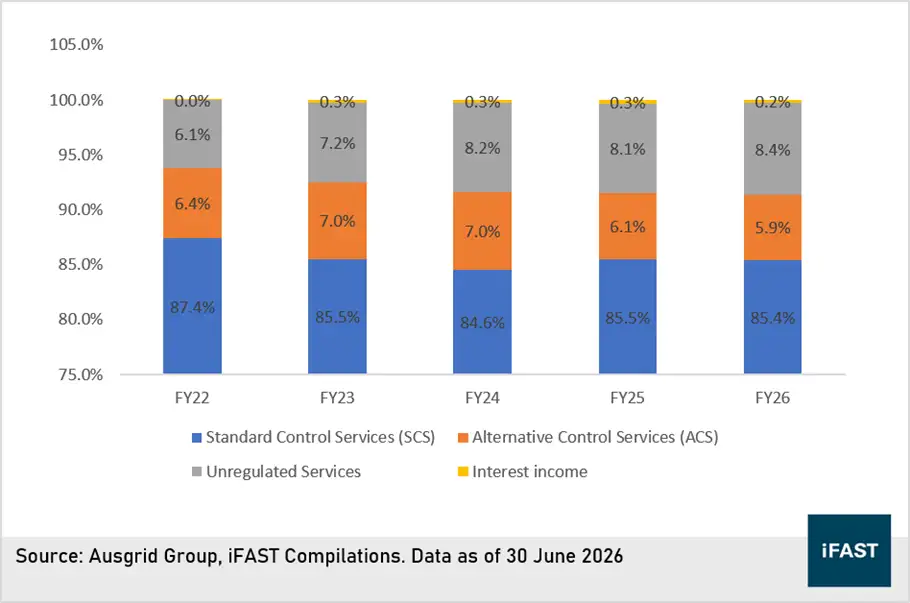
As shown in Chart 1, Standard Control Services (SCS) accounted for an average of approximately 86% of total revenue over FY2022–FY2026, while Alternative Control Services (ACS) contributed around 7%. The revenue composition remained broadly stable over the period, highlighting the resilience of Ausgrid’s regulated business model. Together with its natural monopoly position and long-term access to essential network infrastructure, these factors continue to underpin the Group’s credit profile.
Previous Article: Ausgrid: Stable Regulated Utility Offering Attractive AUD Bond Yields Between 5.3% to 5.9% | Bondsupermart
Ausgrid's long-term earnings visibility is further supported by its involvement in the Hunter-Central Coast Renewable Energy Zone (HCC REZ), where it has been appointed as the network operator. The AER-approved investment includes A$125 million in initial Infrastructure Planner Fees recognised in its Regulated Asset Base (RAB), alongside A$190 million in REZ-related capital expenditure in FY26. These investments are expected to expand Ausgrid's RAB and support future regulated revenue, while maintaining its relatively predictable, low-risk earnings profile under the Revenue cap (AER-regulated).
Chart 1: Ausgrid Revenue by Service Type, FY22–FY26
Stable Operating Margins Amid Rising Financing Pressures
As shown in Chart 1, revenue increased by 10% YoY from AUD 2.9 billion in FY25 (ended June 2025) to AUD 3.2 billion in FY26 (ended June 2026), primarily driven by Standard Control Services (SCS), which grew by AUD 249 million (10.0%) from AUD 2,503 million to AUD 2,752 million. SCS represents core electricity distribution services delivered to all customers, with growth mainly attributable to higher Distribution Use of System (DUOS) charges. Despite the revenue growth, the adjusted operating profit margin remained stable at 32%, as higher energy distribution costs offset the benefit of increased revenue.
Meanwhile, finance costs increased by 8% YoY to AUD 662 million, reflecting the impact of a higher weighted average interest rate, which rose from 4.71% to 4.83%, alongside a 3% increase in total borrowings. Consequently, the interest coverage ratio declined by 16% from 1.9 times to 1.6 times. While the deterioration indicates increased debt-servicing pressure, coverage remains manageable, as discussed in the subsequent section.
Table 1 Ausgrid’s Profit Indicators
|
FY25 |
FY26 |
Change |
|
|
Revenue (AUD Million) |
2,928 |
3,221 |
10% |
|
Adjusted Operating Profit (AUD Million)* |
949 |
1,036 |
9% |
|
Adjusted Operating Profit Margin (%)* |
32% |
32% |
- |
|
Finance Costs (AUD Million) |
613 |
662 |
8% |
|
Weighted Average Interest Rate (%) |
4.71% |
4.83% |
3% |
|
Interest coverage Ratio (Times) |
1.9 |
1.6 |
-16% |
|
*Excluding Gain on disposal of property, plant and equipment Source: Ausgrid Group, iFAST compilations. Data as of 30 June 2026. |
|||
Strong Operating Cash Flow Supports Manageable Leverage Despite Rising Debt
Operating cash flow has significantly increase of 40% YoY to AUD 1 billion mainly driven by was driven by strong customer cash collections and reduced operating payments, partially offset by higher interest costs. Total debt has steadily increased in line with continued investment in utility infrastructure and expansion of the asset base.
However, given the capital-intensive nature of the business, a substantial portion of assets is financed through debt, as reflected in a debt-to-regulated asset of 0.69 times. This is also evident in leverage metrics such as debt-to-operating cash flow of approximately 14 times. While leverage is relatively high, this is typical for regulated utilities given their stable cash flow generation and infrastructure financing requirements. Overall, we view the current debt level as manageable and within an acceptable range.
Compared with peers in Table 3, Ausgrid maintains a moderate leverage profile, with a gearing ratio of 149% and debt-to-regulated-assets ratio of 0.69 times, both lower than AusNet's 272% and 0.83 times, respectively, but slightly higher than TasNetworks' 140% and 0.53 times. While AusNet exhibits the highest leverage, it benefits from slightly higher interest coverage of 1.8 times, compared with 1.6 times for both Ausgrid and TasNetworks. Overall, Ausgrid's leverage and interest servicing capacity remain manageable and broadly within the range observed among its peers in the regulated utilities sector.
Table 2 Ausgrid’s Credit Metrics
|
FY25 |
FY26 |
Change |
|
|
Operating Cash Flow (AUD Million) |
736 |
1,027 |
40% |
|
Total Debt (AUD Million) |
13,444 |
13,868 |
3% |
|
Property, Plant and Equipment (AUD Million) |
18,308 |
18,937 |
3% |
|
Debt to Regulated asset Ratio (Times) |
0.71 |
0.69 |
-3% |
|
Debt to operating cash flow (times) |
18 |
14 |
-22% |
|
Source: Ausgrid Group, iFAST compilations. Data as of 30 June 2026. |
|||
Table 3 Peer Comparison
|
|
Ausgrid |
Ausnet |
TasNetworks |
|
Gearing Ratio |
149% |
272% |
140% |
|
Debt to Regulated asset (Times) |
0.69 |
0.83 |
0.53 |
|
Interest coverage Ratio (Times) |
1.6 |
1.8 |
1.6 |
|
Source: Company Report, iFAST Compilations. Data as of 31 December 2025, and 30 June 2026 |
|||
Manageable Refinancing Risk Supported by Regulated Revenue Framework
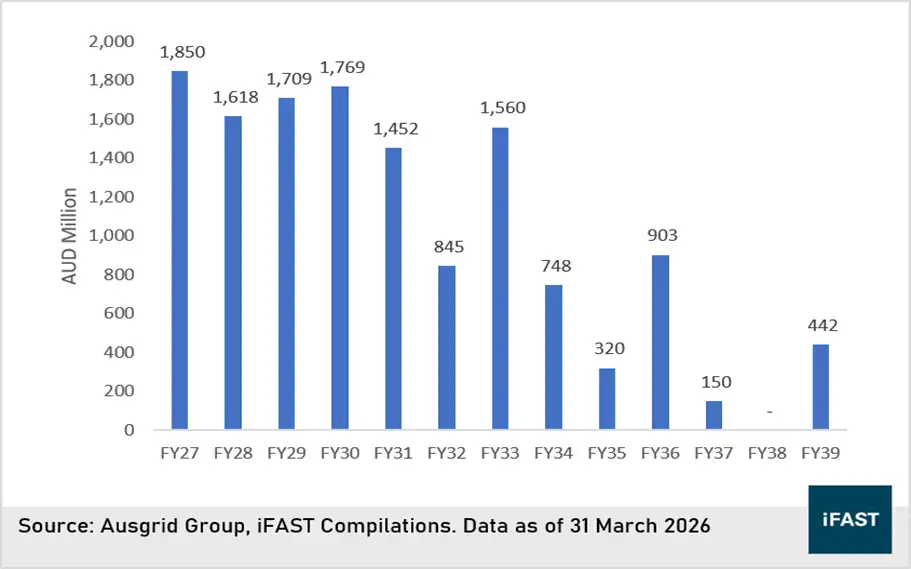
Ausgrid’s debt maturity profile, as illustrated in Chart 1, is relatively front-loaded, with maturities concentrated between FY2027 and FY2033, averaging approximately AUD1.5 billion annually. Near-term refinancing pressure is most pronounced in FY2027, with AUD1.9 billion falling due. However, cash balances of AUD720 million and committed undrawn credit facilities of AUD1.7 billion as at FY2026 provide a combined liquidity buffer of AUD2.4 billion, sufficient to cover FY2027 maturities.
Nevertheless, the sizeable maturity wall between FY2028 and FY2033 will require ongoing refinancing and prudent debt management, potentially leading to a modest increase in gearing as funding requirements evolve. Despite this, Ausgrid’s gearing remains relatively low compared with AusNet and broadly comparable to TasNetworks (Table 3), providing some capacity to absorb additional debt without materially weakening its credit profile.
Refinancing risks are further mitigated by Ausgrid’s substantial property, plant and equipment base of approximately AUD18.9 billion and its regulated revenue framework, under which the AER-approved revenue mechanism supports stable and predictable cash flows. These factors underpin Ausgrid’s access to funding and debt-servicing capacity, supporting our view that its refinancing risk remains manageable.
Chart 1 Ausgrid’s Debt Maturity Profile
Recommendation
Overall, we maintain a positive view on Ausgrid, a regulated electricity distributor operating as a natural monopoly under a 99-year network lease. Its regulated business model and long-term AER regulatory framework support stable and predictable cash flows, underpinning resilient financial performance and manageable leverage. Existing bondholders may consider maintaining their holdings, supported by Ausgrid’s stable operating profile and manageable credit profile.
For investors seeking exposure to a regulated electricity utility with strong fundamentals, we prefer the AUSGF 5.277% 10 Dec 2030 Corp (AUD) for medium-term exposure, with an approximate year to call of 3 years and 10 months and a yield to call of 5.7%. For investors with a longer investment horizon, the AUSGF 5.946% 10 Dec 2035 Corp (AUD), with an approximate year to call of 8 years and 10 months and a yield to call of 6.3%, is also worth considering (Table 4).
Ausgrid bonds are rated BBB by S&P and are secured by all present and future property of Ausgrid Finance Pty Ltd, the Group's financing vehicle. The bonds are further supported by guarantees from multiple Ausgrid Group entities—including operating subsidiaries, asset-holding partner entities, and operational partnerships—as well as security from holding entities, providing bondholders with direct recourse to the Group's broader asset base and cash flows.
Investors should note that the bonds carry an early redemption feature, allowing the issuer to redeem before the call date at the higher of the outstanding principal or a calculated make-whole amount based on market swap rates plus a margin (interest rate). With most maturities between 2027 and 2033 as show in chart 1 above, early redemption risk is expected to be minimal.
Table 4: Ausgrid’s Bond
|
Bond name |
Year to Call/Maturity |
Yield to Call/Maturity |
Min / Sub investment |
|
3Y 10M/4Y1M |
5.7%/5.7% |
AUD 10,000/10,000 |
|
|
8Y10M/9Y1M |
6.3%/6.3% |
AUD 10,000/10,000 |
|
|
Source: FSMONE, iFAST Compilations. Data as of 12 November 2026. |
|||