- Boeing’s revenue in the first half of 2025 grew 26% YoY to USD 42.2 billion, with operating profit turning positive for the first time since the pandemic. With improvements in quality and safety management and capacity gradually recovering, the company is returning to a more normalised trajectory.
- Although Boeing’s debt level remains relatively high, the planned USD 10.55 billion sale of non core subsidiary Jeppesen will bring in full cash proceeds, strengthening the balance sheet and supporting a gradual reduction in leverage.
- Our platform currently offers five Boeing USD bonds across different maturities, with yield to maturity ranging from 4.3% to 5.8%
Boeing is one of the global leaders in the aerospace industry, headquartered in Washington, United States. Its operations are diversified across three core business segments: Commercial Airplanes, Defense, Space & Security, and Global Services.
In the Commercial Airplanes segment, Boeing focuses on the development, production, and sale of passenger aircraft to airlines and leasing companies worldwide. The current product lineup includes the 737, 767, 777, and 787 families, which serve a broad range of travel distances and passenger capacities. The company is also progressing with next generation models such as the 737‑7, 737‑10, and 777X, which are expected to complete certification between 2025 and 2026 before entering into delivery, further consolidating Boeing’s position in the global aviation market.
The Defense, Space & Security segment primarily serves the US government and allied nations, providing aircraft, rockets, satellites, and missile systems. Meanwhile, the Global Services division offers engineering support, fleet management, training systems, supply chain integration, and aftermarket solutions.
It is worth noting that in April 2025, Boeing announced plans to divest part of its Digital Aviation Solutions business, including navigation subsidiary Jeppesen and related assets such as ForeFlight and AerData to private equity firm Thoma Bravo in an all‑cash transaction valued at USD 10.55 billion. The deal, expected to close by the end of 2025 pending regulatory approval, carries positive implications for both the company and bond investors. The sale of non-core assets will help release liquidity, strengthen balance sheet flexibility, and support Boeing’s investment grade credit profile. Following the announcement, market sentiment became positive, with both Boeing’s stock and bond prices trading higher.
Recovery in deliveries and operational restructuring drive Boeing’s earnings
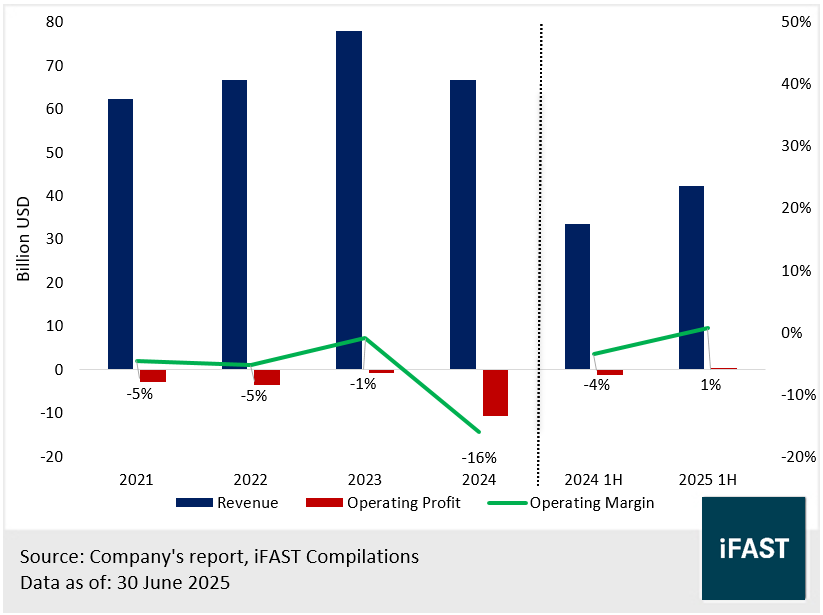
As shown in Figure 1, Boeing’s revenue in 1H 2025 rose 26% YoY to USD 42.2 billion. This rebound was led by a 78% increase in the Commercial Airplanes segment, while other divisions remained relatively stable. For the first time since the pandemic, the company reported a clear turnaround in its core business, reflecting a broader recovery across operations.
Supported by the normalisation of production lines, Boeing reported its first positive operating profit since the pandemic, reaching USD 285 million. Losses in the Commercial Airplanes segment narrowed, and the Defense, Space & Security division returned to profitability.
Figure 1: Boeing revenue and operating profit
The improvement in revenue was primarily driven by a recovery in aircraft deliveries (see Figure 2). Following a series of quality and regulatory setbacks in 2024, Boeing resumed production and deliveries of the 737 MAX, as well as the 787, 767, and 777 programs in early 2025. This increase in deliveries contributed to improved revenue momentum and enhanced production efficiency.
Figure 2: Boeing aircraft deliveries by model
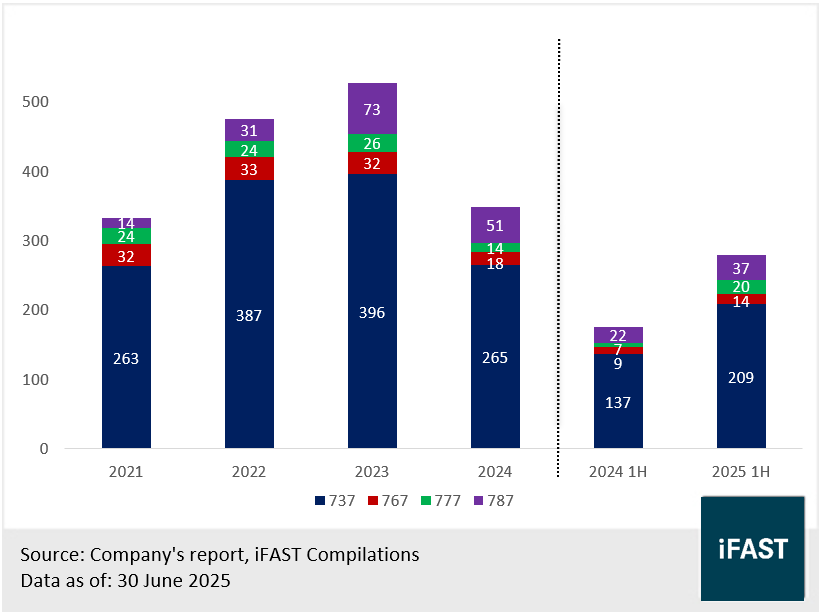
In recent years, Boeing has faced several negative incidents. In early 2024, a 737‑9 MAX accident involving an Alaska Airlines flight led to a mid‑air door plug failure. The Federal Aviation Administration (FAA) grounded the model for inspection and imposed limits on Boeing’s monthly 737 production rate until safety and quality standards were fully met. A labour strike later that year compounded delivery delays and constrained capacity, weighing heavily on 2024 revenue and cash flows.
Since then, Boeing has implemented stricter quality and safety controls and worked closely with the FAA. Production was allowed to resume in 2025, stabilizing deliveries across all programs.
Boeing’s operating challenges in recent years had been driven by multiple factors, including the pandemic downturn, regulatory penalties, safety incidents, and production halts. With the aviation industry gradually recovering and Boeing addressing these structural issues, we expect operating performance to move further toward normalization in the coming periods.
Large order backlog provides strong revenue visibility
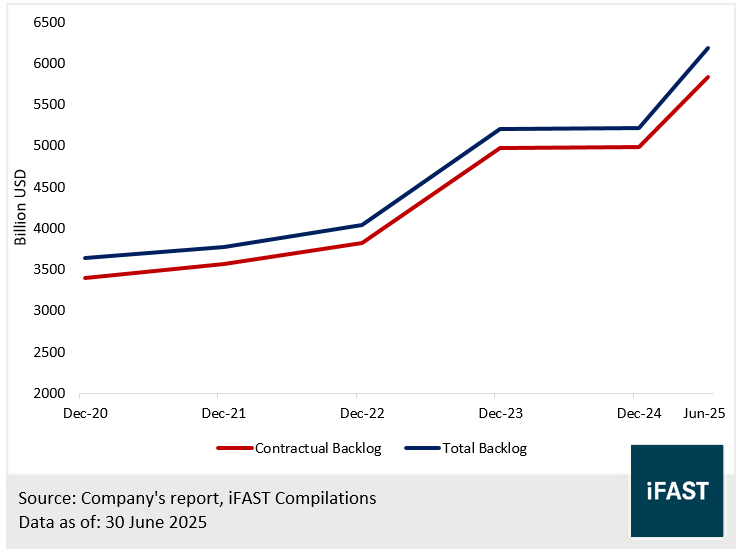
Beyond the recovery in revenue and operating profit, Boeing’s substantial backlog also highlights its growth potential. In the aviation industry, backlog is a key indicator of future performance, as contractual backlog represents binding customer contracts, with the corresponding value will gradually be recognised as revenue upon delivery.
As of June 2025, Boeing’s total backlog reached USD 618.5 billion, with 84% attributable to the Commercial Airplanes segment, equivalent to more than 5,900 aircraft awaiting delivery. Although recent delivery delays and production constraints have slowed the pace of backlog conversion, the overall trend remains upward, reflecting solid long term demand for Boeing’s products.
Figure 3: Boeing backlog
Boeing also continues to benefit from supportive US trade policies, with aircraft orders frequently integrated into diplomatic agreements. This has resulted in major new deals in recent months. For example, in August 2025, Korean Air announced plans to purchase 103 aircraft worth over USD 50 billion, representing the largest order in its history. Japan similarly committed to acquire more than 100 Boeing commercial aircraft, while Malaysia, Indonesia and other countries have also placed significant orders. These developments strengthen Boeing’s global market share and underpin higher production utilisation.
With deliveries recovering, backlog steadily growing, and production capacity gradually restoring, the company is well positioned for sustained business development in the years ahead.
Leverage remains elevated but asset sale is expected to support gradual deleveraging
Boeing has faced multiple challenges in recent years, including the impact of the pandemic, product quality issues, fines, and certification delays. These factors have worsened its profitability and led to persistently high leverage levels.
As of the end of June 2025, Boeing’s total debt stood at $53.3 billion, slightly lower than the $53.9 billion at the end of 2024 (see Table 1). While the debt level remains relatively high, the company has benefited from a sustained increase in market capitalisation. Its total debt to enterprise value ratio dropped from 37% in 2022 to 28%, reflecting an improved ability in equity financing.
On interest expenses, rising overall interest rates, combined with Boeing’s unstable operational performance and increased credit risk over the past few years, have slightly driven up borrowing costs. For the first half of 2025, interest expenses rose by 14.5% YoY to $1.4 billion. However, with the anticipated entry into a rate cutting cycle and the company’s improving operational performance, Boeing's average borrowing costs are expected to gradually decline.
As of June 2025, Boeing held approximately $23 billion in cash and cash equivalents, down slightly from $26.3 billion at the end of 2024, but still maintaining solid liquidity. The company also has a $10 billion undrawn revolving credit facility, which can serve as a backup financing tool to address operational or unexpected needs.
Also, Boeing has announced plans to sell its navigation subsidiary Jeppesen and related assets for $10.55 billion, with the all-cash transaction expected to close in the fourth quarter of 2025. This transaction will generate significant one-time cash inflows, effectively strengthening the balance sheet and reducing leverage levels.
Table 1: Boeing credit metrics
| (USD billions) | 2022 Dec | 2023 Dec | 2024 Dec | 2025 Jun |
| Cash & Cash equivalents | 17.2 | 16 | 26.3 | 23 |
| Short term debt | 5.2 | 5.2 | 1.3 | 8.7 |
| Long term debt | 51.8 | 47.1 | 52.6 | 44.6 |
| Net debt | 39.8 | 36.3 | 27.6 | 30.3 |
| Total debt / Enterprise Value* | 37% | 27% | 33% | 28% |
Interest expense (Last 12 months) |
2.6 | 2.5 | 2.7 | 1.4 (2025
1H) 1.2 (2024 1H) |
| Average borrowing cost | 4.4% | 4.5% | 5.1% | 5.4% |
| *Enterprise value = market capitalization + total debt − cash
& cash equivalents Data as of 30 June 2025 Source: Company reports, iFAST compilation |
||||
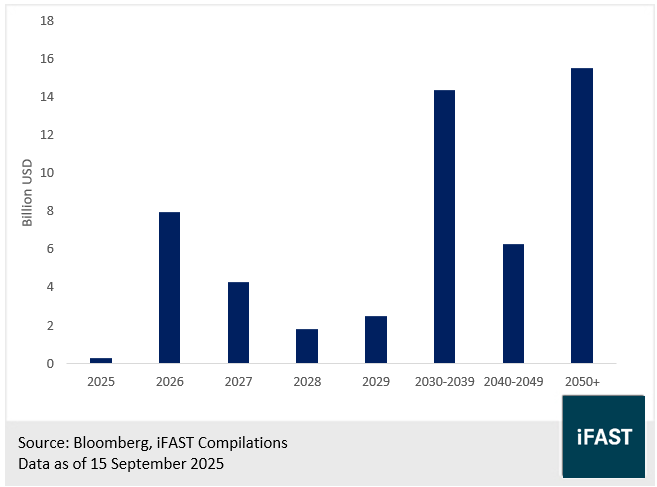
Boeing's debt structure is primarily composed of senior unsecured bonds. The company's short term debt has increased to $8.7 billion, mainly due to approximately $7.95 billion in bonds maturing in 2026 (see Figure 4). Currently, the company’s cash to short term debt ratio stands at 2.6x, indicating that liquidity remains manageable. As the high interest rate environment gradually recedes, Boeing is expected to benefit, and its strong refinancing ability should help optimise its capital structure and lower financing costs.
Figure 4: Debt Maturity Profile
Our platform offers five Boeing USD bonds across different maturities
Currently, our platform offers five Boeing USD bonds across different maturities, with yield to maturity ranging from 4.3% to 5.8%. Boeing’s issuer and bond credit ratings stand at BBB‑ / BBB‑ (S&P / Fitch), which remain within investment grade.
A key feature worth highlighting is that all five bonds are structured with a coupon step‑up mechanism linked to credit rating changes. If Boeing’s credit rating is downgraded by Moody’s or S&P, for example to Ba1 or BB+, the coupon rate will automatically increase by 0.25%. Further downgrades would result in larger coupon adjustments.
Table 2: Boeing USD bonds available on platform
| Bond name | Tenor (years) | Ask
Price (Investor Buy) |
YTM |
| BA 5.040% 01May2027 Corp (USD) | 1.6 | 101.4 | 4.3% |
| BA 5.150% 01May2030 Corp (USD) | 4.6 | 103.5 | 4.4% |
| BA 5.705% 01May2040 Corp (USD) | 14.6 | 103.5 | 5.4% |
| BA 5.805% 01May2050 Corp (USD) | 24.7 | 100.6 | 5.7% |
| BA 5.930% 01May2060 Corp (USD) | 34.6 | 101.8 | 5.8% |
| Source: Bondsupermart Data as of 19 September 2025 |
|||
Related Risks
Although Boeing’s revenue and profit have shown signs of recovery, if the company does not continue to improve operating efficiency and achieve positive free cash flow, the rebound may prove insufficient. This could weaken the confidence of the market and credit rating agencies in its financial structure, thereby raising funding costs and reducing refinancing flexibility.
Boeing has not yet completed the final certification procedures for its key models such as the 777X, 737‑7, and 737‑10. Failure to obtain regulatory approval on schedule would delay deliveries and place pressure on revenue. At the same time, although delivery volumes have improved, the company continues to face challenges related to supply chain timeliness, production capacity expansion, and quality control. Any further disruption to the supply chain could hinder the timely conversion of backlog into revenue.
A portion of Boeing’s backlog, particularly orders from Asia and the Middle East, is highly dependent on support from US foreign policy and bilateral trade agreements. Any deterioration in US‑China relations, for example could increase the risk of order cancellations, delivery delays, or price adjustments.
While Boeing has reinforced its quality management and is working closely with the Federal Aviation Administration, the legacy impact of past incidents and ongoing regulatory scrutiny remain. Should another major quality issue or regulatory sanction occur, it would negatively affect brand reputation, customer confidence, and business development, while potentially creating additional legal and financial liabilities.
Boeing is also expected to face a USD 700 million one off fine in 3Q 2025, linked to violations under a deferred prosecution agreement relating to the earlier 737 MAX incidents. This fine will weigh on free cash flow and short term liquidity management in that quarter.
Conclusion
Boeing’s revenue in the first half of 2025 grew 26% YoY to USD 42.2 billion, with operating profit turning positive for the first time since the pandemic. With improvements in quality and safety management and capacity gradually recovering, the company is returning to a more normalised trajectory.
Although Boeing’s debt level remains relatively high, the planned USD 10.55 billion sale of non core subsidiary Jeppesen will bring in full cash proceeds, strengthening the balance sheet and supporting a gradual reduction in leverage.
Our platform currently offers five Boeing USD bonds across different maturities, with yield to maturity ranging from 4.3% to 5.8%