Receive first-hand news on the latest bond issues, credit updates and special events when you join us on our Telegram channel at https://t.me/bondsupermart!
Highlights:
- Jaguar Land Rover ‘s number of sold vehicles continues to trend downward, with the US and China markets contracting sharply. The group carried out an overhaul by splitting the existing car models into four sub-brands and planning to speed up the pace of electrification in June this year. Emerging market such as India is expected to be a new growth driver in the future.
- Jaguar Land Rover ‘s credit profile remains stable with ample liquidity, and the credit risk is manageable in the short term.
- Jaguar Land Rover ‘s bond due in 2025 is currently yielding 7%. Investors interested in European high-yield bonds can give consideration.
Automobile Sales Continue to Slide
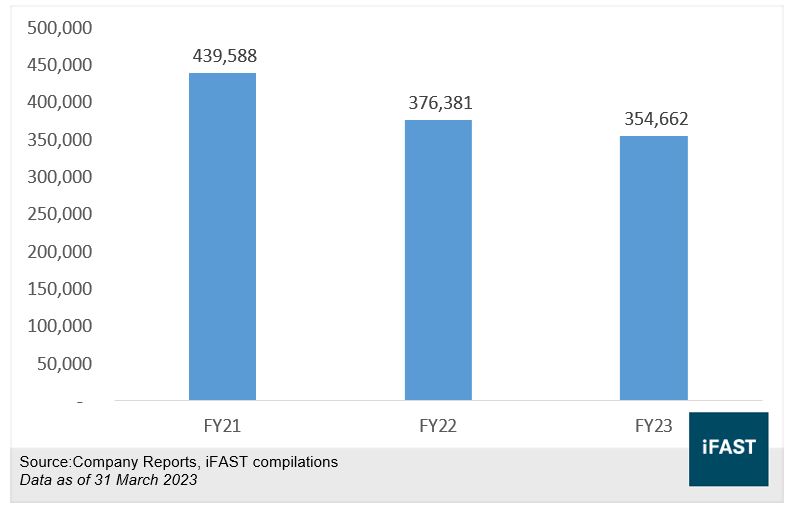
Owing to the shortage of semiconductor chips, the total number of sold vehicles in FY22 (from 1 April 2021 to 31 March 2022) stood at 376,000, down 14.4% YoY (Chart 1). While most automakers saw a significant rebound in 2022 as the chip shortage and supply chain issues were gradually addressed, Jaguar Land Rover continued to decline, with sales totaling 355,000 units in FY23, a year-on-year decline of 5.6%, and overall poor performance.
Chart 1: Vehicles Sold by Jaguar Land Rover
 The declining sales number of Jaguar
Land Rover is in line with our expectations, mainly due to the following two
reasons. Firstly, the group is facing increasing competitive pressure, as
traditional luxury automakers are rolling out full-size SUVs one after another,
squeezing Jaguar Land Rover's market share to a certain extent.
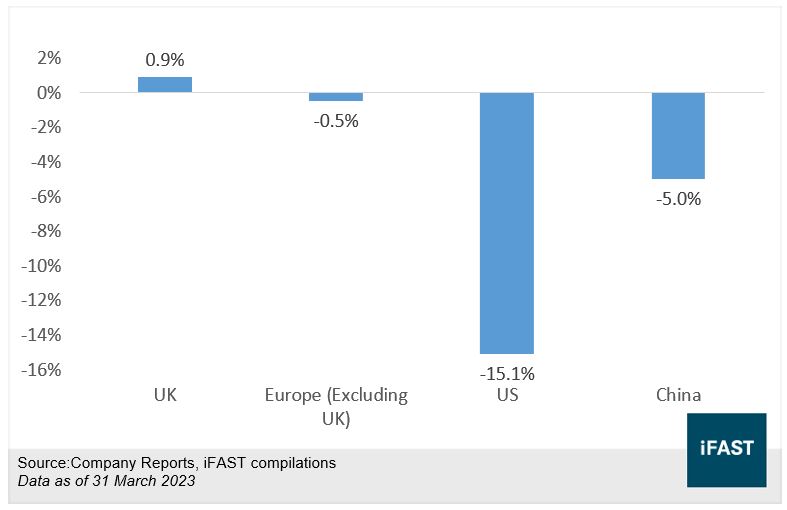
On the other hand, Jaguar Land Rover's pace of electrification moves slowly. Currently, Jaguar I-pace is the only BEV (Battery Electric Vehicle) model on sale, which is well below the industry average. As such, we note that in regions with higher acceptance of electric vehicles, such as China and the US, the decline in sales of Jaguar Land Rover was remarkably higher than in other regions.
Table 2: Sales Breakdown by Geography
 Revenue in FY23 rose by 24.6%
year-on-year to GBP 22.8 billion as vehicle deliveries rebounded following the
alleviation of supply chain issues. Net loss narrowed to GBP 60 million from
0.8 billion in FY22. It isIt is worth noting that the improved revenue is
mainly due to the low base in the past, and we expect the revenue to drop in
FY24 given the poor sales profile.
Table 1: Jaguar Land Rover’s Revenue and Profit
|
Billion GBP |
FY22 |
FY23 |
Change |
|
Revenue |
18.3 |
22.8 |
24.6% |
|
Adjusted EBITDA |
1.9 |
2.6 |
36.8% |
|
Net Loss |
0.8 |
0.06 |
/ |
|
Source: Company reports, iFAST compilations Data as of 31 March 2022 |
|||
Company Announced Strategic Change to Accelerate Pace of Electrification
The depression in operation performance over the past few years motivated the management of Jaguar Land Rover to make a change. In June, the company unveiled a new strategy- Reimagine, which is a roadmap for the transformation of Jaguar Land Rover into an electric-first luxury automobile manufacturer by spitting the existing car models into four sub-brands, namely Range Rover, Defender, Discovery, and Jaguar.
According to the scheme, the company will invest GBP 15 billion over the next five years and roll out 6 EV models at least. The first pure electric Range Rover is expected to be available for pre-order later this year. Jaguar will become an entirely electric vehicle brand, and the first will be a 4-door GT with a recharge range of around 700km. Additionally, the company proposes to become a full-scale EV luxury automaker, and all nameplates will offer pure-electric options by 2030.
Objectively speaking, under the highly competitive environment of the automobile industry, the change in brand names seems to be unhelpful in a substantial way. Meanwhile, whether Defender and Discovery could be recognized by the market after stepping away from the well-known brand name Land Rover is still quite uncertain. However, the accelerated pace of electrification is undoubtedly an important change. The rather aggressive electrification is expected to help the company expand into new sales markets and may be able to reverse the sales downtrend. More importantly, compared to other luxury automakers, most have just started the pace of electrification, suggesting that Jaguar Land Rover is not lagging too far behind.
On the other hand, over the past few years, some emerging economies have seen rapid growth in vehicle sales. For example, vehicle sales in India rose by 16% to 3.4 million in 2022 and ranked the third largest in the world. It suggests the demand for luxury automobiles is seeing an improvement. We thus believe that emerging markets could be a new growth driver for Jaguar Land Rover.
To warp up the points above, despite indecent track records, the rather aggressive scheme of electrification is a good start. Coupled with the demand for luxury cars from emerging markets, it is believed that the company can get out of the doldrums in the future and return to the growth area.
Credit Quality Improved Slightly with Credit Rating Upgrading
From the perspective of credit profile, given the company's operating results are not quite robust in recent years, the senior management adopted a relatively conservative business strategy by significantly reducing the amount of investment, including the purchase of manufacturing equipment and financial assets. As a result, the company's cash balance is less impacted by poor track records. As of 31 March 2023, the cash and cash equivalents amounted to GBP 3.7 billion, slightly lower than FY22, but still 2.5 times larger than its short-term borrowings of GBP 1.5 billion. In other words, the company's liquidity remains decent and the ability to repay short-term borrowings is quite sound.
Credit metrics-wise, as of 31 March 2023, the net gearing ratio moved down from 62.4% in FY22 to 56.4%, and the total debt/EBITDA ratio also contracted to 2.4x, translating into a decline in leverage. Jaguar Land Rover's gearing is still at a reasonable level, and the debt burden is still not considered large. However, given the company's poor sales performance and rather aggrieve investment in EVs in the near term, we expect the gearing to rise.
All in all, the credit profile of Jaguar Land Rover improved a little bit in FY 23, and overall credit risk in the short term is manageable. it is noteworthy that rating agency S&P upgraded the rating of Jaguar Land Rover from B+ to BB- in April this year, to reflect the improvement in credit quality.
Table 2: Jaguar Land Rover’s Credit Metrics
|
(Billion GBP) |
FY21 |
FY22 |
FY23 |
|
Short-term Borrowings |
1.2 |
1.8 |
1.5 |
|
Cash and Cash Equivalents |
3.8 |
4.2 |
3.7 |
|
Cash to Short-term Debt |
3.1 |
2.4 |
2.5 |
|
Net Gearing Ratio |
45.60% |
62.40% |
56.4% |
|
Total Debt /EBITDA |
2.4x |
3.7x |
2.4x |
|
Free Cash Flow |
0.2 |
-1.2 |
0.5 |
|
Source: Company reports, iFAST compilations Data as of 31 March 2022 |
|||
Liquidity Is Expected to Remain Decent
As mentioned earlier, the company plans to invest GBP 15 billion in electric vehicle development in the next few years, will such a huge expenditure lead to liquidity constraints?
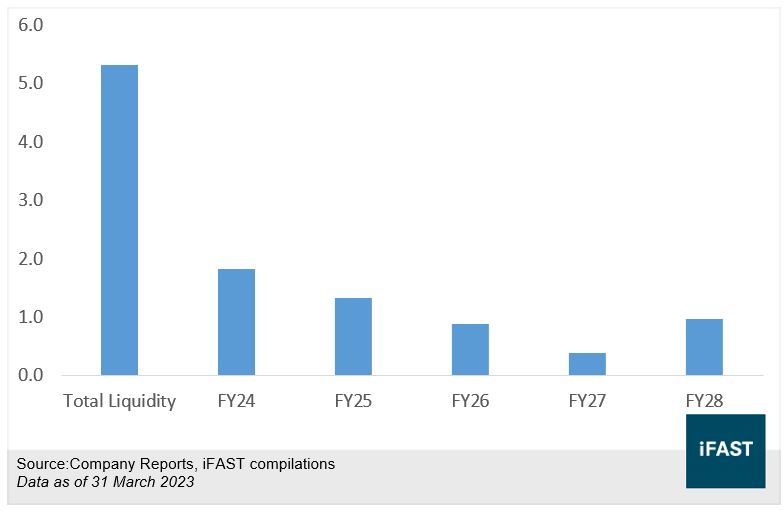
As of 31 March 2023, the total liquidity of Jaguar Land Rover stood at GBP 5.3 billion, including GBP 3.7 billion in cash position and the unused revolving credit line of about GBP 1.5 billion, the latter of which can be used from now to FY24. Concurrent total interest-bearing debt amounted to GBP 6.0 billion, suggesting the current liquidity is good enough and could be able to cover roughly 90% of total debt.
It is noteworthy that the borrowing structure is somewhat favorable, with the debt maturity profile well spread out (Chart 4), leaving the company ample time for fundraising, and we thus expect the cash flow to be sufficient to meet payment obligations in the coming years.
Table 3: Debt Maturity Profile of Jaguar Land Rover
Short-term Bonds Are Attractive with Bond Yield of 7%
In relation to bond investment, there are three USD bonds issued by Jaguar Land Rover on our platform (Table 3). As operating results are not quite as good as they could be, leaving much uncertainty on its long-term credit outlook. Investors thus can give priority to short-duration bonds, for example, “TTMTIN 7.750% 15Oct2025 Corp (USD)”, which currently yields roughly 7.1%, making it pretty attractive for investment. Looking at bonds issued by European automobile manufacturers, most of them are yielding less than 6%, thus giving Jaguar Land Rover a good alternative to the European high-yield market.
Table 3: Bond Investment
|
Bond |
Bond Credit Rating |
Years to Maturity |
Ask Price |
YTM |
|
TTMTIN 7.750% 15Oct2025 Corp (USD) |
BB- (S&P) |
2.1 |
101.2 |
7.1% |
|
TTMTIN 4.500% 01Oct2027 Corp (USD) |
BB- (S&P) |
4.2 |
88.8 |
7.7% |
|
TTMTIN 5.875% 15Jan2028 Corp (USD) |
BB- (S&P) |
4.5 |
92.4 |
8.0% |
|
Source: Bondsupermart Data as of 25 August 2023 |
||||
Corporate Risk
Investors should be mindful of the following risks. First, as the largest consumption market, China contributes over 25% of the total sales of Jaguar Land Rover. However, the demand for luxury vehicles in China is expected to fall as China's economy slows down, and Jaguar Land Rover might face a larger downside risk in sales volume.
Furthermore, if the scheme of electrification progresses aggressively, the massive capital expenditure might have adverse impacts on liquidity and solvency.
Conclusion
The number of sold vehicles continues to trend downward, with the US and China markets contracting sharply. The group carried out an overhaul by splitting the existing car models into four sub-brands and planning to speed up the pace of electrification. Emerging market such as India is expected to be a new growth driver in the future. The credit profile remains stable with ample liquidity, and the credit risk is manageable in the short term. Bond due in 2025 is currently yielding 7%. Investors interested in European high-yield bonds can give consideration.Declaration: For specific disclosure, at the time of publication of this report, IFPL (via its connected and associated entities) and the analyst who produced this report hold a NIL position in the abovementioned securities.
Our podcast series, Yield Hunters, is available on Spotify, iTunes Podcasts and Google Podcasts. We share our thoughts on new bond issues and hold discussions on the fixed income space. Listen to our latest episode below and follow us!