Receive first-hand news on the latest bond issues, credit updates and special events when you join us on our Telegram channel at https://t.me/bondsupermart!
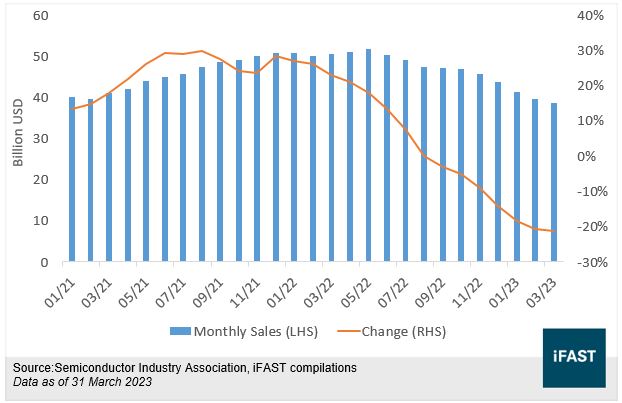
The semiconductor industry started to enter the down cycle in the second half of last year after a long boom period of about three years. With the decline in market demand, the semiconductor market is oversupplied and prices of related products plummeted. Data from Semiconductor Industry Association demonstrated that the monthly global semiconductor revenue peaked at USD 51.7 billion in May 2022, but turned downtrend ever since, reaching less than USD 38.5 billion in March 2023, and remaining in double-digit decline for multiple months.
Chart 1: Monthly Global Semiconductor Revenue
 We noted
that vast majority of semiconductor companies delivered their worst ever
results in the first quarter of this year (Table 1), particularly memory chip
makers, with Hynix and Micron posting revenue slumps of over 50%.
We noted
that vast majority of semiconductor companies delivered their worst ever
results in the first quarter of this year (Table 1), particularly memory chip
makers, with Hynix and Micron posting revenue slumps of over 50%.
Table 1: 1Q2023 Revenue of Selected Semiconductor Companies
|
Revenue (Billion USD) |
Change |
|
|
Samsung |
47.6 |
-18% |
|
Intel |
11.7 |
-36% |
|
TSMC |
16.7 |
-5% |
|
Hynix |
3.8 |
-58% |
|
Qualcomm |
9.5 |
-12% |
|
AMD |
5.4 |
-9% |
|
Micron* |
3.7 |
-53% |
|
NVIDIA* |
6.1 |
-21% |
|
Western Digital* |
3.1 |
-36% |
|
Sources: Company Report, iFAST Compilations *Figures based on the second quarter of the
fiscal year |
||
It is widely believed that as a typical cyclical sector, the semiconductor industry is expected to bottom out in 2H2023, with full-year revenue declines estimated at 20% or less. In other words, semiconductor companies will soon pass through the toughest moment, and industry fundamentals are awaiting recovery.
The unfavourable industry sentiment resulted in a widened yield spread for semiconductor issuers, and their bond yields approached record highs. On the other hand, given that nearly all semiconductor issuers are assigned with investment-grade ratings, with some of them reporting a net cash position, implying excellent solvency and manageable potential investment risk. We thus believe that it’s a great timing to invest in semiconductor bonds now. Below are some of the notable semiconductor issuers that investors should look out for.
Highlighted Semiconductor Issuers
1. SK Hynix
SK Hynix (abbreviated as Hynix hereafter) is a Korea-based semiconductor company producing memory chips which are mainly divided into memory (SDRAM) and storage chips (NAND Flashing Memory). The company is the fourth-largest semiconductor company in the world in terms of total sales volume, trailing behind Samsung Electronics, Intel, and TSMC.
In terms of credit profile, as of the end of 2022, Hynix owned KRW 6.4 trillion worth of cash and cash equivalents. Its short-term and long-term debt is KRW 7.4 trillion and KRW 15.6 trillion respectively. It suggests that the company's cash to short-term debt ratio was 0.9x, and the liquidity weakened in comparison with that of 2021. On the other hand, the company proposes to reduce about 50% of capital expenditure in 2023 in response to the deterioration of industry fundamentals, somewhat improving the company's liquidity. The net gearing ratio of end-2022 recorded a surge from 12.2% in 2021 to 26.0%, but was still below the industry average, reflecting its low leverage and pressure for debt repayment.
It is important to note that HYUELE 6.250% 17Jan2026 Corp (USD) is tradable on Bond Express with yield to maturity of 5.8%, allowing Investors to buy this investment-grade bond at a lower cost.
Credit Rating: BBB- (S&P)
Related Article: “Idea of the Week: The New USD Bond Selection—SK Hynix and Vital Energy (Bond Express New Members)” and “Idea of the Week: SK Hynix–A Korea-based Memory Semiconductor Leader”
2. Western Digital
Founded in 1970, Western Digital (WDC) is listed on New York Exchange with the stock code WDC.US. The current market capitalisation reached roughly USD 12.0 billion. WDC's major business comprises the production of memory chips which are mainly divided into hard disk drives (HDD) and storage chips. WDC is the largest producer in the world, with a market share of approximately 44% as of September 2022.
Looking into credit metrics, as of 30 December 2022, the total debt of WDC amounted to USD 7.0 billion, a slight decline compared to the last few quarters. In terms of debt, no short-term borrowing is shown on WDC's balance sheet, and over 80% of debt will mature in 2026 and thereafter, hinting at a favourable debt structure. From the leverage perspective, WDC's total debt/EBITDA ratio remained at roughly 2x from 2QFY22 to 1QFY23, which is below the industry average and suggests a limited indebtedness repayment obligation and a manageable credit risk.
Investment-wise, Investors can consider WDC 4.750% 15Feb2026 Corp (USD). The bond has a yield to maturity of 6.6%, which is one of the higher levels among the semiconductor issuers.
Credit Rating: BB-/BBB- (S&P/Fitch)
Related Article: “Idea of the Week: Western Digital, Seizing the Window of Rising Yield Spreads”
3. AMD
Established in 1969, AMD is listed on the New York Stock Exchange with the stock code AMD.US. The company has a market capitalisation of approximately USD 110 billion. AMD is the world's second-largest desktop processor supplier after Intel, with a market share of approximately 35%, AMD is also the second largest discrete Graphics card supplier after NVIDIA, with a market share of around 20%.
Credit-wise, as of 1 April 2022, the total cash and cash equivalents stood at USD 5.9 billion, a significant increase from the end of 2022. Total borrowings were far below the cash balance at USD 2.5 billion, translating into a net cash position. As a matter of fact, AMD has maintained a net cash position for a long time, with net cash of USD 2.0 billion and USD 3.3 billion in 2020 and 2021 respectively, and its liquidity is remarkably adequate. As of December 2022, the total debt to EBITDA ratio of AMD was 0.4x, which is one of the lowest levels in the industry. It shows that AMD could be able to repay all indebtedness on its own operations without using the existing funding, making it very solvent.
Investors can give consideration to AMD 2.950% 01Jun2024 Corp (USD), which is yielding roughly 4.8%.
Credit Rating: A- (S&P)
4. Micron
Micron was established in 1978 and is headquartered in Idaho, USA. The Company is currently listed on the New York Stock Exchange with stock code MU.US. The market capitalisation reached roughly USD 6.6 billion at the market close on 5 May 2022.
Similar to Hynix, Micron produces two major types of semiconductors: SDRAM and NAND Flashing Memory. Micron Technology is the world's fifth-largest semiconductor company in terms of total sales in 2022 and the second-largest semiconductor company in the US, trailing behind Intel.
In terms of credit, as of 2 March 2023, the company owned the unused credit facility from banks of USD 2.5 billion and also owned marketable securities of USD 1.6 billion, which both could be regarded as potential sources of liquidity. Additionally, after Chip Act takes effect, the subsidies and tax credits will have positive impacts on Micron's liquidity. All in all, we estimate the liquidity to be at an ample level with solid credit quality.
For investors, we think MU 4.185% 15Feb2027 Corp (USD) is a good choice. The bond yield is around 5.0%.
Credit Rating: BBB-/BBB (S&P/Fitch)
Related Article: “Idea of the Week: Micron Technology, a U.S Memory Chip Giant”
Declaration: For specific disclosure, at the time of publication of this report, IFPL (via its connected and associated entities) holds a postion in HYUELE 6.250% 17Jan2026 Corp (USD) and the analyst who produced this report hold a NIL position in the abovementioned securities.
Our podcast series, Yield Hunters, is available on Spotify, iTunes Podcasts and Google Podcasts. We share our thoughts on new bond issues and hold discussions on the fixed income space. Listen to our latest episode below and follow us!