
Introduction
Home to the third largest bond market in Asia after Japan and the Republic of Korea[1] measured by total bonds outstanding, Malaysia has RM 1.6 trillion in bonds outstanding as of Nov 2020[2]. The sovereign market (including quasi-government issued debt) accounts for more than 69% of the total bonds outstanding, with corporate credit making up the rest. These corporate bonds are issued from various sectors such as the financial sector, property development, construction, and oil and gas.
From the RM 1.6 trillion bonds outstanding, Rm 1.1 trillion of these fixed income instruments consist of sukuks while the rest are conventional bonds. Sukuk is a shariah-compliant financial instrument similar in characteristics to conventional bonds.
Given such a proportion of sukuk in the local market, it should come as no surprise that Malaysia is also home to the largest sukuk market in the world, accounting close to 50% of total global sukuk issuances in 2019.
Closer to recent times, Malaysia’s sovereign bond market’s attractiveness has proven its value in the global fixed income market. Despite the global low interest rate environment which has seen the central bank of Malaysia, Bank Negara Malaysia (“BNM”) cut interest rates 3 times in 2020 to drive interest rate at an all-time low of 1.75%, foreign holders of local sovereign debt – comprising of both the Malaysian Government Securities ("MGS") and Malaysian Government Issued Instrument ("MGII") – have been net buyers for 7 months in a row since May 2020. Much of this is due to the fact that Malaysia still offers one of the highest interest rate differentials in comparison to US Treasury bills across the region which has driven foreign investors hunt for yield.
How has yields changed in the past 10 years?
While foreign inflow has been positive for the sovereign debt market, it begs the question: how has the yield changed in the past 10 years, in the local fixed income space? To examine this, we take a look at historical yield of corporate bonds denominated in Malaysia in the past 10 years and analyze the spread these bonds offer in excess of the MGS.
In running this exercise, we have taken the aggregate yield of a generic corporate local AA-rated 5-year bond as well as the 5-year MGS as our benchmark bond. The figure below illustrates our findings.
Figure 1: Corporate AA2-rated 5Y bond and 5Y MGS yields
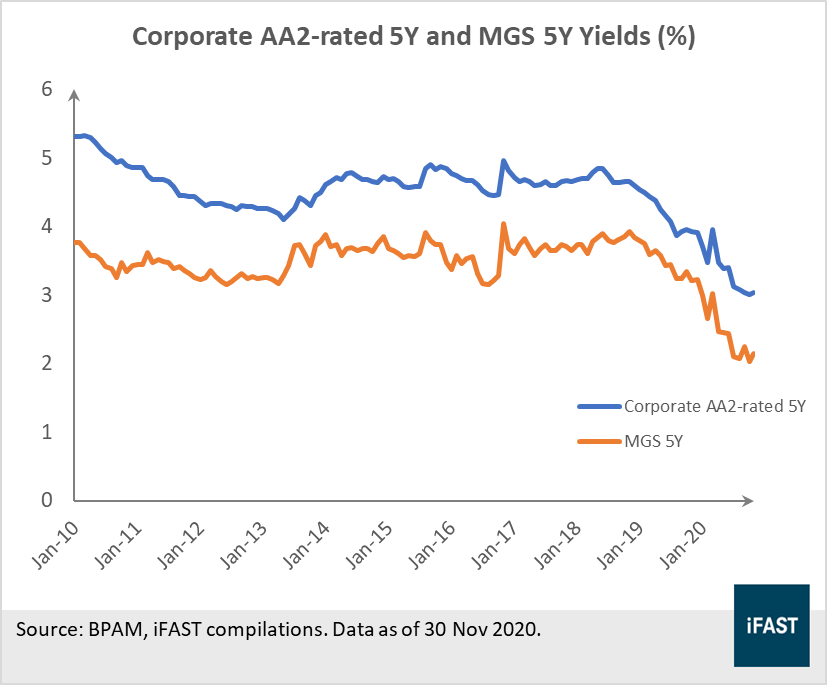
It should come as no surprise that overall yields have generally lowered in tandem of the global low interest rate environment.
Rating agencies in Malaysia
Similar to global rating agencies such as Moody's, S&P, and Fitch; Malaysia’s has it very own rating agencies that is primarily engaged in rating local Ringgit corporate bonds. The 2 rating agencies are namely RAM and MARC. Between them, they rate more than 70%[3] of total outstanding corporate bond compromising of local corporate credit from various sectors such as property development, finance, oil and gas, and construction.
Among rated bonds that are rated by either RAM and MARC include household names in the Malaysian market including TNB, Genting, Tropicana, and Maybank to name a few.
Primary risk: Risk of default
One of the key risks associated with investing in fixed income securities is the risk of default. Broadly speaking, it is defined as the risk of losing the principal investment amount and accrued interest as the entity that owes the obligation is no longer in a financial position to honor the owed obligation.
The global corporate credit by virtue of being a subset of the investable universe of fixed income securities is no stranger to the risk of default. It follows closely macroeconomic conditions which broadly dictates the aptitude of issuers meeting their obligations although company-specific risks also play a part when corporate credit are evaluated for default risk. For example, the Global Financial Crisis (“GFC”) in 2008 presented an enormous shock to the global financial markets that led to a slew of corporate credit defaults around the globe.
While Malaysia’s corporate credit market followed suit with the number of corporate credit defaults peaking in 2009, the past ten years has seen fairly low default rates with single-digit defaults since 2010. This is despite a number of endogenous market events such as the oil market plunge and introduction of GST in 2015, the FED rate hike and change in Malaysian government for the first time in 2018, to name a few.
While
there are possibly many factors that may have contributed to the low default
rates in corporate credit in Malaysia, it is hard to ignore the discipline of
local corporates in managing their balance sheet as a contributing factor. This
is evident as the median gearing of listed companies on Bursa Malaysia
(Malaysia’s stock exchange) has been below 30% since 2010. This low debt load suggests
the risk-averseness of local corporates in managing their businesses.
Figure 2 and 3 outlines the number of corporate credit
default as well as median gearing of listed Malaysian companies since 2008.
Figure 2: Number of corporate credit defaults since 2008
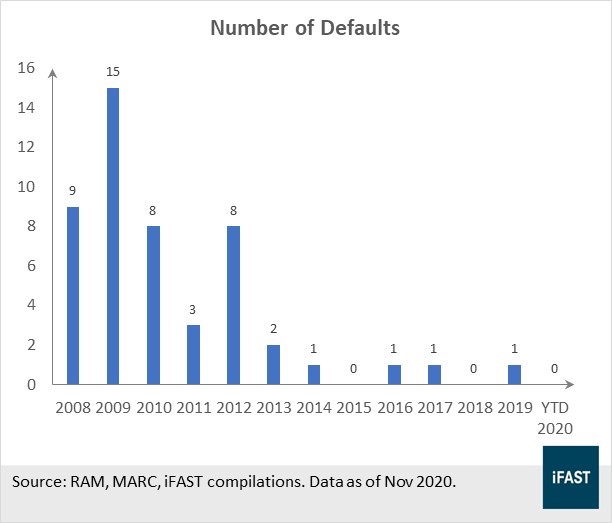
Figure 3:
Median
gearing of listed Malaysian companies since 2008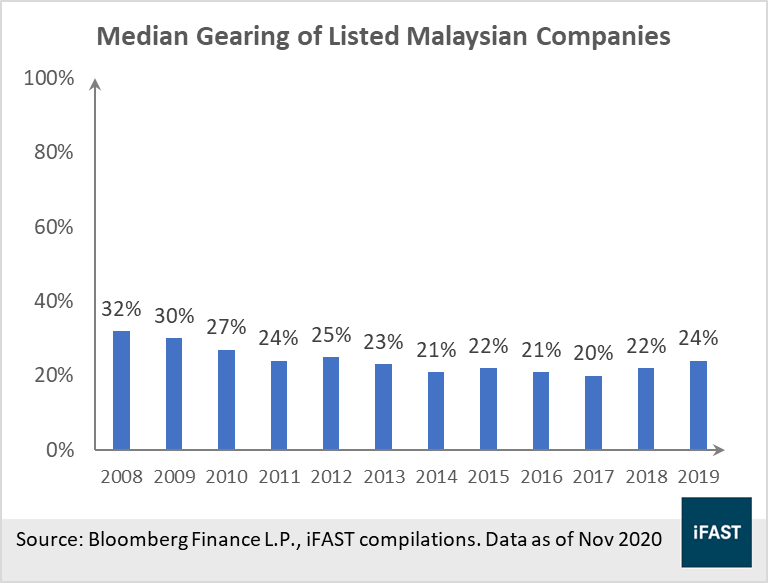
Latest bond market updates
Foreign inflow
A stark contrast in foreign investors taste in our local bond market and local equity market can be measured by foreign investors' participation in the respective asset class.
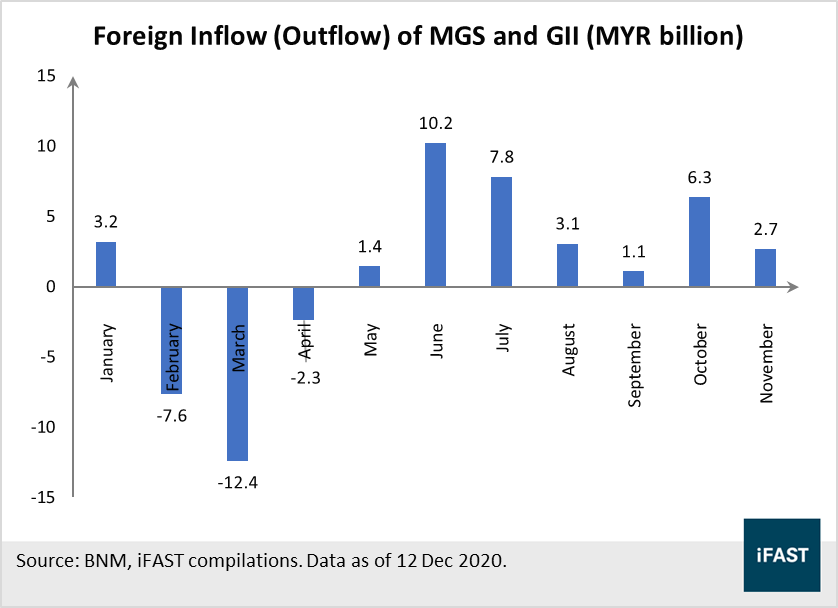
While it is no secret that the local equity market has seen net outflows for an extended period of time, foreign investors have been recording net inflows in the local sovereign debt market. As highlighted above, MGS and GII taken together has seen a net inflow in foreign participation for the past 7 months in a row. Figure 4 illustrates the foreign inflow in the Malaysia’s sovereign debt market.
Figure 4: Foreign inflow/outflow of Malaysia's sovereign debt securities in MYR Billion
Fitch downgrade
On December the 4th, Fitch downgraded Malaysia’s sovereign bond rating to “BBB+” from “A-“ moving from a negative to stable outlook. Fitch cited several factors that influenced its downgrade, citing issues around the dependence and concentration of revenue from the oil and gas segment, expanded fiscal budget, as well as corporate governance issues related by the political instability in the country among others.
Despite the downgrade, the local bond market remained sturdy as the recent re-opening auction of 10Y GII saw a healthy participation with a bid-to-cover (“BTC”) ratio of 2.61 times, a stronger-than-expected response with the total bids amounting to RM 10.5 billion. This round’s auction BTC of 2.61x is almost similar of the preceding re-opening auction of 10Y government bond in July of 2.591x, suggesting a healthy demand in the government issue despite the downgrade.
Recent corporate bond issuances
The pandemic COVID-19 has put an unprecedented dent in the global capital markets with business confidence taking a hit. This resulted in sluggish corporate bond issuances as businesses are less-than-willing to take on additional debt burden on their balance sheet.
That being said, BNM’s move to bring down the OPR rate down to all time low of 1.75% has seen some corporate players re-finance their existing debt in the local corporate credit market while some have taken advantage of the low interest environment to tap into external funding via the debt capital market. Below are some recent issuances in the local credit market.
Table 1: Recent corporate bond issuance in Malaysia
| Issuer | Bond | Ask Yield to Maturity ("YTM") |
| DRB-HICOM Berhad | DRBHMK 5.080% 30Aug2030 Corp (MYR) | 4.974% |
| Alliance Bank Berhad | AFGMK 4.050% 26Oct2035 Corp (MYR) | 3.870% |
| Tropicana Corporation Berhad | DJCMK 5.650% 30Jun2025 Corp (MYR) | 5.257% |
| Cypark Renewable Energy Sdn Bhd | CYPREN 6.500% Perpetual Corp (MYR) - Series 3 | 6.500% |
| Pestech International Berhad | PESTMK 6.000% Perpetual Corp (MYR) | 6.000% |
Source: BPAM, iFAST compilations. Data as of 10 December 2020.
Looking to invest in bonds?
Given the opaque and complex nature of the fixed income universe, where bonds are transacted through what is called an over-the-counter (“OTC”) market, the requirement of an individual looking to invest in bonds is also set at reasonably high standards. These standards are usually set by the regulatory body of respective bodies and vary accordingly. For example, among the chief requirement set by the Securities Commission Malaysia (“SC”) for individuals looking to invest in bonds is income exceeding RM 300,000 per annum in the preceding 12 months or its equivalent in foreign currencies. In Singapore, the threshold is set at SGD 300,000 (~RM 910,000) and in Hong Kong it is HKD 8 million in total assets (~RM 4.2 million).
Retail bond framework
In 2019, Securities Commission Malaysia launched the seasoned bond framework to facilitate retail bond participation where investors can buy bonds for as low as RM 1,000 in nominal value, in which certain requirements for such bond were placed for it to be considered “retail”. Some key highlights to the framework for the eligibility of the bond to be considered “retail” include the need for the bond to be denominated in Ringgit Malaysia, the bond must have a remaining tenure of 1 year, have been issued at for at least 1 year, and have a minimum credit rating of “A” by local rating agencies RAM or MARC.
Foreign currency bonds
In addition to yield, currency represents a major driver in an investors behavior when it comes to fixed income investing, particularly in the corporate credit space. Apart from the local ringgit-denominated bonds that are available, sophisticated investors who desire to diversify their bond portfolio have multiple options at their disposal. Some popular choices include investment into corporate credit offered by high yield Chinese property developers, Indonesian mining companies, and Singaporean banks to name a few. These bonds are usually denominated either in US Dollar (“USD”) or in their local currency such as HKD and SGD. The table below represent some of the available options a sophisticated investor has at his or her disposal.
Table 2: Foreign currency bonds available at FSMONE
| Issuer | Bond | Ask Yield to Maturity ("YTM") |
| 361 Degrees International Ltd | DEGREE 7.250% 03Jun2021 Corp (USD) | 32.43% |
| China Evergrande Group | EVERRE 8.250% 23Mar2022 Corp (USD) | 15.265% |
| Fortune Star BVI Ltd | FOSUNI 5.250% 23Mar2022 Corp (USD) | 4.018% |
| Commerzbank AG | CMZB 4.875% 01Mar2027 Corp (SGD) | 3.468% |
| HSBC Holdings PLC | HSBC 4.700% Perpetual Corp (SGD) | 3.413% |
Source: FSMONE.com.my. Data as of 10 December 2020
Getting started
For investors that wish to get started – including foreign investors from Singapore and Hong Kong that qualify (~98,000 SGD in annual income for Singapore investors and ~HKD 573,000 in annual income for Hong Kong investors) – visit FSMONE.com.my to begin your bond investment journey.
[1] Source: World Bank Group
[2] Source: BPAM
[3] Source: BPAM, iFAST compilations. Data as of Nov 2020.