- Negative industry news triggered a sell-off: CoreWeave’s bond prices fell into the US$80 range, yields briefly rose above 15% and its CDS hit a record, with high debt amplifying the impact.
- Available liquidity of about US$22.8 billion means unrestricted cash alone can cover the roughly US$4.4 billion of debt maturing in the second half, so short-term default risk is low, although financing costs have risen markedly.
- Rising secured borrowing is weighing on recovery prospects. Existing holders need not panic-sell, but new money should wait for clarity from the third-quarter results; investors seeking stable income may consider hyperscaler bonds.
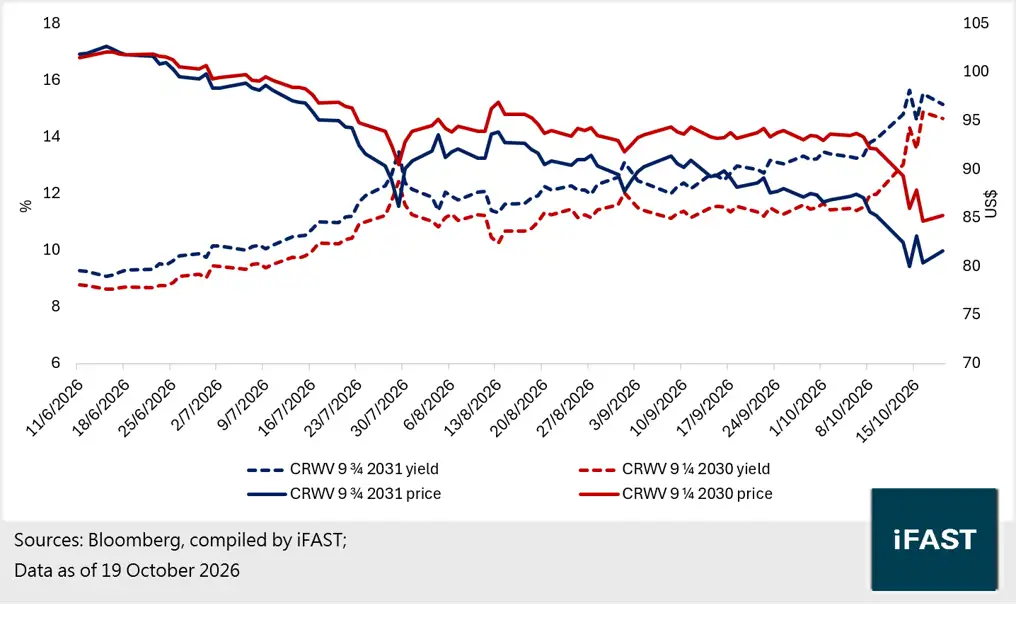
In our previous article, “The Price of CoreWeave Bonds’ 11% Yield! What Risks Lie Behind Surging Capex and Debt?”, we noted: “Should market sentiment towards AI infrastructure financing reverse, the company could stall because of funding problems.” The mid-October sell-off is that risk materialising, with bonds and shares falling in tandem. The price of CRWV 9.250% 01Jun2030 Corp (USD) fell from a high of US$103 to the US$80 range, while the yield on the longer-dated 9.75% 2031 bond briefly rose above 15%. Its five-year credit default swap (CDS) hit a record 1,194.5 basis points intraday on 15 October, signalling a marked deterioration in the market’s view of its credit risk (see Chart 1).
Chart 1: CoreWeave bond prices and yields
 Negative Industry News Sours Sentiment Towards
AI
The high leverage, negative free cash flow and the low repayment ranking of the unsecured bonds were discussed in our previous article, and the market had already priced in these risks before this sell-off. The trigger this time was negative news affecting the whole industry, not just CoreWeave itself.
On 14 October, research firm Gartner published a report predicting that more than 80% of emerging cloud service providers (neoclouds) will be unable to operate independently by 2030. To recoup their infrastructure investment and financing costs, cumulative AI revenue of about US$8.5 trillion would be needed by 2030, yet actual revenue is projected at only about US$3.6 trillion – far too little to support the current scale of infrastructure investment. CoreWeave’s share price fell 15.5% on the day the report was published.
Before that, Nvidia-backed Australian data centre operator Firmus withdrew its planned IPO of about US$5 billion on 9 October, as investors had reservations about its debt levels and target valuation of about US$30 billion – a sign that market sentiment was deteriorating.
Heavy Reliance on External Funding Amplifies the Impact of Negative Sentiment on CoreWeave
As of the end of June, the company’s total debt stood at about US$35.6 billion, up 218% year on year, with net gearing as high as 570%. Management has not provided a timeline for free cash flow to turn positive, so debt may keep rising for some time. Notably, depreciation costs reached US$2.54 billion in the first half, resulting in an operating loss. In other words, CoreWeave’s ability to service its debt rests not on current earnings, but on whether its backlog converts into cash as scheduled and whether the market remains willing to keep providing funding.
For this reason, whenever adverse news emerges, investors demand a higher risk premium, directly raising financing costs and amplifying the impact on its bonds. CoreWeave CEO Michael Intrator acknowledged in an internal memo that peers’ difficulties with IPOs and debt financing are “bleeding into” the market’s perception of the company. In addition, higher-than-expected US inflation data on 14 October led markets to bet on a Fed rate hike in December, further tightening CoreWeave’s financing conditions and becoming the main driver of spread widening.
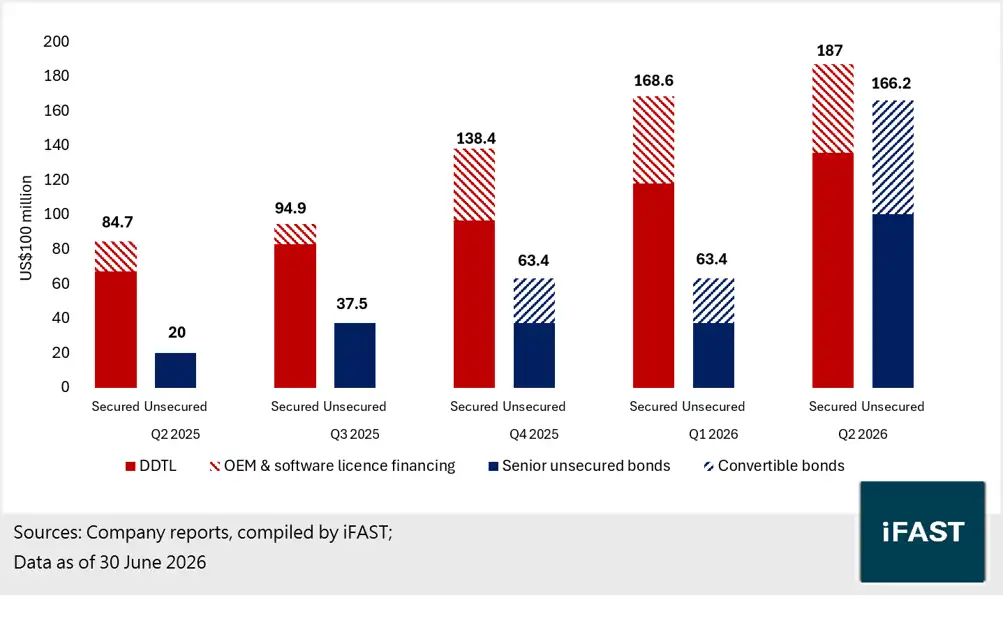
At the same time, the company’s response is also unfavourable to bondholders: co-founder Brannin McBee said the company will seek more investment-grade financing secured by customer contracts and GPUs. Although this helps lower financing costs, it means secured borrowing will keep growing, lowering the recovery rate for senior unsecured bonds in a default and deepening the fall in bond prices (see Chart 2).
Chart 2: CoreWeave’s secured and unsecured debt
 Short-Term Default Risk Remains Low
CoreWeave issued another US$4.2 billion of convertible bonds in September. Together with about US$5.52 billion of unrestricted cash at the end of June, about US$10 billion of committed but undrawn delayed draw term loan (DDTL) and revolving credit facilities, and operating cash flow in the second half, available funds total about US$22.8 billion. Including the roughly US$2.1 billion that could be raised at the current share price under its at-the-market (ATM) equity programme, the total rises to about US$24.9 billion.
Unrestricted cash alone is sufficient to cover the roughly US$4.4 billion of debt maturing in the second half. The remaining funds can cover about 75% to 90% of capital expenditure, and the company can fill the rest of the gap by modestly slowing its expansion or raising small amounts of financing. More importantly, the DDTLs are committed facilities, so drawdowns do not require going back to the market and are unaffected even if the financing window temporarily closes. In other words, even if financing conditions deteriorate, repayment pressure is unlikely to emerge in the near term.
CoreWeave Can Keep Raising Funds, but at a Markedly Higher Cost
Available funds are sufficient to meet second-half needs, but the market expects CoreWeave’s capital expenditure to reach about US$50 billion a year from 2027, and management has not given a timeline for free cash flow to turn positive, so financing will need to continue.
With existing bond yields close to 15%, new issuance is too costly, so the unsecured bond market is effectively closed to CoreWeave. The company’s current financing model relies mainly on its customers’ credit rather than its own. DDTLs are borrowed through special purpose vehicles (SPVs), secured by customers’ take-or-pay contracts and equipment, and amortise over the contract term. If CoreWeave can sign contracts with creditworthy customers, each new contract can support a certain amount of financing. DDTL 4.0, secured by a Meta contract, obtained an investment-grade A3 rating from Moody’s and is priced at just SOFR plus 225 basis points, far below the close-to-15% yield on its bonds (see Table 1).
Table 1: Overview of CoreWeave’s DDTLs
| Facility | Signed | Size (US$100 million) |
Pricing | Underlying customers | Rating (Moody's / Fitch) |
| DDTL 1.0 | Jul 2023 | 23 | SOFR + 962 bps | Not disclosed | No public rating |
| DDTL 2.0 | May 2024 | 76 | SOFR + 600 to 1,300 bps | Microsoft | No public rating |
| DDTL 2.1 | Sep 2025 | 30 | SOFR + 425 bps | Microsoft, OpenAI | No public rating |
| DDTL 3.0 | Jul 2025 | 26 | SOFR + 400 bps | OpenAI | No public rating |
| DDTL 4.0 | Mar 2026 | 85 | Floating: SOFR + 225 bps; fixed: approx. 5.9% | Meta | A3 |
| DDTL 5.0 | May 2026 | 31 | SOFR + 450 bps | Two non-investment-grade customers (unnamed) | Ba2 / BB+ |
| DDTL 5.5 | Aug 2026 | 26 | SOFR + 550 bps | Reportedly including Anthropic, Jane Street, Hudson River Trading | Ba2 / BB+ |
| Sources: Company reports, compiled by iFAST; Data as of 21 October 2026 |
|||||
The company’s backlog currently stands at US$104.2 billion, with more than US$25 billion of new commitments added in the third quarter. Deutsche Bank estimates that about two-thirds of the backlog comes from investment-grade customers and that about half has not yet been pledged as DDTL collateral. In other words, there is still an ample pool of contracts that can serve as collateral. However, the US$2.6 billion DDTL 5.5 completed in August was priced at SOFR plus 550 basis points, 125 basis points above the initial price talk in July, showing that while financing channels remain open, costs have clearly risen.
CoreWeave expects interest expense of US$860–940 million in the third quarter, up sharply from US$640 million in the second quarter, mainly because DDTLs are drawn as new capacity is built and spreads on new loans have widened. However, higher interest does not necessarily mean weaker debt-servicing capacity. DDTL interest is paid from the cash flows of the corresponding customer contracts, so debt growth broadly goes hand in hand with revenue growth. The near-term pressure comes mainly from a timing gap: interest starts accruing as soon as a loan is drawn, but it takes one to two quarters for computing capacity to go live and generate revenue, so interest temporarily grows faster than revenue. Interest coverage based on operating cash flow in the first half of 2026 was 3.1 times, which remains manageable.
It Is Not Just CoreWeave: Transparency of the AI Financing Chain Is Key
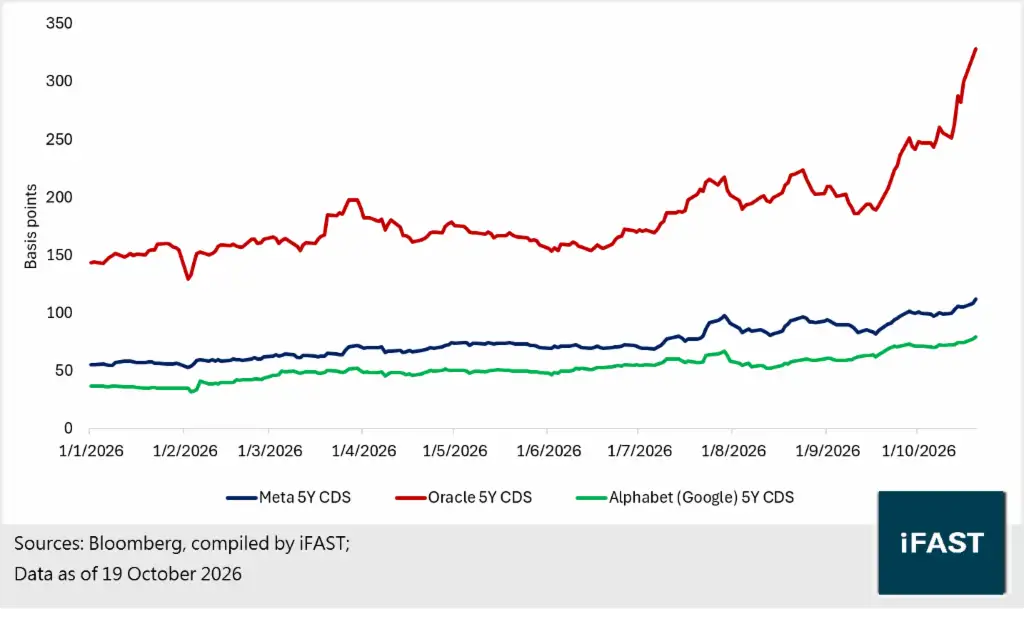
In fact, CoreWeave is not the only company under pressure. In mid-October, Oracle’s five-year CDS rose above 300 basis points, while Alphabet’s and Meta’s CDS also hit record highs, reflecting the market’s growing sensitivity to credit conditions across the AI infrastructure sector, where isolated negative news is enough to trigger widespread concern (see Chart 3).
Chart 3: Five-year CDS of hyperscalers
 In our
view, this sentiment stems from the opacity of the financing chain. Funding for
AI infrastructure flows through SPVs, long-term leases, joint ventures and
landlords’ project debt, so much of the debt does not appear directly on the
balance sheets of the companies involved. Meanwhile, the AI labs that are the
ultimate payers, such as OpenAI and Anthropic, are still not required to
disclose their financials publicly. Unable to gauge the total debt along the
chain or how its links are connected, the market naturally draws comparisons
with the complex structures of collateralised debt obligations (CDOs) before
the 2008 financial crisis and demands a higher risk premium, directly weakening
the refinancing capacity of data centre debt.
That said, today’s situation differs markedly from 2008. Demand for computing power is real: CoreWeave is signing new contracts at higher prices, and Oracle’s GPU utilisation is close to 98%. However, this demand is currently supported mainly by AI labs’ external funding rather than their own profits. If financing conditions deteriorate, customers’ ability to pay and data centre financing could come under pressure at the same time, so systemic risk does exist. For investors, the key is whether AI labs gradually move towards listing and public disclosure, making the financing chain more transparent; until then, volatility in AI infrastructure-related bonds is likely to persist.
Bond Investment
Beyond financing costs and market sentiment, the continued growth of DDTLs lowers the recovery rate of unsecured bonds in a default, making CoreWeave’s bonds less attractive. However, based on the company’s current liquidity, it can meet its debt maturities over the next year, so existing holders need not panic-sell. New money should wait until the third-quarter results and financing terms become clearer. Overall, CoreWeave bonds are suitable only for investors who are positive on the outlook for AI data centres and can tolerate large swings in principal, and position sizes should be kept small (see Table 2).
Table 2: CoreWeave bonds
| Bond name | Issuer | Currency | Remaining tenor (years) | Investor buy price | Yield to maturity | Credit rating (S&P / Fitch) |
Callable |
CRWV 9.250% 01Jun2030 Corp (USD) |
CoreWeave Inc. | USD | 3.61 | 86.13 | 14.38% | B+/ BB- | On or after Jun 2027 @104.625% On or after Jun 2028 @102.313% On or after Jun 2029 @100.000% |
| CRWV 9.000% 01Feb2031 Corp (USD) | CoreWeave Inc. | USD | 4.28 | 83.26 | 14.86% |
B+ /BB- | On or after Jun 2028
@104.500% On or after Jun 2029 @102.250% On or after Jun 2030 @100.000% |
Sources:
Bondsupermart, compiled by iFAST; Data as of 22 October 2026 |
|||||||
For investors who want exposure to AI growth but place more emphasis on stable income, we believe bonds issued by hyperscalers such as Alphabet, Meta and Amazon are a better choice (see Table 3). As the largest buyers of AI computing power, they sit upstream in the AI value chain, with businesses spanning advertising, cloud and e-commerce, relatively ample cash flows, and AI capital expenditure funded mainly by operating cash flow. In this sell-off, although Alphabet’s and Meta’s CDS hit record highs, the increases were far smaller than CoreWeave’s, showing that the market remains confident in their credit.
Table 3: Hyperscaler bonds on Bondsupermart Live
| Bond name | Issuer | Currency | Remaining tenor (years) | Investor buy price | Yield to maturity | Credit rating (S&P / Fitch) |
| GOOGL 2.050% 15Aug2050 Corp (USD) | Alphabet Inc. | USD | 23.83 | 49.40 | 6.1% | AA+/ N.R |
| GOOGL 4.500% 15May2035 Corp (USD) | Alphabet Inc. | USD | 8.57 | 92.62 | 5.6% | AA+/ N.R |
| GOOGL 5.200% 27Aug2029 Corp (AUD) | Alphabet Inc. | AUD | 2.85 | 99.50 | 5.4% | AA+/ N.R |
| GOOGL 5.500% 13Nov2041 Corp (GBP) | Alphabet Inc. | GBP | 15.07 | 91.05 | 6.4% | AA+/ N.R |
| GOOGL 5.500% 27Aug2031 Corp (AUD) | Alphabet Inc. | AUD | 4.85 | 98.60 | 5.8% | AA+/ N.R |
| GOOGL 6.250% 27Aug2036 Corp (AUD) | Alphabet Inc. | AUD | 9.85 | 99.75 | 6.3% | AA+/ N.R |
| GOOGL 6.900% 27Aug2046 Corp (AUD) | Alphabet Inc. | AUD | 19.86 | 98.60 | 7.0% | AA+/ N.R |
| AMZN 2.700% 03Jun2060 Corp (USD) | Amazon.com Inc. | USD | 33.64 | 49.11 | 6.4% | AA/ AA- |
| AMZN 5.450% 20Nov2055 Corp (USD) | Amazon.com Inc. | USD | 29.10 | 85.65 | 6.6% | AA/ AA- |
| AMZN 6.650% 14Sep2045 Corp (GBP) | Amazon.com Inc. | GBP | 18.91 | 100.45 | 6.6% | AA/ AA- |
| META 4.550% 15May2031 Corp (USD) | Meta Platforms Inc. | USD | 4.56 | 96.14 | 5.5% | AA-/ N.R |
| META 4.600% 15May2028 Corp (USD) | Meta Platforms Inc. | USD | 1.56 | 99.74 | 4.8% | AA-/ N.R |
| META 5.500% 15Nov2045 Corp (USD) | Meta Platforms Inc. | USD | 19.08 | 84.44 | 7.0% | AA-/ N.R |
Sources: Bondsupermart, compiled by iFAST; Data as of 22 October 2026 |
||||||
Risks
The core risk for CoreWeave bonds is persistently rising financing costs. The market expects capital expenditure of about US$50 billion a year from 2027, while the unsecured bond market is effectively closed, leaving financing reliant mainly on DDTLs. The spread on DDTL 5.5 has already widened by 125 basis points from July. If market sentiment keeps deteriorating, interest expense could grow faster than revenue for an extended period, reducing interest coverage.
Recovery rates are also under continued pressure. Secured debt more than doubled within a year to about US$18.7 billion, while pari passu senior unsecured debt rose to about US$20.8 billion (including the convertible bonds issued in September). In a default, senior unsecured bondholders would rank behind secured debt and would also have to share the remaining assets with more creditors of the same rank (see Figure 2).
Interest rates and industry news are also risks. DDTLs are mostly floating-rate, so a Fed rate hike in December would push interest expense higher still. Given the lack of transparency in the AI financing chain, funding difficulties at peers or weaker-than-expected third-quarter results could trigger a new round of selling. The risks noted in our previous article – GPU depreciation, customer concentration and construction delays – also remain.
Conclusion
Negative industry news triggered a sell-off: CoreWeave’s bond prices fell into the US$80 range, yields briefly rose above 15% and its CDS hit a record, with high debt amplifying the impact.
Available liquidity of about US$22.8 billion means unrestricted cash alone can cover the roughly US$4.4 billion of debt maturing in the second half, so short-term default risk is low, although financing costs have risen markedly.
Rising secured borrowing is weighing on recovery prospects. Existing holders need not panic-sell, but new money should wait for clarity from the third-quarter results; investors seeking stable income may consider hyperscale bonds.
For specific disclosure, at the time of publication of this report, IFPL (via its connected and associated entities) holds CRWV 9.250% 01Jun2030 Corp (USD), GOOGL 2.050% 15Aug2050 Corp (USD) , GOOGL 4.500% 15May2035 Corp (USD), AMZN 2.700% 03Jun2060 Corp (USD), AMZN 5.450% 20Nov2055 Corp (USD), META 4.550% 15May2031 Corp (USD), META 4.600% 15May2028 Corp (USD), META 5.500% 15Nov2045 Corp (USD), GOOGL 5.200% 27Aug2029 Corp (AUD), GOOGL 5.500% 27Aug2031 Corp (AUD), GOOGL 6.250% 27Aug2036 Corp (AUD), GOOGL 6.900% 27Aug2046 Corp (AUD) and the analyst who produced this report holds a NIL position in the abovementioned securities.
RISK DISCLOSURE STATEMENTS FOR BONDS
Key risks of investing in bond
|
Key risks of investing in high-yield bonds
|
| Bonds with special features Some bonds may contain special features and risks that warrant special attention. These include bonds:
|
Remarks
|