
Malaysia retained in FTSE Russell’s World Government Bond Index (WGBI)
On the 29th March 2021, FTSE Russell’s in its semi-annual country classification review for fixed income announced that Malaysia will be removed from the watchlist for potential reclassification of its market accessibility level from “2” to “1” and will retain its membership in the FTSE World Government Bond index.
The news allayed concerns that MGS and bond investors had on a potential MGS sell off scenario should Malaysia be taken off the list, as a removal would cause index tracking ETFs to sell down their positions.
In its press release, FTSE Russell commended Bank Negara Malaysia’s on-going engagement and initiatives to address the accessibility concerns which placed them on the watchlist since mid-2019. The initiatives implemented by Bank Negara Malaysia includes the improvement in secondary market liquidity through more Malaysian Government Securities (MGS) re-openings in 2021, the ability to switch out illiquid bonds to more liquid bonds, and the increase in availability of MGS via the repo market, and the introduction of physical settlement of MGS futures as an option for interest rate hedging among others.
The enhancement of foreign exchange market structure and liquidity was also commended by the index provider as the inclusion of Japanese trust banks and global custodians to allow for the a more dynamic hedging programme under the Appointed Overseas Office (AOO) programme.
Government bond auction drew strong interest
On the back of positive news flow from the retainment of Malaysia on the WGBI Index, the following day saw the new issuance of 20.5Y Government Investment Issue (“GII”) maturing in September 2041 auction garner strong support with a bid-to-cover ratio (“BTC”) of 2.57 times, the strongest bidding metric since mid-January 2021.
The strong interest saw a total of RM 4 billion worth of GII issued (RM2 billion auction plus RM 2 billion in private placement) with an average yield of 4.417% where the auction closed with a high/low of 4.435% and 4.390%.
Table 1: MGS and GII auction results since the beginning of the year:
|
MGS and GII |
Auction date |
Issue Size (RM Billion) |
BTC ratio (times) |
|
7-yr Reopening of MGS 06/28 3.733% |
6-Jan-21 |
3.5 |
2.026 |
|
15.5-yr New Issue of MGII |
14-Jan-21 |
4.5 |
2.917 |
|
10-yr Reopening of MGS 04/31 2.632% |
21-Jan-21 |
4.0 |
2.008 |
|
5-yr Reopening of MGII 03/26 3.726% |
3-Feb-21 |
4.5 |
2.067 |
|
20-yr Reopening of MGS 05/40 3.757% |
17-Feb-21 |
4.0 |
2.224 |
|
7-yr Reopening of MGII 09/27 3.422% |
24-Feb-21 |
3.5 |
2.196 |
|
30-yr Reopening of MGS 06/50 4.065% |
5-Mar-21 |
4.0 |
2.023 |
|
10-yr Reopening of MGII 10/30 3.465% |
12-Mar-21 |
4.0 |
1.799 |
|
5-yr Reopening of MGS 09/25 3.955% |
22-Mar-21 |
4.5 |
1.789 |
|
20.5-yr New Issue of MGII (Mat on 09/41) |
30-Mar-21 |
4.0 |
2.575 |
Foreign demand for Malaysia bonds remains high
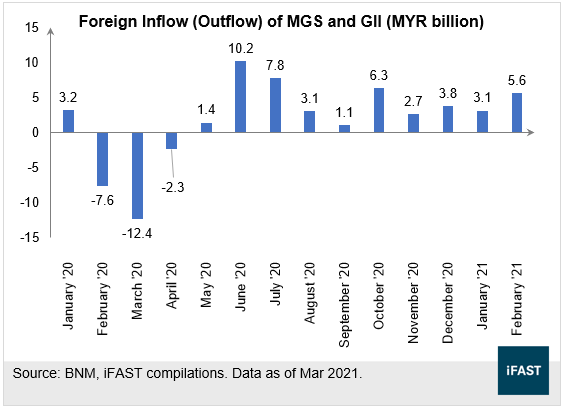
Despite beginning the year on multiple speedbumps which saw the number of COVID-19 cases of spike to new highs ranging in the 4-digit territory which then saw a second round of Movement Control Order (MCO) implemented and heightened political tension, foreign investors remain net buyers in Malaysian government bonds. Most of this is due to yield-hunting activities as Malaysia still offers one of the highest interest differentials across the region. This saw a 10 consecutive month of net foreign inflow since May 2020 (inclusive of MGS and GII).
In March 2021, the world’s largest sovereign wealth fund that has a market value of NOK 11.08 trillion (RM 5.48 trillion) reported that it bought NOK 11.34 billion (RM 5.44 billion) worth of Malaysian government bonds as at 31st December 2020, underlying foreign investors’ appetite in our local government securities[1]
Figure 1: Malaysia bond market continue to see foreign inflow
Yields to stabilize
The global bond rout which started in the US on the back of reflation trade fears remain a dominant theme. This was on the back of the USD1.9 trillion COVID-19 relief bill as well as the on-going proposal of the infrastructure package thought to be worth up to USD 2.25 trillion expected to be spent over the next 8 years. This caused the US Treasury 10Yyield to spike 1.74% as of 31st March 2021. The global rout in the US Treasury saw a spillover to our local bond market which saw the 10Y MGS spike. This was also thought to be partly contributed by the easing of the i-Sinar facility withdrawals by EPF.
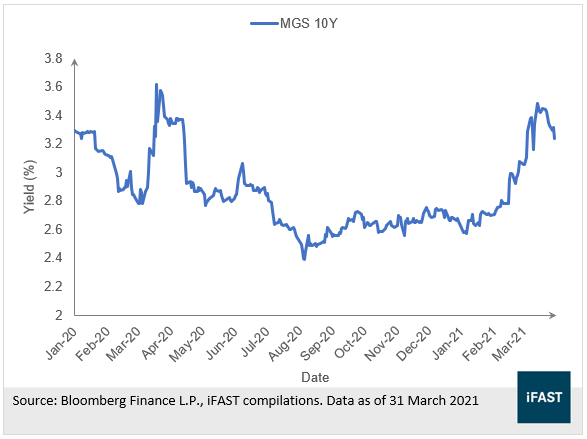
That being said, we have seen in recent days that the beginning of a stabilization in MGS yields. The 10Y MGS which saw a spike to 3.485% on 15th March 2021 has retreated to 3.237% as of 31st March 2021. We believe that this is due to the positive sentiment around the removal from the WGBI watchlist as well as the lower correlation of between our local interest rate policy and US’ interest rate policy.
Figure 2: Malaysian bond yields beginning to stabilize
iFAST Research Team View
At this juncture, we are of the opinion that local bonds have begun to stabilize after the bond rout experienced in February and March this year.
New positive developments like FTSE Russell’s decisions to remove Malaysia from the watchlist and retain Malaysia in the WGBI, together with the strong demand indicated through the interest for government bond auction and foreign fund inflows, would boost Malaysian bonds further.
Additionally, with local inflation numbers remain stable and the possibility of a rate hike remains mute, we believe that investors should take the opportunity to lock in duration with higher yields at this point in time.
Investors who are interested can consider the following bond funds and individual bonds:
Eastspring Investments Bond Fund
UMWHMK 6.350% Perpetual Corp (MYR)
CYPREN 6.500% Perpetual Corp (MYR) - Series 1
[1] Source: The Edge