If I had to use as little words as possible, the answer is yes. Bonds as an asset class have historically exhibited low correlations to, as well as lower price volatility than, other riskier asset classes such as equities. However, in this market meltdown caused by COVID-19 disruptions on the economy, we have seen prices of different asset classes moving in the same direction: down.
Thus, this begs the question, why should investors still consider MYR bonds as part of their portfolio? In this article, we explain why we think MYR bonds are still an attractive investment tool in these turbulent times.
Malaysian debt capital market experiencing a sell-off
Debt capital markets around the world have been experiencing a sell-off accompanied with extreme volatility, in what appears to be a flight to cash. Malaysia’s debt capital markets were not spared.
Much of this drawdown and volatility were contributed by the COVID-19 pandemic, which has reduced demand and caused supply shocks across sectors around the world. Adding to financial market woes is the oil price shock exacerbated by the ongoing price war between Saudi Arabia and Russia, which has seen the price of crude oil futures plummeting to a 17-year low, with neither party showing signs of backing down from the price war. At the same time, Malaysia also continues to tussle with political uncertainty as a new government was formed some four weeks, spurring capital outflows.
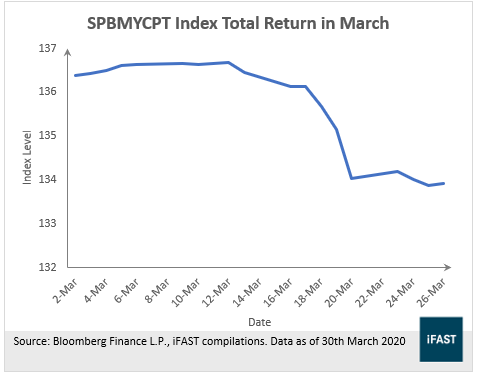
These factors led to a weaker ringgit and prompted a foreign sell-off activity in the Malaysian Government Security (“MGS”), which in turn led to a re-pricing of corporate bonds. Figure 1 illustrates the impact of the sell-off using the S&P Malaysia Corporate Bond Index Total Return (“SPBMYCPT”) as a proxy for the local MYR bond space performance.
Figure 1: Malaysia's corporate bond performance for the month of March
Corporate fundamentals remain solid with historically low default rates
While the debt capital markets have had their say in terms of pricing, the situation is not all gloom and doom, and certainly not in the MYR corporate bond space.
Balance-sheet fundamentals strongly determine the credit risk of corporate bonds, more so in turbulent economic times. Having learnt their lesson in the Asian Financial Crisis in 1998, when many listed Malaysian corporates were highly geared (in hard currencies, no less), Malaysian corporates have actively trimmed down their debt levels to solidify their balance sheet.
Using the median debt-to-equity ratio as a yardstick to measure gearing, these listed corporates have maintained financial discipline in the past ten years, staying well below the 50% debt-to-equity mark. We think this clearly signals the risk-averse attitude of listed corporates when it comes to debt leverage. Figure 2 illustrates the median gearing of listed Malaysian corporates in the past ten years.
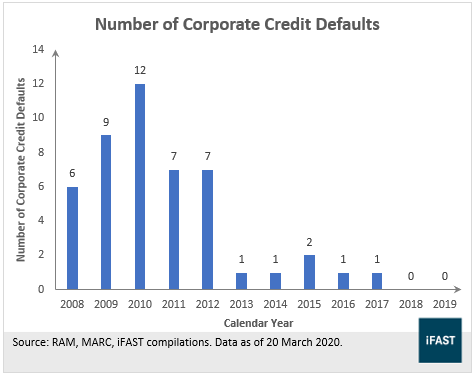
Higher balance-sheet discipline has translated to a low number of bond defaults in the local corporate bond space over the past ten years. The height of the Global Financial Crisis in 2008 saw a slew of defaults in the corporate bond space, with 2010 representing a peak year of twelve defaults. This number began to drop thereafter, although the trickle-down effect lasted until 2012.
As listed Malaysian corporates turned more risk-averse, their gearing was further reduced after 2012. This trend coincided with the significant drop in the number of defaults post-2012, indicating Malaysian corporates’ improved discipline in managing their balance sheet.
Listed Malaysian corporates’ balance-sheet resilience was further demonstrated in the face of plummeting oil prices in 2014, the introduction of GST 2015, and MSCI’s Emerging Market Index reduction of Malaysia’s weightage and China’s growth deceleration in 2016. Despite these major adverse events and a slowdown in Malaysia’s GDP growth (from 6% in 2014 to 4.2% in 2016), the number of defaults continued to remain low, suggesting the robustness of Malaysian corporates’ balance sheets.
In addition to that, even with rising trade tensions, three US Fed rate hikes, as well as the first-ever change in Malaysia’s government in 2018, which caused the country’s financial market to underperform, there was zero corporate bond default in 2018. The absence of corporate bond defaults amidst these headwinds point to the financial resilience of listed Malaysian corporates. Figure 3 illustrates the number of bond defaults from 2008 to 2019.
Figure 2: Median gearing of listed Malaysian corporates for the past 10 years
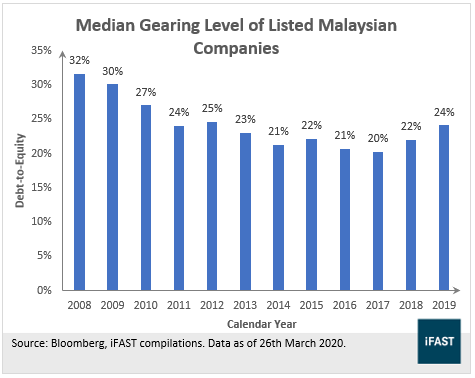
Figure 3: Number of corporate credit defaults in the MYR space in the past 10 years
Government and central bank working hand-in-hand
The acceleration of COVID-19’s impact on global economy has prompted the government to step in with fiscal stimulus measures as well as the central bank easing monetary policy to shelter the Malaysia economy from a deep economic contraction. The government has introduced the PRIHATIN economic stimulus package totalling RM 250 billion, which include financial assistance to small and medium enterprises. Some highlights from the stimulus package include working capital assistance up to RM 3 billion at an interest rate of 3.5%, HRDF tax exemption up to six months, and a RM 500 million micro-credit scheme at the rate of 2%.
The central bank, meanwhile, has introduced a debt moratorium of up to six months for individual borrowers, covering all loans except credit card balances to ease liquidity concerns. Prior to that, the central bank had reduced the Statutory Reserve Ratio of local banks from 3% to 2%, and earlier cut benchmark interest rates twice this year, bringing the Overnight Policy Rate down to 2.50%, in an attempt to inject liquidity into the markets.
Malaysia retained under FTSE Russell World Government Bond Index’s watch list
In addition to macroeconomic headwinds, Malaysia had an additional headache that needed to be dealt with: the potential exclusion or reduction in weight of Malaysian bonds from the FTSE Russell World Government Bond Index. As of April 2nd, the index provider has retained Malaysia under its watch list with a possible reclassification to Market Accessibility Level 1 from Level 2 currently. This situation should lend well for the MYR-denominated bonds as it reduces a further sell-off of the MGS.
Bond recommendations
With these factors in mind, which bonds should investors go for? We highlight below a couple of ideas that investors may find interesting:
Matrix Concept’s 3Y 5.5% sukuk
For investors that are risk-averse but would like to still earn more than the fixed-deposit rate in Malaysia, we think Matrix Concepts Holdings Berhad (MCH MK) offers just the right bond. With this bullet sukuk maturing in three years, investors get to earn 5.462% in terms of yield to maturity. From a valuation perspective, investors are locking in a credit spread of ~250bps, which is rather generous in our view taking into account Matrix Concepts’ healthy balance sheet. Given the currently ultra-low cash rate, we think investors can consider this bond as an alternative, albeit with a higher risk than fixed deposits.
Matrix Concepts is a property developer that is best known for its projects in Bandar Sri Sendayan and Bandar Sri Impian. Matrix Concepts’ low debt-to-equity ratio as compared to its property peers indicates the robustness of its balance sheet. In addition to that, its high take-up rates in completed property development projects, low land cost, and project diversification across the region point to a solid business.
LBS Bina’s 6.8% perpetual sukuk
Investors that are looking for higher yields and able to stomach a higher risk are best suited for LBS Bina Group Berhad’s (LBS MK) perpetual bond. The annual coupon rate of 6.8% is be one of the highest offered among newly issued ringgit bonds to-date. While investors run the risk of the bond running into perpetuity, the step-up feature embedded within the bond should provide investors with some relief. If the bond is not redeemed on its first call date in March 2025, a step-up margin of 250bps will kick in, adding to the initial spread of 3.851% and prevailing 5-year MGS rate.
LBS Bina is a property developer that operates in the affordable housing segment, selling products below the RM 600,000 mark. According to LBS Bina’s senior management, about 50% of the group’s properties are landed properties, which we think is a rather unique value proposition as other property developers tend to focus on high-rise buildings.
As previously mentioned, this bond has the inherent risks of a perpetual (deferral of coupon payments, no maturity date). In addition to the structure of the bond, LBS Bina’s balance sheet does appear more aggressive than its property peers. That being said, we are of the opinion that for investors who are risk-seeking, the risk-return ratio is attractive as the perpetual bond offers a credit spread of ~362bps. We think this compensates investors fairly for the level of risk that they are taking on.
To offer investors with a confidence boost, the week of 25th March 2020 saw the founder of Top Glove Corporation Berhad, Tan Sri Dr Lim Wee Chai, emerge as a substantial shareholder in the company. Subsequently, the property developer’s share price increased by 7% the day after.
Related article:LBS Bina Group Berhad: Upcoming MYR perpetual note
Declaration: For specific disclosure, at the time of publication of this report, IFC (via its connected and associated entities) has a principal position in LBSMK 6.800% Perpetual Corp (MYR) and MCHMK 5.500% 06Mar2023 Corp (MYR). The analyst who produced this report holds a position in MCHMK 5.500% 06Mar2023 Corp (MYR).