Highlights:
SJM’s revenue and earnings have not shown any significant improvement amid the pandemic, while the contribution from the newly opened Grand Lisboa Palace is limited.
Macau’s VIP gaming business has hit rock bottom as the Chinese government tightened regulations to contain capital outflow and target cross-border gambling, but the impact on SJM is relatively small. Despite the deteriorating leverage metrics, the Group maintains a decent refinancing ability and adequate short-term liquidity.
The bonds due 2026 and 2028 are yielding above 7% and offering a higher relative value than the peers. However, we believe the overall attractiveness is mediocre given the increasing uncertainty of the medium to long-term bonds.
It has been two years since Macau imposed border controls due to the outbreak of COVID-19 in early 2020, which badly hit the main casino operators. Recently, the sector is further impaired by concerns over gaming license renewal and China's cross-border gambling crackdown.
As one of the key pillar sectors of Macau’s economy, gaming industry has been contributing 60% of the GDP over the years. Six of its casino operators are also considered the most iconic companies in Macau (see Table 1).
Table 1: The “Big Six” Casino Operators in Macau
Name | Stock Code | Market Cap (billion HKD) |
Galaxy Entertainment | 0027.HK | 200.5 |
Sands China | 1928.HK | 172.4 |
Wynn Macau | 1128.HK | 36.4 |
SJM Holdings | 0880.HK | 29.0 |
MGM China | 2282.HK | 19.7 |
Melco International | 0200.HK | 13.5 |
Source: HKEX, iFAST Compilations Data as of 27 January 2022 | ||
SJM Holdings (“SJM”), a subsidiary of Sociedade de Turismo e Diversões (“STDM”), has the longest history in Macau's casino market. It operates more than 20 casinos, such as Lisboa Hotel, Grand Lisboa, Pier 16, L'Arc and Babylon.
As a traditional and reputable corporation in Macau, could SJM come up with a solution for the upcoming challenges?
Mediocre Revenue and Earnings Results; Grand Lisboa Palace Has Limited Contribution
In the first nine months in 2021, SJM’s gross gaming revenue (“GGR”) 2021 has increased by 43.8% YoY to HKD 7.35 billion (same currency below, unless otherwise specified). The loss attributable to shareholders amounted to $2.71 billion ($2.44 billion loss in the same period of 2020).
In the third quarter, the Group’s GGR increased by 170% YoY, with adjusted EBITDA at -$460 million (see Chart 1), which also performed better than last year.
Chart 1: SJM’s Revenue and Earnings Performance
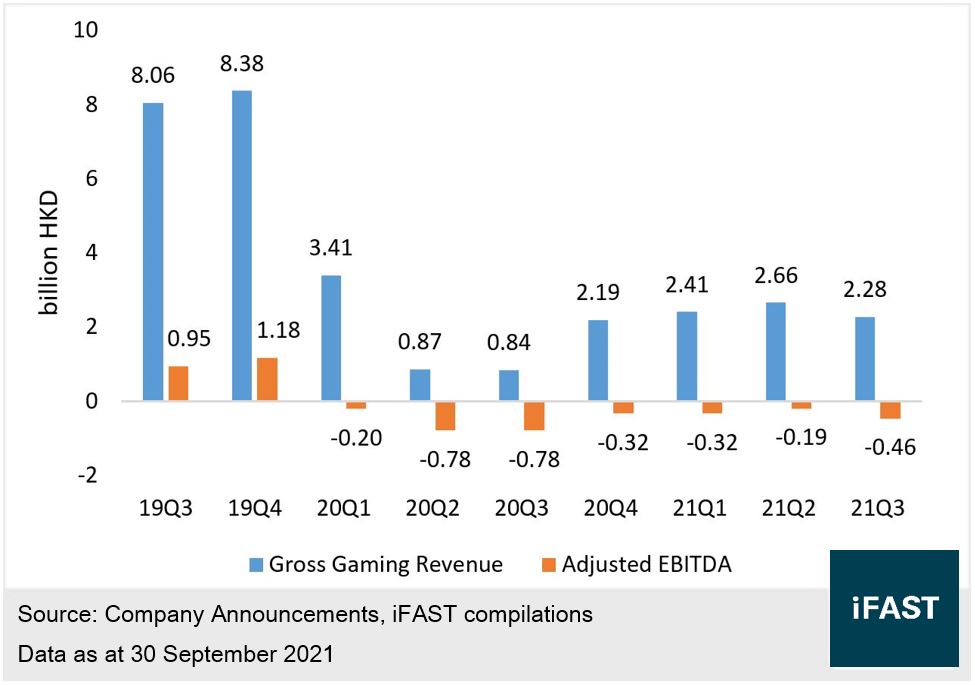
Although there is significant year-on-year growth, it was mainly due to the low base effect. Despite achieving $2 billion GGR in each quarter of 2021, we did not see a continuous improvement in SJM’s revenue amid the relentless COVID pandemic, and there is still a long way to go before it can return to its previous level of above $8 billion.
The Grand Lisboa Palace, which has a total investment amount of over $37.8 billion, has started the phased opening at the end of July 2021. The flagship Grand Lisboa Palace Macau, the largest hotel tower in the resort, as well as several restaurants, spa and wellness facilities, and event spaces, are now in services. However, without the top-notch gaming clients, these value-added services are expected to have limited contributions to the Group.
In the third quarter of 2021, Grand Lisboa Palace recorded a revenue of $128 million, but its adjusted property EBITDA reached -$176 million. It shows that this new high-end market-focused integrated resort could not bring any immediate positive impact to SJM under the COVID pandemic.
New Gaming Law Revision Should Have Bigger Impact on SJM
In mid-January, the Macau government published the revision draft of Macau’s gaming law, which proposed to the number of new licenses would be limited to six. Although it is somewhat different from the existing three main licenses and three sub-concession licenses, the total number of licenses has not been changed. Considering SJM is undoubtedly a key player in the Macau gaming industry, we believe that the risk of the license renewal is manageable.
Besides, the draft also mentioned that the authority has no intention to raise gaming tax. Despite the fact that it is a piece of positive news to the sector, we think it is not material to bondholders until the revenue of these casino operators has significantly recovered from the pandemic.
However, what has a greater impact on SJM is that the new law also requires all satellite casinos to tie the ownership of the premises to its gaming concessionaire, within a 3-year period. SJM has been the provider of gaming rights to many casinos inside the local hotels (14 out of 18 satellite casinos in Macau), including Lan Kwai Fong Hotel, New Orient Landmark Hotel and Grand Emperor Hotel. This part of income contributed more than 10% of SJM’s EBITDA over the years before COVID. It will definitely hurt the Group’s earnings as we expect some of the satellite casinos will close down under the new law.
VIP Business Hit a Bottom as the Chinese Government Tightened Regulations to Contain Capital Outflow and Target Cross-Border Gambling
Conventionally, the two key segments of Macau casinos are mass-market and VIP business. The rolling chip volume, representing the VIP business, is usually larger than the mass-market’s non-rolling chip drop.
In recent years, there have been speculations that Mainland China is cracking down on gambling-related cross-border capital outflow. In March last year, the Chinese government revised the Criminal Law, which clearly stated that any form of cross-border gambling by Chinese citizen is illegal, even soliciting or encouraging Chinese citizens to participate would also be regarded as having broken the law.
Last year, the arrest of the chairman Alvin Chau of Sun City Group, a junket promoter, has further triggered the market fear, and it was reported that many casinos have terminated their cooperation with the junkets. In addition, the new revision draft stated that each junket operator can only provide services to only one casino operator, which we believe it will be difficult for the VIP gaming business in Macau to recover in the near future.
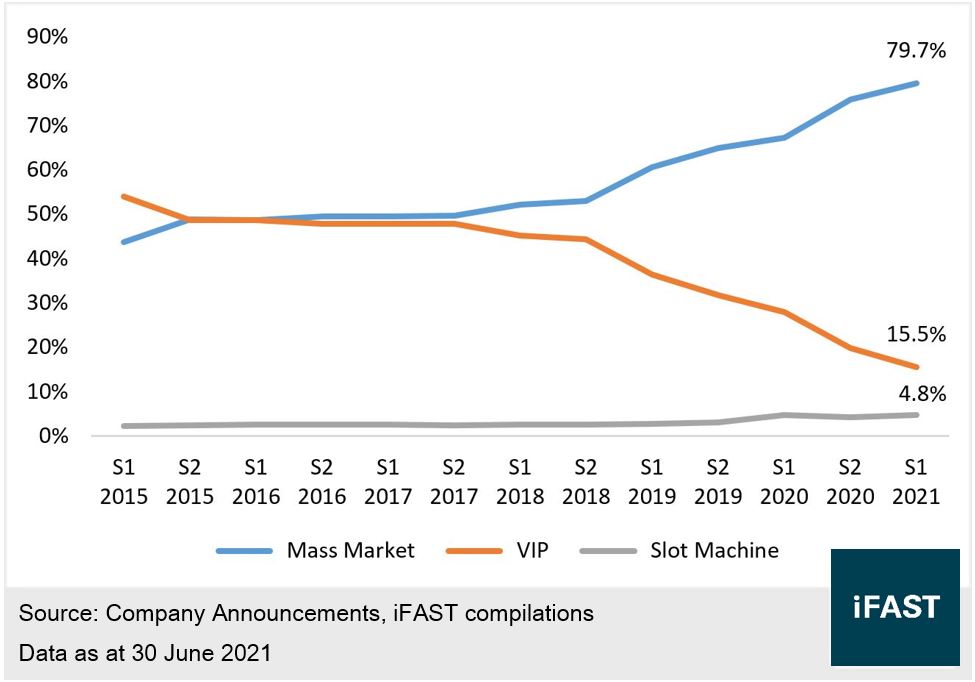
Fortunately, compared to other US-owned casinos, the local tilted SJM is focusing more on mass-market business. Since the second half of 2015, the VIP business has never amounted to over 50% of total revenue. In the first 9 months of 2021, the revenue of mass-market business has even reached 80% of total (see Chart 2), while VIP business’s revenue dropped over 90% compared to the pre-COVID level. It should have a limited downside now and will not continue to drag down the operating performance of the Group.
Chart 2: Revenue Distribution of SJM’s Mass-Market, VIP and Slots Business
Despite the Deteriorating Leverage Metrics, the Short-Term Liquidity Remains Adequate
From the quarterly result, SJM owned a cash reserve of $2.8 billion and net debt of $17.6 billion at the end of September. The Group’s net gearing ratio increased to 73% at the end of June, and this ratio kept worsening over the last few years (see Chart 3).
Chart 3: SJM’s Net Gearing Ratio Trend
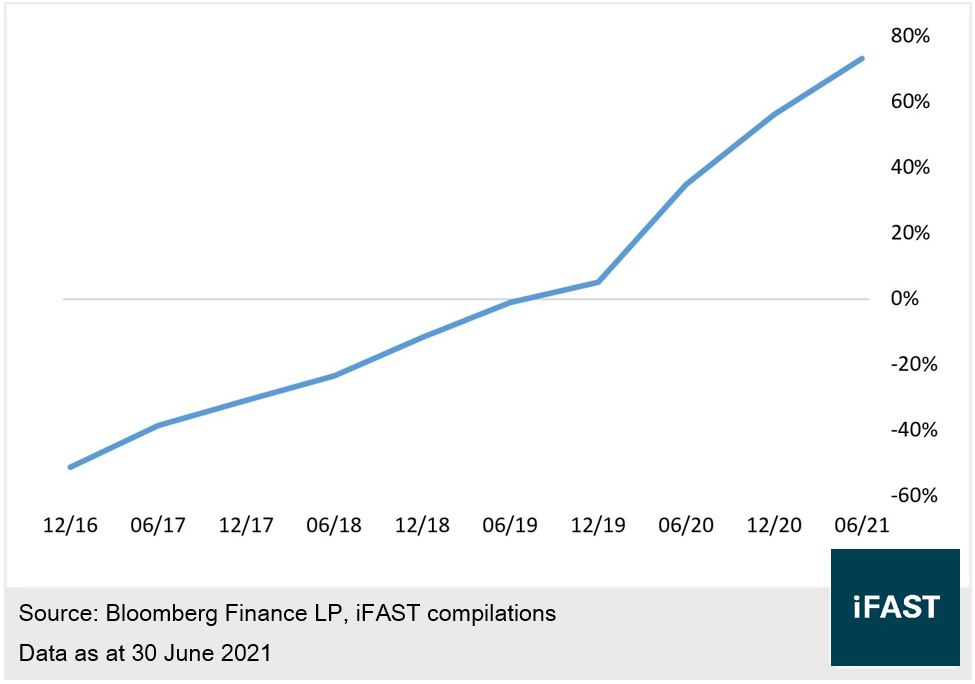
The worsening credit condition was mainly attributable to the development cost of Grand Lisboa Palace, as the bank loan for this project amounted to $18.6 billion at end of 2020. The outstanding balance of this loan fell to $8.8 billion at end-Jun after the Group repaid part of it last year, but its cash on hand also decreased by around $3.3 billion.
Although this bank loan will expire in February this year, the effective annual rate of the loan is only 2.3%, and the Grand Lisboa Palace has just begun its phased opening, we believe that it would not be difficult for SJM to negotiate with the bank for a rollover of the loan. Fitch's report in December last year pointed out that the Group is going to obtain a new revolving credit facility of $19 billion, and it is expected to have $7 billion left after the repayment of the loan. Therefore, we believe that SJM’s short-term liquidity is still adequate.
The remaining debts of the Group are the two bonds due 2026 and 2028, with a total outstanding amount of USD 1 billion, and the interest payment each year is around USD 467.5 million. Nonetheless, even with this healthy debt maturity profile, the Group’s debt-servicing ability will decline in the next two to three years if the pandemic persists, and it will become harder for the Group to refinance at that time.
Mediocre Attractiveness even with Bond Yield Exceeding 7%
The bonds issued by SJM received Ba2 and BB+ ratings from Moody’s and Fitch respectively, around one to three notches higher than Melco Resorts, Studio City and Wynn Macau. From the yield perspective, SJM apparently offers a higher relative value than its peers (see Table 2).
With a yield to maturity of around 7.5%, SJM’s bonds still have certain investment values. However, we believe the overall attractiveness is mediocre given the rising risk of credit deterioration and increasing uncertainty of the medium to long-term bonds.
Table 2: USD Bonds Issued by SJM and Other Peers
Bond Name | Issuer | Bond Credit Rating (Moody’s) | Years to Maturity | Yield to Maturity |
SJM Holdings | Ba2 (Negative) | 4.0 | 7.50% | |
6.0 | 7.41% | |||
Melco Resorts | Ba3 (Negative) | 4.2 | 5.52% | |
Studio City | B1 (Negative) | 3.5 | 7.03% | |
Wynn Macau | B2 (Negative) | 4.0 | 7.15% | |
Source: BSM Data as of 27 January 2022 | ||||
Corporate Risks
The pandemic is continuing to spread around the world, Macau's tourism and gaming industry will likely continue to be affected for the next few years. Despite the parted opening of Grand Lisboa Palace, the project would be difficult to balance the revenue and cost during this sector downturn, and may further drag down the overall earnings performance of the Group.
The amount of SJM’s bank loans are huge, and there would still be certain risks in refinancing. The failure to refinance will pose a significant detrimental effect on its cash flow. In addition, the uncertainties on cross-border gambling and gaming licenses are not completely eliminated yet, so the Group could face the possibility of a credit downgrade.
Conclusion
SJM’s revenue and earnings have not shown any improvement since the pandemic, while the contribution from the newly opened Grand Lisboa Palace is limited.
Macau’s VIP gaming business has hit a rock bottom as China government tightened regulations to contain capital outflow and target overseas gambling platforms, but the impact on SJM is relatively small. Despite the deteriorating leverage metrics, the Group maintains decent refinancing ability and adequate short-term liquidity.
The bonds due 2026 and 2028 are yielding above 7% and offering a higher relative value than its peers. However, we believe the overall attractiveness is mediocre given the increasing uncertainty of the medium to long-term bonds.
Declaration: For specific disclosure, at the time of publication of this report, IFPL (via its connected and associated entities) holds a NIL position and the analyst who produced this report holds a NIL position in the abovementioned securities.
Our podcast series, Yield Hunters, is available on Spotify, iTunes Podcasts and Google Podcasts. We share our thoughts on new bond issues and hold discussions on the fixed income space. Listen to our latest episode below and follow us!